



Professional Climbing Carabiners: The Ultimate Guide to Secure Connections
Did you know that an industrial-grade connector must withstand over 3,600 pounds of force on the gate alone to meet ANSI Z359.12 standards? In a professional environment, a climbing carabiner is far more than a simple attachment point; it's a critical safety link that must endure constant cycles and high-stakes tension. You've likely felt the weight of responsibility when inspecting a fleet of hardware, wondering if your current gear truly meets the demands of a commercial zipline or a complex rigging task. It's common to feel overwhelmed by technical jargon and the subtle differences between recreational and professional-grade equipment.
This guide provides the technical clarity you need to make informed procurement decisions. You'll master the nuances of kN ratings, understand the real-world safety margins of different materials, and learn exactly what those ANSI and CE markings mean for your liability. We'll compare the durability of steel against the weight savings of aluminum while establishing a rigorous maintenance protocol for your fleet equipment. This article delivers a methodical breakdown of industrial standards and selection criteria to ensure your hardware remains a dependable guardian in any vertical environment.
Key Takeaways
- Understand how the modern climbing carabiner evolved from a simple hook into a precision-engineered safety link for complex industrial systems.
- Learn the critical performance differences between aluminum and steel alloys to choose the right material for your specific rigging environment.
- Identify the most effective locking mechanisms to eliminate human error and ensure gate security in high-use commercial settings.
- Decode industrial safety markings like ANSI Z359.12 to verify that your hardware meets the rigorous demands of professional fall protection.
- Implement a documented inspection protocol based on a "retire early" philosophy to maintain the long-term integrity of your equipment fleet.
Anatomy of a Professional Climbing Carabiner: More Than Just a Hook
A professional climbing carabiner is far more than a simple metal loop. It's a specialized, high-strength connector engineered for safety-critical systems where failure isn't an option. The term originates from the German "Karabinerhaken," meaning "rifle hook," which was used by cavalry to connect carbines to their shoulder belts. Over time, these simple hooks evolved into the sophisticated industrial hardware used today in rigging, ziplining, and fall arrest. Understanding Carabiner basics helps professionals recognize that modern connectors are precision tools designed to withstand immense force while maintaining operational efficiency.
While recreational climbers often prioritize weight savings, professional operators focus on industrial reliability and standardized performance. A professional climbing carabiner is a precision-engineered, high-strength connector designed to provide a secure, load-bearing link within a fall-protection or rigging system. It must meet specific industrial ratings that guarantee performance under extreme conditions.
The Core Components: Gate, Spine, and Basket
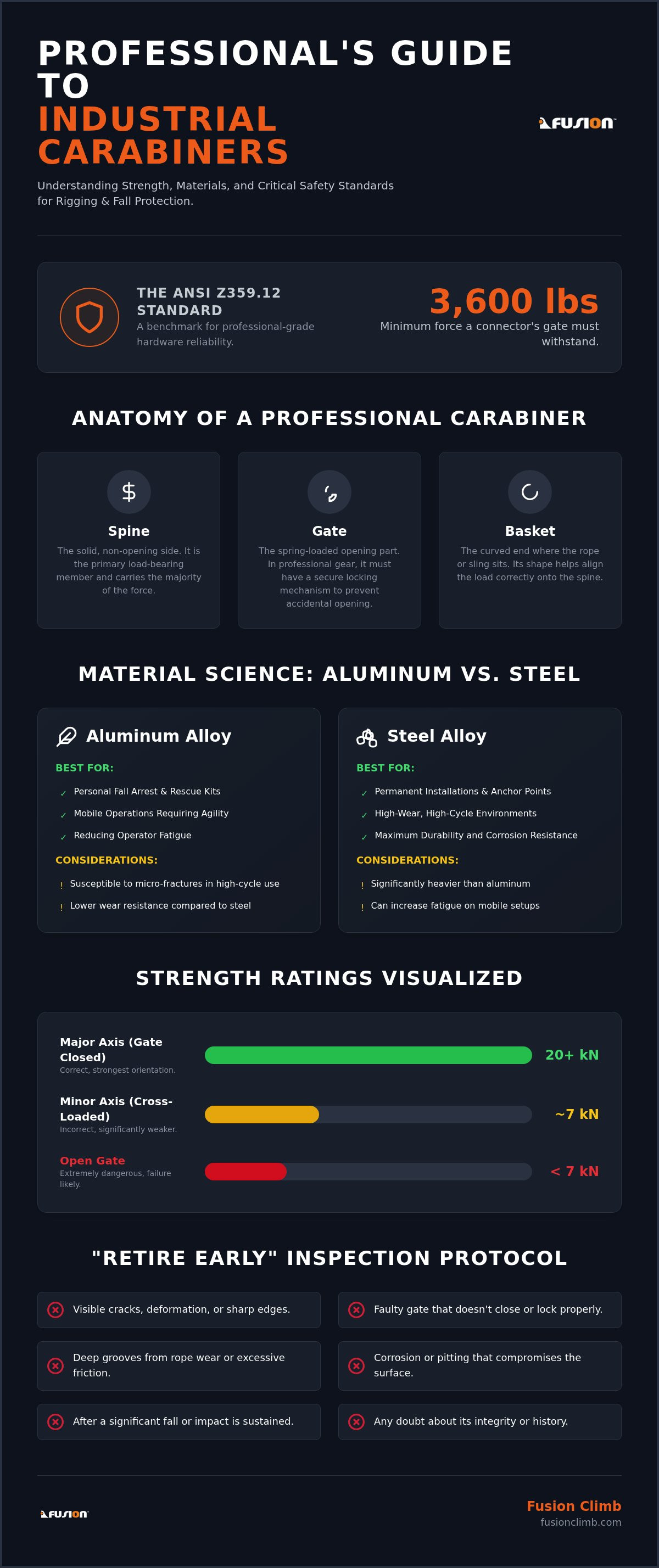
Every professional connector consists of three primary structural elements. The spine is the solid back of the carabiner and acts as the primary load-bearing member; it carries the majority of the weight during a fall or tensioning event. The gate is the spring-loaded opening that allows for attachment. In professional settings, this gate must be redundant and secure to prevent accidental opening under vibration or contact. The basket is the curved area where ropes, pulleys, or lanyards sit. Its shape dictates how the load aligns with the spine. D-shaped baskets are the strongest because they force the load toward the spine, while oval baskets are preferred for rigging pulleys to ensure centered alignment.
Key Terminology for Professional Riggers
To ensure safety, riggers must master specific technical terms. The major axis represents the carabiner's strongest orientation, typically rated at 20kN or higher. Conversely, the minor axis, or "cross-loading," occurs when the load pulls against the gate and spine sideways, reducing strength to roughly 7kN. Professional hardware is also rated for open gate strength. This is critical because "gate lash," a phenomenon where the gate vibrates open during a sudden impact, can cause a connector to fail at a fraction of its rated capacity. Finally, the keylock nose has become the industry standard. This snag-free design eliminates the small notch found on older models, preventing the carabiner from catching on bolts, webbing, or wire rope during critical maneuvers.
Material Science and Strength: Aluminum vs. Steel Carabiners
Selecting the right climbing carabiner begins with a cold assessment of the environment and the expected cycle count. Material choice is the first decision in any rigging plan because it dictates the system's longevity and response to friction. Professionals must balance the need for a lightweight mobile kit against the demand for a durable, high-wear connection in permanent installations. For instance, when selecting commercial zipline pulleys, matching the carabiner's material to the pulley's attachment point prevents premature hardware degradation and ensures system-wide material compatibility.
Environmental factors like salt air, extreme humidity, or industrial chemicals also dictate your selection. Aluminum performs well in most conditions but can pit in coastal environments. Steel offers a more robust defense against the elements in permanent outdoor setups. Choosing the wrong alloy for the environment doesn't just lead to rust; it compromises the structural integrity of your entire safety chain.
When to Prioritize Lightweight Aluminum
Aluminum connectors are the standard for personal climbing harnesses and mobile rescue kits. High-strength 7075 aerospace-grade aluminum offers an exceptional strength-to-weight ratio, which reduces operator fatigue during long shifts. However, professionals must understand the fatigue life of aluminum. In high-cycle commercial environments, the metal can develop micro-fractures over thousands of loading cycles. Most professional aluminum hardware features hard-anodized surface treatments to enhance corrosion resistance. If your team moves constantly across a site or performs technical rescues, aluminum provides the necessary agility without sacrificing security.
The Case for Industrial Steel in Permanent Rigging
Steel is the only viable choice for high-wear areas or permanent rigging. It offers superior resistance to friction-induced heat and rope abrasion. In commercial zipline operations, the constant movement of trolleys and steel cables would wear through aluminum quickly. Steel maintains its structural integrity even under the punishing heat of high-speed descents. Professionals often prefer steel carabiners for rigging when building anchors that will remain in place for an entire season. It's a matter of industrial reliability over portability.
Deciphering kN Ratings and Safety Standards
A standard rating of 23kN translates to roughly 5,170 pounds of static force. While this sounds high, professional safety factors require much lower working load limits to account for dynamic forces. Riggers must look for specific stamps. ANSI Z359.12 is the gold standard for industrial fall protection. This standard mandates that the gate can withstand 3,600 pounds of force, which aligns with OSHA gate strength requirements. Identifying these markings, along with CE and UIAA certifications, is the only way to verify that your hardware meets the rigorous demands of professional use.
Ensuring your hardware matches your environment is the hallmark of a seasoned rigger. If you're outfitting a new course, explore our range of professional carabiners to find the right balance of weight and durability.
Locking Mechanisms: Balancing Speed and Security
In industrial rigging and commercial ziplining, non-locking connectors aren't just discouraged; they're often prohibited. A professional climbing carabiner must remain closed under vibration, contact, and dynamic loading. Human error remains the leading cause of gate-related incidents. Operators get distracted. Staff get rushed. A manual gate stays open. To mitigate this risk, many organizations transition to automated systems. If you're looking for advanced redundancy, consult our double locking carabiner guide to understand how mechanical closures provide a silent layer of protection.
Manual Screwgate Carabiners: Simplicity and Reliability
Manual screwgates are the workhorses of the rigging world. Their mechanism is straightforward: a threaded sleeve spins over the gate to lock it in place. This type of climbing carabiner excels in harsh environments where grit, ice, or mud might jam more complex auto-lockers. They provide a clear visual cue. If you see the threads, the gate's open. However, they're prone to user error. In high-frequency environments, the repetitive motion of locking leads to complacency. They're best suited for semi-permanent anchors or rigging where the hardware isn't constantly cycled during a shift.
Auto-Locking and Triple-Action Gates
Automated gates close and lock the moment you release them. Double-action, or twist-lock models, require two movements: a twist of the sleeve and a pull on the gate. These are ideal for frequent transitions where speed is essential but security is mandatory. For maximum safety redundancy, triple-action gates are the gold standard. They require three movements: lift the sleeve, turn it, and pull. Commercial ropes courses and aerial adventure parks prioritize triple-action hardware because it virtually eliminates the risk of "roll-out," where a rope or lanyard accidentally forces the gate open during movement.
Follow a strict risk-level directive for your fleet. Use manual screwgates for fixed rigging and anchor points that require infrequent access. Reserve auto-locking and triple-action gates for personal connections, lanyard attachments, and any scenario where the user moves between stations. By matching the locking mechanism to the frequency of use, you optimize operational speed without compromising participant safety.
Operational Selection: Matching Hardware to Application
Match the tool to the tension. Effective selection starts with the 'Job to be Done' (JTBD) framework. Every climbing carabiner in your inventory must have a specific, documented role. It's the silent partner in your safety chain, providing security without requiring constant adjustment. System compatibility is non-negotiable. Your hardware must interface seamlessly with your zipline lanyards and tethers to ensure that loads remain aligned and gates remain unobstructed. When you view your gear as a single, integrated system, you eliminate the friction that leads to equipment wear and operational delays.
Best Carabiners for Commercial Zipline Operations
Commercial zipline environments demand hardware that can handle high-speed trolley attachments and constant vibration. If you're rigging for high-speed dual-track pulleys, you need connectors that won't chatter or loosen under the harmonic resonance of the cable. Large-gate openings are a requirement, not a luxury. Most industrial cables and trolley attachment points are thick; a standard recreational gate won't clear them comfortably. Look for gate clearances of at least 20mm to ensure smooth transitions. In these high-cycle environments, steel is often the preferred choice for its ability to withstand the micro-abrasions caused by galvanized steel cables and trolley frames.
Rigging and Anchor Point Considerations
Rigging requires a different mechanical approach. While D-shaped connectors are stronger, oval carabiners are essential for anchor points and pulley systems. Their symmetrical shape ensures that loads remain centered, which prevents the hardware from shifting or "climbing" the side of a pulley. This is critical for equalizing loads in multi-point anchors. You must also guard against tri-axial loading. This occurs when a carabiner is pulled in three directions simultaneously, which can catastrophically reduce its breaking strength. Proper selection means choosing hardware that allows for clean, linear load paths. Managing hardware friction is equally vital; ensure your connectors allow ropes to run freely without binding against the gate or the spine.
Build your fleet with gear designed for the rigors of commercial use. Explore our full range of ANSI-compliant climbing carabiners to outfit your operation with industrial-grade reliability.
Inspection and Longevity: When to Retire Your Hardware
A safety-first culture is the foundation of any professional vertical operation. It requires more than a quick glance at your gear before the first guest arrives. Documented, rigorous inspections turn safety from a concept into a measurable standard. We champion a "Retire Early, Retire Often" philosophy for all high-use commercial gear. When a climbing carabiner is cycled hundreds of times a week, its fatigue life accelerates far beyond recreational expectations. Adhering to ropes course safety equipment standards ensures your operation remains compliant and your participants remain secure.
You must establish a definitive list of red flags that trigger immediate retirement. If any piece of hardware exhibits these symptoms, remove it from the field and destroy it to prevent accidental reuse. Common red flags include:
- Gate fails to close or lock automatically during a snap test.
- Visible cracks, even hairline fractures, in the metal or gate rivets.
- Material loss exceeding 10% of the original diameter due to cable wear or scoring.
- Exposure to extreme heat or corrosive chemical agents that cause discoloration.
- Deployment in a significant fall or any sudden shock-loading event.
Daily Inspection Checklist for Professional Operators
Daily checks are your first line of defense. Start with gate action; every gate must snap shut and lock without manual assistance. If the spring feels sluggish or the sleeve sticks, pull it from service. Next, inspect for physical deformity. Look for deep grooves in the basket or spine. Scoring from steel cables can create sharp burrs that damage textile components like lanyards. Finally, check for chemical exposure. Look for pitting or white oxidation. Environments with high salt content or proximity to industrial cleaners can compromise the alloy's structural integrity over time.
Fusion Climb: Engineering Reliability for Vertical Professionals
Fusion Climb has prioritized industrial-grade strength since 1998. Our manufacturing process focuses on the rugged confidence required for commercial adventure parks and industrial rigging. By maintaining US-based quality control, we provide a level of oversight that ensures every piece of hardware meets its stated rating. We don't just build hooks; we engineer dependable guardians for your daily operations. Your next step is to perform a comprehensive audit of your current fleet. If any hardware shows signs of age or lacks modern ANSI markings, it's time to upgrade to professional-grade hardware designed for the rigors of the industry.
Secure Your Vertical Future with Industrial Precision
Mastering technical nuances transforms a simple attachment point into a dependable guardian. You've seen that selecting the right climbing carabiner requires balancing material science with specific locking redundancies to eliminate human error. Whether you're rigging permanent anchors with industrial steel or outfitting rescue kits with lightweight aluminum, every choice must align with rigorous ANSI Z359.12 standards. Maintaining a "retire early" philosophy through documented inspections ensures your fleet remains a silent partner in your success rather than a point of liability.
Choosing equipment is a declaration of your commitment to safety. Our hardware utilizes rugged industrial-grade steel and aluminum, trusted by national zipline and ropes course operators who refuse to compromise on integrity. We provide the technical assurance you need to focus on the adventure with rugged confidence. Equip your operation with Fusion Climb's professional-grade carabiners today. Select with purpose. Inspect with rigour. Your team deserves the security of hardware built for the long haul.
Frequently Asked Questions
What is the difference between an aluminum and a steel climbing carabiner?
Steel offers superior durability and heat resistance for high-wear areas like permanent anchors, while aluminum provides a high strength-to-weight ratio for mobile kits. Steel is the preferred choice for zipline trolleys because it resists the abrasive effects of galvanized cables. Aluminum is more susceptible to fatigue over high cycles but remains easier for operators to carry during long shifts. It's a choice between long-term industrial longevity and immediate operational agility.
What does the kN rating on a carabiner mean for safety?
The kN rating indicates the minimum breaking strength in kilonewtons, where 1 kN equals approximately 225 pounds of force. A standard climbing carabiner is typically rated for 20 kN or more on its major axis. However, industrial standards like ANSI Z359.12 require a 5,000-pound breaking strength. This rating ensures the hardware can withstand the massive dynamic forces generated during a fall arrest. Always verify the technical stamp on the spine before deployment.
How often should commercial zipline carabiners be inspected?
Commercial operators must perform a visual and tactile inspection of every connector before each daily shift. You should also conduct a more thorough, documented inspection every six months to remain compliant with industrial safety standards. High-use environments accelerate material fatigue, making it vital to check gate action and basket integrity frequently. If any piece of hardware is subjected to a significant dynamic event, it requires immediate removal from service and a detailed evaluation.
Why are triple-locking carabiners required for some ropes courses?
Triple-locking gates provide the highest level of redundancy by requiring three distinct movements to open: lift, turn, and pull. This mechanism prevents accidental "roll-out," where a lanyard or rope unintentionally forces the gate open during movement. Many commercial aerial adventure parks mandate these for participant connections to mitigate human error. It's a sobering but necessary precaution that ensures the gate remains secure even during complex maneuvers, high vibrations, or accidental contact with other hardware.
Can I use a recreational climbing carabiner for industrial fall protection?
No, recreational hardware often lacks the specific gate strength required by industrial regulations. While a UIAA-rated climbing carabiner is safe for mountain use, industrial fall protection requires compliance with ANSI Z359.12. This standard mandates that the gate must withstand a load of 3,600 pounds to prevent failure during a fall arrest. Industrial environments present different risks than recreational climbing; therefore, you should always use hardware specifically rated for the professional task at hand.
What is 'gate lash' and why is it dangerous for riggers?
Gate lash is the momentary opening of a gate caused by the vibration of a sudden impact or a fall. When the gate is open, the carabiner's strength drops significantly, often to less than a third of its rated capacity. This phenomenon is particularly dangerous in rigging systems with high dynamic loads. Selecting hardware with high open-gate strength or utilizing specialized locking mechanisms helps riggers mitigate this risk and ensures the system's structural integrity remains intact.
When should I retire a carabiner that has been dropped?
Retire any connector that has fallen from a significant height onto a hard surface, such as concrete or steel. While micro-fractures aren't always visible to the naked eye, the internal structural integrity may be compromised. If the drop results in visible scoring, a bent spine, or a sticky gate, the hardware is no longer fit for service. In professional rigging, it's safer to destroy the dropped unit than to risk a catastrophic failure later.
Are D-shaped carabiners stronger than oval carabiners?
Yes, the D-shape is inherently stronger because it shifts the load toward the solid spine, which is the strongest part of the connector. This design allows the hardware to achieve higher major-axis ratings than symmetrical oval models. While ovals are excellent for centering pulleys and equalizing loads, the D-shape provides the maximum breaking strength for high-tension applications. Professionals typically use D-shaped connectors for primary anchors and personal fall-arrest systems for this exact reason.