


Commercial Zipline Pulleys: Engineering, Safety Standards, and Operator Guide
Could a few degrees of heat buildup be the silent killer of your zipline's overhead cable? In high-volume environments, commercial zipline pulleys aren't just simple wheels; they're high-performance industrial machines that must dissipate friction and manage intense duty cycles without compromise. You likely already know that rapid hardware wear is the price of a successful season, but constant replacements shouldn't be your baseline for operations. When the global zipline market is projected to reach $12.4 billion by 2034, the stakes for your hardware's reliability have never been higher.
We understand the pressure of maintaining a perfect safety record while navigating the technical confusion of shifting standards like ASTM F2959-23 and the upcoming 2026 ANSI/ACCT revisions. This guide provides the clarity you need to master the engineering specifications and safety requirements of professional-grade hardware. We'll explore how to identify industrial-standard pulleys, reduce long-term maintenance costs through smarter selection, and ensure every rider is protected by the highest levels of regulatory compliance. From heat-resistant alloys to certification nuances, you're about to gain the technical edge required for peak performance in any vertical environment.
Key Takeaways
- Distinguish between simple static break strength and the operational longevity required for high-volume industrial throughput.
- Identify critical engineering features like tandem wheel alignment and reinforced side-plates that protect your cables from premature friction wear.
- Master heat management techniques for commercial zipline pulleys to mitigate thermal degradation during high-speed, long-distance descents.
- Implement rigorous pre-flight inspection routines and documented logs to ensure 100% regulatory compliance and rider security.
- Learn to match hardware specifications to your park's specific line tension and braking systems for a seamless, professional-grade operation.
Defining Commercial Zipline Pulleys: Beyond Backyard Hardware
A 30kN rating on a product page looks impressive, but for a professional operator, that number is only the beginning of the story. While recreational gear might survive a few dozen runs over a summer, commercial zipline pulleys are purpose-built to endure thousands of cycles per season without structural failure. Professional rigging requires a shift in perspective. You aren't just buying a component; you're investing in a high-throughput asset that must maintain its integrity under constant friction, varying rider weights, and extreme environmental exposure.
To understand the mechanics of these systems, one must first ask: What is a Zipline? At its core, it's a pulley system designed for gravity-driven transport. However, in an industrial context, the distinction between static Minimum Breaking Strength (MBS) and operational longevity is vital. A pulley might have a high MBS but fail prematurely because its bearings weren't designed for the heat generated by high-speed descents. Professional operators prioritize hardware that offers a "dependable guardian" level of security. This ensures that liability is managed through documented, certified performance rather than marketing promises.
Certification and Safety Standards: ANSI vs. CE
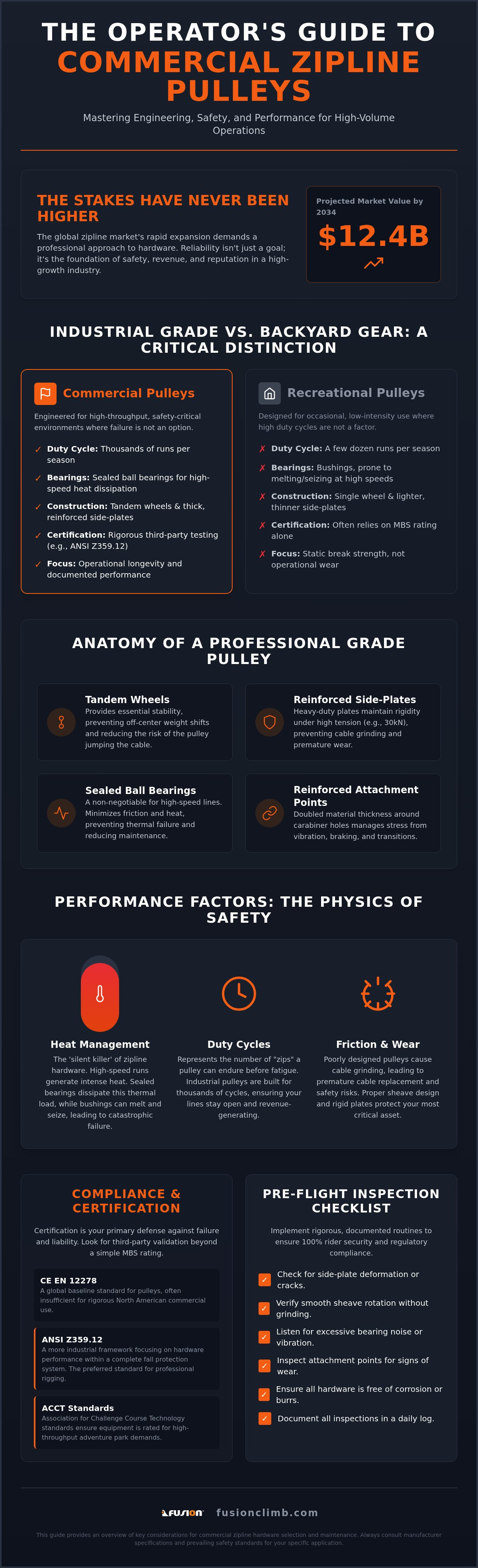
Certification isn't just paperwork; it's your primary defense against equipment failure and legal liability. CE EN 12278 is often viewed as the global baseline for pulleys, yet it frequently falls short of the rigorous demands found in North American adventure parks. ANSI Z359.12 provides a more industrial framework, focusing on the hardware's performance within a larger fall protection or professional rigging system. Look for hardware that undergoes third-party testing. This independent validation ensures that manufacturer claims regarding 30kN+ ratings are backed by empirical data, providing a sobering sense of security for your staff and guests.
Duty Cycles and High-Volume Throughput
In a high-volume park, duty cycles define your bottom line. A duty cycle represents the number of successful "zips" a pulley can execute before bearing fatigue or side-plate deformation occurs. Heavy riders and high-velocity lines accelerate this wear, turning minor friction into significant hardware damage. Over-specifying your hardware by choosing commercial zipline pulleys with thicker side-plates and industrial-grade bearings might cost more upfront, but it drastically reduces long-term operational expenses. Reliable gear keeps your lines open. It prevents the mid-season hardware failures that lead to downtime, lost revenue, and safety interventions.
The Anatomy of Professional Grade Zipline Pulleys
Tandem pulleys serve as the industrial backbone of any serious aerial operation. Unlike single-wheel variants, the tandem configuration provides essential stability. It prevents the rider's weight from shifting off-center, which reduces the risk of the pulley jumping the track. For high-volume parks, side-plate thickness is equally critical. Heavy-duty plates remain rigid under the tension of a 30kN load. This rigidity prevents the cable from grinding against the inner plates, a common failure point in lighter, recreational hardware.
Attachment points, specifically the carabiner holes, must be reinforced to handle constant vibration and metal-on-metal contact. Professional manufacturers often double the material thickness around these holes. This design choice manages the stress concentrations that occur during heavy braking or high-speed transitions. When you evaluate professional commercial zipline pulleys, look for these structural reinforcements as a sign of industrial intent.
Sealed Ball Bearings vs. Bushings
On high-speed commercial lines, sealed ball bearings are a non-negotiable requirement. While bushings are common in backyard setups, they rely on friction-reducing materials that can't handle the high RPMs of a professional course. Bushings often melt or seize under the thermal load of back-to-back runs. In contrast, 'sealed-for-life' ball bearings utilize high-grade lubrication and precision-ground races to minimize heat. This technology reduces maintenance by keeping grit and moisture out of the internal mechanics. Bearing failure is a critical safety risk that often starts with subtle vibrations. Adhering to ACCT safety standards ensures your equipment is rated for these high-throughput demands.
Sheave Design and Cable Compatibility
Sheave geometry must perfectly match your cable diameter, typically ranging from 3/8" to 1/2". If the groove is too narrow, the cable will pinch; if it's too wide, the pulley will wobble. Sheave hardness also dictates how long your commercial zipline pulleys last. Steel cables are abrasive and will quickly 'groove' soft aluminum sheaves, leading to cable damage. Hardened steel or high-density alloy sheaves prevent this deformation. Dual-track pulleys offer superior stability by distributing the load across two points of contact. This reduces vibration and creates a smoother ride for the guest, which is a hallmark of professional-grade engineering.
Performance Factors: Speed, Friction, and Heat Management
High-speed descents aren't just about the thrill; they're about managing physics. As a rider accelerates, friction between the cable and sheave generates intense thermal energy. This "Heat Sink" effect means your pulley acts as a reservoir for that heat. If the hardware can't dissipate this energy, the structural integrity of the components begins to fail. Commercial zipline pulleys must be engineered to handle these thermal loads without compromising rider safety or cable health. Maintaining consistent speeds across varying rider weights also requires a deep understanding of rolling resistance. A heavy rider creates more downward force, increasing friction and heat generation compared to a lighter guest.
Material choice directly impacts the lifespan of both the pulley and the cable. Stainless steel sheaves offer the highest level of durability for high-frequency operations. They resist the "grooving" effect caused by abrasive steel cables, which is a common failure point in cheaper alternatives. While aluminum sheaves are lighter, they're significantly softer and deform quickly under industrial use. This deformation creates sharp edges that eventually shred your expensive overhead cable. Aluminum alloy side-plates are still useful for weight reduction, making it easier for guides to transport gear, but the contact points must remain rugged and resilient.
Material Selection: Stainless Steel vs. Aluminum
For most aerial adventure parks, a hybrid approach works best. You want the strength of steel where the pulley meets the cable and the lightness of aluminum for the housing. All-steel construction is the only choice for extreme industrial environments or exceptionally long lines where heat buildup is constant. These units provide a "dependable guardian" level of security, ensuring that the hardware won't warp or fail during a busy holiday weekend with hundreds of consecutive zips. Durable materials translate directly to lower replacement costs and fewer maintenance windows.
Dissipating Heat on Long-Distance Lines
On long-distance lines, heat management is a critical safety factor. Excessive friction can raise internal temperatures enough to liquefy bearing grease. Once the lubricant turns to liquid and leaks out, the bearing will seize, potentially leading to catastrophic failure mid-zip. Operators must establish mandatory cooling periods between runs to allow hardware to return to safe operating temperatures. Following OSHA operator safety guidelines helps maintain a structured environment where equipment isn't pushed beyond its thermal limits. Technological innovations like sheave venting now help pull air through the assembly to accelerate cooling, but these features are only effective when paired with disciplined operational procedures.
Maintenance and Inspection: Ensuring Operator Safety
Safety is a relentless commitment. A documented inspection log serves as both a legal shield and an ethical foundation for any professional aerial park. It transforms safety from a passive hope into an active discipline. Professional operators must establish a rigorous "Pre-Flight" routine where every guide examines the hardware before the first guest clips in. This hands-on approach ensures that minor wear doesn't escalate into a systemic failure. Training your staff to recognize the auditory signs of bearing failure is equally vital. A healthy pulley hums; a failing one clicks, grinds, or emits a high-pitched squeal. If a guide hears grit in the machine, that unit must enter immediate quarantine.
Managing the lifecycle of your hardware requires a "dependable guardian" mindset. You must be willing to retire gear that no longer meets the standard, regardless of its remaining manufacturer-specified lifespan. Real-world wear patterns often outpace laboratory estimates, especially in high-salt or high-dust environments. When you invest in commercial zipline pulleys, you are buying into a system that demands constant vigilance. If you're looking to upgrade your current inventory with hardware designed for industrial longevity, explore the professional-grade commercial zipline pulleys manufactured for high-throughput environments.
Daily Inspection Checklists for Pulleys
Every morning starts with a physical examination. Spin the sheaves to check for "wobble" or lateral play. A sheave that doesn't run true will cause uneven cable wear and vibration. Run a gloved finger along the side plates to feel for cracks, burrs, or sharp edges that could damage a lanyard or harness. Inspect the attachment points for signs of elongation. Carabiner holes should remain perfectly circular. If they appear oval-shaped, the metal has reached its elastic limit and the pulley must be retired. Verify that all locking mechanisms and pins are secure and show no signs of backing out under vibration.
Retirement Criteria: When to Replace Your Hardware
Adhere to the "10% Rule" for sheave wear. If the groove depth has increased by 10% of the original cable diameter, the sheave is "grooved" and will begin to pinch and damage your overhead lines. Impact loading is another non-negotiable trigger for retirement. If a pulley is dropped from height onto a hard surface, or if it's involved in an unusual safety event like a high-speed collision, it must be removed from service. Internal micro-fractures aren't always visible to the naked eye. Trust the data and the physical measurements over visual intuition to ensure 100% rider safety and regulatory compliance.
Selecting the Right Hardware for Your Aerial Adventure Park
Selection is the final step in translating engineering into a guest experience. You must match your hardware to the specific physics of your course. A steep decline with high line tension requires a pulley that can handle extreme velocities without introducing dangerous vibration. Conversely, a longer, flatter line demands maximum efficiency to ensure riders reach the terminal platform. Selecting the right commercial zipline pulleys involves more than just checking a break strength; it's about synchronizing the hardware with your braking systems. Whether you utilize bungee returns or magnetic zipStop units, your pulley's impact surface must be compatible with the landing interface to prevent equipment deformation.
Ergonomic handles are another critical selection factor. They don't just provide comfort; they stabilize the rider's center of gravity. This positioning reduces the likelihood of spinning during the descent, which keeps the rider facing forward and ready for the braking zone. In a commercial environment, these small design details significantly reduce the risk of limb injuries and improve overall throughput. When you choose professional commercial zipline pulleys, you are investing in the stability of your entire operation.
Integrated Braking and Handle Options
Your pulley design directly influences braking efficiency at the terminal platform. Captured pulleys are the preferred choice for professional parks. These units feature side-plates that wrap around the cable, making it physically impossible for the pulley to detach during the run. This design provides a sobering sense of security for both guides and guests. When designing your course, decide between hands-free systems and active-braking participation. Hands-free designs are generally safer for high-volume tourism, as they remove the variable of rider error. In these setups, the pulley must be perfectly balanced to maintain a straight trajectory into the braking block.
Why Fusion Climb Engineering Sets the Standard
Fusion Climb represents the dependable guardian in the aerial adventure industry. Our commitment to industrial-grade safety is reflected in every component we manufacture. By maintaining US-based design and engineering, we ensure that every unit meets rigorous quality control standards before it ever reaches your course. We specialize in 30kN+ rated pulleys that are built for the high-throughput demands of professional parks. Safety isn't found in a single component; it exists in a complete system. We provide the full range of gear needed for a secure operation, including full body harnesses, lanyards, and carabiners. If you are ready to upgrade your facility with hardware that prioritizes precision and reliability, Explore Fusion Climb's Full Range of Commercial Zipline Pulleys to find the perfect match for your operation.
Secure Your Operation with Industrial Precision
Mastering the technical landscape of high-throughput ziplining requires a transition from recreational gear to true industrial hardware. You now understand that effective heat dissipation and meticulous maintenance logs are the primary hallmarks of a professional course. By prioritizing duty cycles over simple break strength, you ensure your equipment survives the rigors of thousands of runs. Selecting the right commercial zipline pulleys isn't just a purchase; it's a long-term investment in every rider who clips into your line.
Reinforce your safety infrastructure today. We offer ANSI Z359.12 compliant hardware featuring rugged 30kN+ rated construction that is trusted by commercial operators worldwide. Our US-based engineering provides the durability required for high-volume environments. Upgrade Your Course with Professional Grade Fusion Climb Pulleys and build a legacy of safety. Your guests deserve the confidence that comes with industrial-grade rigging. The next season of adventure starts with the right hardware. Let's push the limits of your course together.
Frequently Asked Questions
What is the difference between a 30kN and a 50kN zipline pulley?
The primary difference lies in the Minimum Breaking Strength (MBS), where a 30kN pulley is rated for approximately 6,744 pounds of force and a 50kN unit handles roughly 11,240 pounds. While 30kN is the industrial standard for most commercial zipline pulleys, a 50kN rating provides an increased safety margin for high-tension lines or rescue scenarios. Always choose the rating that exceeds your system's calculated peak load by a factor of at least five to one.
How often should I replace pulleys in a commercial zipline park?
Hardware retirement is dictated by wear patterns and duty cycles rather than a fixed calendar date. You must replace a pulley immediately if sheave wear exceeds 10% of the original cable diameter or if the bearings show any signs of clicking or seizing. In high-volume environments, this often occurs every one to three seasons, but daily inspections remain the only reliable way to determine retirement.
Can I use aluminum pulleys on steel cables for commercial use?
You can technically use aluminum, but it's not recommended for professional operations due to the material's low hardness. Steel cables are significantly more abrasive than aluminum, which leads to rapid "grooving" and sharp edges on the sheave. For maximum durability and cable protection, professional operators should prioritize stainless steel sheaves that can withstand the friction of thousands of cycles.
What are the most common causes of zipline pulley failure?
Bearing seizure due to excessive heat buildup is the leading cause of failure on long, high-speed lines. Other common issues include sheave deformation from using mismatched cable diameters and structural micro-fractures caused by impact loading, such as dropping the unit onto a hard platform. Regular thermal monitoring and strict "no-drop" policies are essential for maintaining your hardware's integrity.
Do all commercial zipline pulleys require ANSI certification?
While local regulations vary, adhering to ANSI Z359.12 standards is the professional benchmark for ensuring industrial reliability and managing liability. Certification provides independent verification that the hardware can withstand the specific stresses of a vertical environment. Choosing certified commercial zipline pulleys signals a commitment to the highest safety standards and protects your operation from the risks of unverified gear.
How do I clean and lubricate my professional zipline trolley?
Most high-end pulleys utilize "sealed-for-life" bearings that don't require internal lubrication. Attempting to grease these units can actually attract grit and accelerate wear. Instead, clean the exterior side plates and sheaves with a mild soap and water solution to remove salt and dirt. Always dry the hardware thoroughly and inspect for burrs or sharp edges after cleaning.
What is the benefit of a tandem pulley over a single sheave pulley?
Tandem designs provide essential stability by utilizing two wheels to distribute the rider's weight along the cable. This configuration prevents the "pitch and roll" effect that can cause a single pulley to vibrate or jump the track at high speeds. The dual-contact points also reduce the load on individual bearings, which extends the overall lifespan of the hardware in a professional setting.
How does rider weight affect the lifespan of my zipline hardware?
Heavier riders increase the downward force on the sheaves, which generates higher friction and more intense thermal energy during the descent. This extra heat can thin out bearing grease and accelerate the deformation of the sheave groove. If your course frequently hosts heavier guests, you must implement shorter inspection intervals and allow for longer cooling periods between runs to prevent premature hardware fatigue.