



Theatrical Rigging Full Body Harness: 2026 Buyer's Guide
A standard construction harness has no place in a theater fly grid or an arena truss. High-visibility webbing and polished chrome hardware reflect stage lighting instantly, while bulky D-rings snag on truss chords and cable runs. You already know the physical toll of hanging in rigid industrial straps through long overhead focus sessions, battling painful pressure points while racing the clock against suspension trauma. Selecting the right full body harness for theatrical rigging means ditching repurposed jobsite gear for low-profile, non-reflective protection built specifically for vertical stage work.
Discover how to select an ANSI-compliant, blackout full body harness engineered for entertainment rigging safety and all-day suspension comfort. We examine how current ANSI Z359.11-2021 standards apply to overhead venue work, contrast rope access demands with industrial fall arrest requirements, and reveal the ergonomic features stage crews need to stay agile, compliant, and secure in the air.
Key Takeaways
- Selecting an ANSI Z359.11-compliant full body harness for theatrical rigging provides vital fall arrest protection while eliminating glare under high-intensity stage lighting.
- Low-profile, matte-black hardware minimizes snag risks against truss chords, lighting battens, and vertical cable runs.
- Ergonomic padding and integrated suspension trauma relief features safeguard technicians during prolonged overhead hangs and focus calls.
- Distinguishing between standard fall arrest configurations and hands-free work positioning systems ensures OSHA compliance and preserves crew mobility.
- Rugged, professional-grade harnesses paired with certified connection hardware deliver the durability required for heavy arena and theater production schedules.
Why Theatrical Rigging Demands Dedicated Full Body Safety Harnesses
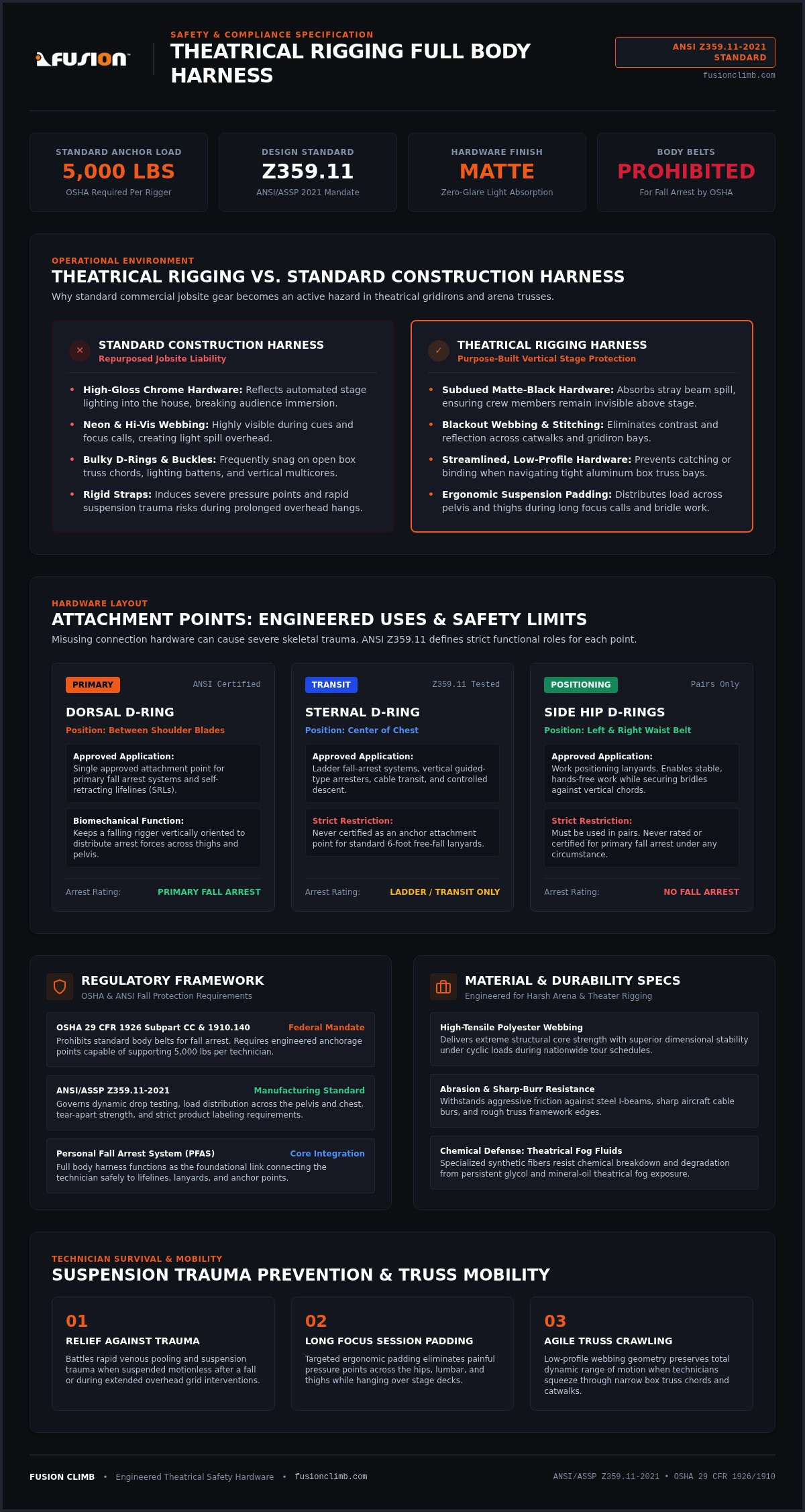
Operating at height in live entertainment presents challenges that standard commercial jobsites never encounter. Riggers navigate open aluminum box truss, crawl through dark gridiron systems, and traverse narrow catwalks directly above high-value production equipment. In these vertical workspaces, using a standard high-visibility construction harness is a liability. Bulky straps snag on structural chords, oversized hardware catches loose lighting multicores, and rigid webbing restricts dynamic movement when squeezing through tight truss bays.
A dedicated full body harness for theatrical rigging serves as the critical foundation of an entertainment technician's personal fall arrest system. It integrates drop-tested impact protection with streamlined profiles that preserve total mobility, ensuring technicians move swiftly without dragging, catching, or binding on rigging hardware.
The Stealth Requirement: Why Blackout Hardware Matters On Stage
Live productions rely on visual discipline. When a focus call extends into sound check or cue adjustments demand mid-show grid interventions, overhead crew members must remain unseen. High-gloss zinc buckles and neon straps act like beacons under high-intensity automated profiles, throwing glare into the house and breaking audience immersion. Subdued matte-black hardware, non-reflective webbing, and dark contrast stitching absorb stray beam spill, ensuring riggers operate as invisible guardians above the stage deck.
Fall Arrest Versus Work Positioning in Entertainment Venues
General industrial safety gear often focuses solely on basic fall arrest, catching a worker after a sudden drop occurs. Theatrical rigging demands more. Riggers frequently remain suspended or leaned back at odd angles to land motor points, balance heavy truss bridles, and pin corner blocks. Pure fall arrest setups leave technicians fighting the webbing for balance and leverage.
Rigging-specific designs merge fall arrest with ergonomic work positioning through purposeful hardware layouts:
- Dorsal D-Ring: Serves as the primary connection point for fall arrest lanyards and self-retracting lifelines during truss traverses.
- Side Hip D-Rings: Enable rapid positioning lanyard attachment for stable, hands-free work while securing bridles against vertical chords.
- Sternal Connection Points: Facilitate vertical ladder climbs, cable transit systems, and controlled rope ascents without binding the chest.
Essential Engineering Standards: ANSI Z359.11 Compliance and Hardware
Every rigging call hinges on predictable, proven equipment. In the United States, personal fall protection falls under OSHA mandates (such as 29 CFR 1926 Subpart CC and 1910.140), which prohibit body belts for fall arrest and demand engineered anchorage points supporting 5,000 pounds per technician. The technical design framework governing manufacturing is ANSI/ASSP Z359.11-2021. This standard governs dynamic drop testing, load distribution across the pelvis and chest, tear-apart strength, and strict product labeling requirements.
Selecting an ANSI-compliant full body harness for theatrical rigging guarantees the structure can withstand catastrophic impact forces. High-tensile polyester webbing forms the structural core, offering superior resistance against friction over steel beams, sharp cable burs, and chemical exposure from theatrical fog fluids. Paired with heavy-duty stitching, this fabric maintains dimensional stability even during rigorous tour schedules.
Decoding ANSI Z359.11 and OSHA Fall Protection Mandates
Hardware layout determines how arresting forces transfer to your skeletal frame. Misusing a connection point can result in severe bodily trauma during a fall. Riggers must verify each attachment point meets its intended role:
- Dorsal D-Ring: Positioned squarely between the shoulder blades. It serves as the single approved attachment point for primary fall arrest systems, keeping a falling rigger oriented vertically to distribute shock through the thighs and pelvis.
- Sternal D-Ring: Centered on the chest. Certified under Z359.11 for ladder fall-arrest systems, guided-type fall arresters, and controlled descent, but never as an anchor for standard six-foot free-fall lanyards.
- Side Hip D-Rings: Located on the waist belt. Engineered exclusively in pairs for work positioning, allowing you to lean into your gear securely. They are never rated for primary arrest impacts.
Hardware Durability: Buckles, Adjusters, and Connection Points
Hardware must endure repeated adjustments without slipping under dynamic loads. High-grade alloy steel components deliver unmatched wear resistance against abrasive truss contact, while drop-forged aluminum options trim critical ounces to fight crew fatigue on long climbs. Quick-connect chest and leg buckles expedite donning during fast-paced setup calls, while traditional tongue-buckle leg straps provide a locked-in, slip-free fit that stays put when carrying heavy tool pouches.
System reliability extends beyond the harness itself. Pairing your harness with certified professional climbing carabiners ensures that every link in your line meets rigid tensile strengths. Look for equipment with specialized electro-deposited or powder-coated matte finishes that resist humidity changes between air-conditioned arenas and damp amphitheaters. If you are updating your overhead inventory, explore Fusion Climb safety gear for American-engineered hardware that satisfies stringent jobsite codes.
Riggers must also incorporate plans for suspension trauma prevention into their daily setups. Post-fall suspension can restrict blood flow rapidly, making proper harness sizing, leg strap fit, and relief mechanisms critical long before anyone leaves the ground.
Theatrical Ergonomics: Suspension Trauma Prevention and Truss Mobility
Rigging calls stretch across grueling ten- to twelve-hour shifts. When you spend hours perched on I-beams or tensioning deck cables, harness comfort is not a luxury. It is an operational safeguard. Heavy padding designed for rescue litters quickly turns into an oven in hot arena ceilings, while unpadded straps dig into nerve clusters during awkward leans. Riggers need targeted support that distributes load across skeletal points without adding dead weight or bulk.
Every reputable full body harness for theatrical rigging balances structural stability against physiological protection. High-density, closed-cell EVA foam pads cushion the waist and leg loops, shielding the technician from sharp edges while permitting essential airflow. This targeted padding keeps pressure off the femoral arteries during prolonged focus calls, preserving leg sensation and preventing premature exhaustion.
Mitigating Orthostatic Intolerance During Overhead Operations
Hanging motionless after an arrested fall triggers orthostatic intolerance with alarming speed. Research indicates that venous pooling in the lower extremities can induce unconsciousness in under ten minutes, with fatal complications possible within fifteen to forty minutes without prompt rescue. Constricted femoral veins trap oxygen-depleted blood in the legs, starving the brain and heart.
Even force distribution across wide sub-pelvic straps prevents rapid circulatory collapse by keeping the body stable and buying critical time for overhead extraction.
Deployable suspension trauma relief straps represent an essential defense. Once released, they allow a suspended technician to step down and stand upright in mid-air. This simple foot-push activates calf muscle pumps, returning blood to the upper torso while rescue crews mobilize their retrieval systems.
Mobility Features for Beam Walking and Grid Navigation
Stagehands do not stand in one place. They straddle structural steel, duck under motorized hoists, and crawl across tension grids. Gear must flex in sync with the human body rather than fight it.
- Articulated Waist Belts: Independent lumbar pivots allow natural pelvic rotation when balancing across narrow flange surfaces or navigating diagonal truss lacing.
- Elastic Webbing Keepers: Tidy, secure containment points prevent loose webbing tails from whipping into machinery or snagging on sharp split pins.
- Dedicated Gear Loops: Rigid, downturned loops position spud wrenches, tape rolls, and dead-blow hammers close to the hips so tools stay accessible without swinging loose in the air.
A streamlined, ergonomic build keeps you agile when precision matters most. By shedding superfluous bulk, modern harnesses let you focus on technical execution rather than your gear.
Selection Checklist: Matching Harness Configurations to Venue Demands
Selecting the right gear requires auditing actual stage environments rather than picking a generic package off a warehouse shelf. High-steel arena beams present vastly different mechanical clearance demands and posture challenges than operating a chain motor from an arena floor. Matching a full body harness for theatrical rigging to your specific crew assignments guarantees that technicians carry only what is essential for safety, efficiency, and comfort.
Arena Up-Rigger Versus Ground Technician Requirements
Up-riggers scale high steel, crawl tension grids, and hang bridle points directly above open decks. They require integrated side positioning rings, breathable lumbar support, and low-bulk profiles that slide through tight chord geometry without hanging up. Ground technicians spotting loads or tending cable runs need streamlined fall arrest harnesses without heavy positioning belts, prioritizing lightweight upper-body flexibility. Before stepping onto the grid, always calculate total fall clearance by tallying lanyard deceleration, harness webbing stretch, and worker height to prevent deck contact.
Sizing Precision: Achieving the Safe and Secure Professional Fit
Fit determines whether safety gear protects or injures during sudden deceleration. Take accurate measurements over standard show blacks and utility layers:
- Dorsal Alignment: Keep the dorsal D-ring positioned squarely between the shoulder blades. A D-ring riding too low can tip a fallen technician dangerously forward.
- Sub-Pelvic Support: Seat the sub-pelvic strap firmly under the buttocks rather than across the lower back, ensuring bone structure absorbs primary arrest energy.
- Chest Strap Elevation: Fasten the sternal strap across mid-chest, roughly two inches below the collarbone, to prevent shoulder straps from peeling outward during an arrest.
Environmental Resistance for Arena Tours and Outdoor Stages
Outdoor sheds and festival stages present grueling conditions for synthetic textiles. Continuous ultraviolet exposure, torrential summer rain, and airborne road grit degrade structural webbing much faster than climate-controlled concert halls. Evaluate wear thresholds and service intervals by applying proven ropes course safety equipment maintenance standards to your gear rotation.
Conduct daily tactile inspections before ascending. Flex the webbing between your fingers to check for hard spots, heat glazing from hot motors, pulled stitch tracks, or chemical burns from fog fluid drift. When high-mileage gear shows signs of fraying or hardware distortion, order certified Fusion Climb harnesses to keep your stage crew compliant, mobile, and secure in the air.
Deploying Fusion Climb Full Body Harnesses for Professional Production
Rigging high above an active stage leaves zero margin for equipment doubt. Fusion Climb designs professional-grade vertical safety equipment built specifically for these punishing conditions. Operating as a privately held US manufacturer since 1998, the company engineers full body harnesses, lanyards, and connection hardware that withstand heavy touring cycles while keeping crews fully compliant with active ANSI Z359.11 standards. Purpose-built blackout configurations give entertainment technicians the stealth they need without compromising on certified strength.
Selecting a Fusion Climb full body harness for theatrical rigging means outfitting your crew with gear built by vertical specialists. Reinforced polyester webbing, rugged computerized box-X stitching, and drop-forged alloy steel hardware eliminate the weak points common in repurposed utility gear. These harnesses deliver the dependable, no-nonsense security required when walking open steel or hanging motor points in the dark.
The Manufacturing Edge: Built for Demanding Vertical Environments
Every piece of vertical equipment must perform reliably under extreme dynamic tension. Fusion Climb approaches harness manufacturing through a philosophy of rugged American design and disciplined quality assurance:
- Drop-Forged Hardware: Meticulously engineered buckles and D-rings sustain multi-directional loads without distorting or binding against webbing.
- Tactical Blackout Webbing: Non-reflective, all-black materials blend seamlessly into the grid, eliminating spotlight glare above the stage deck.
- Rigorous Testing: Dedicated production testing verifies structural seam integrity, abrasion resistance, and absolute dimensional consistency across every production run.
Building Your Complete Rigging and Fall Protection Kit
A dependable harness is only the foundation of a complete fall management system. Pairing your harness with certified hardware creates a unified safety chain that moves smoothly with the rigger. Fusion Climb engineers an extensive ecosystem of heavy-duty carabiners, dual-locking connection points, and energy-absorbing lanyards designed to operate together without awkward binding.
Understanding how connection hardware integrates into specialized systems is vital for safe rigging design. Review critical attachment dynamics in our zipline lanyards and tethers safety resource to see how tether ratings apply across demanding aerial environments. When lives hang on the integrity of your vertical system, choose gear engineered with uncompromising craftsmanship. Upgrade your crew with Fusion Climb full body harnesses to deliver rugged safety, long-shift comfort, and flawless stage discipline on every call.
Equip Your Crew for Uncompromising Overhead Safety
Every rigging project demands total confidence in your equipment. When technicians step onto an arena beam or tension a high wire, their safety depends on gear engineered specifically for vertical entertainment environments. Settling for reflective construction gear risks show aesthetics and compromises crew agility. Selecting an ANSI Z359.11-compliant full body harness for theatrical rigging delivers the stealth profile, drop-tested impact protection, and ergonomic weight distribution your production requires.
Rigorous manufacturing makes the difference between enduring a brutal load-in and working with complete focus. Decades of dedicated vertical safety hardware and harness manufacturing experience ensure every stitch, buckle, and connection point holds up against relentless production schedules. Equip your team with gear engineered to meet strict commercial, tactical, and aerial standards so they stay secure from the first motor hang to the final load-out. Ready to upgrade your overhead inventory? Explore heavy-duty full body harnesses at Fusion Climb and step onto the grid with absolute confidence.
Frequently Asked Questions
What makes a theatrical rigging harness different from a construction harness?
A dedicated full body harness for theatrical rigging features non-reflective blackout webbing and low-profile hardware to eliminate glare under stage luminaires. Unlike bulky neon construction harnesses, entertainment models prioritize a slim silhouette that navigates tight aluminum truss chords without snagging. They also integrate targeted work positioning rings and lightweight, breathable padding, letting riggers hang comfortably during extended overhead focus calls rather than just offering basic impact arrest.
Does OSHA require a full body harness for theatrical rigging at height?
Yes. OSHA mandates full body harnesses for all personal fall arrest systems across general industry and construction standards, strictly prohibiting body belts for arrest since 1998. Entertainment venues must protect technicians exposed to falls from elevated truss, catwalks, or temporary structures. Harness systems must connect to engineered anchor points supporting at least 5,000 pounds per technician, ensuring fall forces distribute safely across the pelvis and thighs.
Can I use a rock climbing harness for professional theatrical rigging?
No. Recreational rock climbing harnesses fail to satisfy OSHA regulations and ANSI Z359.11 commercial standards. Sport harnesses lack a dorsal D-ring for overhead fall arrest, leaving technicians vulnerable during vertical impacts and violating site safety mandates. Commercial stage rigging requires industrial certification, drop-tested tensile ratings, and dedicated dorsal attachment points to keep a falling worker oriented vertically while awaiting rescue.
What is the role of a dorsal D-ring versus a sternal D-ring on stage?
The dorsal D-ring sits between your shoulder blades and serves as the single certified anchor point for primary fall arrest lanyards and self-retracting lifelines. In contrast, the sternal D-ring rests on the center of the chest. Stage technicians use the sternal ring for ladder fall arrest devices, vertical travel systems, and controlled rope descent, but never as the primary tie-off for standard free-fall shock cords.
How often should a theatrical rigging full body harness be inspected and retired?
Technicians must conduct a tactile inspection before every shift, checking webbing for abrasion, broken stitches, chemical exposure, and distorted hardware. A designated competent person must also conduct a formal, documented inspection at least once a year. Any harness subjected to a fall arrest impact must be removed from service immediately. Most manufacturers recommend retiring synthetic harnesses after five years of active use, regardless of visual condition.
Is an all-black harness required for backstage and truss operations?
While OSHA standards don't dictate gear color, production companies and venue technical directors almost universally mandate blackout equipment. High-visibility orange or yellow webbing reflects spill light, ruining audience sightlines and revealing overhead technician movement during cues. Choosing a matte-black full body harness for theatrical rigging ensures total compliance with production standards while keeping the focus squarely on the performance happening below the grid.