



High-strength zipline trolley for steel cables: how bearings affect ride and cost
Cable compatibility comes before bearing choice. A high-strength zipline trolley for steel cables must be designed for steel wire rope; a trolley listed only for rope sizes is not necessarily suitable for steel. Bearings affect how freely the wheels turn and how the trolley responds to ride forces.
Strength matters, but a high load rating alone does not show whether a trolley suits your line or how it will perform. This guide explains how to assess cable compatibility, what a double-wheel design changes, and why bearing construction matters under load. It also explains how design can affect price, without treating cost as a measure of suitability. You’ll learn how to compare trolley options for a steel-cable setup and which specifications to review before choosing.
Key Takeaways
- Match the trolley to the steel cable’s diameter and construction; a rope-size listing alone doesn’t establish steel-cable compatibility.
- Consider how a double-wheel layout can help limit side-to-side twisting as the trolley travels.
- Look beyond smooth rotation: bearing strength matters because the trolley must handle forces generated during a ride.
- Compare price in light of the trolley’s design and intended use, not as a stand-alone measure of suitability.
Cable and rope compatibility
Start with the cable, not the trolley’s load rating. A high-strength zipline trolley for steel cables must be intended for steel wire rope; a rope-size listing alone does not establish compatibility. The trolley wheels and cable need to work together at the contact point. A mismatch can affect how the wheels track and roll along the line.
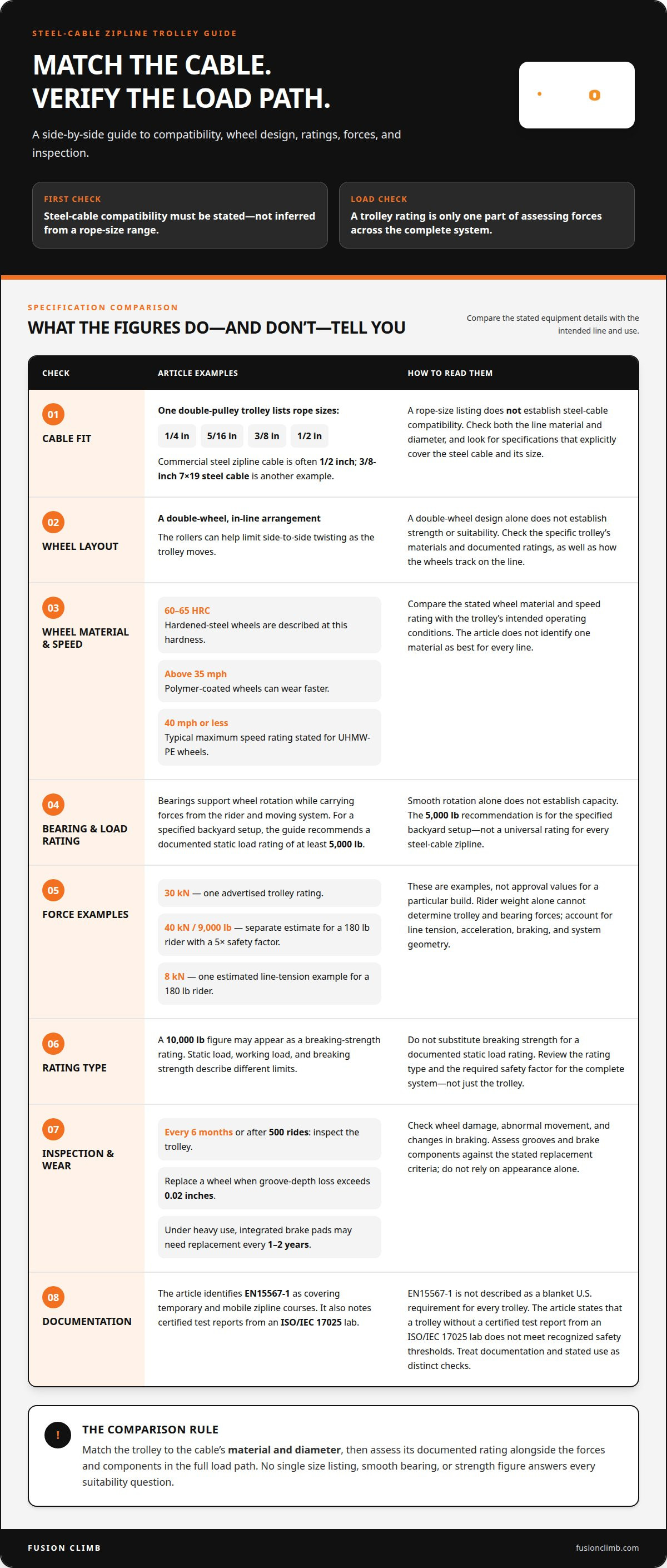
Diameter is the first specification to compare. One double-pulley trolley is described for rope sizes of 1/4, 5/16, 3/8, and 1/2 inch. Those figures describe its listed rope-size range; they don’t prove that the same trolley suits steel cable. For example, a proposed 3/8-inch steel 7×19 cable needs a trolley whose specifications explicitly cover steel and that cable size.
Use these checks to narrow the match:
- Identify the line: Record whether it is steel wire rope or rope, then note its diameter. A 3/8-inch measurement alone doesn’t identify the material.
- Match the stated use: Look for trolley specifications that name steel cable, rather than relying on rope sizes such as 1/4 or 5/16 inch.
- Compare the exact diameter: A trolley listed for 1/2-inch rope isn’t automatically suitable for 1/2-inch steel cable. The material and diameter both matter.
- Keep the construction in view: For 3/8-inch 7×19 steel cable, use compatibility information that addresses that cable type, not just a general diameter range.
Commercial steel zipline cable is often 1/2 inch, while 3/8-inch cable is another relevant example. These sizes aren’t interchangeable selection cues: each requires a trolley suited to its own diameter and material. Choose by matching the cable’s stated specifications to the trolley’s steel-cable compatibility. If that match isn’t clear from the product details, don’t treat a rope-size range or strength figure as a substitute for it.
Double-wheel zipline trolley design
Two wheels can change how a trolley tracks on the line. In an in-line arrangement, the rollers can help limit side-to-side twisting as the trolley moves. Steadier tracking matters on steel cable, where wheel profile and contact affect travel. A double-wheel design alone, however, does not establish strength or suitability. Those depend on the specific trolley’s materials and documented ratings.
Wheel material affects strength, speed limits, and wear. Hardened-steel wheels are described at 60-65 HRC, while polymer-coated wheels can wear faster above 35 mph. UHMW-PE wheels typically have a maximum speed rating of 40 mph or less. Compare the stated material and speed rating with the trolley’s intended operating conditions rather than assuming one material is best for every line.
For U.S. readers, EN15567-1 is identified as covering temporary and mobile zipline courses; that doesn’t make it a blanket U.S. requirement for every trolley. A trolley without a certified test report from an ISO/IEC 17025 lab does not meet recognized safety thresholds. Treat the report and the equipment’s stated use as distinct checks when assessing documentation.
Inspection and maintenance should focus on wear and function. Inspect the trolley every 6 months or after 500 rides, and replace a wheel when groove depth loss exceeds 0.02 inches. Under heavy use, integrated brake pads may need replacement every 1-2 years. Look for wheel damage, abnormal movement, and changes in braking, then remove worn components from service rather than relying on appearance alone.
- Check the wheel path: Confirm both rollers track freely and the assembly doesn’t twist abnormally.
- Assess wear: Compare wheel grooves and brake components against their replacement criteria.
- Review documentation: Match the trolley’s material, speed rating, and test report to its intended use.
For compatible equipment options, explore zipline pulleys alongside the rest of the system.
Trolley bearings and ride forces
Bearings support wheel rotation while carrying forces from the rider and moving system. A strong bearing matters, but bearing smoothness alone doesn’t establish trolley capacity. For a specified backyard setup, a guide recommends a documented static load rating of at least 5,000 pounds. That figure isn’t a universal rating for every steel-cable zipline.
There’s no single load rating or safety factor that fits every trolley and line. One advertised trolley is rated at 30 kN, while a separate estimate for a 180 lb rider proposed 40 kN, or 9,000 lb, for a 5× safety factor. Those examples don’t establish that the trolley is suitable for a particular system.
Capacity calculations must account for more than rider weight. Start with the intended rider and equipment load, then assess line tension and additional forces from acceleration, braking, and the system’s geometry. One estimate for a 180 lb rider put line tension at 8 kN. Treat that as an example, not a design value: rider weight alone can’t determine the forces acting on the trolley and bearings.
Use the trolley’s documented rating and the system’s calculated forces together. A breaking-strength figure describes a different limit from a working or static load rating. For example, 10,000 lb may appear as a breaking-strength rating, but it shouldn’t be substituted for a documented static load rating. The required safety factor must suit the complete system, not just the trolley.
- Confirm the rating type: Distinguish static load, working load, and breaking strength.
- Assess the full load path: Include rider, equipment, cable, trolley, and attachments.
- Account for motion: Consider forces during travel and braking, not only the stationary load.
- Review bearing condition: Rough rotation, looseness, or damage can affect trolley operation.
A capacity decision should use system calculations and matching documentation. Don’t treat a 30 kN label or a 5× example as a standalone approval for a build.
Zipline trolley prices
Price alone cannot tell you whether a trolley suits a steel-cable system. Compare its design, materials, bearings, cable compatibility, and documented load rating. A lower-cost trolley may be intended for a different use or have different supporting documentation than a model designed for demanding operation. Check what each trolley is designed to handle before comparing prices.
Use the system requirements outlined above as your starting point. A trolley intended for steel cable must match the cable, and its rating should be considered alongside expected ride forces. Then review the product information on wheels, bearings, and testing. A higher price does not automatically mean greater suitability; the specifications must address your line and intended use.
Where can you buy a professionally rated trolley for steel cable? Choose a manufacturer’s product channel that clearly states cable compatibility and provides documented trolley ratings. That information lets you compare intended use and supporting specifications before selecting equipment.
- Check compatibility: Confirm the product information identifies steel cable and the relevant cable size.
- Read the rating: Distinguish the stated load rating from other strength figures.
- Review construction: Compare wheel and bearing details to understand what the trolley is designed for.
- Assess documentation: Look for records that support the stated rating and intended application.
Apply the same criteria to every option. Comparing one trolley’s listed breaking strength with another’s working load rating is not an equal comparison. First match the rating type, then assess compatibility and design. A clear product description explains what the price covers, while the rating and cable fit determine whether the trolley suits your system.
To review a product option in this category, browse zipline pulley options and compare its specifications with your steel-cable requirements.
Fusion Climb
Fusion Climb offers zipline pulleys and rider equipment to support a complete setup around your trolley selection. Its range includes Full Body Harnesses, Superman Style Harnesses, and lanyard and tether equipment. These products serve different roles, so consider how the trolley, rider connection, and harness work together in your planned configuration.
For a steel-cable project, use the compatibility and load-rating criteria above to guide your trolley decision. Then consider which additional equipment suits the intended rider setup. Fusion Climb offers equipment across these categories, but each component must be assessed as part of the whole system.
Contact Fusion Climb to discuss equipment for your zipline setup.
Make the next decision with confidence
Choosing a high-strength zipline trolley for steel cables is only one part of preparing a complete system. Bring together the line details and intended setup, then assess how each component fits that configuration. A deliberate equipment decision is more useful than choosing by a single rating or price.
Fusion Climb offers equipment for zipline systems, including Zipline Pulleys, Full Body Harnesses, and Superman Style Harnesses. Use the criteria in this guide to define your requirements and identify the setup details to discuss. Knowing the cable type and intended use will help focus that conversation.
Discuss trolley options with Fusion Climb as you plan your equipment selection. Move forward with care, and build your next ride around informed choices.
Frequently Asked Questions
Which high-strength zipline trolleys are compatible with steel cables?
Choose a trolley whose product specifications explicitly state that it is compatible with steel wire rope. A general rope-size range or high strength rating alone does not establish compatibility. For example, do not assume a trolley described for rope is suitable for a steel line of the same diameter. Compare cable type, diameter, intended use, and trolley documentation as a complete set of requirements before choosing equipment.
What steel cable diameters are compatible with common zipline trolley models?
There isn’t one universal diameter range for steel-cable trolleys. A double-pulley trolley may list rope sizes of 1/4, 5/16, 3/8, and 1/2 inch, but those listed sizes don’t prove steel-cable compatibility. A 3/8-inch 7×19 steel cable and a 1/2-inch steel cable each require specifications that cover both their material and diameter. Match the exact cable to the trolley’s stated use.
How much do high-strength zipline trolleys cost in the United States?
A trolley’s design, materials, bearings, intended duty, and supplied documentation all affect its cost. Compare options using equivalent specifications rather than treating a lower price as proof of good value. For a steel-cable setup, prioritize clear compatibility and load information, then compare construction and included components. Compare products designed for the same cable and operating requirements.
What are the risks of using an unrated or incompatible trolley on a steel cable?
An unrated or incompatible trolley may not track or roll as intended, and its capacity under ride forces may be unclear. A poor fit can contribute to abnormal wear or equipment damage, while uncertain load performance can put the rider and connected system at risk. Do not rely on appearance or a rope-size label alone. Choose equipment with documentation that matches the steel cable and planned application.