



Commercial Grade Superman Harness Trolley Compatibility
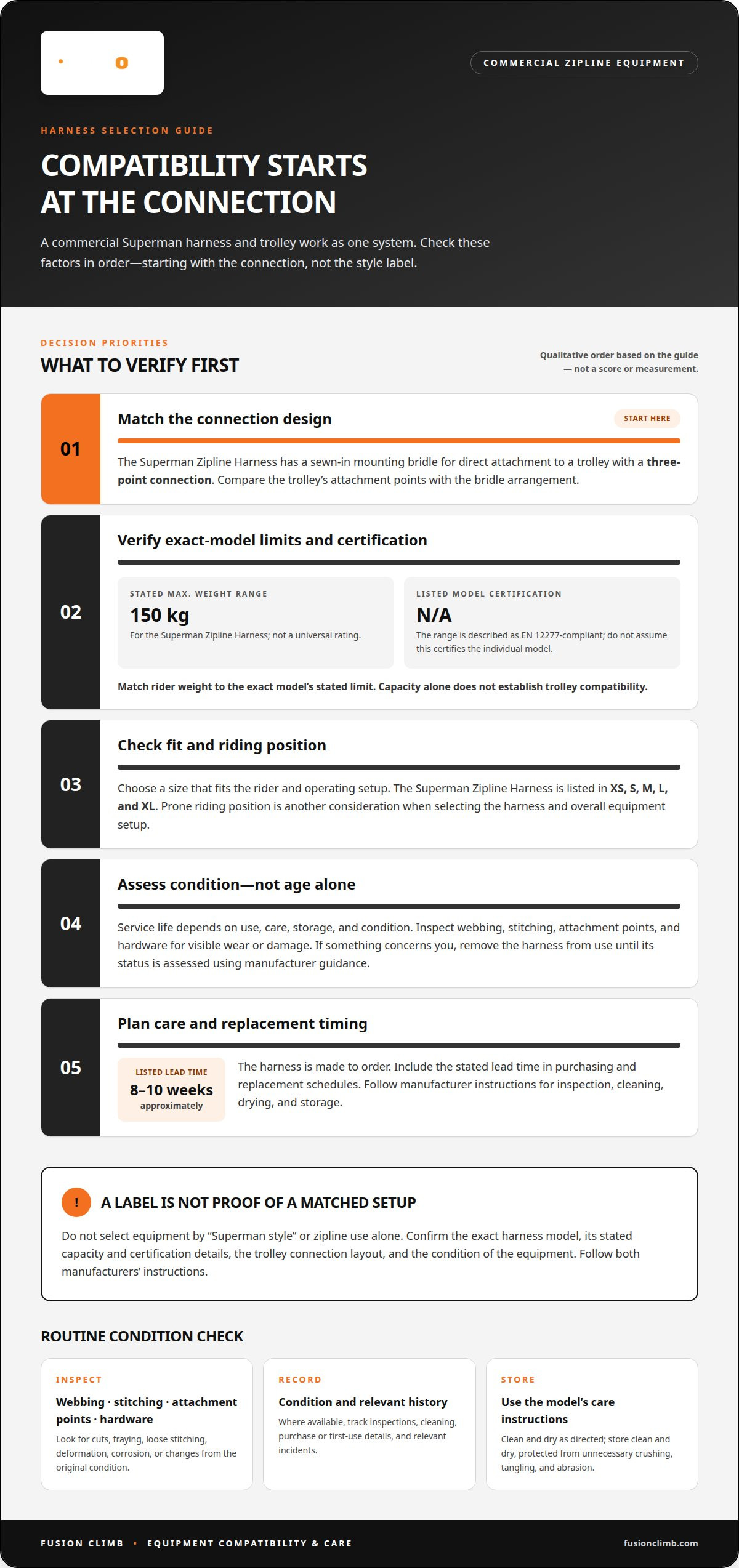
Compatibility starts at the connection, not the harness label. A commercial-grade Superman harness attaches directly to a zipline trolley with a three-point connection, using its sewn-in mounting bridle. The trolley’s connection points must match the harness’s attachment design.
It’s easy to focus on the harness alone, but the harness and trolley work as one system. A compatible connection is only part of the decision: fit, condition, maintenance, and riding position also matter when selecting equipment for commercial use.
This guide explains how to assess trolley compatibility and choose a harness for prone riding. It also covers service life, routine maintenance, and how to interpret certification information without treating a label as proof of compatibility. Use these factors to make an informed equipment decision and understand how Superman-style harnesses and zipline pulleys fit into a setup.
Key Takeaways
- Understand why certification details should be assessed for the specific harness model, rather than assumed from a broader product range.
- Learn which inspection and care practices help identify wear that can affect a harness’s continued service.
- See how sizing and made-to-order availability factor into selecting a harness for a commercial setup.
- Explore how prone riding position influences harness choice and the overall equipment setup.
What certifications apply to commercial zipline harnesses?
Certification details and weight capacity are model-specific, so assess the exact harness rather than relying on the Superman style label. The available comparison lists the Superman Zipline Harness certification as N/A. Separately, the zipline harness range is described as EN 12277-compliant; those statements shouldn’t be treated as proof that this individual model carries that certification.
The Superman Zipline Harness has a maximum weight range of 150 kg. Treat that figure as a limit for the stated harness, not a universal capacity for Superman-style equipment. Match the rider’s weight to the harness’s model-specific limit, then consider the complete connection setup. A suitable harness capacity alone doesn’t establish compatibility with a trolley or other components.
Which Superman harness brands and models are rated for commercial use? The model identified here is the Superman Zipline Harness, but its comparison-table certification is N/A. The range’s EN 12277 compliance description is separate, so don’t transfer it to that model as a certification claim.
What load capacity and safety certifications should a commercial Superman harness have? Use the exact model’s stated limit and certification information. For the Superman Zipline Harness, the stated maximum weight range is 150 kg, while its listed certification is N/A; the broader range is described as EN 12277-compliant.
What safety risks and contraindications apply when using a Superman harness? Key concerns include exceeding the 150 kg limit, selecting a mismatched connection, or using equipment with visible damage. These are practical reasons to assess the full setup and harness condition, not a model-specific list of medical contraindications.
- Match the rider’s weight to the exact harness model’s stated limit.
- Keep model-specific certification details distinct from claims about a product range.
- Assess the harness, trolley connection, and visible equipment condition as one setup.
For commercial use, record the model name, capacity, and certification details in equipment documentation. This makes the basis for equipment selection clear without assuming that a style name or range-level description applies to every harness.
Harness service life and maintenance
Inspect the harness before use, clean and store it according to the manufacturer’s care instructions, and record its condition. Service life depends on use, care, storage, and condition, so age alone can’t show whether a harness remains suitable.
Harness Service Life
Service life describes how long a harness remains fit for use, not simply how long it has been owned. Review the specific model’s manufacturer instructions, including any service-life limits or retirement criteria. Where available, track purchase or first-use details, inspections, cleaning, and incidents that may have affected the equipment.
During each inspection, examine the webbing, stitching, attachment points, and hardware for visible wear or damage. Look for cuts, fraying, loose stitching, deformation, corrosion, or other changes from the harness’s original condition. If you find a concern, remove the harness from use until its status is assessed according to the manufacturer’s guidance. Don’t rely on age alone to decide.
Inspection and Storage
Before use, lay out the harness and inspect each section in good light. Check the webbing from end to end, examine stitched areas and load-bearing connections, and operate hardware as its instructions describe. Look for dirt or residue that could conceal damage. After use, repeat the visual check and note any changes in the equipment record.
Clean the harness using the method and products specified by the manufacturer. Don’t substitute a cleaning agent or process that the instructions prohibit. Allow the harness to dry as directed before storing it in a clean, dry place away from conditions identified as damaging in its care guidance. Keep it organized so the webbing and hardware aren’t crushed, tangled, or exposed to unnecessary abrasion.
- Inspect: Check webbing, stitching, attachment points, and hardware.
- Record: Log inspection findings, cleaning, and relevant use history.
- Store: Follow the model’s care instructions and protect the harness from damage.
For a Superman-style harness, follow the same model-specific process. If the harness is damaged or its care history is unclear, don’t return it to service based on appearance alone. Use the manufacturer’s instructions to determine the appropriate next step.
Does the Superman harness require a specific trolley?
Yes. The Superman Zipline Harness has a sewn-in mounting bridle for direct attachment to a trolley with a three-point connection. It also attaches directly to the trolley’s attachment holes. Compatibility depends on the connection design, so assess the harness and trolley as a matched setup rather than selecting them by name alone.
Before choosing a trolley, identify its attachment points and compare them with the harness’s bridle arrangement. Confirm that the connection aligns correctly and that the setup follows both manufacturers’ instructions. Don’t treat a trolley with a different connection layout as compatible just because it is designed for zipline use. Keep the harness and trolley specifications together when documenting equipment selection.
What types of Superman harnesses are available for commercial or professional use? The Superman Zipline Harness is made to order and listed in four sizes: XS, S, M, L, and XL. Select a size that fits the rider and operating setup rather than assuming one size suits every user.
Made-to-order availability affects planning. The listed lead time is approximately 8 to 10 weeks after an order is placed. Include that interval in purchasing and replacement schedules, especially when a harness is needed for a planned operating period. Sizing and order timing are separate decisions: establish the appropriate size first, then account for the stated lead time.
What training, supervision, and operating procedures are recommended for Superman harness use? Use documented procedures for fitting, trolley attachment, and pre-use checks, and ensure riders understand the prone position before operation. Supervisors should follow the site’s established operating process and the equipment manufacturers’ instructions. This guidance doesn’t replace activity-specific training.
- Match: Align the sewn-in bridle with the trolley’s three-point connection.
- Size: Choose from the listed size options for the intended rider.
- Plan: Allow approximately 8 to 10 weeks after ordering.
For a commercial setup, record the harness model, selected size, trolley connection type, and order timing together. This creates a clear reference for equipment planning and helps prevent a replacement order from overlooking the required attachment arrangement.
Superman harness prone riding position
A commercial-grade Superman harness supports a rider in a prone, headfirst position on a zipline. This orientation creates the distinctive Superman-style ride, unlike the upright position used with a conventional full-body harness.
In prone riding, the rider faces forward with the body extended in the direction of travel. The harness supports the rider while connected to the zipline trolley, so both must work together as designed. The riding position depends on the harness configuration and a compatible trolley connection, not simply on the rider leaning forward.
Before a ride, follow the equipment’s fitting instructions and operating procedures. Position the harness as directed, secure every adjustment and connection, and make sure the rider understands how to enter and hold the prone position. For example, a rider preparing to launch should know how to position their body and maintain that position during travel. Don’t improvise a different attachment or use an upright harness to recreate the setup.
Prone, headfirst travel changes the rider’s orientation and view of the course. Explain the launch, travel, and arrival sequence before use, with clear instructions suited to the site’s operating procedure. Staff supervision should include checking that the harness is fitted correctly, the trolley connection is secure, and the rider is ready to follow instructions. The harness alone doesn’t define the complete operating system.
- Fit: Follow the harness instructions and secure its intended adjustments.
- Connect: Use the trolley attachment designed for that harness.
- Brief: Explain the prone position and ride sequence before launch.
For equipment selection, compare the intended riding position with the harness and trolley configuration. Explore Superman Style Harnesses when planning a prone zipline setup, and use the model’s instructions to guide fitting and operation.
Fusion Climb: Superman Style Harnesses
Fusion Climb offers Superman Style Harnesses for setups designed around prone zipline riding. When selecting equipment, consider the harness’s intended riding position and trolley connection, then match components according to their specifications.
Fusion Climb also offers Zipline Pulleys, Full Body Harnesses, and lanyards and tethers. These products serve different equipment needs, so choose according to the application and required configuration rather than treating them as interchangeable. For a Superman-style setup, focus on how the harness connects to the trolley and supports the rider’s intended position.
Build Your Setup With Confidence
Start by defining the riding position and equipment configuration your operation requires. Consider a commercial-grade Superman harness as part of a complete setup, with compatibility and intended use guiding selection. Clear requirements make it easier to identify which equipment belongs together.
Fusion Climb offers Superman Style Harnesses, Full Body Harnesses, and Zipline Pulleys. These options support planning for prone riding and other harness needs, but different equipment types aren’t interchangeable. Keep your intended application at the center of the decision.
To discuss harness options for your setup, contact Fusion Climb about harnesses. Move forward with a clear plan and equipment choices suited to your operation.
Frequently Asked Questions
What accessories extend the operational range of each harness?
Accessories support different configurations, but they don’t independently extend a zipline’s physical range. A compatible zipline pulley connects the rider’s setup to the line, while a lanyard, tether, or carabiner serves a role specified for that system. Select hardware according to its intended function and the harness connection, rather than adding components to increase reach.
What does the Superman harness offer as a product differentiator?
The defining feature is the prone, headfirst riding position, which faces the rider forward during a zipline ride. The Superman Zipline Harness also has a mobile phone pocket with Velcro fastening. This is a convenience feature, not a substitute for checking the harness fit, connection, or operating instructions before use.
What is the participant weight range for each model?
The Superman Zipline Harness has a stated maximum weight range of 150 kg. Don’t apply that figure to other harness models or confuse participant capacity with hardware strength ratings. For each model, use its own participant weight criteria when planning rider eligibility; size labels or the strength rating of a separate component don’t establish that range.
How do you choose the right size and fit for a Superman harness?
Choose a size using the specific harness’s sizing guidance and the rider’s measurements, not clothing size alone. During fitting, follow the model’s instructions, secure each adjustment, and check that the harness sits as intended for its riding position. For example, fit and check a prone setup in the position described by its instructions.