


Aerial Work Platform Harness: 2026 Industrial Buying Guide
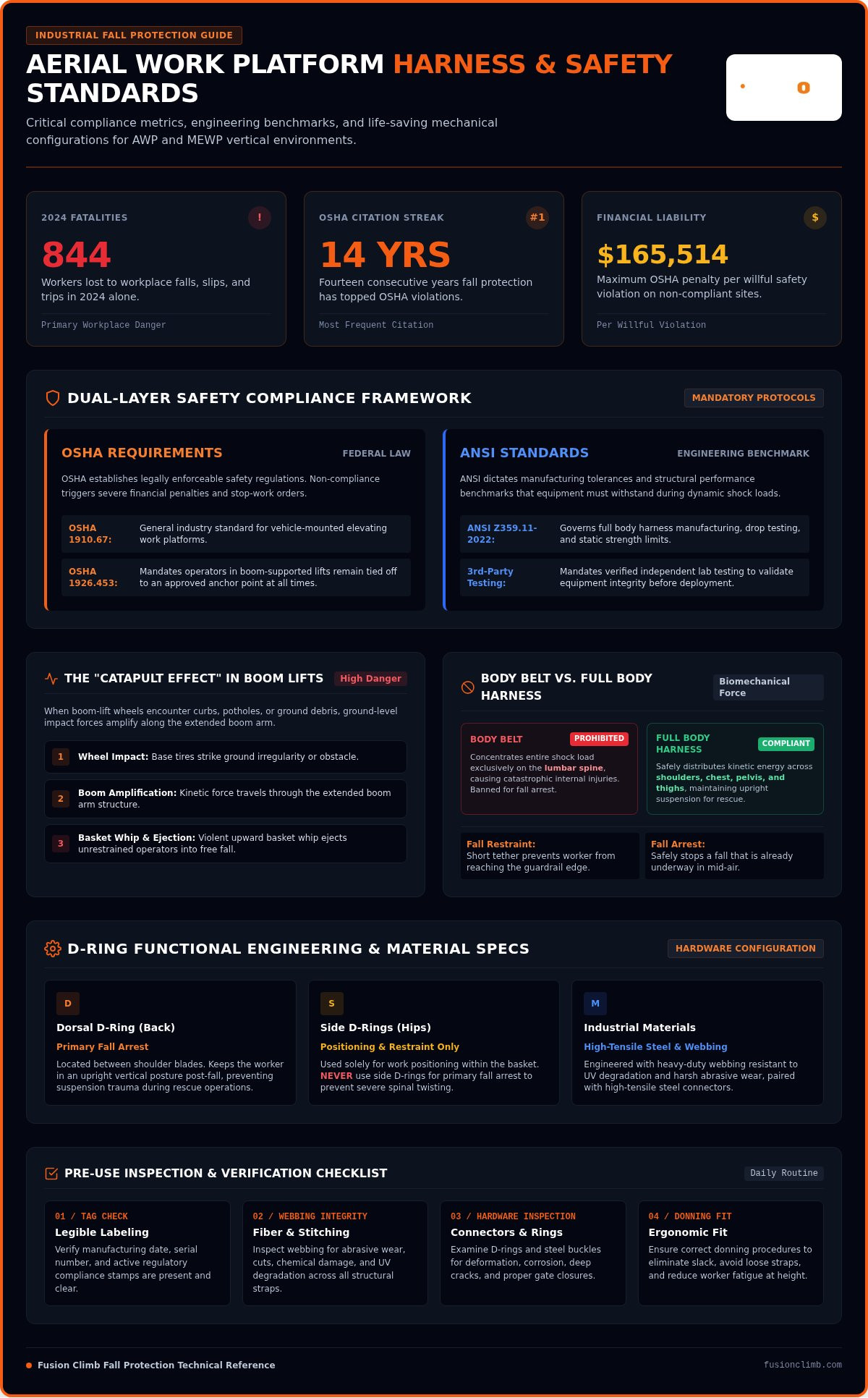
In 2024, 844 workers lost their lives to workplace falls, slips, and trips. For fourteen consecutive years, fall protection has topped OSHA’s list of most frequent citations. These aren't just numbers; they represent preventable tragedies that demand professional-grade solutions. Selecting the right full body harness for aerial work platforms is the first line of defense against these statistics. You need gear that stands up to harsh industrial environments while meeting the latest ANSI Z359.11-2022 standards.
You know that keeping a crew safe at height is a high-stakes responsibility. It's frustrating when workers bypass safety protocols because their equipment is heavy, hot, or restrictive. This guide solves those challenges. You'll discover how to select OSHA and ANSI-compliant harnesses that balance rugged durability with all-day comfort. We'll break down the latest 2026 regulatory updates, compare essential features for boom and scissor lifts, and provide a clear roadmap for equipment longevity.
Key Takeaways
- Navigate the complexities of current ANSI Z359.11-2022 standards and OSHA fall protection regulations to ensure total site compliance.
- Identify high-performance webbing and hardware components that resist UV degradation and abrasion in demanding industrial settings.
- Select the ideal full body harness for aerial work platforms to improve worker ergonomics and reduce fatigue during long shifts at height.
- Establish rigorous pre-use inspection protocols and correct donning procedures to eliminate equipment failure risks.
- Understand the critical mechanical differences between fall arrest systems for boom lifts versus scissor lifts to optimize gear selection.
The Critical Role of Full Body Harnesses on Aerial Work Platforms
An industrial safety harness isn't just a collection of straps. It's a highly engineered piece of personal protective equipment designed to save lives in high-risk vertical environments. Specifically, a premium full body harness for aerial work platforms serves as the foundational anchor of an integrated fall arrest system. When an operator falls from an elevated basket, gravity accelerates the body rapidly, creating immense kinetic energy. Older safety systems relied on simple body belts, but these are now strictly prohibited for fall arrest. A body belt concentrates the entire shock load onto the lumbar spine, causing severe internal injuries. In contrast, a full body design safely distributes impact forces across the shoulders, chest, pelvis, and thighs, keeping the worker securely contained and suspended until rescue arrives.
Understanding AWP and MEWP Fall Hazards
Boom-supported platforms introduce a violent physical dynamic known as the catapult effect. When the lift's wheels hit a curb, pothole, or debris, the impact amplifies along the extended boom arm, violently whipping the basket through the air. This sudden motion easily ejects an unrestrained worker. Managing this risk requires a clear understanding of fall restraint versus fall arrest. Fall restraint utilizes a short tether to physically prevent a worker from stepping over the guardrail. Fall arrest stops a plunge that is already underway. Don't mistake standard structural climbing gear for industrial-grade equipment. Generic harnesses lack the heavy-duty webbing and specialized D-ring placements required to withstand unique Mobile Elevating Work Platform (MEWP) hazards.
The Cost of Non-Compliance in Industrial Settings
Cutting corners on fall protection introduces massive liability and operational risk. OSHA penalties for willful safety violations can reach up to $165,514 per violation, creating a massive financial burden for non-compliant operations. Beyond legal fines, sub-par equipment damages workforce morale. When your crew operates at height, confidence directly drives productivity. Providing a reliable full body harness for aerial work platforms ensures that workers focus on the task at hand rather than their immediate safety. Look for gear built with high-tensile steel hardware and premium webbed materials. Meticulous manufacturing control prevents catastrophic equipment failure, protects your bottom line, and brings every worker home safely at the end of the shift.
Engineering Standards and Regulatory Compliance for Fall Protection
Compliance isn't optional when working high above the ground. Federal law mandates strict adherence to safety protocols on elevated platforms. Under OSHA standards 1910.67 and 1926.453, operators on boom-supported lifts must remain tied off to an approved anchor point at all times. Failing to meet these OSHA fall protection requirements leads to heavy regulatory penalties and catastrophic liabilities. A fully compliant system relies on a proper full body harness for aerial work platforms paired with certified connectors. Component compatibility is vital here; mismatched carabiners, tethers, or hardware can fail under sudden loads. Always check the safety markings and certification tags on your gear. Every industrial harness must feature a legible label showing its manufacturing date, serial number, and specific regulatory compliance stamps.
OSHA vs. ANSI: What Managers Must Know
OSHA writes the legal regulations, but ANSI establishes the strict manufacturing performance benchmarks that keep gear reliable. Specifically, the ANSI Z359.11 standard dictates rigorous drop testing, static strength requirements, and tight manufacturing tolerances for full-body designs. This ensures the equipment can withstand real-world industrial abuse without tearing or snapping. Compliance validation requires clear verification through independent third-party testing metrics to guarantee the equipment meets these strict parameters.
D-Ring Configurations for Aerial Platform Work
D-ring placement dictates how a harness responds during an accident. For aerial platforms, the dorsal D-ring located between the shoulder blades serves as the primary attachment point for fall arrest. It keeps the worker upright after a fall, preventing suspension trauma while waiting for rescue teams. Side D-rings serve a different purpose entirely. Use them only for work positioning or restraint within the basket; relying on side D-rings for primary fall arrest is dangerous and can cause severe spinal twisting during a drop. To achieve optimal safety, managers often integrate their harness setups with engineered zipline lanyards and tethers to enforce positive restraint. This combination keeps workers securely inside the platform boundaries. If you are upgrading your fleet's safety gear this season, explore the rugged hardware options available in the Fusion Climb lineup to ensure complete system compatibility.
Key Evaluation Criteria for Selecting an AWP Safety Harness
Selecting a high-performance full body harness for aerial work platforms demands a systematic evaluation of its core components. You can't rely on guesswork when your crew operates at extreme heights. Every strip of fabric and piece of metal must withstand intense industrial abuse while maintaining absolute alignment with OSHA fall protection standards. Field managers must look beyond generic safety ratings to analyze how a harness performs under real-world stress. Consider the deployment environment, shift lengths, and specific worker movements before purchasing any gear.
Buckle design directly impacts both deployment speed and user security. Pass-through buckles offer a traditional, mechanical connection that resists dirt clogging, making them ideal for gritty jobsites. Quick-connect buckles allow workers to don their gear in seconds, which significantly improves daily compliance rates. To maximize utility during extended shifts, examine the padding configurations. Ergonomic waist, shoulder, and leg pads distribute weight evenly, preventing painful pressure points and reducing worker fatigue during long hours in the basket.
Webbing Durability and Tensile Strength
Industrial environments expose safety gear to brutal elements. High-density polyester or premium nylon webbing is absolutely essential to resist severe abrasion, UV degradation, and chemical splatters. Look for advanced coatings that actively repel oil, dirt, and moisture. These treatments keep the fabric pliable and drastically extend the harness's operational life. Meticulous, multi-row stitching patterns at critical load-bearing junctions provide the ultimate insurance against tearing, ensuring the fabric holds firm when subjected to sudden kinetic forces.
Hardware Integrity and Connection Points
Hardware construction dictates the overall ruggedness of your fall protection setup. Heavy-duty alloy steel buckles provide unmatched durability in harsh, corrosive outdoor environments. They resist rust and mechanical deformation over years of continuous field use. Lightweight aluminum components offer an excellent alternative for reducing a worker's physical load, though they require close monitoring for micro-cracks. Ensure all adjustment mechanisms operate smoothly without binding, which prevents premature webbing wear over time. Complete your safety loop by pairing your harness with high-tensile hardware like professional climbing carabiners to secure the system to the platform's anchor point. Meticulous hardware selection guarantees that your integrated fall arrest system performs flawlessly when the stakes are highest.
Step-by-Step Fitting and Pre-Use Inspection Protocols
Even the most advanced full body harness for aerial work platforms will fail if it's poorly fitted or damaged. Life-safety equipment requires an unyielding commitment to daily maintenance and proper usage. Establishing a mandatory pre-use inspection routine ensures that minor material wear doesn't escalate into a catastrophic failure at elevation. Workers must treat this process as a non-negotiable step before stepping onto any lift platform. Once the gear passes inspection, correct donning ensures that fall forces distribute across the body as engineered.
Deploying a buddy system adds an essential layer of security to your site's safety protocol. A coworker must visually verify the placement of your dorsal D-ring, ensuring it sits squarely between the shoulder blades where it can function correctly during a fall. This partner check also reveals twisted back straps that the wearer cannot see. Finally, train your crew to identify clear signs for equipment retirement. Industrial harnesses feature integrated impact indicators; if these stitched loops are ripped or deployed, it proves the gear has withstood a fall and must be removed from service immediately.
The Pre-Use Inspection Checklist
Before putting on the equipment, conduct a methodical visual and tactile assessment of all components. Follow these specific checkpoints:
- Webbing: Flex the fabric in an inverted 'U' shape to check for deep cuts, burns, fraying, pulled stitches, or chemical degradation.
- Hardware: Inspect all metal parts for hairline cracks, structural distortion, heavy corrosion, or sharp burrs that could slice the fabric.
- Indicators and Grommets: Verify that all adjustment grommets are perfectly round and ensure the factory impact indicators remain completely intact.
Donning and Adjusting for Maximum Security
Follow this precise, sequential protocol to guarantee a secure fit every time you gear up:
Step 1: Hold the harness by the dorsal D-ring and shake it gently to allow all leg and waist straps to fall into their natural positions.
Step 2: Slip the shoulder straps over your arms like a standard jacket, keeping the fabric completely flat against your body without any twists.
Step 3: Reach between your legs to secure the thigh straps; adjust them until they're snug, ensuring a flat hand can just pass between the webbing and your leg.
Step 4: Fasten the chest strap securely, positioning it directly across the mid-chest zone to prevent the shoulder straps from slipping outward during movement.
If your current fleet gear shows signs of wear or fails these basic checks, protect your crew by upgrading to a rugged Fusion Climb full body harness before your next shift.
Industrial-Grade Reliability: The Fusion Climb Approach
Fusion Climb operates as a seasoned, authoritative expert in the vertical safety industry. We prioritize substance over style, ensuring every piece of equipment meets the grueling demands of high-stakes industrial work. A high-performance full body harness for aerial work platforms must be more than just compliant; it must be dependable under extreme stress. Our engineering team draws on decades of expertise to build gear that empowers workers to push their physical limits while remaining anchored in security. We don't settle for surface-level safety. Instead, we apply rigorous quality control protocols to every stage of manufacturing, from the initial webbing weave to the final hardware attachment.
Safety managers have a responsibility to equip their teams with gear designed for the reality of the job. Don't compromise on worker protection by selecting generic, light-duty alternatives. By choosing Fusion Climb, you invest in high-performance engineering that protects your most valuable assets. Secure your site today with a full body harness for aerial work platforms that defines industrial-grade reliability.
Rugged Construction for Demanding Workspaces
Demanding industrial workspaces require equipment that doesn't quit. Every harness in our lineup undergoes meticulous testing to ensure it survives harsh weather, chemical exposure, and mechanical abrasion. We utilize heavy-duty buckles and high-tensile steel hardware that provide a sobering sense of security for the end user. Reinforced stitching at every critical load-bearing junction prevents fabric separation during a fall arrest event. Despite this focus on strength, our design philosophy minimizes unnecessary bulk. This ensures that operators maintain full range of motion while working in cramped baskets or reaching for overhead hazards.
Building an Integrated Fall Protection System
Safety is a holistic discipline that requires a methodical approach. A premium harness provides the foundation, but it must integrate seamlessly with compatible, high-capacity tethers and lanyards. Using mismatched components creates weak links that jeopardize the entire safety chain. For structural insights into how these systems perform in diverse vertical environments, see our professional guide to ropes course safety equipment. This resource details the standards and hardware required for maximum load-bearing integrity across various industries. Corporate procurement teams looking for professional-grade rigging hardware can source directly from our catalog to ensure every component in their fall arrest system matches our high-performance manufacturing standards.
Fortify Your Safety Standards for the Modern Jobsite
Site safety on elevated platforms demands more than just a checklist; it requires an unyielding commitment to professional-grade equipment. By prioritizing ANSI Z359.11-compliant gear and enforcing strict pre-use inspection protocols, you effectively mitigate the risks of catastrophic failure. A high-performance full body harness for aerial work platforms remains the single most important investment you can make for your crew's well-being. It's the difference between a preventable accident and a secure return home.
Fusion Climb remains a trusted partner in professional rigging and tactical safety equipment, delivering rugged, safety-first engineering for industrial environments. We build our gear using high-tensile steel hardware and premium webbed materials that withstand the elements without compromising worker ergonomics. You've seen the risks and the regulations. Now, it's time to provide your team with the dependability they deserve.
Equip Your Crew With Professional Industrial Safety Gear From Fusion Climb
Frequently Asked Questions
What is the difference between a fall arrest harness and a fall restraint harness for AWPs?
Fall restraint systems utilize short lanyards to physically prevent a worker from reaching a leading edge or falling out of the basket. Fall arrest systems are designed to stop a plunge already in progress. In aerial platform operations, restraint is often preferred because it prevents the worker from experiencing the violent catapult effect. A proper full body harness for aerial work platforms supports both configurations, provided you pair it with the correct tethers.
How often must a full body harness used on an aerial work platform be inspected?
You must perform a visual inspection before every single shift. This pre-use check identifies immediate hazards like frayed webbing or distorted hardware. Beyond daily checks, OSHA and ANSI standards require a formal, documented inspection by a competent person at least once every twelve months. If the equipment operates in harsh industrial environments with high chemical or UV exposure, you should increase the frequency of these formal safety audits to ensure total reliability.
Can I use a standard climbing harness on a commercial boom lift?
No, you cannot substitute recreational gear for industrial fall protection. Standard climbing harnesses are engineered for different load distributions and lack the specific dorsal D-ring positioning required for aerial lift safety. Industrial-grade gear must meet ANSI Z359.11 standards, featuring high-tensile steel hardware and integrated impact indicators. Using non-compliant equipment on a commercial site invites unnecessary risk and leads to severe OSHA citations during safety inspections.
What is the weight capacity of an industrial full body safety harness?
Most industrial full body safety harnesses are rated for a capacity range of 130 to 310 pounds according to ANSI standards. This total weight must include the worker's body, clothing, and all tools carried onto the platform. Some specialized heavy-duty models can support up to 420 pounds. Always verify the specific capacity printed on the manufacturer's label, as exceeding these limits compromises the shock-absorbing capabilities of the entire fall arrest system.
How do I know if my industrial safety harness has been involved in a fall?
Look for the deployment of factory-stitched impact indicators located near the dorsal D-ring. These specialized loops are designed to rip open when subjected to the extreme forces of a fall. If the warning threads are visible or the webbing appears elongated, the harness has done its job and must be retired. Never attempt to repair a deployed unit. Physical distortion of the metal hardware or glazed webbing also indicates a significant load event.
What OSHA regulations cover fall protection on scissor lifts vs. boom lifts?
OSHA classifies boom-supported lifts under 1926.453, which mandates that workers remain tied off to the boom or basket at all times. Scissor lifts fall under the general scaffold standard, 1926.451. While compliant guardrails often satisfy scissor lift requirements, many safety managers still require a full body harness for aerial work platforms to mitigate ejection risks. Always follow the manufacturer’s specific instructions for each lift type to maintain 100% regulatory compliance.
How should full body harnesses be stored to prevent material degradation?
Store your safety gear in a cool, dry, and well-ventilated environment away from direct sunlight. UV radiation and extreme heat cause premature webbing degradation and weaken the synthetic fibers. Keep harnesses away from batteries, solvents, or corrosive chemicals that can eat through the material without visible signs of damage. Hanging the gear on a dedicated rack prevents moisture buildup and allows you to conduct a quick visual scan of your inventory before the next shift begins.