



Padded Full Body Harness: Professional Buyer’s Guide
What if the equipment meant to save your life is actually the primary source of your daily exhaustion? For many professionals, the reality of working at height involves a constant battle against leg numbness, heat buildup, and straps that shift during every movement. You shouldn't have to choose between rigorous safety standards and the ability to stand comfortably at the end of an eight-hour shift. Selecting the right padded full body harness for extended wear is about more than just adding foam; it's about precision engineering that supports the human body under stress.
We understand that a harness is your most critical tool. It's the silent partner in every climb and suspension. In this guide, you'll discover how to select professional-grade gear that balances industrial-strength protection with the ergonomic design required for all-day movement. We'll examine the essential features of high-performance rigs, from moisture-wicking 3D mesh to ANSI Z359.11 compliance. By the end of this article, you'll know exactly how to achieve reduced worker fatigue and long-term gear durability without compromising on the safety standards your job demands.
Key Takeaways
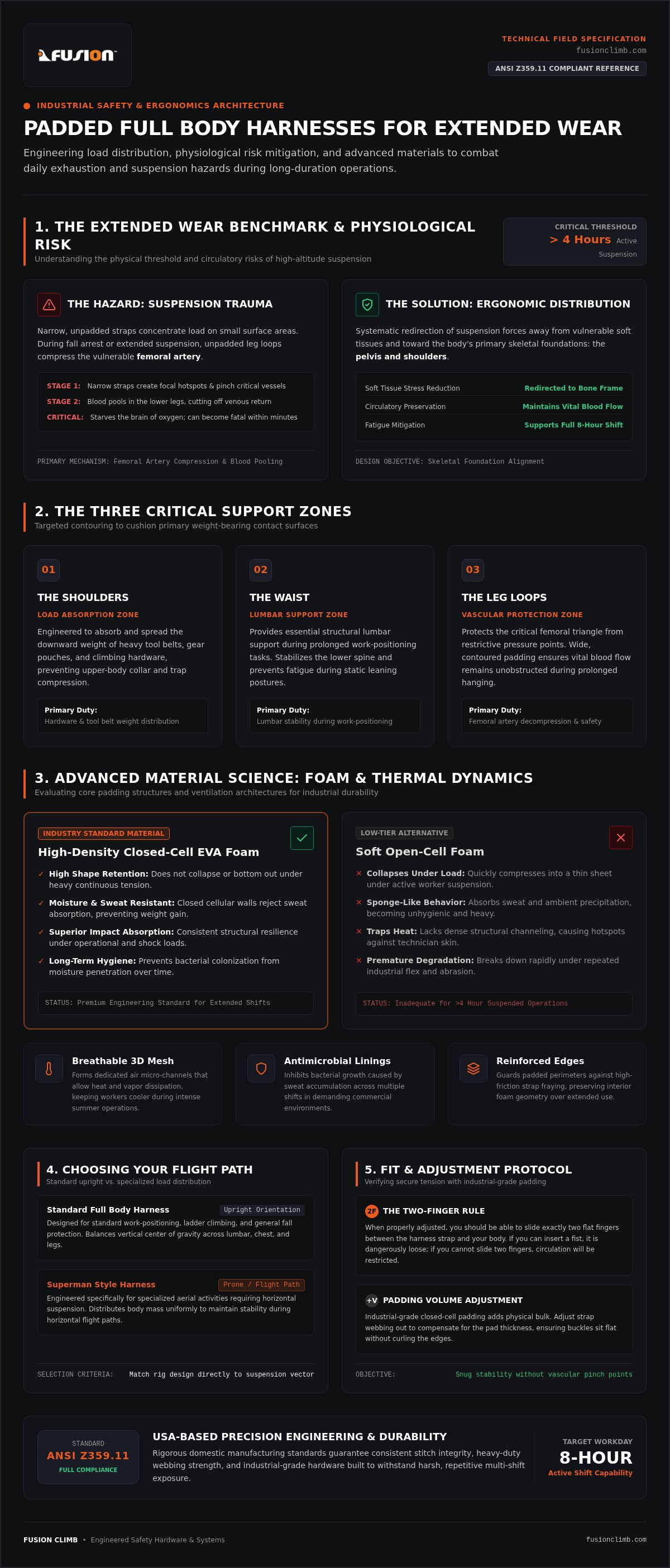
- Understand how ergonomic padding mitigates the physiological risks of suspension trauma by distributing weight away from the femoral artery during shifts exceeding four hours.
- Identify critical structural components like breathable 3D mesh that manage heat and moisture to maintain comfort in demanding industrial environments.
- Learn the functional differences between standard upright harnesses and specialized Superman Style harnesses to ensure optimal load distribution for your specific flight path.
- Discover how to select a padded full body harness for extended wear by applying the two-finger rule and adjusting for the additional volume of industrial-grade padding.
- Gain clarity on ANSI Z359.11 compliance and why USA-based manufacturing is essential for securing long-term gear durability and worker safety.
The Science of Comfort: Why Padding Matters for Extended Wear
In the world of high-altitude work and aerial adventure, comfort isn't a luxury; it's a safety requirement. We define extended wear as any professional or recreational application that exceeds four hours of active suspension. When you're hanging in a rig for half a day, the physical toll on your body accumulates rapidly. A padded full body harness for extended wear is designed to transform that experience from a test of endurance into a manageable professional task.
Discomfort in the field is a direct threat to worker productivity. When a technician is fighting a harness that pinches or restricts movement, their focus shifts from the task at hand to their own physical distress. This distraction increases the risk of accidents. Ergonomic load distribution is the systematic redirection of suspension forces away from vulnerable soft tissues and toward the body's primary skeletal foundations, such as the pelvis and shoulders.
Suspension Trauma and Pressure Points
Narrow, unpadded straps are the primary cause of hotspots and circulatory issues. During a fall or long-duration suspension, the weight of the body concentrates on small surface areas. If the leg loops lack proper support, they can compress the femoral artery, leading to suspension trauma. This condition involves blood pooling in the legs, which starves the brain of oxygen and can become fatal in minutes. Utilizing a sophisticated full-body safety harness design ensures that these forces are spread across wide, contoured pads. These pads maintain vital blood flow by cushioning the three critical zones:
- The Waist: Provides essential lumbar support during work-positioning tasks.
- The Shoulders: Absorbs the weight of heavy tool belts and hardware.
- The Leg Loops: Protects the femoral triangle from restrictive pressure.
Padding vs. Mobility: Finding the Equilibrium
There's a common misconception that thicker padding always equals better performance. In reality, excessive bulk can hinder your range of motion and trap intense heat against the body. Choosing a padded full body harness for extended wear requires a balance between cushioning and agility. High-density EVA foam is the industry standard for a reason. Unlike cheap soft-cell foam that collapses under tension, high-density materials retain their shape and protective properties even under significant load.
Fusion Climb engineers their equipment to meet this equilibrium. By utilizing streamlined, rugged designs, they provide the necessary protection without the unnecessary weight. It's about precision. We use high-performance materials that stand up to industrial abuse while allowing the wearer to move naturally. You need a harness that acts as a silent partner, providing security when you need it and staying out of your way when you're on the move.
Anatomy of a High-Performance Full Body Harness
A high-performance rig is an engineered assembly of technical textiles and forged hardware. To qualify as a padded full body harness for extended wear, the design must go beyond basic fall protection. It integrates multi-layered padding systems with high-strength webbing to create a structure that supports the skeletal frame during long shifts. Every layer matters. We utilize material science to ensure that the equipment remains a silent partner in your safety, providing comfort without compromising the structural integrity required for high-stakes environments.
The primary challenge in design is managing the microclimate between the skin and the gear. Breathable 3D mesh is essential for summer operations, as it creates dedicated air channels that allow heat to dissipate. Without this ventilation, moisture builds up, leading to skin irritation and premature material degradation. Fusion Climb focuses on these granular details to ensure your gear performs as hard as you do.
Advanced Padding Materials and Moisture Management
We prioritize closed-cell EVA foam for professional rigs because it provides superior impact absorption and shape retention. Unlike open-cell foam, which acts like a sponge, closed-cell structures resist sweat and moisture. This prevents the harness from becoming heavy or unhygienic after days of use. In commercial environments, antimicrobial linings offer an additional layer of protection against bacteria buildup. We also incorporate reinforced edges on all padded sections. These edges prevent the foam from fraying or compressing over time, ensuring the harness maintains its ergonomic profile throughout its service life.
Attachment Points and Load Distribution
The positioning of hardware is critical for both safety and mobility. A dorsal D-ring serves as the primary connection point for fall arrest, keeping the worker upright during a descent. Sternal D-rings are utilized for rope ladders or controlled descents. Compliance with OSHA personal fall arrest standards ensures these points can withstand forces up to 1,800 lbs. Proper padding prevents these steel components from pressing into the spine or sternum. It also ensures that professional climbing carabiners don't chafe against the wearer during active movement. If you are upgrading your kit, consider our specialized Full Body Harnesses for your next high-altitude project.
Effective load distribution is the hallmark of a padded full body harness for extended wear. By spreading the energy of a fall across the entire torso and pelvis, the equipment reduces the peak force felt by the body. This engineering protects the user from internal injuries and localized trauma, making it the standard choice for professional operators who value both safety and longevity.
Superman Style vs. Standard Full Body: Choosing Your Flight Path
Selecting the right rig depends entirely on the angle of your mission. While vertical fall arrest is the industrial standard, the evolution of aerial adventure has introduced horizontal flight geometries that demand specialized equipment. A padded full body harness for extended wear must be matched to the user's orientation to prevent localized fatigue and circulatory restriction. Whether you are performing high-angle maintenance or guiding guests through a canopy tour, the geometry of your harness determines your endurance limits.
Standard upright harnesses excel in vertical environments where the worker remains in a seated or standing posture. However, for high-end tours that offer a prone experience, the Superman style zipline harness is the elite choice. This configuration shifts the load from the groin and shoulders to the chest and abdominal plane, providing a stable platform for high-speed travel. Proper selection ensures that adventure park guides can operate for hours without the physical degradation common in poorly fitted gear.
The Ergonomics of Prone Flight
Flying headfirst at speeds exceeding 60 mph requires more than just a secure connection. It requires a design that supports the head and neck to prevent cervical strain. Multi-point adjustment systems are critical in this orientation. They allow the operator to fine-tune the center of gravity, ensuring the user remains aerodynamic and stable. This stability is essential when the harness is paired with high-performance commercial zipline pulleys that generate significant momentum. Without precise adjustment, the prone position can lead to lower back discomfort during long descents.
Standard Full Body Harnesses for Vertical Work
For ropes course maintenance and industrial climbing, a traditional vertical padded full body harness for extended wear remains the primary tool. These rigs are built for versatility. They incorporate reinforced tool loops and gear racking points that allow technicians to carry essential hardware while climbing. Comfort in these models is focused on vertical suspension. Empirical data from NIOSH research on harness fit and suspension tolerance demonstrates that strap angle and ergonomic fit directly impact how long a professional can remain suspended before orthostatic intolerance begins.
The goal is to balance fall arrest requirements with the mobility needed for active climbing. A well-designed vertical harness uses contoured padding to protect the iliac crest and lumbar region. This allows for a full range of motion during complex maneuvers. By choosing a rig tailored to your specific flight path, you ensure that safety and comfort work in tandem rather than in opposition.
Sizing and Adjusting Your Padded Harness for the Perfect Fit
Properly adjusting a padded full body harness for extended wear is the difference between a secure shift and a dangerous distraction. A harness that is too loose increases the risk of high-impact injury during a fall, while one that is too tight restricts circulation and breathing. The industry-standard 'two-finger' rule remains the most reliable field test for tension. You should be able to slide two flat fingers snugly between the webbing and your body at the legs, waist, and shoulders. If you can't, it's too tight. If you can fit a whole hand, it's dangerously loose.
When selecting your size, remember that high-density padding adds significant volume to the internal circumference of the gear. This is a common gap in generic safety guides. If your measurements fall at the upper limit of a size range, we recommend sizing up to accommodate the padding and potential seasonal clothing. You must be able to adjust the harness over thick winter layers without maxing out the straps, yet still achieve a snug fit over summer gear. For more details on auxiliary equipment and securing your kit, see our comprehensive climbing harness fitting guide.
Initial Fitting and Multi-Point Adjustment
Sequencing is critical when donning professional gear. Always start by securing and centering the waist belt. This anchors the harness to your primary skeletal structure. Next, adjust the leg loops to ensure they sit high on the thigh without pinching. Finally, tighten the shoulder straps. For professional crews, quick-release buckles are essential because they allow you to maintain your custom sizing across multiple days of work. Always verify that the dorsal D-ring is correctly positioned exactly between the shoulder blades. This placement ensures that you remain in an upright, safe orientation during a fall arrest event.
Inspection and Maintenance for Padded Gear
Padded harnesses require specific maintenance to ensure long-term gear durability. During your pre-shift inspection, feel for 'dead spots' where the internal EVA foam has compressed or shifted. If the padding no longer rebounds after being squeezed, its ability to distribute load is compromised. Sweat-soaked mesh should be cleaned regularly using mild soap and water to prevent the breakdown of antimicrobial linings. While cosmetic scuffs are normal, you must retire a padded full body harness for extended wear if you find any structural fraying, heat-damaged webbing, or hardware deformation. Ready to secure your team? Browse our professional-grade Full Body Harnesses to find the right fit for your operation.
Fusion Climb: Engineering Safety and Comfort into Every Stitch
Fusion Climb stands as a dependable guardian in the high-stakes world of vertical adventure and industrial safety. We don't just manufacture equipment; we engineer solutions for the most demanding environments on earth. A padded full body harness for extended wear from Fusion Climb is the result of over 25 years of specialized expertise. Since our founding in 1998, we've focused on the intersection of rugged durability and ergonomic innovation. Every stitch represents a promise of security, ensuring that professional operators can perform their duties with total confidence in their gear.
Our equipment is designed to function as a unified system. High-performance harnesses work best when paired with compatible hardware, such as our zipline lanyards and tethers. This seamless integration ensures that there are no weak links in your safety chain. Whether you're managing a commercial canopy tour or performing industrial maintenance, Fusion gear provides the reliability you need to push physical limits safely. Contact our team today for bulk operator pricing or custom safety solutions tailored to your specific project requirements.
The Fusion Advantage: Professional-Grade Craftsmanship
Reliability is forged through rigorous testing. We maintain a steadfast commitment to manufacturing standards that meet or exceed ANSI Z359.11 requirements. Our lineup isn't limited to generic designs; we specialize in gear for unique applications. From our industry-leading Superman harnesses for prone ziplining to tactical rescue models built for rapid deployment, we provide the right tool for every vertical challenge. Professional operators trust Fusion because we prioritize substance over style. We use MIL-SPEC webbing and heavy-duty T131 bonded nylon stitching to guarantee long-term gear durability in high-volume, high-stakes environments.
Building Your Professional Safety Kit
True safety requires a holistic approach to equipment. Pairing your padded full body harness for extended wear with the correct lanyards and carabiners is essential for maintaining full compliance and maximum comfort. Buying directly from a dedicated manufacturer with a quarter-century of experience gives you access to technical expertise that generic retailers simply can't match. We understand the physiological demands of suspension and the mechanical requirements of fall arrest. Don't leave your safety to chance. Invest in gear that is built to last and engineered to protect. Explore our full range of padded harnesses today and experience the Fusion difference for yourself.
Secure Your Future at Height
Achieving a balance between industrial-strength safety and all-day comfort requires more than just thick foam; it demands precision engineering. You now understand how ergonomic load distribution prevents suspension trauma and how choosing the correct flight path, whether upright or prone, impacts your team's performance. A padded full body harness for extended wear is an investment in both worker health and operational efficiency. With over 25 years of experience, Fusion Climb manufactures ANSI Z359.11 compliant designs that stand up to the most rigorous professional demands.
From specialized gear for prone zipline flight to tactical rescue rigs, our equipment is built to endure. Don't settle for gear that compromises your focus or your safety. Upgrade your crew to Fusion Climb professional padded harnesses today. Step into your next mission with the confidence that only professional-grade craftsmanship can provide. We remain your dependable guardian in every vertical environment, providing the security you need to push your limits.
Frequently Asked Questions
What is the best type of padding for a harness used in hot climates?
Moisture-wicking 3D mesh combined with closed-cell EVA foam is the most effective solution for high-temperature environments. This combination allows air to circulate between your body and the webbing, preventing heat from becoming trapped. Unlike open-cell foam, closed-cell materials won't soak up sweat like a sponge. This keeps the gear lightweight and hygienic even during intense summer shifts. High-quality designs prioritize these air channels to ensure professional operators stay cool while working.
Does extra padding on a full body harness interfere with fall arrest safety?
Engineered padding does not interfere with fall arrest safety as long as the equipment meets ANSI Z359.11 requirements. Professional manufacturers integrate padding so it doesn't obstruct the deployment of fall arrest indicators or the movement of D-rings. A padded full body harness for extended wear actually enhances safety by reducing user fatigue. A tired worker is more prone to errors, so maintaining comfort is a critical component of a comprehensive safety strategy on any job site.
How often should a professional padded harness be replaced?
Professional safety gear typically has a service life of five years from the date of first use, though this depends on the environment. You must perform a formal inspection at least annually. Retire the equipment immediately if you see frayed webbing, deformed hardware, or if the internal foam padding no longer rebounds after compression. Because Fusion Climb treats soft goods as non-returnable to ensure structural integrity, you should always start with a new, certified rig.
Can I add aftermarket padding to a standard full body climbing harness?
You should never add aftermarket padding to a standard full body climbing harness. Modifying life-safety equipment voids the manufacturer's warranty and, more importantly, can compromise the harness's ability to distribute fall forces correctly. If your current rig is uncomfortable, you should invest in a factory-engineered padded full body harness for extended wear. These models undergo rigorous dynamic drop testing to ensure the padding and webbing work together to protect you during a fall event.
Is a padded full body harness necessary for short zipline rides?
While not strictly required for short rides, padding significantly improves the experience for participants and operators alike. For guests, it prevents the pinch often felt during the braking phase of a ride. For guides who spend hours in their gear, it's essential for long-term comfort. If your operation involves multiple rides or long wait times at height, the added support helps maintain focus and reduces the physical toll on the body throughout the day.
What is the difference between a work-at-height harness and a zipline harness?
The primary difference lies in the attachment points and intended orientation. Work-at-height harnesses focus on vertical fall arrest and often include dorsal, sternal, and side D-rings for positioning. Zipline harnesses, particularly Superman style models, are designed for horizontal flight. They distribute weight across the chest and abdomen to keep the spine neutral during high-speed travel. Both styles prioritize safety, but their ergonomic profiles are tailored to different physical challenges and movement patterns.
How do I clean the sweat and salt out of my harness padding without damaging the foam?
Clean your harness using only mild soap and lukewarm water to remove sweat and salt buildup. Scrub the mesh and padding gently with a soft-bristle brush, then rinse thoroughly. Never use harsh chemicals, bleach, or high-heat dryers, as these will degrade the nylon fibers and the internal foam structure. Always allow the equipment to air dry in a well-ventilated area away from direct sunlight. Proper maintenance ensures the antimicrobial properties of the lining remain effective.
Does padding help prevent suspension trauma during a fall?
Ergonomic padding is a vital tool in delaying the onset of suspension trauma. By using wide, contoured leg loops, the harness distributes your body weight across the gluteal muscles rather than pressing directly into the femoral triangle. This helps maintain blood flow to the heart while you await rescue. While no harness can prevent trauma indefinitely, a well-padded rig buys you critical time and reduces the immediate physiological impact of motionless suspension.