



Lightweight Full Body Climbing Harness: 2026 Buyer's Guide
In a high-stakes vertical environment, every extra ounce of equipment isn't just a burden; it's a direct threat to your operational safety. You've likely felt the persistent tug of a heavy harness on your lower back after hours of suspension, or struggled with bulky gear that limits your reach in confined spaces. It's frustrating to choose between the perceived security of weight and the mobility required for professional precision.
Finding a lightweight full body harness for climbing shouldn't mean compromising on the strict ANSI Z359.11-2021 standards that keep you alive. We're here to help you discover professional-grade equipment that balances uncompromising safety with an ergonomic, barely-there feel. This 2026 guide breaks down the latest advancements in high-strength webbing and explores how specific D-ring configurations can improve your efficiency in commercial environments. By the end of this article, you'll understand exactly how to select gear that supports your movement rather than hindering it.
Key Takeaways
- Learn how modern multi-point suspension systems distribute weight across the chest and shoulders to prevent lower back fatigue during long shifts.
- Identify the advanced materials that allow a lightweight full body harness for climbing to maintain a 5,000-pound tensile strength while reducing overall gear bulk.
- Apply a professional decision framework to select the right harness configuration for your specific vertical environment, from commercial courses to tactical operations.
- Master the technical nuances of the ANSI Z359.11-2021 standard to ensure every piece of your fall protection kit meets current US safety regulations.
- Gain insight into why US-based manufacturing and 25 years of engineering experience are critical factors when investing in professional-grade reliability.
The Evolution of Lightweight Full Body Climbing Harnesses
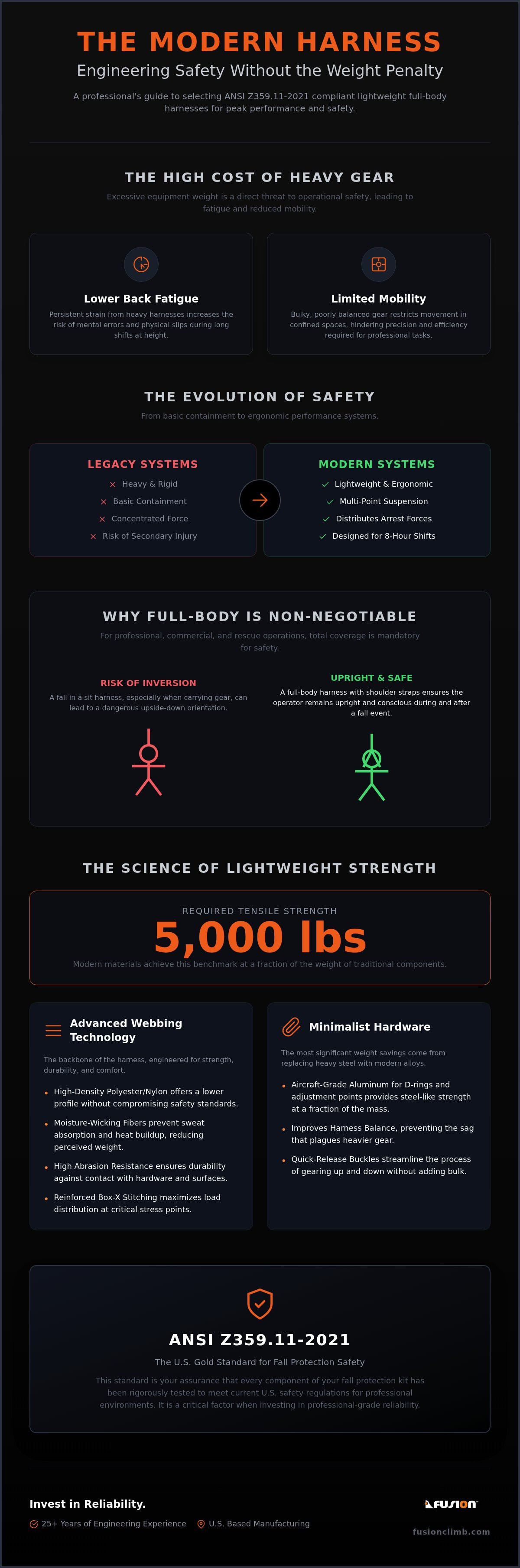
The safety equipment industry has moved past the era of heavy, rigid industrial belts. These legacy systems often prioritized basic containment over user physiology, frequently leading to secondary injuries during a fall. Today, The Evolution of Lightweight Full Body Climbing Harnesses has resulted in specialized systems designed to distribute weight across the shoulders, chest, and legs. This shift toward ergonomic, multi-point suspension systems ensures that arrest forces are managed by the strongest parts of the human skeletal structure. For professionals working 8-hour shifts at height, this isn't just about comfort. It's about maintaining focus and precision. You need gear that balances rugged reliability with industrial-grade performance without the unnecessary bulk of the past.
Full-Body vs. Sit Harnesses: The Case for Total Coverage
While recreational climbers often prefer sit harnesses for their simplicity, professional environments demand total coverage. Full-body harnesses are mandatory for most commercial zipline and rescue operations because they provide superior protection against inversion. If a fall occurs while carrying heavy gear or in a tactical scenario, shoulder straps ensure the operator remains upright and conscious. Modern lightweight designs have closed the mobility gap that once made traditional models feel restrictive. You can now move through tight vertical spaces with the same agility as a sport climber while maintaining full industrial compliance. This combination of safety and range of motion is the new standard for commercial operators.
Why Weight is a Critical Safety Metric
Weight is a silent factor in operational security. Excessive gear weight leads to lower back fatigue and muscle strain, which directly increases the risk of mental errors and physical slips. In tactical or rescue environments, speed is life. Every pound saved allows for faster movement and quicker response times. High-strength webbing and lightweight alloys have replaced heavy steel components in many professional designs. The weight-to-strength ratio serves as the primary benchmark for 2026 safety gear. Choosing a lightweight full body harness for climbing ensures that your equipment acts as a silent partner rather than a physical anchor. It allows you to focus on the task at hand, knowing your gear meets the highest standards without dragging you down.
Engineering Efficiency: Materials that Reduce Weight without Sacrificing Strength
Modern engineering has redefined what's possible for a lightweight full body harness for climbing. It isn't just about using less material. It's about using better material. The three core components of any professional harness, webbing, buckles, and D-rings, have undergone a technical revolution. By integrating high-performance fibers and aerospace alloys, manufacturers now offer equipment that feels substantially lighter without compromising the 5,000-pound tensile strength required for industrial fall protection. This precision engineering ensures that every gram of material serves a specific safety purpose.
Advanced Webbing Technology
The backbone of any harness is its webbing. Traditional industrial webbing is often thick and rigid, adding unnecessary bulk that hampers movement. In contrast, modern high-density polyester and nylon alternatives offer a lower profile while exceeding safety standards. These materials don't just hold weight. They manage the user's microclimate. Moisture-wicking fibers are now integrated into the webbing to reduce perceived weight by preventing sweat absorption and heat buildup during strenuous climbs. These lightweight fibers are also rigorously tested for abrasion resistance. This ensures they don't fray when coming into contact with professional climbing carabiners or abrasive vertical surfaces. Reinforced box-X stitching patterns are utilized in critical weight-bearing areas to maximize load distribution without adding the mass of extra hardware.
Minimalist Hardware: Stripping the Bulk
Hardware is where the most significant weight savings occur. The industry has largely transitioned from heavy plated steel to aircraft-grade aluminum for D-rings and adjustment points. This change significantly improves the overall balance of the harness, preventing the sag that often plagues heavier gear. Aluminum D-rings provide the same structural integrity as steel but at a fraction of the mass. Quick-release buckles have also become a standard for efficiency. They allow for rapid donning and emergency egress without the fumbling associated with traditional pass-through buckles. 3D-molded padding provides essential lumbar and shoulder support without adding significant mass to the system. For those ready to upgrade their kit, exploring a range of professional full body harnesses is the first step toward a more efficient and comfortable workday.
Selecting Your Harness: Matching Gear to Your Vertical Discipline
Choosing the right equipment requires a clear understanding of your specific vertical environment. A common concern for commercial operators is whether a lightweight full body harness for climbing can withstand the rigors of daily use. The answer lies in the engineering. While these harnesses reduce bulk, they don't sacrifice the industrial-grade durability needed for high-throughput operations. You aren't just buying a lighter kit; you're investing in a system designed for specific mission profiles. Whether you're managing an aerial adventure park or executing a high-angle rescue, your gear must align with your operational reality.
Commercial Zipline and Ropes Course Standards
In environments like adventure parks, efficiency is just as critical as safety. Operators must manage diverse guest demographics, making easy-to-adjust sizing a non-negotiable feature for high-throughput success. When selecting ropes course safety equipment, prioritize harnesses with reinforced attachment points that resist the constant friction of thousands of carabiner cycles. Back D-rings are essential here. They provide a secure, stable connection point for zipline trolleys while keeping the guest's center of gravity balanced. This specific configuration ensures a smooth ride and simplifies the transition between course elements for both guides and participants.
Professional Rescue and Tactical Operations
Rescue and tactical scenarios introduce complexities that standard commercial courses rarely face. These operations require multi-point attachment configurations to handle litters, complex rope-access maneuvers, and secondary safety lines. For tactical teams, low-visibility color options like Tactical Black or OD Green are functional requirements. They allow operators to maintain a low profile while working at height in sensitive environments. Integrating lanyards and tethers into a full body fall arrest system creates a cohesive safety network. This level of integration is what separates a basic harness from a professional-grade vertical tool. Specialized rescue harnesses often feature additional sternal and side D-rings, allowing for the precise positioning required during litter-carry scenarios or technical rope work.
Selecting the right harness is about more than just checking a safety box. It's about finding a tool that enhances your ability to perform in demanding environments. By matching your harness to your specific vertical discipline, you ensure that your gear works with you, not against you. A lightweight full body harness for climbing provides the mobility you need without compromising the rugged reliability your profession demands.
Safety Standards and Compliance: Understanding ANSI Z359.11
Safety isn't an opinion. It's a rigorous testing protocol. For professionals, the ANSI Z359.11-2021 standard is the non-negotiable benchmark for any lightweight full body harness for climbing. This standard subjects gear to extreme conditions to ensure it performs when your life depends on it. Testing includes static strength checks where components must withstand thousands of pounds of force. It also involves dynamic drop tests using weighted mannequins to simulate real-world falls. Finally, post-fall suspension tests evaluate how the harness supports a worker after a fall is arrested. This ensures that the user remains upright and protected from suspension trauma while awaiting rescue.
Trusting your gear starts with inspection. Every compliant harness features a safety label sewn directly into the webbing, often protected by a durable cover. You must locate and read these labels to verify the manufacture date and compliance status. Beyond labels, professional gear includes fall-arrest indicators. These are typically folded sections of webbing designed to tear open during a high-impact event. If these indicators are deployed, or if the warning threads are visible, the harness must be retired immediately. Regular inspections are the only way to ensure your silent partner remains reliable.
How to Verify Safety Ratings on Lightweight Gear
There is a significant difference between a product that "meets standards" and one that is independently certified. Certification involves third-party testing labs that verify manufacturer claims through unbiased trials. Always look for specific load-bearing documentation provided by the manufacturer. Industrial-grade gear should come with a clear record of its testing history and rated capacities. This transparency is what defines professional-grade equipment. It provides the technical assurance required for high-stakes commercial environments where failure is not an option.
The Critical Role of D-Rings and Connection Points
D-ring placement determines the specific function of your harness. The dorsal D-ring on the back is the primary connection point for fall arrest. Sternal D-rings on the chest are utilized for climbing systems or limited fall arrest scenarios. Side D-rings are strictly for work positioning, allowing you to work hands-free while supported; they are never to be used for fall arrest. It's vital to ensure these connection points are compatible with your other hardware, such as commercial zipline pulleys and trolleys. For gear you can trust in any vertical environment, explore our range of ANSI-rated full body harnesses to ensure your team remains compliant and secure.
Investing in Reliability: Why Fusion Climb Sets the Standard
Safety equipment is more than a purchase; it's a long-term investment in your professional security. Since 1998, Fusion Climb has occupied the space where industrial reliability meets innovative engineering. By maintaining a 25-plus year manufacturing history, we've refined our processes to meet and exceed the most stringent requirements of the modern vertical world. Buying direct from a US-based manufacturer provides a level of quality control that third-party resellers simply cannot match. Every harness that leaves our facility carries the weight of that legacy, ensuring your team has gear they can trust without reservation.
Our design philosophy is rooted in a no-nonsense approach to safety. We don't add features for the sake of marketing fluff. Every strap, buckle, and stitch serves a specific ergonomic or safety purpose. This focus on functional precision is what allows us to produce a lightweight full body harness for climbing that doesn't sacrifice the ruggedness required for daily commercial use. You need gear that acts as a silent partner, performing its duty flawlessly so you can concentrate on the high-stakes tasks at hand.
Professional-Grade Construction for Daily Use
Balancing rugged confidence with lightweight mobility is the core challenge of modern safety design. Fusion Climb addresses this by utilizing high-strength webbing and reinforced belay loops that have been proven in the most demanding real-world applications. Whether you are managing high-speed commercial ziplines or conducting emergency search and rescue operations, our gear is built to endure. This durability ensures that your investment pays dividends through reduced gear retirement rates and increased operator confidence. We build our equipment to be the dependable guardian on your journey, valuing substance over style in every vertical environment.
Completing Your Safety System
A harness is the foundation, but a true safety kit is a unified system. To maintain maximum operational security, you must choose compatible carabiners, lanyards, and pulleys that work in harmony with your primary gear. Using mismatched hardware can lead to premature wear or technical complications during critical maneuvers. While high-quality hardware is essential, it must be paired with professional training to be truly effective. We encourage all operators to view their kit as a complete safety network. Once you have the right training in place, explore our full range of professional ANSI-rated harnesses at Fusion Climb to complete your professional setup with gear that sets the industry standard for 2026.
Elevate Your Vertical Performance with Precision Engineering
Selecting a lightweight full body harness for climbing is a decision that impacts your daily efficiency and your long-term physical health. By prioritizing advanced materials like aircraft-grade aluminum and high-density webbing, you reduce the lower back fatigue that often leads to operational errors. Safety remains the paramount concern. Ensuring your gear meets the rigorous ANSI Z359.11-2021 standard is essential for any professional environment. Whether you are managing a high-throughput zipline course or performing technical rescue maneuvers, your equipment should act as a silent partner that supports every move without adding unnecessary bulk.
Fusion Climb has been a leader in US-based manufacturing since 1998. Our products are trusted by professional zipline and rescue teams nationally because we don't compromise on rugged reliability. We invite you to experience the difference that 25 years of engineering expertise makes in your kit. Secure your future at height with gear designed to work as hard as you do. Take the next step in your professional progression today.
Shop ANSI-Rated Lightweight Full Body Harnesses
Frequently Asked Questions
How often should I inspect my lightweight full-body harness for wear?
You must perform a visual and tactile inspection before every use to identify immediate safety risks. A formal, documented inspection by a competent person is required at least once every 12 months, though high-frequency commercial environments often require quarterly reviews. Check for frayed webbing, pulled stitches, and hardware corrosion. Regular oversight ensures your gear remains a dependable partner during vertical operations and prevents minor wear from becoming a catastrophic failure.
Is there a weight limit for professional climbing harnesses?
Most professional harnesses are rated for a total user weight between 130 and 310 pounds, including clothing and tools. This specific range is established by ANSI Z359.11 standards to ensure the gear performs correctly during a fall arrest event. Exceeding these limits can increase the impact forces on both the user and the anchor system. Always verify the specific capacity on the manufacturer’s label before beginning any mission to ensure total compliance.
Can I use a lightweight full-body harness for both rock climbing and industrial work?
It isn't recommended to use the same gear for both disciplines because they are governed by different safety standards. A lightweight full body harness for climbing designed for industrial work meets ANSI Z359.11, which prioritizes fall arrest and upright suspension. Recreational rock climbing gear typically follows UIAA or EN standards, focusing on different physics and comfort profiles. Using industrial gear for sport climbing often results in unnecessary bulk and restricted movement.
What is the difference between ANSI Z359.11 and OSHA requirements for harnesses?
OSHA provides the legal regulatory framework that mandates fall protection in the workplace, while ANSI Z359.11 establishes the technical testing and manufacturing standards. OSHA often incorporates ANSI standards by reference to define what constitutes safe equipment. While OSHA is the law you must follow, ANSI is the voluntary consensus standard that ensures your hardware has survived rigorous static and dynamic testing. Choosing ANSI-compliant gear is the best way to meet your legal obligations.
How do I clean and maintain high-strength webbing to ensure longevity?
Clean your webbing using only mild soap and cool water to remove dirt, salt, or grit that can cause internal fiber abrasion. Avoid harsh chemical detergents or high-heat drying cycles, as these can degrade synthetic fibers and weaken tensile strength. Always air dry the harness away from direct sunlight or heat sources. Proper maintenance prevents the buildup of contaminants that can compromise the integrity of your safety system over time.
What are the signs that a harness should be retired immediately?
Retire any harness immediately if it has arrested a fall or if the integrated fall-arrest indicators are deployed. Other critical red flags include significant webbing cuts, heat damage, chemical staining, or heavily corroded hardware. If the manufacturer's labels are missing or illegible, the gear is no longer compliant and must be removed from service. Don't gamble with equipment that shows signs of structural compromise; when in doubt, cut it up and replace it.
Can I customize my harness with additional gear loops or pads?
You should never modify a harness or add unauthorized components, as this can void the ANSI certification and compromise safety. Field modifications like sewing on extra loops or adding non-approved padding can interfere with load-bearing webbing or hardware function. If you require additional storage or comfort, choose a model that includes those features from the factory. Fusion Climb designs every element for a specific purpose to ensure the system works in harmony.
How do I ensure a proper fit with a full-body harness for different body types?
Achieve a secure fit by adjusting the leg loops first, followed by the torso straps and chest buckle. The harness should be snug enough that you can only fit a flat hand between the webbing and your body. Ensure the dorsal D-ring is positioned between your shoulder blades for optimal fall arrest performance. A properly adjusted lightweight full body harness for climbing prevents the user from slipping out during an inversion or suffering excessive suspension trauma.