



Heavy Duty Zipline Trolley: The Professional Operator’s Guide to Commercial Hardware
A standard pulley is a simple tool, but a heavy duty zipline trolley is an industrial asset designed to survive the relentless friction of a high-volume commercial course. If you've ever watched a bearing seize or felt the heat radiating from a housing after a long descent, you know that recreational gear cannot handle the professional workload. We understand that your operation demands hardware that resists rapid wear while maintaining absolute safety for every rider on the line.
You need equipment that performs consistently from the first tour of the morning to the last run of the season. This guide outlines the engineering standards, performance metrics, and safety protocols required for professional-grade hardware in commercial environments. You'll learn how to maximize equipment lifespan and ensure rider safety by adhering to certified standards like ASTM F2959-23a. We will explore the technical distinctions that separate industrial dual-track designs from basic pulleys, providing you with a clear roadmap to reduce maintenance downtime and eliminate compliance anxiety through superior hardware selection.
Key Takeaways
- Learn how to distinguish a true heavy duty zipline trolley from recreational gear by evaluating Minimum Breaking Strength and industrial frame rigidity.
- Understand the engineering behind high-performance hardware, focusing on how dual ball bearings and stainless steel sheaves manage friction during long descents.
- Identify the performance metrics that allow commercial units to endure 10,000 plus cycles while standard pulleys fail under the stress of high-volume use.
- Establish a rigorous safety protocol using daily and annual inspection schedules to spot visual indicators of hardware fatigue before they compromise rider security.
- Discover how to integrate your trolleys into a complete safety system using high-strength carabiners and lanyards designed for professional rigging environments.
What Defines a Heavy Duty Zipline Trolley?
A heavy duty zipline trolley is not just a pulley with a handle. It is a precision-engineered mechanical device built to survive the high-heat, high-friction environment of a commercial canopy tour or high-speed zip course. While a recreational pulley might serve for occasional backyard use, an industrial trolley manages the extreme load distribution required on long-span steel cables. Understanding What is a Zipline? requires looking past the excitement to the core physics of the hardware. These units are designed to stay cool and stable under constant use, ensuring the cable and the hardware remain intact through thousands of cycles.
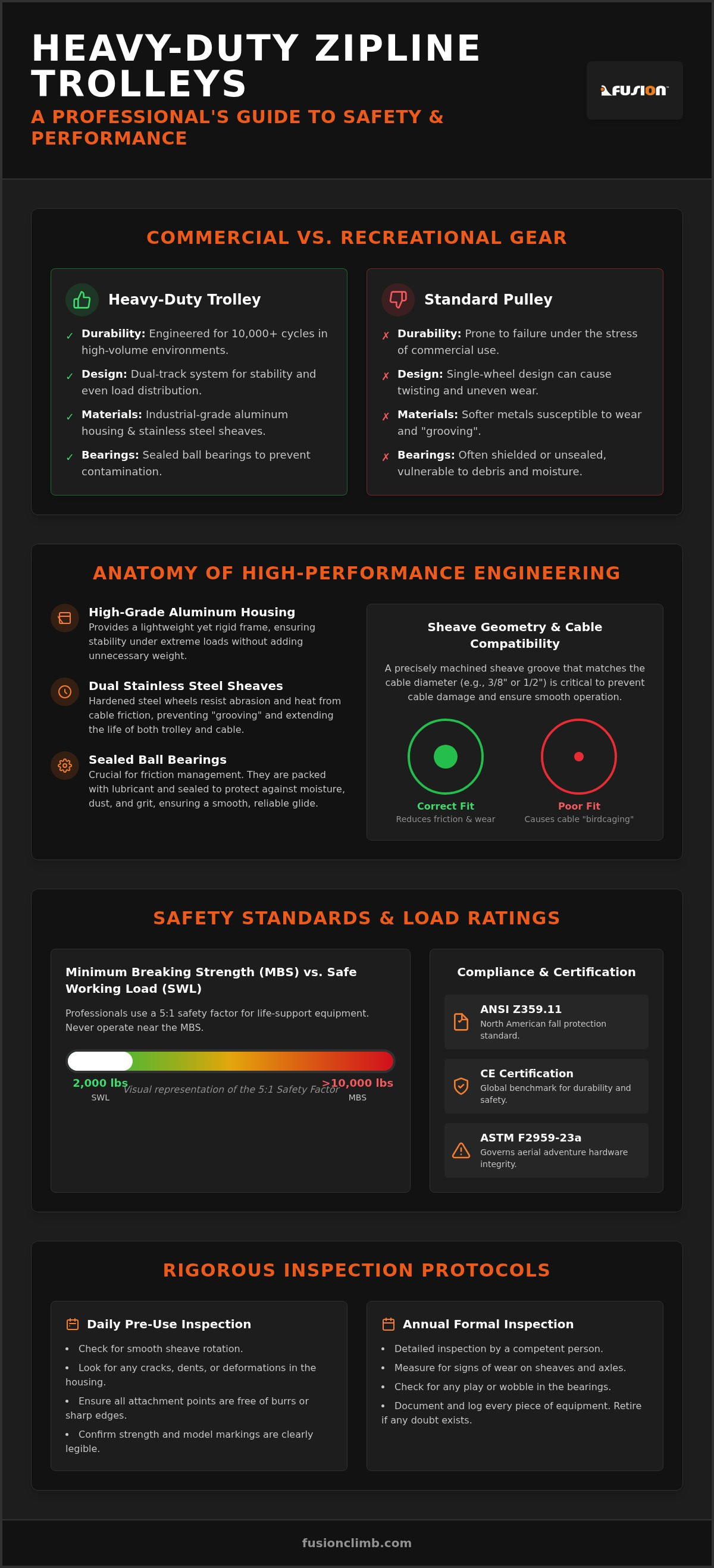
Professional operators prioritize dual-track systems over single-wheel pulleys for several reasons. Dual-track designs use two sheaves in tandem to distribute the rider's weight across a larger surface area of the cable. This configuration reduces "chatter" and premature wear on the wire rope. It also prevents the housing from tilting or twisting during the descent, which provides a smoother, more predictable ride for the participant. When you're running a high-volume operation, this stability translates directly into lower maintenance costs and a longer equipment lifespan.
Minimum Breaking Strength (MBS) and Safe Working Loads
Minimum Breaking Strength is the ultimate failure point of the hardware, and for a heavy duty zipline trolley, this rating typically exceeds 10,000 lbs. However, safety-conscious professionals don't operate at the limit. They follow the 5:1 safety factor rule for life-support equipment. If a trolley has an MBS of 10,000 lbs, its Safe Working Load (SWL) is 2,000 lbs. You should always locate the strength markings laser-etched directly onto the trolley housing before putting gear into service. If the markings are illegible or missing, the hardware must be retired immediately.
ANSI and CE Certification Standards
Compliance is a non-negotiable requirement for commercial operators. ANSI Z359.11 standards ensure that hardware meets rigorous North American safety requirements for fall protection and aerial work. Similarly, CE certification serves as a global benchmark, signaling that the gear has passed independent laboratory testing for durability and strength. Utilizing certified gear does more than protect the rider; it significantly reduces operator liability and insurance risks. In an industry where safety is the primary product, using hardware that meets these recognized standards is the only way to operate with total confidence.
The Engineering of High-Performance Commercial Trolleys
A heavy duty zipline trolley relies on sophisticated material science to handle the stresses of a commercial course. Engineers typically specify high-grade aluminum alloy for the housing to keep the unit lightweight and maneuverable. In contrast, the sheaves are forged from stainless steel to withstand the constant abrasion of the main line. This combination is essential for meeting ASTM F2959 safety standards, which govern the mechanical integrity of aerial adventure hardware. By using dissimilar metals, manufacturers ensure the trolley remains rigid under load while the contact surfaces resist the "grooving" effect common in lesser gear.
Friction management is the difference between a smooth ride and a safety hazard for any heavy duty zipline trolley. As the device travels down the line, it generates heat that can degrade both the hardware and the cable. High-performance designs utilize larger sheave diameters to reduce rolling resistance and improve heat dissipation. By increasing the sheave size, the trolley rotates fewer times per foot of travel, which significantly extends the life of the internal bearings and prevents thermal fatigue on the cable.
Sealed vs. Shielded Bearings
Outdoor environments are brutal on moving parts. While shielded bearings offer basic protection, sealed bearings are the professional standard for commercial zip lines. These components are packed with high-quality lubricant and closed off to the elements. This prevents moisture, salt, and fine grit from entering the bearing race. It's a maintenance-free solution that ensures your gear performs predictably in every weather condition, from humid coastal tours to dusty mountain descents.
Sheave Geometry and Cable Compatibility
A sheave is the grooved wheel within the trolley that acts as the primary interface for load-bearing cable interaction. Precision machining ensures the sheave groove matches the cable diameter, which is usually 3/8" or 1/2". A poor fit causes the cable to "birdcage" or fray, leading to expensive cable replacements and potential downtime. When you pair these trolleys with professional climbing carabiners, you create a stable, industrial-grade assembly that resists the vibration found in high-speed descents. This alignment is critical for maintaining the 5:1 safety factor required for commercial life-support systems.
Commercial vs. Recreational: Why Standard Pulleys Fail
The gap between recreational gear and professional hardware is measured in cycles. While a backyard pulley is rated for occasional use, a heavy duty zipline trolley must withstand 10,000 or more runs without a loss in structural integrity. Professional operators understand that equipment failure isn't just a maintenance issue; it's a safety breach. Adhering to ACCT industry standards requires hardware that can handle these high-volume environments without the risk of axle fatigue or bearing seizure. You can't afford to guess when it comes to the longevity of your primary movement hardware.
Cost-per-run analysis reveals the true price of under-specifying your gear. A recreational pulley might have a lower initial price point, but its limited lifespan means you'll replace it several times before a commercial unit shows significant wear. When you factor in the labor costs of frequent inspections and the potential for course downtime, the industrial-grade option is the only fiscally responsible choice. Professional hardware is an investment in reliability and long-term operational efficiency. It's about protecting your bottom line as much as your participants.
Structural Integrity Under Load
Thin-walled aluminum housings in recreational pulleys are prone to flex under the weight of an adult rider. This deformation leads to sheave misalignment, causing the wheels to "pinch" the cable. A heavy duty zipline trolley utilizes reinforced side plates to maintain a rigid frame. This rigidity ensures the sheaves stay perfectly aligned, which protects the internal bearings and prevents the unit from dragging against the cable during high-speed descents. Reinforced frames are the silent guardians of your cable's lifespan.
Attachment Point Security
Reliability depends on the connection. Commercial gear features oversized carabiner holes that allow for easy rigging and the inclusion of secondary safety backups. This design is essential when using commercial zipline pulleys as part of a redundant system. High-quality trolleys are engineered to prevent cross-loading, ensuring the carabiner stays seated in its strongest orientation. By prioritizing these integrated attachment points, you eliminate the rigging errors that often plague lighter, non-commercial hardware.
Safety Protocols: Inspecting and Maintaining Your Trolleys
Professional operation requires more than just high-end gear. It demands a culture of meticulous maintenance. Every heavy duty zipline trolley in your fleet must be part of a serialized gear log. This tracking system allows you to record the exact cycle count, date of purchase, and inspection history for every individual unit. Without serialization, you're guessing at the service life of your hardware, which is a risk no commercial operator should take. Reliable safety starts with accountability and documented proof of equipment integrity.
Establishing a rhythmic inspection schedule is the backbone of risk management. Conduct visual "pre-flight" checks every morning before the first participant clips in. Perform a more intensive monthly audit where you remove the hardware from the line for a detailed bench inspection. Finally, schedule annual third-party reviews to ensure your equipment and logs remain compliant with current safety standards. This tiered approach catches minor wear before it evolves into a mechanical failure.
Step-by-Step Inspection Checklist
Start with the sheaves. Spin them by hand; they should rotate silently and stop gradually without any grinding or "clicking" sounds. Any lateral wobble in the sheave indicates bearing failure, which mandates immediate removal from service. Inspect the housing for hairline cracks, especially around the attachment points and axle seats. In high-volume environments, professionals use dye penetrant kits to reveal microscopic fatigue that isn't visible to the naked eye. Finally, use calipers to measure the depth of the sheave groove. If the metal has worn down beyond the manufacturer's specified tolerance, the trolley's ability to manage heat and cable friction is compromised.
When to Retire Your Hardware
Metal doesn't last forever. Most manufacturers recommend retirement if you observe a 10% reduction in material thickness due to abrasion or wear. You must also retire any heavy duty zipline trolley that has been subjected to a major shock load or dropped from a significant height onto a hard surface. Even if there's no visible damage, internal fractures can compromise the unit's MBS. Retirement criteria for a commercial trolley are the specific, measurable thresholds of physical wear or mechanical degradation that mandate the permanent hardware removal from life-support service.
Cleaning and storage are often overlooked but critical for longevity. Use only mild soap and warm water to remove salt, grit, and old lubricant. Avoid pressurized air, as it can force debris into the sealed bearings. Dry the hardware thoroughly and store it in a cool, dry environment away from corrosive chemicals or direct sunlight. To ensure your entire rigging setup meets these same industrial standards, consider auditing your commercial zipline pulleys and connectors to maintain a unified safety system.
Optimizing Your Setup with Professional Rigging Hardware
Rigging a commercial zipline is an exercise in total system integrity. Your heavy duty zipline trolley may have a massive breaking strength, but that rating is irrelevant if your connectors fail. You must ensure every component in the safety chain meets or exceeds the trolley’s MBS to prevent a catastrophic weak point. This requires matching your hardware with professional climbing carabiners that can withstand the vibrations of high-speed travel without gate fatigue. When these elements work in unison, they create a redundant system that protects the rider and the operator's liability.
Consistency is key for high-volume courses. Pairing your trolleys with the correct zipline lanyards and tethers ensures that the distance between the rider and the cable remains within the designed safety envelope. If the lanyard is too long, the rider’s center of gravity shifts, which can lead to unstable swinging or "pendulum" effects at the terminal brake. A professional setup uses dual lanyards to provide a secondary safety connection, ensuring that even a primary point failure does not result in a fall.
Harness Integration and Rider Positioning
The type of harness you choose dictates the rigging requirements for your heavy duty zipline trolley. Standard upright harnesses are common, but Superman-style harnesses for prone flight are becoming the industry benchmark for high-speed "flight" experiences. These specialized harnesses require specific trolley attachments to maintain a horizontal flight path. Because prone flight puts different stresses on the trolley's axles, you must use hardware engineered for the specific load distribution of a Superman-style prone harness. This setup maximizes the thrill for the participant while maintaining the sobering sense of security that professional gear provides.
The Fusion Climb Advantage
Professional operators choose gear based on a track record of industrial reliability. Fusion Climb equipment is designed for the most demanding aerial environments, where failure is never an option. We believe in the concept of "Dependable Guardianship," acting as a silent partner in your user's journey. Our hardware isn't just about meeting a standard; it's about exceeding it through meticulous manufacturing and traditional values of strength. When you invest in industrial-grade US manufacturing, you're buying more than a tool. You're securing the future of your operation with hardware that values substance over style and safety above all else.
Secure Your Course with Industrial-Grade Precision
Integrating a heavy duty zipline trolley into your operation is more than a hardware upgrade; it is a commitment to the highest safety standards in the industry. By prioritizing industrial-strength MBS ratings and dual-track engineering, you eliminate the mechanical failures that often plague recreational gear. We've explored how consistent maintenance and serialized tracking turn these mechanical assets into long-term investments that protect both your riders and your bottom line.
True reliability extends through every carabiner and lanyard in your safety chain. Whether you're running standard upright tours or specialized prone flight integrations, your hardware must meet the rigorous demands of high-volume use. Our ANSI & CE Compliant Hardware is built to serve as a dependable guardian for every participant on your line. Don't compromise on the integrity of your rigging.
Explore Fusion Climb’s Professional Zipline Hardware to elevate your safety standards today. Build your course on a foundation of strength and meticulous manufacturing.
Frequently Asked Questions
What is the minimum breaking strength (MBS) for a heavy duty zipline trolley?
The Minimum Breaking Strength for a professional-grade heavy duty zipline trolley is typically 10,000 lbs, which is approximately 44 kN, or higher. This rating ensures the hardware can handle the extreme dynamic forces of a commercial course while maintaining the required 5:1 safety factor. Always check the laser-etched markings on the housing to verify the specific rating for your unit. Operating within the Safe Working Load is critical for long-term structural integrity.
Can I use a climbing pulley for a commercial zipline course?
No, a standard climbing pulley should not be used for high-volume commercial ziplines. While climbing pulleys are excellent for vertical hauling or rescue, they aren't built for the sustained heat and friction generated on a steel cable. A true industrial trolley features reinforced frames and specialized sheaves that prevent the pinching effect. Using recreational gear in a commercial environment increases liability and equipment failure risks significantly.
How often should I replace the bearings in my zipline trolley?
Bearings in a commercial trolley are generally not replaceable; instead, the entire unit is retired when the bearings fail. Signs of failure include grinding noises, lateral sheave wobble, or a clicking sensation during rotation. Most high-performance trolleys are rated for approximately 10,000 cycles, but environmental factors like salt air or fine dust can shorten this lifespan. Regular bench inspections are the only way to determine if your hardware is retirement-ready.
What is the difference between stainless steel and aluminum sheaves?
Stainless steel sheaves are the industry standard for commercial courses because they resist the abrasive wear caused by steel cables. Aluminum sheaves are lighter but wear down much faster, leading to grooving that can damage your main line. A heavy duty zipline trolley typically uses an aluminum housing for weight reduction paired with stainless steel sheaves for durability. This combination ensures the hardware remains manageable for staff while providing a long, reliable service life.
Do heavy duty trolleys require special cable types?
Most commercial trolleys are designed for use with 7x19 or 6x26 galvanized or stainless steel aircraft cable. The critical factor is matching the sheave groove diameter to your cable size, which is commonly 3/8 inch or 1/2 inch. Using a trolley on an incompatible cable diameter causes premature fraying and birdcaging of the wire rope. Always consult the manufacturer's specifications to ensure your hardware geometry matches your specific course rigging requirements.
How do I know if my zipline trolley is ANSI compliant?
You can verify ANSI compliance by looking for the specific standard number, such as ANSI Z359.11, stamped or etched directly onto the trolley housing. Manufacturers must undergo rigorous independent testing to claim this certification. If the markings are missing or illegible, you should contact the manufacturer for a Certificate of Conformance. Using certified gear is a non-negotiable requirement for meeting industry safety standards and securing commercial insurance coverage for your operation.
Can a heavy duty trolley handle speeds over 60 mph?
Yes, a high-performance heavy duty zipline trolley is engineered to handle speeds exceeding 60 mph, provided it features large-diameter sheaves and high-speed ball bearings. Larger sheaves rotate fewer times per foot of travel, which reduces heat buildup and rolling resistance. However, at these speeds, thermal management becomes a major factor. You must ensure your braking system and secondary safety backups are also rated for the kinetic energy generated at high velocities.
What maintenance is required for sealed ball bearing trolleys?
Sealed ball bearing trolleys are designed to be maintenance-free regarding internal lubrication, but they still require external care. Clean the exterior with mild soap and warm water to remove salt spray or grit that can degrade the housing. Never use high-pressure air or solvents, as these can force contaminants past the seals and into the bearing race. Store the units in a dry, temperature-controlled environment to prevent oxidation and maintain gear longevity.