



Full Body & Rope Access Harness Buying Guide 2026
Did you know that fall protection remained the most frequently cited OSHA violation for the 15th consecutive year in 2025? With 5,914 citations issued and serious violation fines exceeding $16,550, selecting the right full body & rope access harness is a critical decision for any professional. You likely already know that your gear is more than just a tool; it's a silent partner that ensures you return home safely after every shift. However, the frustration of mid-air discomfort and the confusion over shifting ANSI vs. OSHA certifications can make procurement feel like a gamble.
We're here to eliminate that uncertainty. This guide provides the technical mastery you need to navigate safety standards and ergonomic engineering for rescue, industrial, and aerial adventure environments. You'll learn how to identify high-performance features like MIL-SPEC webbing and 3D memory foam padding that reduce worker fatigue while ensuring total regulatory compliance. We'll examine the specific hardware requirements for 2026, from impact indicators to load-bearing attachment points, so you can invest in gear that delivers long-term durability in the most rugged vertical environments.
Key Takeaways
- Understand how professional full body harnesses distribute impact forces across the shoulders and thighs to effectively mitigate the risks of suspension trauma.
- Master the critical safety standards required for a full body & rope access harness, focusing on ANSI Z359.11-2021 compliance and the superior tensile strength of MIL-SPEC webbing.
- Learn to distinguish between specialized hardware configurations for rescue, industrial suspension, and aerial adventure environments to ensure your gear matches your specific operational needs.
- Discover how ergonomic features like 3D memory foam padding and Presto quick-release buckles reduce worker fatigue while maintaining a secure, repeatable fit.
- Evaluate the latest equipment solutions to find the ideal balance between rigorous industrial certification and the long-term durability required for high-stakes vertical work.
What Defines a Professional Full Body & Rope Access Harness?
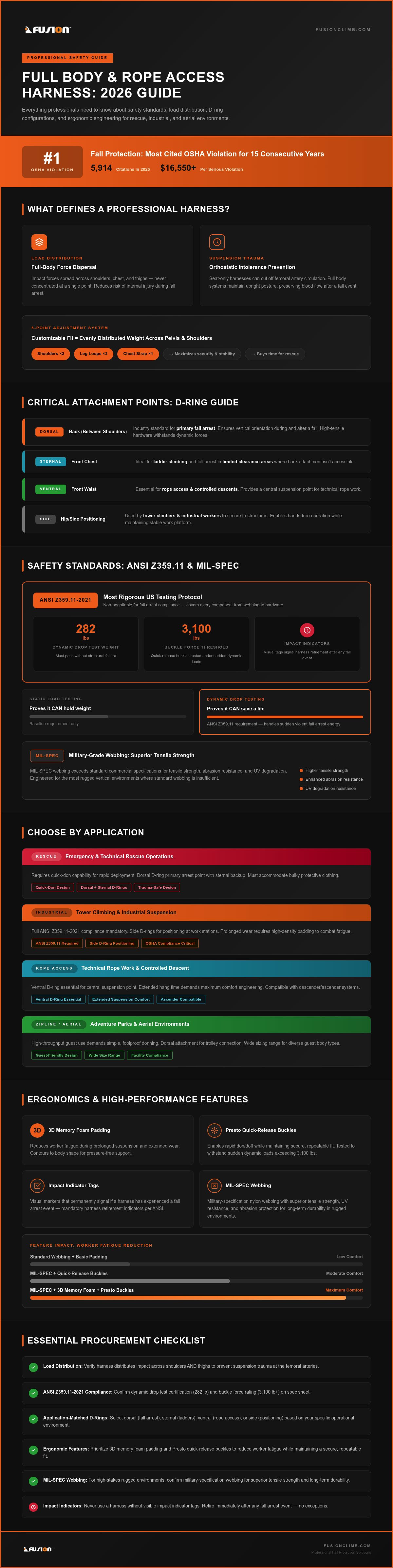
Professional grade gear is more than a collection of straps and buckles. It's a precisely engineered system designed to protect life in high-stakes vertical environments. A high-quality full body & rope access harness provides superior load distribution across the shoulders, chest, and thighs. This ensures that in the event of a fall, the impact forces are not concentrated on a single point of the body. Instead, the energy is dispersed, reducing the risk of internal injury and providing the structural support necessary for prolonged suspension. This level of protection is essential for anyone working in rescue, industrial, or aerial adventure settings.
Load Distribution and Preventative Safety
Suspension trauma, or orthostatic intolerance, occurs when a worker remains upright and immobile for an extended period after a fall arrest event. Seat-only harnesses can cut off circulation at the femoral arteries, leading to a rapid decline in consciousness. Full body systems mitigate this risk by utilizing integrated leg loops and shoulder straps to keep the user in an upright position. The primary purpose of a 5-point adjustment system is to provide a customizable fit that ensures the user's weight is distributed evenly across the pelvic and shoulder regions to maximize security and stability. By maintaining this posture, the harness allows for better blood flow and buys critical time for rescue teams to execute a retrieval plan.
Critical Attachment Points: D-Rings Explained
The functionality of a professional Safety harness is defined by its attachment points. Each D-ring serves a specific tactical or industrial role. Dorsal D-rings, located on the back between the shoulder blades, are the industry standard for primary fall arrest connections. They ensure the user remains in a vertical orientation during and after a fall event. Professional grade requires high-tensile hardware that can withstand these dynamic forces without failure.
For technicians working in more complex environments, sternal and ventral points are indispensable. Sternal D-rings on the chest are ideal for ladder climbing and fall arrest in limited clearance areas. Ventral D-rings, located at the waist, are essential for rope access and controlled descents, as they provide a central point for suspension. Finally, side D-rings act as positioning tools. These allow tower climbers and industrial workers to secure themselves to a structure, facilitating hands-free operations while maintaining a stable work platform. This blend of ergonomic support and specialized hardware ensures the user can focus on the task at hand without compromising their security.
The Standards of Strength: ANSI Z359.11 and MIL-SPEC Webbing
Safety is not a suggestion; it's a measurable standard. When selecting a full body & rope access harness, the certifications on the label tell the story of its survival capability. The ANSI Z359.11-2021 standard represents the most rigorous testing protocol for full-body harnesses in the United States. It guarantees that every component, from the webbing to the hardware, can withstand the brutal forces of a real-world fall. For park operators and industrial managers, adhering to these requirements isn't just about safety. It's about legal survival. Compliance with ropes course safety equipment standards ensures that your facility remains operational and your liability is managed.
Why ANSI Z359.11 is Non-Negotiable
Static load testing proves a harness can hold weight, but dynamic drop testing proves it can save a life. Under the 2021 standard, certified harnesses must pass a dynamic drop test using a 282-pound weight without structural failure. This ensures the gear handles the sudden, violent energy of a fall arrest. This includes rigorously tested hardware, such as quick-release buckles, that must ensure connectors don't fail under sudden dynamic loads exceeding 3,100 pounds of force. Additionally, ANSI requires clear impact indicator tags. These visual markers provide a definitive sign if a harness has experienced a fall, signaling immediate retirement. Failure to provide equipment that meets OSHA personal fall protection systems requirements can lead to fines exceeding $16,550 per violation. Don't gamble with uncertified equipment when the stakes are this high.
The Integrity of MIL-SPEC Webbing
Industrial environments are unforgiving. Standard nylon webbing often fails when exposed to constant UV radiation, abrasive concrete, or harsh chemicals. MIL-SPEC webbing solves this by offering enhanced tensile strength and superior resistance to environmental degradation. High-denier polyester and nylon blends maintain their integrity even in extreme weather conditions or when exposed to oil and industrial solvents. Fusion Climb utilizes reinforced stitching at all critical load-bearing points to ensure the webbing never becomes the weak link in your safety chain. This commitment to materials is what separates professional-grade gear from recreational alternatives. When you're ready to upgrade your team's protection, explore our full body harness collection for gear that exceeds the standard.
Choosing by Application: Rescue, Rope Access, and Zipline
Selecting the correct full body & rope access harness depends entirely on the vertical environment you operate in. While every professional unit must adhere to OSHA Fall Protection Standards, the mechanical requirements for a technical rescue differ vastly from those of a high-volume adventure park. Professional gear isn't universal. It's application-specific engineering. Choosing the wrong configuration leads to equipment failure, worker fatigue, or compromised safety during critical operations. Industrial rope access, for instance, demands maximum comfort for long suspension times. This requires deep, breathable padding and ergonomic leg loops that prevent the circulation issues discussed in previous sections.
Tactical and Professional Rescue Requirements
In emergency scenarios, speed is safety. Rescue harnesses require rapid donning capabilities, often facilitated by Presto quick-release buckles that allow for immediate deployment without sacrificing a secure fit. Tactical units frequently demand blacked-out hardware and webbing to maintain low visibility during specialized operations. These models must also include multiple hardware attachment points to facilitate the use of litters and complex technical rigging systems. For complex extraction missions, these harnesses must integrate seamlessly with specialized zipline lanyards and tethers to ensure secure, redundant connections during high-angle transitions. Every second saved during donning translates to a more effective rescue response.
Commercial Zipline and Aerial Adventure Parks
Park operators face a unique set of challenges regarding guest safety and operational efficiency. Their gear must accommodate high-weight capacities and a wide range of guest body types. Throughput is the priority here. Harnesses designed for these environments focus on ease of use for staff and participants alike, allowing for quick adjustments between users. The Superman style harness represents a specialized solution for prone flight experiences. It offers a unique suspension profile that standard industrial models cannot replicate, providing the thrill of flight with the sobriety of professional-grade security.
Durability is paramount for high-frequency use in rugged outdoor settings. Components must withstand hundreds of cycles per week without losing structural integrity or showing excessive wear on the MIL-SPEC webbing. Operators must also ensure their professional climbing carabiners are fully compatible with the harness's D-ring sizes. Hardware mismatch can lead to dangerous cross-loading or gate interference. Always verify that your connectors and attachment points are engineered to work in tandem to maintain a fail-safe system.
Ergonomics and Fitting: Sizing for Performance and Comfort
A full body & rope access harness is only as effective as its fit. Even the highest-rated hardware cannot compensate for a loose strap or a misaligned D-ring. Proper adjustment is as critical as the hardware itself. An ill-fitting system can shift during a fall, causing secondary injuries or compromising the arrest force. Presto quick-release buckles are a standard for professional reliability. They allow for a consistent fit every time you don the gear. This eliminates the need to re-adjust every strap at the start of a shift. Consistency saves time and ensures that the safety settings established during the initial fitting remain intact.
The Technology of Padding: EVA vs. 3D Memory Foam
Comfort is a safety feature. When a worker is distracted by pressure points, their focus on the task wavers. High-performance full body & rope access harness models utilize 3D memory foam and EVA padding to distribute weight across the lower back and thighs. 3D contoured padding provides essential structural support for tower-work harnesses where long hours of suspension are the norm. EVA foam offers a firmer, closed-cell structure that resists compression over time. Moisture-wicking liners are another critical addition. They prevent skin irritation during summer operations by managing sweat and heat buildup. Wide waist belts further enhance weight distribution, reducing the strain on the lumbar region. For operators in aerial parks, ensure your harness setup aligns with your trolley system by checking our commercial zipline pulleys guide.
Achieving the 'Two-Finger' Fit
Adjusting your harness requires a methodical approach. Start by donning the harness and securing the leg loops. You should be able to slide two fingers between the webbing and your thigh, but no more. Next, adjust the shoulder straps to position the dorsal D-ring between your shoulder blades. Once secured, perform a suspension test in a controlled environment. This allows you to identify 'harness creep' or loose sternal straps before you're at height. The suspension test isn't just about comfort; it's a functional check of the entire system's geometry under load. If the harness tilts significantly or the webbing pinches, the fit is incorrect. Precision in these adjustments is the difference between a secure work day and a preventable accident.
Ready to equip your team with precision-engineered gear? Browse our full body harness collection to find the perfect fit for your vertical environment.
Top Professional Harnesses for 2026: Standout Solutions
The vertical world is not a place for compromise. Finding the right full body & rope access harness means matching the equipment's technical profile to the specific demands of your industry. Our collection includes 37+ models tailored for specific vertical disciplines. This variety ensures that whether you are scaling a telecommunications tower or managing a high-volume adventure park, your gear is a precise fit for the mission. Every piece is manufactured in the USA using MIL-SPEC webbing, providing the reliability required for government and industrial contracts.
Best for Tower Work and Industrial Access
Industrial environments demand gear that supports long-term suspension without compromising mobility. For high-rise construction and tower maintenance, we provide ANSI-certified harnesses that strictly adhere to ANSI Z359.11 and OSHA standards. These models often feature reinforced belay loops and rigid seat attachments to provide a stable work platform. Integrated tool loops allow technicians to carry essential hardware safely, preventing dropped object hazards. By focusing on ergonomic support, these systems help reduce the physical toll of a ten-hour shift at height. Reliability is built into every stitch.
Best for Aerial Adventure and Zipline Operators
Commercial ropes courses require a balance of high-throughput efficiency and absolute guest security. Superman style harnesses are the definitive choice for parks offering prone-position flight experiences. These specialized systems utilize high-durability webbing to withstand the rigors of commercial use. For operators, color-coded webbing options simplify guest fitting and safety checks, ensuring that even in high-volume scenarios, every connection is verified. We also offer youth-specific full body harnesses to ensure that adventure park safety extends to even the smallest participants. This allows park managers to maintain a high level of security across all age groups.
For elite SAR teams and first responders, tactical rescue systems are designed for rapid deployment and high-load capacity. These systems act as the silent partners for professionals who operate in low-visibility or high-stakes environments. No matter the application, the goal remains the same: total compliance and worker safety. Explore the full range of professional gear at the Fusion Climb Collection Page to find your ultimate vertical solution.
Secure Your Future in the Vertical World
Mastering the vertical environment requires more than just courage; it demands gear that matches your professional commitment. You've learned that a full body & rope access harness is a complex safety system, not just a commodity. Choosing equipment that features ANSI Z359.11 certified models and Made in the USA engineering ensures you meet the most rigorous industrial standards. From the precision of MIL-SPEC webbing to the ergonomic relief of 3D memory foam, every technical detail serves to reduce fatigue and maximize security during long hours of suspension.
Whether you're leading an elite SAR team or managing a high-volume aerial park, your equipment is the silent partner in your journey. Trusted by professional rescue and tactical units, our solutions provide the technical assurance you need to focus on the mission. Don't leave your safety to chance with unverified gear. Take the next step in professionalizing your vertical operations today. Browse the Full Collection of Professional Full Body Harnesses and equip yourself with the strength to push your limits safely.
Frequently Asked Questions
What is the difference between a full body harness and a seat harness?
Full body harnesses distribute impact forces across the entire torso, including the shoulders and thighs, while seat harnesses focus only on the waist and legs. In a fall arrest scenario, a full body system keeps the user upright and prevents them from falling out of the equipment. This configuration is essential for mitigating suspension trauma. Seat harnesses are primarily for work positioning or recreational climbing where vertical fall arrest isn't the primary hazard.
How often should I inspect my professional rope access harness?
You must perform a pre-use inspection before every single shift to check for abrasions, burns, or chemical damage. Additionally, OSHA and ANSI standards require a formal, documented inspection by a competent person at least once every six months. If your full body & rope access harness is used in harsh environments like offshore rigs or chemical plants, increase this frequency to quarterly to ensure the MIL-SPEC webbing remains structurally sound.
Are Fusion Climb harnesses ANSI Z359.11 compliant?
Yes, many Fusion Climb models are fully ANSI Z359.11 compliant and meet or exceed current OSHA standards. These professional-grade harnesses are manufactured in the USA specifically for industrial and rescue applications. Each compliant model features the required impact indicators and permanent labeling. This ensures that safety managers can verify equipment integrity during site audits and maintain total regulatory compliance for their teams across the country.
Can I use a climbing harness for industrial fall protection?
No, recreational climbing harnesses are not suitable for industrial fall protection because they lack the required dorsal D-ring and ANSI certification. Industrial standards like ANSI Z359.11 mandate specific dynamic drop tests and load-bearing requirements that recreational gear isn't designed to meet. Using non-compliant equipment in a professional setting creates significant liability risks and fails to provide the necessary protection against suspension trauma during a fall event.
What is the weight capacity of a professional full body harness?
Most professional full-body harnesses are certified for a user weight range of 130 to 310 pounds, including tools and clothing. This capacity aligns with ANSI Z359.11 testing protocols using a 282-pound test weight. Some specialized models may offer higher capacities, but you must always verify the specific manufacturer's label. Exceeding these limits compromises the impact-absorbing capabilities of the entire fall protection system, including lanyards, carabiners, and anchors.
When should I retire my safety harness?
Retire your harness immediately if it has arrested a fall or if the impact indicator is deployed. Even without a fall event, most manufacturers recommend a maximum service life of five to ten years from the date of manufacture. You should also pull any unit from service if you discover frayed webbing, cracked hardware, or illegible labels during inspection. Reliability is binary; if there's any doubt about its integrity, destroy the gear.
How do I clean and maintain MIL-SPEC webbing?
Clean your full body & rope access harness using only mild soap and lukewarm water. Avoid harsh detergents or chemical solvents, as these can degrade the high-denier nylon or polyester fibers. Rinse the webbing thoroughly and hang it to dry in a well-ventilated area away from direct sunlight. Proper maintenance prevents grit from working into the fibers, which preserves the tensile strength and long-term durability of the MIL-SPEC materials in rugged environments.
Do I need a sternal D-ring for my specific job?
You need a sternal D-ring if your work involves ladder climbing systems, rope access, or confined space rescue. This chest-level attachment point keeps the user centered and upright during a descent or ascent. While the dorsal D-ring is the primary connection for fall arrest, the sternal point provides better control for work-positioning tasks. It's an essential feature for tower climbers and rescue professionals who require multiple points of contact for stability.