



Fixed & Restraint Lanyards Buyer's Guide (2026)
Surviving a sudden drop on an energy-absorbing line counts as an OSHA save, but never reaching the unprotected edge is true fall prevention. Rigging an engineered fixed / restraint lanyard eliminates the drop variable entirely by physically restricting your travel before you can contact a hazard. You already know that managing height safety requires zero guesswork. Even so, confusing travel restriction setups with work positioning systems, or hesitating between standard 1-inch and high-density 1.75-inch webbing, creates uncertainty that no crew can afford.
This buyer's guide details how to choose the right fixed restraint and positioning lanyard to eliminate fall hazards and maintain secure work positions across demanding jobsites. We cover the core ANSI/ASSP Z359.3-2019 performance benchmarks, evaluate rugged MIL-SPEC webbing options for high-abrasion environments, and break down certified captive eye hardware terminations that lock securely into your harness D-rings every time.
Key Takeaways
- Distinguish between travel restriction and positioning mechanics to ensure your fixed / restraint lanyard physically eliminates edge access rather than relying on dynamic arrest.
- Evaluate structural webbing builds to determine when standard 1-inch webbing works and where high-density 1.75-inch MIL-SPEC webbing is required for abrasive surfaces.
- Specify captive eye carabiners and double-locking snap hooks that prevent dangerous gate cross-loading and hardware roll-out.
- Select the correct lanyard architecture, comparing single-leg tethers for fixed perimeters against dual-runner configurations for continuous connection.
- Establish rigorous pre-use tactile inspection routines to detect cut fibers, chemical degradation, and compromised stitch patterns before stepping into hazardous zones.
Fixed Restraint vs. Work Positioning Lanyards: Understanding the Core Differences
Working at elevation demands absolute clarity about gear functionality. Too many crews treat non-shock-absorbing lines as interchangeable utility straps. That is a dangerous mistake. A fixed / restraint lanyard functions as a mechanical boundary designed to keep you inside a safe zone. In contrast, work positioning gear supports your weight while you work with both hands. Confusing these two setups compromises worker safety and violates clear jobsite standards.
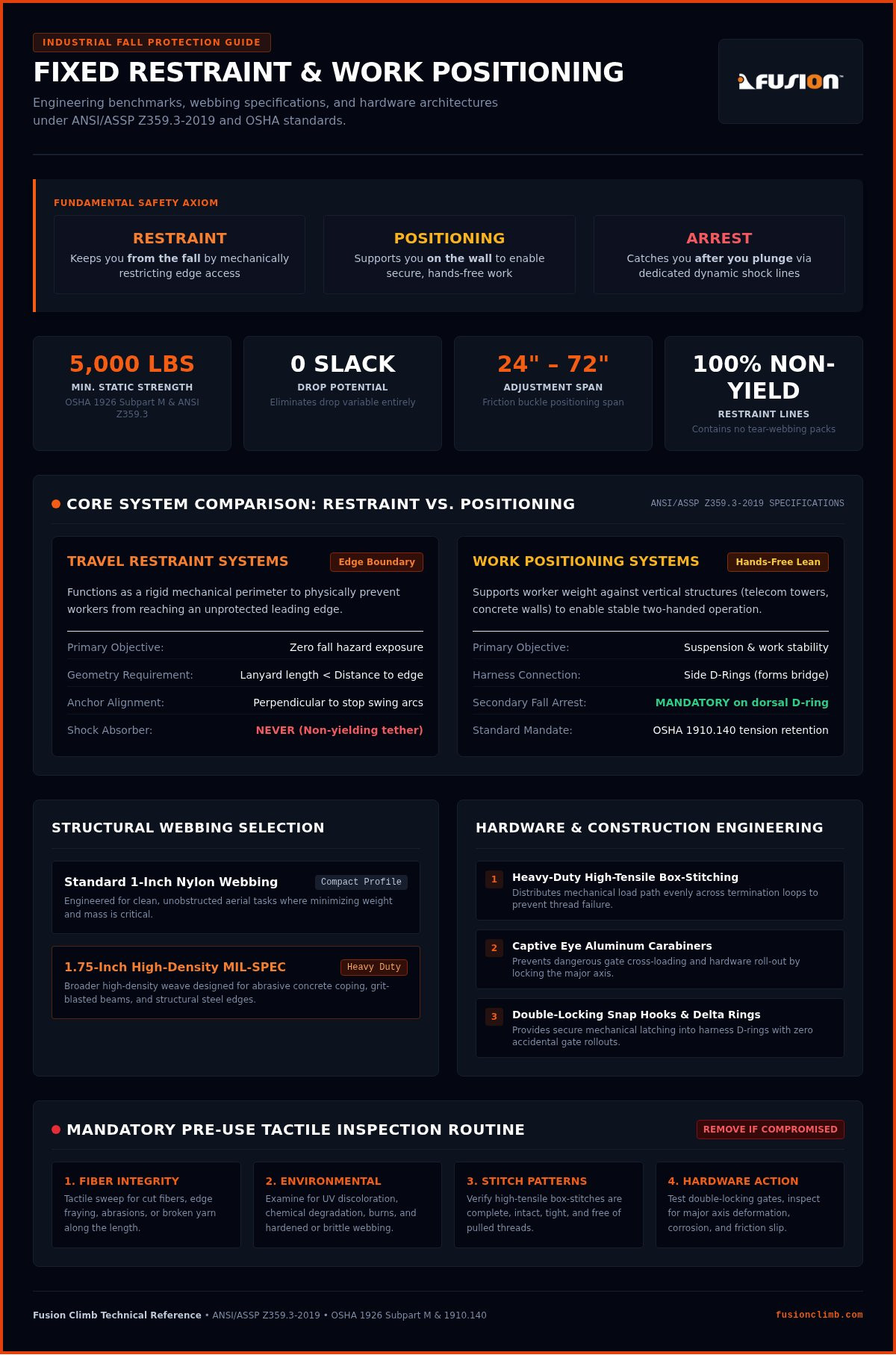
Keep this golden rule front of mind: Restraint keeps you from the fall; positioning supports you on the wall; arrest catches you after you plunge.
Under OSHA 1926 Subpart M and ANSI/ASSP Z359.3-2019 standards, travel restraint assemblies must deliver a minimum static strength of 5,000 pounds. These lines are non-yielding tethers. They do not contain pack absorbers or tear-webbing, which means a fixed / restraint lanyard must never absorb dynamic arrest forces alone. If a worker drops over an edge onto a taut restraint line, the impact shock transfers straight to their body and the anchor, risking catastrophic failure. Dynamic drops belong strictly within certified fall arrest systems.
Travel Restraint Mechanics: Preventing Fall Hazard Exposure
Travel restraint uses simple geometry to eliminate fall hazards completely. The total length of your anchor, tether, and harness attachment must measure less than the distance from the tie-off point to the leading edge. On flat roofs, open telecom decks, or aerial gondolas, anchor points must stay perpendicular to the perimeter to stop dangerous swing arcs. Zero slack equals zero drop potential.
Work Positioning Systems: Achieving Stable Hands-Free Operation
Work positioning equipment holds a rigger firmly against a vertical structure, such as a concrete wall or telecommunications tower. Connect the assembly to your harness side D-rings using certified professional climbing carabiners, creating a secure bridge that supports your lean. Because positioning gear holds suspended body weight without arresting a drop, ANSI rules mandate an independent, secondary fall arrest line attached to your dorsal D-ring at all times.
Key Selection Criteria: Evaluating Webbing, Adjustability, and Hardware Ratings
Precision rigging leaves no room for generic materials. When configuring an industrial fixed / restraint lanyard, every component must withstand constant abrasion, surface friction, and jobsite grit. Choosing made-to-order manufacturing guarantees uncompromised structural fibers that have never sat degrading in unconditioned storage facilities. Heavy-duty, high-tensile box-stitching locks the load path, ensuring mechanical stress distributes evenly across termination loops rather than tearing individual thread lines.
Webbing Width and Material Resilience Under Friction
Webbing dimensions dictate operational lifespan. Standard 1-inch nylon webbing provides a compact profile suited for clean, unobstructed aerial work where saving weight matters. When tackling abrasive concrete coping, grit-blasted beams, or structural steel, upgrade to heavy-duty 1.75-inch MIL-SPEC webbing. This broader weave resists edge friction far longer. Inspect fibers continuously for telltale UV discoloration, stiffening, chemical burns, or edge fraying that demand immediate removal from service.
Fixed-Length vs. Adjustable Positioning Hardware
Application dictates lanyard adjustability. Pre-measured fixed lines eliminate technician tampering on leading edges, enforcing an immovable safety radius. Conversely, friction-buckle mechanisms adjust between 24 and 72 inches, letting workers adapt their positioning across variable steel structures. Keep in mind that OSHA 1910.140 mandates reliable retention under working tension, so adjustment hardware must lock firmly without slipping under real-world loads.
Hardware Terminations: Carabiners, Snap Hooks, and Delta Rings
Connectors take the frontline abuse. Free-floating carabiners often rotate into hazardous cross-load positions during routine movement. Integrating true captive eye aluminum carabiners or double-locking snap hooks prevents rollout and keeps forces aligned along the connector's strongest major axis. Steel triangle D-rings and reinforced girth-hitch soft loops provide rugged options for anchor mating. Always verify that gate strengths meet strict 3,600-pound face test ratings. To equip your team with hardware engineered for these exact field demands, explore our dedicated positioning and fixed restraint lanyards.
Lanyard Architecture: Single-Leg, Dual-Leg, and Trolley Configurations
Lanyard architecture dictates how freely an operator moves across horizontal and vertical structures. Selecting the wrong profile creates dangerous pinch points or forces unauthorized disconnects. Rigging specialists match tether geometry directly to site hazards, structural anchor spacing, and transition frequency. Whether maintaining a linear boundary on an industrial roof or navigating a multi-span aerial canopy, your fixed / restraint lanyard setup must preserve an unbroken connection from start to finish.
Single-Leg Tethers for Linear Work Restraint
Single-leg tethers excel in static, low-complexity environments. Anchored to a central structural point, a single fixed / restraint lanyard establishes an uncompromising travel radius that prevents technicians from reaching leading roof edges or open hatches. These configurations feature minimalist terminations, including girth-hitched loops and reinforced soft eyes, reducing bulk on the harness. Their limitation appears during lateral transit; moving past an intermediate beam requires a second anchor line to avoid unhooking unprotected.
Dual-Leg Lobster Claw Configurations for 100% Tie-Off
Dual-leg systems, often called lobster claw configurations, solve the transition dilemma. Technicians working across telecom towers, complex structural steel, and scaffolding utilize two independent legs attached to a central harness connection point. To maintain continuous safety:
- Connect the first leg securely to a forward anchor point before disconnecting the trailing leg.
- Ensure snap hooks seat flush against structural anchors without resting across corners that induce tri-axial loads.
- Avoid wrapping legs around rough beams unless the lanyard includes an engineered abrasion sleeve.
These practices mirror the 100% tie-off rules outlined in our field analysis of zipline lanyards and tethers, ensuring you stay linked to certified anchors through every step.
Trolley and Dual-Runner Systems for Adventure Operations
Aerial adventure parks and commercial ziplines require specialized non-shock architecture. Trolley-mounted dual-runner tethers incorporate offset primary and secondary loops directly into their webbing build. The primary line connects to the rider's rated harness, while a slightly longer secondary runner connects behind the pulley as a redundant failsafe. This staggered layout prevents trailing lines from binding against high-speed sheaves while satisfying the OSHA 1910.140 Standard for backup security. Commercial operators rely on these robust configurations alongside certified ropes course safety equipment to guarantee redundant rider containment under continuous, high-cycle operations.
Top Positioning and Restraint Lanyards: Matching Models to Demanding Tasks
Selecting the right gear means pairing structural specifications directly with jobsite geometry. A mismatch compromises efficiency and introduces fatal hazards. Whether you need a dedicated fixed / restraint lanyard to keep technicians back from unguarded roof boundaries or an adjustable work positioning tether for hands-free steel erection, choosing purpose-built hardware makes all the difference.
Precision Work Positioning: Adjustable Captive Eye and D-Ring Tethers
Work positioning demands pinpoint tension control. The Zip Line Tether Adjustable Lanyard with True Captive Eye Carabiner locks your connector in its strongest orientation, preventing dangerous gate cross-loading when leaning into a work position. If your setup requires direct mating to tool belts or harness rings, the Zip Line Safety Tether Nylon Adjustable Lanyard with Triangle D-Ring provides a tough, compact anchor interface. Both configurations excel in mast climbing, staging platform maintenance, and telecommunication tower rigging where stability directly impacts work quality.
Continuous Transition Restraint: Heavy-Duty Lobster Claw Y-Legged Lanyards
Navigating structural steel requires uninterrupted tie-off. The Lobster Claw Y-Legged Adjustable Lanyard with Double Zip Snap Hooks delivers continuous protection across variable anchor points. Built with rugged 1.75-inch webbing, this dual-leg setup resists heavy edge wear when dragged over jagged structural members. Each arm adjusts independently, allowing workers to shorten line slack around tight obstructions or lengthen reach when bridging wider spans. This design keeps technicians firmly secured within an established boundary as they advance along vertical ladders and truss systems.
High-Cycle Aerial Operations: Dual-Webbing Trolley and Ripper Sets
Commercial aerial operations run under relentless cycle counts that quickly destroy standard soft goods. The Zipline Trolley Lanyard with Dual 1.75-Inch Webbing Runners solves this through built-in structural redundancy, pairing offset primary and secondary backup loops that capture both the passenger harness and trolley frame independently. For high-speed lines requiring ANSI-rated soft goods, deploy the Super Ripper Zipline Lanyard Full Set with ANSI Webbing. Pair these heavy-duty assemblies directly with high-performance commercial zipline pulleys to maintain complete system integrity across high-speed descents.
Ready to upgrade your jobsite rigging or replace worn gear? Check out our complete line of American-made assemblies and shop positioning and fixed restraint lanyards built for uncompromising safety.
Compliance Protocols, Rigging Inspections, and Deploying Your Restraint System
Deploying safety gear without rigorous verification invites disaster. Even the most durable fixed / restraint lanyard becomes a hazard if compromised by jobsite chemicals, UV rot, or improper gate latching. Real safety rests on strict regulatory compliance, habitual pre-climb inspections, and sourcing gear with known chain-of-custody tracking.
Regulatory Compliance: OSHA Mandates and ANSI Performance Ratings
Federal standards treat travel restriction with zero tolerance. Under OSHA 1926 Subpart M and general industry guidelines, restraint anchors must sustain rigid static loads without failure. ANSI/ASSP Z359.3-2019 sets strict manufacturing criteria, requiring a 5,000-pound static breaking strength and dynamic performance verification. Connectors must meet 3,600-pound gate face ratings to eliminate rollout risks. Employers must maintain formal documentation of competent-person audits while empowering operators to reject non-compliant components immediately.
Step-by-Step Field Inspection and Retirement Criteria
Never rely on a quick visual glance. Execute a hands-on tactile inspection along every inch of the lanyard before tying off:
- Webbing integrity: Bend the strap into an inverted "U" shape to expose hidden fiber cuts, chemical hardening, friction glaze, or internal powdering.
- Stitch patterns: Inspect high-tensile box-stitching under strong light to confirm thread loops are intact, flat, and free of unraveling or elongation.
- Mechanical hardware: Test carabiner and snap hook gates. They must close and deadlock automatically without sticking. Retire any connector with grooving, burrs, gate distortion, or corrosion pitting.
Selecting and Configuring Your Work-at-Height Restraint System
Preventing accidents starts long before workers tie off. Measure the exact working distance from anchor points to the closest edge, ensuring your tether length makes falling physically impossible. Sourcing matters just as much as geometry. Off-the-shelf imports sitting in variable warehouse conditions risk unmonitored degradation. Made-to-order manufacturing ensures that your soft goods arrive freshly produced, fully traceable, and untainted by previous jobsite returns or improper storage.
Whether rigging leading-edge perimeters or setting up hands-free tower work, browse the certified Fusion Climb restraint lanyard collection to verify specifications. You can configure reliable American-built solutions across our complete catalog of positioning and fixed restraint lanyards.
Equip Your Crew for Zero-Hazard Work at Height
Eliminating fall hazards demands gear that leaves zero margin for mechanical error. Specifying the proper fixed / restraint lanyard keeps your workers securely within designated safe zones, replacing fall arrest uncertainty with true physical prevention. High-stakes rigging requires rugged materials. When you pair heavy-duty 1.75-inch MIL-SPEC webbing and high-tensile reinforced stitching with true captive eye carabiners and double-locking snap hooks, you build a tether system that resists edge friction and prevents dangerous gate rollout.
Because critical life-safety soft goods should never sit aging in unconditioned warehouses, made-to-order manufacturing guarantees your equipment arrives factory-fresh, fully traceable, and structurally uncompromised. Step onto the jobsite with total confidence in your gear. Explore positioning and fixed restraint lanyards built for extreme heights and secure your crew with American-built strength today.
Frequently Asked Questions
What is the primary difference between a fixed restraint lanyard and a fall arrest lanyard?
A fixed / restraint lanyard physically prevents a worker from reaching an unprotected edge, whereas a fall arrest lanyard safely stops a worker after a fall has already begun. Restraint lanyards feature static webbing without energy absorbers. In contrast, fall arrest systems deploy shock-absorbing packs to keep arresting forces under 1,800 pounds. Using a restraint line to arrest an active drop can cause catastrophic equipment failure.
Can a work positioning lanyard be used as a standalone fall protection system?
No, a work positioning lanyard cannot serve as a standalone fall protection system. Positioning gear supports your body weight against a vertical structure for hands-free work, but it does not arrest free falls. OSHA and ANSI safety standards mandate pairing any positioning system with an independent, secondary personal fall arrest system connected to your dorsal D-ring whenever you work at elevations with fall exposure.
What webbing width is best for heavy industrial restraint applications?
Heavy-duty 1.75-inch MIL-SPEC webbing is best for rugged industrial environments where edge abrasion, structural steel contact, and concrete friction occur. While 1-inch webbing offers a lightweight profile for clean, open spaces, the 1.75-inch width provides superior surface area, increased cut resistance, and greater durability. This wider build ensures the lanyard withstands repeated rubbing across abrasive jobsite obstacles without compromising tensile strength.
How do I choose between an adjustable restraint lanyard and a fixed-length tether?
Choose a fixed-length fixed / restraint lanyard when working on uniform leading edges where an exact perimeter must be enforced to eliminate human adjustment error. Opt for an adjustable lanyard with a friction buckle when your crew moves across variable structural spans or shifts between tasks requiring different working radiuses. Adjustable models offer versatile positioning, but workers must verify that the adjusted length never reaches an edge.
Why are captive eye carabiners preferred on positioning and restraint lanyards?
Captive eye carabiners keep the connector permanently oriented along its major axis, preventing dangerous cross-loading and hardware roll-out. Standard free-floating carabiners can twist during active movement, placing dangerous side loads against the gate. A captive eye isolates the webbing termination in a dedicated loop, ensuring all mechanical forces pull directly along the carabiner spine where the hardware delivers maximum rated breaking strength.
What anchor strength rating is required for travel restraint systems under OSHA?
OSHA requires travel restraint anchorages to withstand a minimum static load of 5,000 pounds per attached worker, or twice the foreseeable force under the supervision of a qualified person. Unlike dynamic fall arrest anchors that absorb heavy impact drops, restraint tie-offs focus on static holding power. Maintaining this 5,000-pound baseline guarantees the structural connection will hold firm if an operator stumbles against the boundary line.
How often should commercial fixed restraint lanyards be inspected and retired?
Inspect commercial restraint lanyards before every shift with a thorough hands-on tactile check, and schedule formal documented audits by a competent person at least annually. Retire gear immediately if you find frayed edges, cut filaments, chemical hardening, UV fading, or distorted hardware gates. Even without visible defects, retire synthetic webbing according to the manufacturer's recommended service lifespan or whenever subjected to an unapproved shock load.