


Dual Zipline Pulley Guide: Engineering Speed, Stability, and Safety (2026)
Relying on a single-point connection for high-speed transit isn't just an efficiency risk; it's a fundamental compromise of your line's structural integrity. When you integrate a dual zipline pulley into your system, you aren't just chasing velocity; you're investing in the mechanical stability required for professional-grade operations. You want the thrill of the descent, but you can't afford the vibration or the fear of hardware failure mid-line. It's common to feel caught between the lightweight appeal of aluminum and the heavy-duty promise of steel, especially when inconsistent braking affects your throughput.
This guide empowers you to master the technical specifications and safety requirements necessary for peak performance and operator security. We'll examine the physics behind dual-wheel stability and how it eliminates the "walk" common in inferior trolleys. You'll learn to identify the correct pulley for your cable type and ensure your gear complies with the latest 2026 safety standards. From the industrial-grade Z-Max series to the precision of the Tesa Speed, we provide the technical assurance you need to push physical limits with total confidence.
Key Takeaways
- Discover how a dual-wheel configuration eliminates pitch and yaw to provide a smoother, more stable descent on high-speed lines.
- Learn to select the ideal dual zipline pulley by comparing the durability of stainless steel against the lightweight efficiency of aluminum alloy for specific environments.
- Understand how to evaluate duty cycles and throughput efficiency to ensure your gear can handle high-volume commercial use without premature wear.
- Identify the critical 2026 ANSI and CE safety standards required to maintain operational legitimacy and protect your riders.
- Gain insight into the importance of sealed ball bearing technology for maintaining consistent speed and reducing maintenance intervals in rugged conditions.
Understanding the Dual Zipline Pulley: Stability and Redundancy
A dual zipline pulley, frequently referred to as a tandem trolley, represents the industry standard for high-speed aerial transit. Unlike basic single-wheel models, these units utilize two sheaves positioned in a linear sequence to manage the dynamic forces of a descent. Mastering Zip-line basics involves recognizing that as a rider gains momentum, the hardware must counteract significant wind resistance and gravitational pull. A dual zipline pulley provides the necessary surface area and alignment to ensure the ride remains fluid and controlled from start to finish.
The Role of Tandem Wheels in Aerial Stability
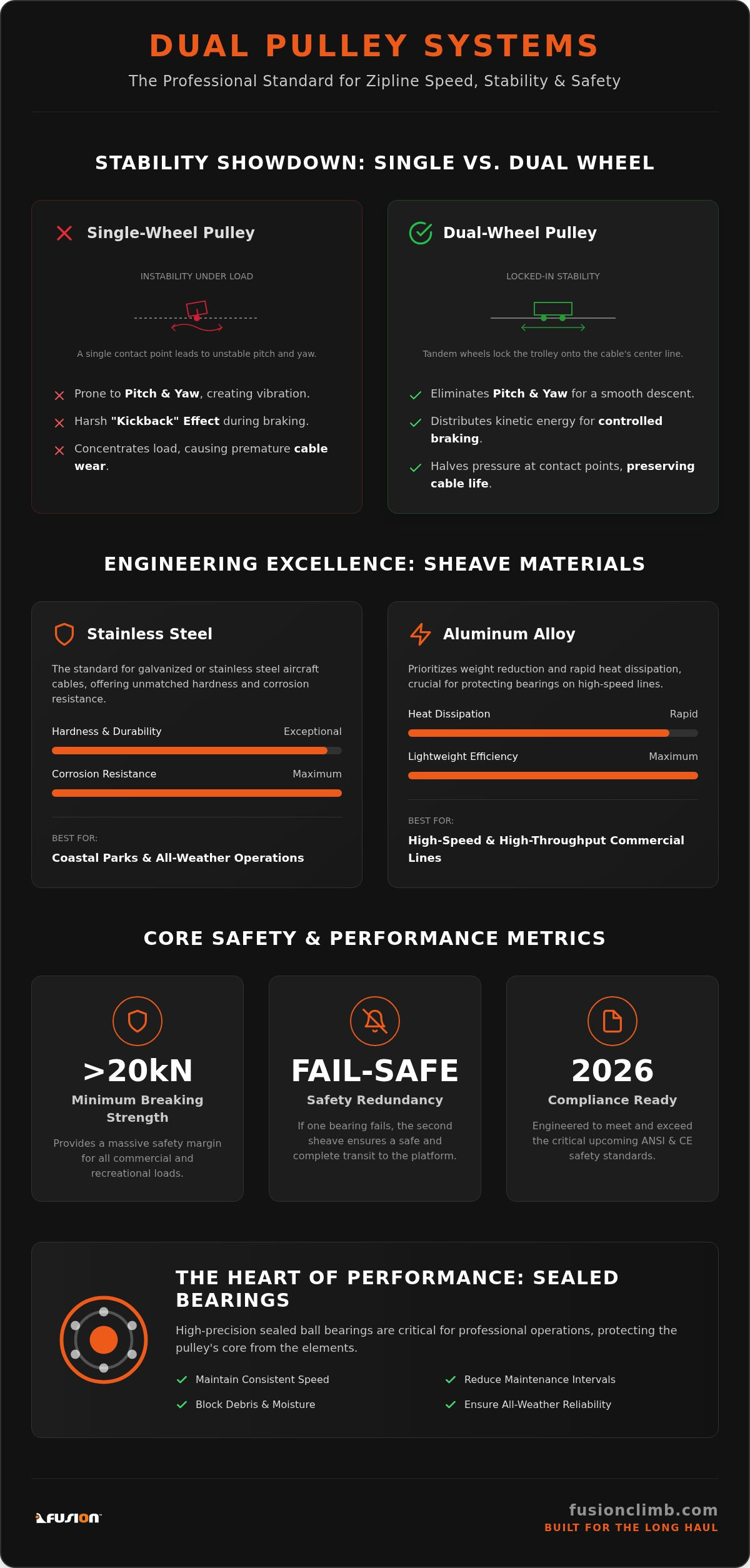
The primary engineering advantage of a tandem system is the elimination of pitch and yaw. Pitch is the tendency of a trolley to tilt forward or backward, while yaw involves side-to-side oscillation. On commercial lines where speeds can be high, these movements create vibrations that degrade the user experience and increase hardware fatigue. Two wheels work together to keep the trolley locked onto the cable center line. This stability is vital during the deceleration phase. When a trolley engages an impact brake, a single-point connection often suffers from a "kickback" effect, where the rear of the unit pivots upward. Tandem wheels distribute this kinetic energy across two points, maintaining a level profile and preventing jarring movements for the rider.
Safety Redundancy: A Non-Negotiable Standard
In vertical environments, redundancy isn't a luxury; it's a requirement for professional-grade operations. The fail-safe logic of a dual zipline pulley is simple. If a single bearing were to seize or fail during transit, a one-wheel pulley would immediately stop or begin grinding against the cable. With a dual system, the second sheave provides a critical backup that allows the rider to continue to the landing platform. This dual-point contact also facilitates better load distribution. By spreading the passenger weight across two sheaves, the system reduces the individual stress on each bearing. This engineering choice reflects a serious, safety-first approach that prioritizes passenger security and equipment longevity over the minimal weight savings of single-wheel alternatives.
Beyond the immediate safety of the rider, these systems are essential for preserving your cable infrastructure. A single wheel concentrates the entire load into one point of contact, which can lead to cable scarring or bird-caging over thousands of cycles. Tandem wheels halve the pressure at each contact point. This reduction in localized stress prevents the cable from developing flat spots or structural weaknesses, ensuring your course remains operational for the long haul. It's a calculated investment in both the rider's experience and the facility's bottom line.
Engineering Excellence: Materials and Bearing Technology
Minimum Breaking Strength (MBS) serves as the definitive benchmark for hardware integrity. It isn't just a number on a spec sheet; it's the verified limit of what your equipment can endure before structural failure. For a professional dual zipline pulley, this rating typically exceeds 20kN, providing a massive safety margin for both recreational and commercial loads. Understanding these ratings is the first step in ensuring your rigging aligns with modern industry safety standards.
Sheave Material: Stainless Steel vs. Aluminum
The choice between stainless steel and aluminum sheaves depends entirely on your cable type and operational environment. Stainless steel sheaves are the standard for galvanized or stainless steel aircraft cables. They offer superior hardness, which prevents the cable from "biting" into the sheave over time. While heavier, their resistance to corrosion makes them indispensable for coastal aerial parks where salt air would quickly degrade lesser materials.
Aluminum alloy sheaves prioritize weight reduction and rapid heat dissipation. On high-speed lines, friction between the cable and the sheave generates significant thermal energy. Aluminum's high thermal conductivity allows it to shed this heat faster than steel, protecting the internal bearings from overheating. However, aluminum is a softer metal. It will wear down faster than steel when used on abrasive cables, necessitating more frequent inspections. For those seeking the right balance of speed and reliability, exploring professional-grade pulleys can help you match material to your specific course requirements.
Bearing Precision: Speed and Longevity
Bearings are the mechanical heart of any dual zipline pulley. In 2026, sealed ball bearings are the non-negotiable standard for outdoor operations. A sealed bearing features a physical barrier that prevents dust, moisture, and grit from entering the race. This protection is vital because even microscopic debris can cause pitting, which leads to a rough, noisy ride and eventual bearing seizure.
High-quality bearings do more than just survive; they define the smoothness of the transit. Precision-ground bearings minimize rolling resistance, allowing for consistent speeds even on lower-grade descents. While some entry-level gear uses bushings or unsealed bearings that require frequent lubrication, professional trolleys utilize maintenance-free sealed systems. These units are designed to withstand thousands of cycles without degradation, ensuring that your throughput remains high and your maintenance downtime stays low. When your operation depends on back-to-back zips, the internal precision of your hardware is what keeps the line moving.
Commercial vs. Recreational: Choosing the Right Trolley
Choosing a dual zipline pulley requires a candid assessment of your operational frequency. A recreational line in a backyard might see fifty zips a season; a commercial adventure park might see five hundred in a single weekend. This difference in duty cycle dictates the level of engineering required for your hardware. Commercial operators must prioritize equipment that maintains its structural integrity under constant friction and repetitive impact braking. You don't want to discover the limits of your gear when the line is at peak capacity.
Operator Requirements for Commercial Ropes Courses
In a professional environment, throughput efficiency is as critical as safety. Guides need equipment that facilitates rapid transitions without sacrificing security. Look for "guide-friendly" features like one-handed installation mechanisms that allow for quick attachment and removal from the cable. The Z-Max series serves as a benchmark here, offering the durability needed for high-volume use. It's also vital to ensure your trolley is compatible with impact braking systems, as repetitive stops at high speeds can warp inferior frames. For a deeper look at park-grade hardware, review the standards for commercial zipline pulleys to align your fleet with 2026 expectations.
High-Performance Gear for Recreational Enthusiasts
Advanced hobbyists often make the mistake of choosing gear based on price rather than performance. If you're building a private line, moving away from single-wheel pulleys to a dual zipline pulley is the single best upgrade for both safety and ride quality. Professional-grade gear provides a level of technical assurance that entry-level kits cannot match. You aren't just buying a trolley; you're buying peace of mind for every rider. When safety is the priority, industrial reliability becomes the only standard that matters.
When rigging your personal line, don't overlook the secondary connectors. A high-performance trolley is only as secure as the hardware that links it to the harness. Selecting the correct professional climbing carabiners ensures that the gate won't rub against the trolley frame or the cable. Consider these factors for heavy-duty or tandem use:
- Weight Capacity: Verify the MBS for the combined weight of two riders if your line supports tandem zipping.
- Lanyard Compatibility: Ensure the attachment point is wide enough to accommodate dual lanyards for redundant clipping.
- Frame Clearance: Check that the carabiner bracket allows for full rotation without binding during the descent.
Whether you're managing a commercial tour or a private retreat, your hardware must be up to the task. Industrial-grade pulleys are designed to handle the heat, the weight, and the repetition of a busy season. Don't settle for gear that just "gets the job done" when you can invest in equipment built for the long haul.
Safety Standards and Rigging for Dual Pulleys
Safety in 2026 is defined by rigorous adherence to ANSI and CE certifications. These standards ensure that your hardware can withstand the dynamic forces of high-speed transit without compromise. When you deploy a dual zipline pulley, you're utilizing a system designed for multi-point contact, which inherently changes the rigging requirements compared to legacy single-wheel units. The carabiner bracket serves as the primary load-bearing interface. It must remain free of burrs or sharp edges that could damage your connectors during a descent.
Integrating your trolley with braking systems requires precise alignment. Dual pulleys have a longer frame, meaning they interact with bungee and impact brakes differently than compact models. You must verify that the trolley strikes the brake block squarely to prevent the unit from twisting or jumping the cable. This interaction is where the structural integrity of the side plates is tested most severely. If the braking force is applied unevenly, it can lead to frame deformation over time.
Professional Inspection Checklist
Maintaining a strict inspection schedule is the only way to guarantee long-term operator security. Before every season, and during routine monthly checks, perform the following steps to ensure your gear remains airworthy:
- Surface Integrity: Run a finger along the sheave grooves to detect pitting, scarring, or flat spots caused by cable friction.
- Bearing Health: Spin each wheel independently. Listen for grinding, clicking, or any tactile resistance that indicates internal debris or bearing fatigue.
- Alignment Check: Ensure the side plates are perfectly parallel. Any bowing or deformation suggests the hardware has been subjected to a fall or an over-limit load.
- Connector Hole Integrity: Inspect the primary attachment point for elongation or "egging," which signals metal fatigue and requires immediate retirement of the unit.
Rigging for Redundancy
Proper orientation on the cable is the first step in successful rigging. The trolley must be placed so that both sheaves make full contact with the line before the rider is clipped in. Redundancy is further achieved by integrating zipline lanyards and tethers as a secondary safety line. This backup tether should be slightly longer than the primary connection to ensure it doesn't carry the load under normal conditions but will immediately catch the rider if the primary attachment fails.
Verifying clearance is equally important. The path through the braking zone must be clear of obstructions that could snag the carabiners or lanyards. A well-rigged dual zipline pulley ensures the trolley moves freely until it engages the designated stopping mechanism. For hardware that meets these industrial demands, shop Fusion Climb's professional zipline equipment to upgrade your safety systems.
Fusion Climb Dual Pulleys: Built for the Long Haul
Fusion Climb operates on a principle of industrial reliability that transcends standard recreational gear. Every dual zipline pulley we manufacture is rooted in the traditional values of strength and meticulous craftsmanship. We don't just build hardware; we act as a silent partner in your journey, providing the technical assurance needed for vertical environments. This commitment to origin and rigorous testing has made our hardware the preferred choice for national operators who demand substance over style. We understand that in this industry, the stakes are always high.
Z-MAX: The Gold Standard for Adventure Courses
The Z-MAX Zipline Trolley represents the benchmark for commercial adventure courses. It features high-grade stainless steel sheaves designed to withstand the abrasive nature of galvanized aircraft cable over thousands of cycles. Its high-speed, dual-bearing system ensures a smooth, vibration-free descent that maximizes rider satisfaction while minimizing mechanical wear. We've prioritized ergonomic designs that allow guides to manage high-volume throughput without physical strain. This focus on durability means fewer replacements and more consistent performance during your busiest seasons. When your reputation depends on equipment that doesn't quit, the Z-MAX delivers the rugged confidence you need.
Tesa Speed: Efficiency in Motion
When your operation requires a blend of speed and tactical versatility, the Tesa Speed series delivers efficiency in motion. These units utilize lightweight aluminum construction, making them ideal for arborist applications, tactical rescue, and hauling systems where weight is a critical factor. While aluminum sheds heat rapidly on high-speed lines, it also provides the agility needed for complex rigging scenarios. By pairing the Tesa Speed with our ropes course safety equipment, operators achieve total system compliance with 2026 performance standards. It's a versatile solution that doesn't compromise on the industrial-grade craftsmanship our brand is known for.
Choosing a dual zipline pulley from Fusion Climb means investing in a legacy of high-performance engineering. Our hardware is built for the long haul, designed to meet the sobering security needs of the most demanding aerial parks. We remain an accessible guide for those looking to push their physical limits, providing the industrial backbone your system requires. Whether you're upgrading a private line or rigging a professional tour, our hardware provides the precision and reliability that professionals trust. We don't just meet standards; we set them.
Elevate Your Operational Safety and Performance
Mastering the mechanics of your aerial system requires more than just speed. It demands a sophisticated understanding of how a dual zipline pulley eliminates pitch and yaw while protecting your cable from unnecessary wear. Whether you're managing a high-volume commercial park or a precision tactical operation, your hardware must deliver consistent results under load. You've analyzed how stainless steel sheaves provide the hardness needed for galvanized cables, while aluminum alloys manage the thermal demands of high-velocity descents.
Industrial reliability is the foundation of every successful zip. Fusion Climb provides the technical assurance you need through ANSI Z359.11 compliant manufacturing and rugged stainless steel and aluminum alloy construction. Our hardware is trusted by commercial zipline operators nationwide to handle the most demanding duty cycles. Don't leave your security to chance. Shop Professional Dual Zipline Pulleys at Fusion Climb to secure your system today. Push your limits with the confidence that only professional-grade engineering can provide.
Frequently Asked Questions
What is the difference between a dual pulley and a tandem trolley?
A dual zipline pulley and a tandem trolley are essentially the same device, characterized by two sheaves aligned in a linear row. The term "tandem" specifically describes the wheel configuration that prevents the unit from twisting on the line. This design is the industry standard for commercial courses because it provides superior stability compared to single-wheel models. Operators use these terms interchangeably when discussing hardware that eliminates pitch and yaw during high-speed transit.
Can I use a dual pulley on a rope instead of a steel cable?
You must match your sheave material to the line type to prevent equipment failure. Stainless steel sheaves are designed exclusively for steel aircraft cables because they resist the abrasive nature of metal-on-metal contact. Aluminum sheaves are better suited for synthetic ropes used in rescue or climbing applications. Using a steel-sheave dual zipline pulley on a rope will cause rapid fraying and compromise the structural integrity of the rope within a few cycles.
How fast can a dual zipline pulley safely travel?
Safe travel speeds depend on the bearing grade and the heat dissipation properties of the trolley frame. Professional-grade pulleys, like the Z-Max series, are engineered to handle speeds exceeding 60 miles per hour on long-span lines. Exceeding the manufacturer's speed rating can lead to bearing seizure due to excessive thermal buildup. Always verify the specific velocity limits of your hardware before rigging a high-gradient line to ensure the internal components don't overheat.
How often should I replace the bearings in my zipline pulley?
Bearings don't follow a fixed calendar schedule but require replacement based on duty cycles and environmental exposure. Commercial operators should inspect hardware daily for any grinding sounds or tactile resistance when spinning the wheels. If you notice a decrease in transit speed or increased vibration, the bearings have likely reached the end of their service life. High-volume courses often retire or refurbish their primary dual zipline pulley fleet after several thousand cycles to maintain safety.
Do dual pulleys require a specific type of carabiner?
Yes, you must use a carabiner that provides sufficient gate clearance and matches the trolley's minimum breaking strength. The connector must be able to rotate freely within the attachment bracket without binding against the side plates. Professional operators typically select steel or high-strength aluminum carabiners with an MBS of at least 25kN. This ensures the entire connection point remains secure even when the system is subjected to the jarring forces of impact braking.
Is a dual pulley safer than a single pulley for kids?
A dual-wheel system is significantly safer for younger riders because it provides a more stable platform. Single pulleys can tilt or "walk" on the cable, which creates a jerky experience that can startle a smaller passenger. The tandem configuration keeps the rider's weight centered and reduces the risk of the trolley bouncing at high speeds. This stability allows kids to focus on the adventure while the hardware manages the complex physics of the descent.
What does the 25kN rating on a pulley actually mean for safety?
The 25kN rating represents the Minimum Breaking Strength (MBS), indicating the hardware can withstand approximately 5,620 pounds of force before failing. This high rating provides a necessary safety factor to account for dynamic loads, such as a rider's weight multiplied by the force of gravity during a sudden stop. In professional rigging, we never operate gear at its MBS. We use these ratings to ensure the system stays well within its elastic limit during normal use.
Can I use a dual pulley for a Superman style prone zipline harness?
Yes, a dual zipline pulley is the preferred choice for a Superman style harness due to the stability required for prone flight. Prone harnesses place the rider's center of gravity in a unique position that can cause single-wheel trolleys to oscillate dangerously. The tandem wheel design ensures the rider remains aerodynamic and level throughout the entire zip. Fusion Climb manufactures specialized harnesses specifically for this application, providing a complete system for high-performance aerial adventure.