



Adjustable Full Body Harness: The 2026 Professional Guide to Safety & Compliance
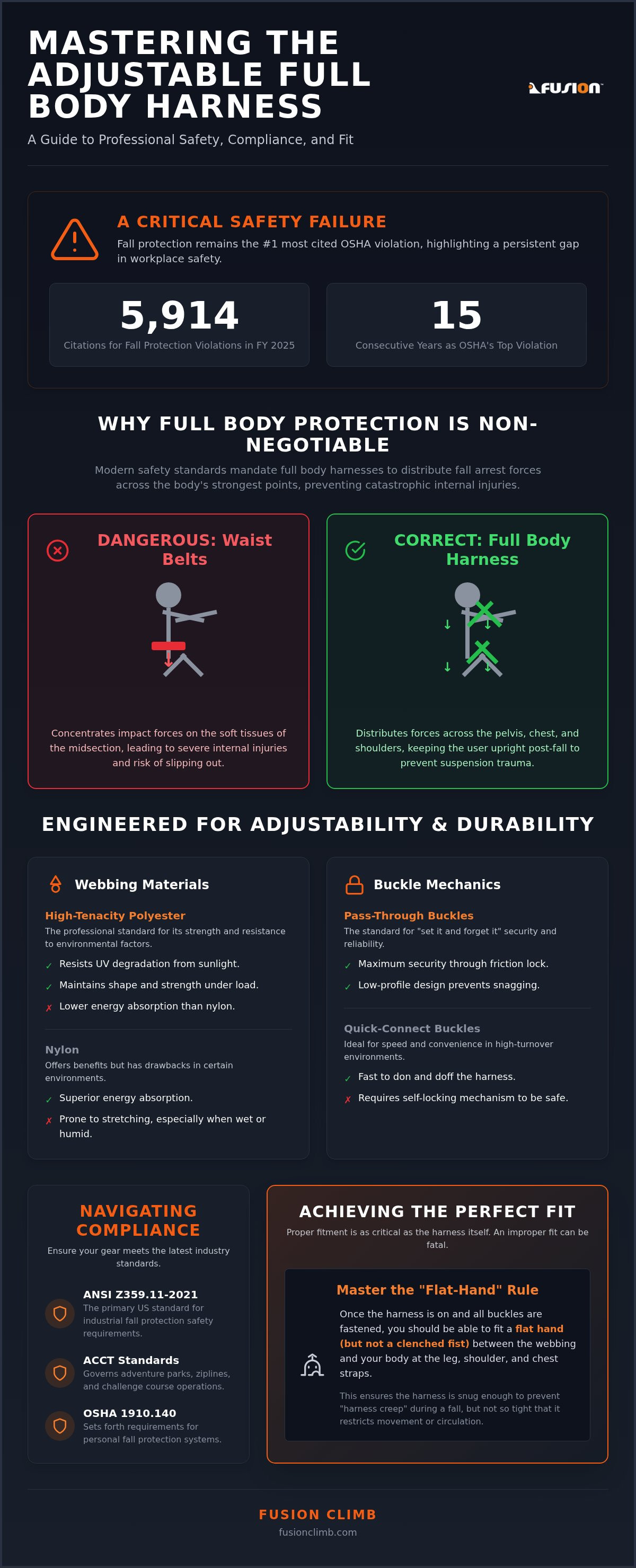
In fiscal year 2025, OSHA issued 5,914 citations for fall protection violations, marking the 15th consecutive year this category has topped the list of workplace safety failures. These numbers prove that simply having gear on-site isn't enough to guarantee a safe return home. You know that a professional adjustable full body harness is the final line of defense between a routine shift and a life-altering event. However, the struggle with equipment that is difficult to adjust between different users or becomes painful during long suspension periods often leads to compliance gaps and frustrated crews.
This guide will help you master the technical specifications, compliance standards, and fitment protocols of adjustable full body harnesses to ensure maximum safety in industrial and aerial adventure environments. We will examine the latest ANSI Z359.11-2021 requirements, explore the mechanics of precision fitment, and identify how rugged manufacturing reduces gear turnover. It is time to move beyond basic checklists and embrace a higher standard of professional security for your team.
Key Takeaways
- Understand why full-body force distribution is the professional standard for mitigating fall-arrest impact and preventing serious internal injuries.
- Identify the technical differences between high-strength webbing materials and reinforced stitching to ensure your gear withstands the rigors of your specific environment.
- Navigate the 2026 regulatory landscape by mastering the specific compliance requirements for an adjustable full body harness under ANSI Z359.11 and ACCT standards.
- Master field-proven tension testing protocols, including the "Flat-Hand" rule, to achieve an ergonomic fit that prioritizes user safety and comfort.
- Discover how tactical-grade engineering and specialized designs, such as Superman-style harnesses, enhance safety for both industrial and aerial adventure applications.
The Critical Role of the Adjustable Full Body Harness
A Safety harness serves as the primary interface between the climber and the safety system. In high-stakes vertical environments, your gear must function as a seamless extension of your body. An adjustable full body harness provides the structural integrity needed to survive a fall by ensuring that energy is absorbed by the strongest parts of the human frame. While legacy safety standards occasionally permitted waist belts, modern industrial and adventure sectors have moved exclusively to full body protection. This shift addresses the fundamental physics of fall arrest. It ensures that the impact is not concentrated on the soft tissues of the midsection, which can lead to catastrophic internal injuries.
Today's safety managers in construction, tower climbing, zipline parks, and search and rescue rely on these systems to manage life-safety risks. The 2026 industry trend is shifting toward multi-point adjustability. This evolution allows commercial operators to manage large fleets of gear while ensuring every individual worker receives a custom fit that mirrors their specific anatomy. It's no longer just about meeting a minimum requirement; it's about optimizing performance and reliability at height.
Why Full Body Protection is Non-Negotiable
Full body protection works by distributing impact forces across the pelvis, chest, and shoulders. When a fall occurs, the harness prevents the user from slipping out, a common failure point in legacy waist belts. It also ensures the body remains in an upright position post-fall. This orientation is vital for preventing suspension trauma, a condition where blood pools in the legs and restricts oxygen flow to the brain. Beyond the technical specs, there's a significant psychological benefit. Workers feel more confident when they're locked into high-tension webbing that doesn't sag or shift during movement. Confidence drives productivity.
The 'Universal Fit' Myth vs. True Adjustability
The idea of a "one size fits all" harness is a dangerous myth in professional high-angle environments. Improper fitment leads to harness "creep," where the gear shifts upward during a fall or even during normal work. True adjustability, especially in torso length, is what differentiates professional-grade equipment from budget alternatives. When a harness is perfectly calibrated to the user's height and girth, it stays in place. For site managers, investing in a high-quality adjustable full body harness reduces the need for massive, expensive gear inventories. Instead of stocking ten different sizes, a smaller selection of highly adjustable units can safely accommodate a diverse workforce. This efficiency saves money without compromising on the safety of the crew.
Engineering Adjustability: Buckle Systems and Ergonomic Webbing
The durability of an adjustable full body harness starts with its fiber. Most professional-grade webbing utilizes high-tenacity polyester. It resists UV degradation and maintains its shape under load better than alternative materials. In contrast, nylon offers superior energy absorption but tends to stretch, especially in humid environments. Manufacturers use contrasting stitching colors, often in a computerized box-stitch pattern, to make inspection easier. This allows a safety officer to quickly verify the integrity of load-bearing points. Following OSHA standard 1910.140, these components must withstand rigorous force without failure to ensure worker protection.
Weight management is a critical engineering factor. Heavy steel hardware increases user fatigue over an eight-hour shift. Modern designs often incorporate lightweight aluminum alloys to balance strength with mobility. Padding also plays a vital role. Strategic placement of breathable foam in the shoulders and leg loops prevents the webbing from cutting into the skin during suspension. This ergonomic focus ensures that the harness remains comfortable during long periods of work or active movement in vertical environments.
Buckle Mechanics: Pass-Through vs. Quick-Connect
Pass-through buckles remain the standard for "set it and forget it" security. They rely on friction and offer a low-profile design that won't snag on structures. Quick-connect buckles are different. They provide speed and convenience, making them ideal for zipline parks or crews with high turnover. These systems must include self-locking mechanisms to prevent accidental release. Reliability is non-negotiable when lives are on the line.
D-Ring Placement and Adjustment
The placement of attachment points determines how a harness responds during a fall. An adjustable full body harness allows for the precise centering of hardware regardless of the user's height. Proper alignment is essential for safety:
- Dorsal D-rings: These are the primary connection for fall arrest and must sit squarely between the shoulder blades.
- Sternal D-rings: These are used for ladder climbing systems or rescue operations to keep the user upright.
- Side D-rings: These are designed strictly for work positioning and should stay centered on the hips.
If the harness is not adjusted correctly, these rings can shift, leading to dangerous body angles or equipment interference. For those seeking gear that balances these technical requirements with rugged durability, exploring the professional range at Fusion Climb is a logical next step for any safety-conscious operator.
Navigating Compliance: ANSI Z359.11 vs. Adventure Park Standards
Safety standards aren't interchangeable. An industrial adjustable full body harness built for tower maintenance might lack the specific ergonomic features required for a high-volume ropes course. Conversely, a lightweight recreational harness often fails the rigorous OSHA 1926.502 fall protection standards required on construction sites. Compliance is the baseline of professional operation. In 2026, safety managers must distinguish between industrial fall arrest and adventure-based passenger restraint to keep crews and customers secure. OSHA remains the primary enforcer of these rules across national job sites. With 5,914 fall protection citations issued in fiscal year 2025, the agency's focus on equipment integrity is sharper than ever.
Understanding ANSI Z359.11 for 2026
The ANSI Z359.11 standard dictates the performance and testing requirements for industrial full body harnesses. Key requirements include:
- Impact Indicators: Mandatory visual markers that deploy during a fall to signal the equipment must be retired.
- Labeling: Permanent, legible tags that identify the harness's capacity and manufacture date.
- Static Strength: Every load-bearing attachment point must withstand a minimum of 3,100 pounds of force.
For 2026, the ANSI Z359.11 standard requires all certified harnesses to successfully arrest a 282-pound test weight during a dynamic drop test without structural failure.
Standards for Zipline and Aerial Adventure Operators
Adventure park operators look to the Association for Challenge Course Technology (ACCT) and ASTM F2959 to guide their equipment choices. These standards prioritize passenger safety during prolonged suspension and high-speed transit. Unlike industrial gear, which focuses on stopping a fall, adventure gear often focuses on preventing a fall while maintaining participant comfort. We've seen a significant shift toward heavily padded leg loops for prone flight experiences where users remain suspended for extended periods. This design prevents circulation issues and enhances the user experience. To understand how these harnesses function as part of a larger mechanical system, consult our Commercial Zipline Pulleys Guide for a breakdown of system-wide safety standards. Whether you're managing a job site or a zipline tour, choosing gear that meets the specific standard for your environment is the only way to ensure 100% compliance.
Achieving the Perfect Fit: Sizing and Field Inspection Protocols
An adjustable full body harness only protects the wearer if it's fitted with precision. A loose strap or a misaligned D-ring can turn a survivable fall into a medical emergency. Professional operators use the "Flat-Hand" and "Two-Finger" rules to verify tension. You should be able to slide a flat hand between the shoulder strap and the collarbone. Similarly, only two fingers should fit between the leg loop and the thigh. If the webbing is too loose, the force of a fall arrest will cause the harness to "creep" upward. This leads to severe bruising or, in extreme cases, internal injuries from improper force distribution.
Before starting any shift or aerial tour, perform a suspension test in a safe, controlled environment. This allows the user to feel how the gear supports their weight and ensures there are no hidden pressure points. Common fitment errors, such as twisted webbing or loose chest straps, often go unnoticed until a load is applied. Twisted straps are particularly dangerous. They concentrate force on a smaller surface area, which can cause the webbing to fail under extreme dynamic loads. Always take the extra minute to ensure every strap lies flat against the body.
5 Steps to a Secure Harness Fit
Consistency is key for fleet management. Follow these steps every time you don your adjustable full body harness:
- Step 1: Inspect the entire harness for signs of fraying, burns, or chemical damage that could compromise fiber integrity.
- Step 2: Orient the harness by the dorsal D-ring. Shake it to let the straps fall into place and ensure nothing is tangled.
- Step 3: Secure the leg loops first. These establish the foundation and prevent the unit from riding up during a fall.
- Step 4: Adjust the torso straps until the dorsal D-ring sits squarely between the shoulder blades.
- Step 5: Close the chest strap and perform a final tension check on all buckles to ensure the fit is snug and symmetrical.
Daily Inspection Checklist for Fleet Operators
Managing gear for a large team requires a methodical approach to maintenance. Always verify the integrity of "load-indicator" stitching. If these threads are popped, the harness has arrested a fall and must be removed from service immediately. Check for corrosion, gate-action failure, or deformation in your professional climbing carabiners. Any hardware that sticks or shows deep scoring should be retired. Finally, keep webbing clean and store it in a cool, dry place away from direct sunlight to prevent UV degradation. To ensure your crew is equipped with gear that meets these rigorous standards, browse our full selection of industrial harnesses.
The Fusion Climb Difference: Rugged Design for National Safety
Fusion Climb has spent decades refining the intersection of tactical-grade durability and commercial utility. Since 1998, we've focused on creating gear that acts as a silent partner in your vertical journey. Every adjustable full body harness we manufacture reflects a commitment to US-based engineering and no-nonsense reliability. National operators choose our equipment because it withstands the harsh realities of high-cycle environments without compromising user comfort. We don't believe in "good enough" when lives are on the line. Instead, we build gear that exceeds the expectations of the most demanding professionals in the field.
One of our most significant innovations is the evolution of the Superman-style zipline harness. Designed specifically for prone flight experiences, these harnesses provide the structural support needed for a secure journey while offering the ergonomic freedom that customers expect. This specialized design ensures that the user's weight is perfectly distributed, even during the high-speed transit characteristic of modern adventure parks. When paired with our zipline lanyards and tethers, the result is a unified safety system that meets the rigorous demands of 2026 compliance standards. Reliability is built into every fiber.
Innovation in Aerial Adventure Gear
Busy adventure parks require gear that can handle constant cycles of use and adjustment. Rapid throughput is essential for profitability, but it must never come at the cost of absolute safety. Our harnesses are engineered to facilitate quick fitment while maintaining the integrity of every connection. We understand that in the adventure sector, the equipment should be invisible to the participant. This allows them to focus on the thrill of exploration while you focus on their security. Innovation is our standard. We prioritize substance over style in every design.
Industrial Reliability for High-Angle Work
In the industrial sector, the stakes are even higher. Whether it's tower climbing, rigging, or high-angle rescue, our gear is built to exceed ANSI Z359.11 requirements. We prioritize dependable hardware that functions flawlessly in high-stress scenarios. There's no room for failure when lives depend on the strength of a single stitch or the snap of a carabiner. Our manufacturing process involves rigorous quality control to ensure every component arrives ready for the field. It's time to equip your team with the protection they deserve. Explore the full range of Fusion Climb full body harnesses for your operation today.
Equipping Your Operation for Vertical Excellence
Mastering high-angle environments requires more than just experience; it demands equipment that mirrors your commitment to excellence. You've learned that true safety hinges on the intersection of rigorous compliance and precision adjustability. By implementing the "Two-Finger" fitment rule and adhering to 2026 ANSI Z359.11 mandates, you've established a foundation for a safer job site or adventure park. An adjustable full body harness isn't just a piece of gear. It's a lifeline designed to distribute force and prevent suspension trauma when every second counts.
Since 1998, Fusion Climb has served as a dependable guardian for national operators. Our deep expertise in ANSI Z359.11 compliance and our specialized Superman Style Harnesses ensure your team remains secure in any high-stakes environment. Don't leave your safety to chance or outdated equipment. It's time to invest in rugged engineering that works as hard as you do. Secure Your Team with Fusion Climb's Professional Harnesses and push your limits with total confidence. The summit is waiting.
Frequently Asked Questions
How do I know if my adjustable full body harness is ANSI compliant?
Look for the permanent certification label stitched directly into the webbing. An adjustable full body harness must clearly state it meets ANSI/ASSP Z359.11 standards to be considered compliant for industrial use. This tag includes the manufacture date, serial number, and weight capacity. You should also verify the presence of visual load indicators. These small folds of stitching deploy during a fall and provide an immediate signal that the equipment is no longer safe for professional service.
Can I use an industrial safety harness for a commercial zipline?
It's possible but rarely the best choice for operator efficiency or participant comfort. Industrial gear is engineered to arrest a vertical fall, while commercial zipline harnesses, such as our Superman style models, prioritize horizontal flight and long-term suspension. Using industrial gear for ziplining can lead to uncomfortable pressure points for passengers. For professional aerial parks, choosing gear specifically designed for the activity ensures a better user experience while still maintaining absolute safety standards.
How often should a professional climbing harness be retired?
Professional gear typically has a maximum service life of ten years from the date of manufacture, even if it hasn't been used. However, heavy daily use in rugged environments can reduce this lifespan significantly. You must retire any harness immediately if it's involved in a fall or fails a pre-shift inspection. Regular exposure to UV light, moisture, and chemicals will degrade synthetic fibers over time, making frequent, documented inspections a non-negotiable part of your safety protocol.
What is the weight capacity for a standard adjustable full body harness?
Standard ANSI-rated equipment is tested for a weight range of 130 to 310 pounds, which includes the worker's body weight and all attached tools. If a user falls outside this range, you must source specialized gear that is specifically tested and labeled for higher or lower capacities. Operating outside these verified weight limits compromises the energy-absorbing capabilities of the system. Always verify the capacity on the manufacturer’s label before authorizing the equipment for use on your site.
What is the difference between a fall-arrest harness and a work-positioning harness?
A fall-arrest harness is designed to stop a person who is already in the process of falling, primarily using the dorsal D-ring. A work-positioning harness uses side D-rings to support a worker at a specific location, allowing them to work with both hands free. Most modern professional units combine these functions into a single adjustable full body harness. This versatility allows a technician to move between different high-angle tasks without needing to switch their primary safety equipment.
How should I clean and store my full body harness to ensure longevity?
Clean your gear using only mild soap and lukewarm water to avoid damaging the synthetic fibers. Rinse thoroughly and allow it to air dry in a well-ventilated area away from direct sunlight or mechanical heat sources. Storage is equally important. Keep your equipment in a cool, dry, and dark environment. This prevents UV degradation and keeps the webbing away from harmful chemicals, oils, or sharp tools that could compromise the structural integrity of the harness over time.
What are the common signs of webbing wear that require immediate retirement?
Immediate retirement is required if you find any cuts, snags, or "fuzziness" on the webbing surface. These signs indicate that the structural fibers have been compromised. You should also look for glazed or melted fibers, which suggest heat or friction damage. Discoloration or brittle sections often point to chemical exposure. If the load-indicator stitching has pulled apart, the harness has already arrested a fall and must be removed from service to prevent a catastrophic failure.
Does Fusion Climb offer harnesses for kids or smaller-framed individuals?
Yes, we manufacture specialized harnesses designed to provide a secure fit for smaller-framed individuals and youth participants. These models utilize the same high-strength webbing and rugged hardware found in our industrial gear but are scaled for ergonomic safety on smaller bodies. This ensures that adventure park operators can offer a safe, comfortable experience for all participants. Proper fitment is the foundation of safety, regardless of the user's size or the specific vertical environment.