



Zipline Pulley Options for Salt Air: Compare Fit, Bearings and Load
A stainless-steel body alone doesn’t make a pulley the right choice. The best zipline pulley for salt air locations must fit the cable, suit the ride’s bearing needs, and have an appropriate load rating. Weigh these specifications together rather than relying on material alone.
Salt exposure makes corrosion resistance important, but fit and performance matter just as much. Compare pulley options by cable compatibility, bearing design, and load rating, then weigh the trade-offs for your zipline setup.
Key Takeaways
- Measure the cable and match the pulley’s stated compatibility before weighing other features.
- Compare bearing and bushing designs by how they affect rolling efficiency and maintenance needs.
- Read minimum breaking strength as a hardware rating, not as a rider weight limit.
- Assess the full system’s load limits and testing evidence, then prioritize corrosion-resistant construction for salt-air exposure.
Cable diameter compatibility
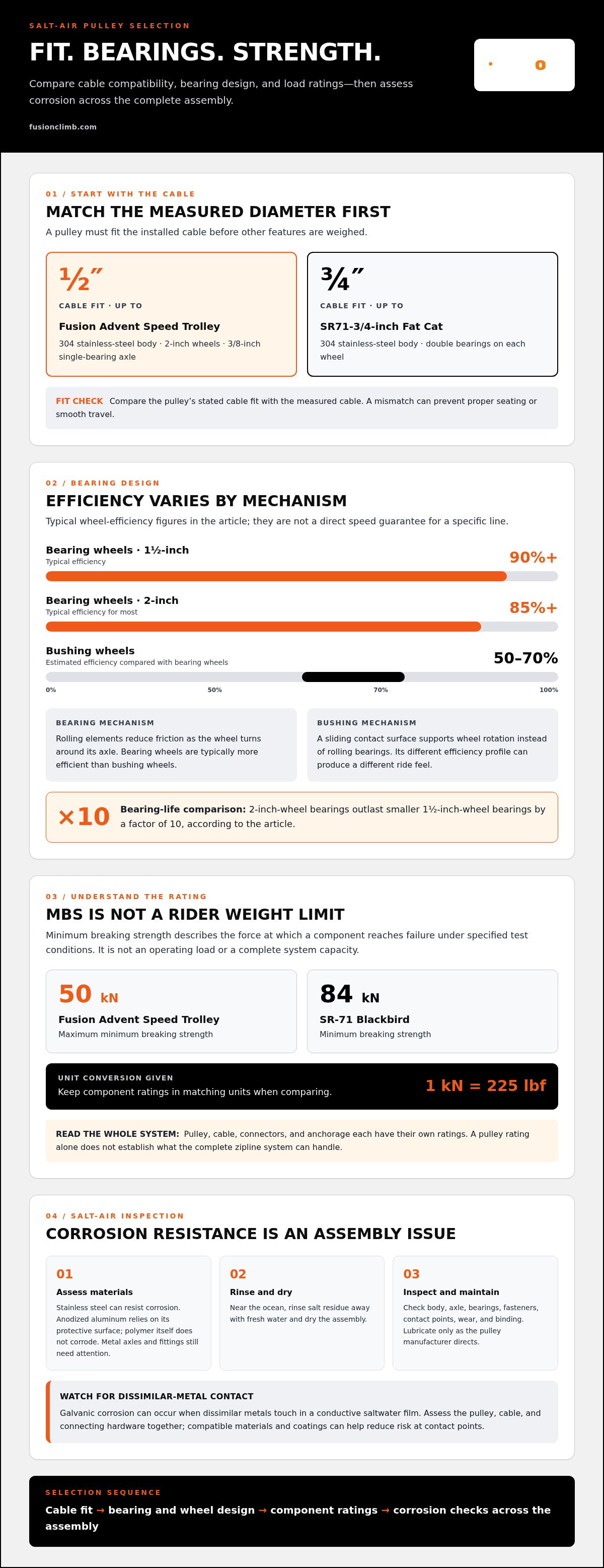
Start with the cable’s measured diameter. The best zipline pulley for salt air locations must fit that cable, not merely suit the environment. The Fusion Advent Speed Trolley fits cable up to 1/2 inch, while the SR71-3/4-inch Fat Cat fits cable up to 3/4 inch. A mismatch can prevent proper seating or smooth travel. Compare the pulley’s stated fit with the installed cable before weighing other features.
For coastal exposure, assess corrosion resistance across the whole assembly. Stainless steel can resist corrosion, anodized aluminum relies on its protective surface, and polymer components do not corrode in the polymer itself. Metal axles and fittings still need attention. Choose the best zipline pulley for salt air locations by considering every exposed part, not just the body material.
Corrosion-resistant pulley prices vary with material, bearing design, cable fit, and load rating. Compare these specifications and the intended use rather than treating material alone as a price guide.
Match the trolley to cable diameter first, then assess its load rating against system requirements. Speed also depends on slope, cable length, rider mass, and braking. The Fusion Advent Speed Trolley has 2-inch wheels and a 3/8-inch single-bearing axle. Those details describe its design, not a rider weight limit.
| Option | Cable fit | Body and bearing details |
|---|---|---|
| Fusion Advent Speed Trolley | Up to 1/2 inch | 304 stainless steel; 2-inch wheels; single-bearing axle |
| SR71-3/4-inch Fat Cat | Up to 3/4 inch | 304 stainless steel; double bearings on each wheel |
Start by matching the pulley to the measured cable diameter, then compare construction and bearing design.
Cable slope and length shape the ride. A steeper line can increase acceleration, while a longer span changes travel time and braking demands. Assess the whole setup, including the landing area and braking system, rather than using pulley choice to compensate for line geometry.
Near the ocean, rinse salt residue away with fresh water, dry the assembly, and inspect the body, axle, bearings, and fasteners for corrosion or wear. Lubricate only as the pulley manufacturer directs, since the right product and application depend on bearing design.
Galvanic corrosion can occur when dissimilar metals touch in a conductive saltwater film. Assess the pulley, cable, and connecting hardware as one assembly. Compatible materials and coatings can help reduce corrosion risk at contact points.
Bearings compared with bushings
For salt-air exposure, prioritize corrosion-resistant materials across the wheel, axle, and bearing assembly. Stainless steel is a practical choice for exposed components; the trolley examples use 304 stainless-steel bodies.
Bearing Pulleys
A bearing pulley uses rolling elements to reduce friction as the wheel turns around its axle. Bearing wheels are typically more efficient than bushing wheels, but their exposed components still need inspection in coastal conditions. The Fusion Advent Speed Trolley has 2-inch wheels and a 3/8-inch single-bearing axle. Its body is 304 stainless steel, while trolley axles are stainless steel unless otherwise noted.
Bushing Pulleys
A bushing pulley supports wheel rotation through a sliding contact surface instead of rolling bearings. Bushing wheels are estimated at 50% to 70% of bearing-wheel efficiency, so they may produce a different ride feel. Their simpler contact arrangement doesn’t remove the need to assess corrosion: inspect the wheel, axle, and metal interfaces for salt residue, wear, and binding.
Wheel size also affects the bearing comparison. The common zipline wheel sizes are 1-1/2 inches and 2 inches. Typical efficiency ratings are 90% or higher for 1-1/2-inch wheels, and 85% or higher for most 2-inch wheels. Those figures describe typical wheel efficiency, not a direct guarantee of speed on a specific line.
Choose a pulley design that suits the intended ride and maintenance conditions. A bearing model may suit a setup where rolling efficiency matters; a bushing model has a different mechanism and efficiency profile. Inspect the complete assembly, including contact points where dissimilar metals and salt residue meet. Connected hardware can corrode even when the pulley body resists corrosion.
For coastal setups, compare zipline pulley options by bearing configuration and exposed materials, then establish a consistent inspection routine.
2-inch-wheel bearings outlast smaller 1-1/2-inch-wheel bearings by a factor of 10. Include that expected cost in upkeep planning, alongside routine checks for salt residue, wear, and binding. Regular inspection can help identify changes in wheel rotation or contact surfaces before they affect the trolley’s ride.
Minimum breaking strength
Minimum breaking strength (MBS) describes the force at which a component reaches failure under specified test conditions. It is not the same as a rider weight limit or an operating load. For example, the Fusion Advent Speed Trolley has a maximum minimum breaking strength of 50 kN. The SR-71 Blackbird has an MBS of 84 kN. These figures describe the respective trolley ratings, not complete zipline-system capacities.
To compare ratings, keep the units consistent. A conversion given for these specifications is 1 kN to 225 lbf. Use the same unit when reading pulley, connector, cable, and anchorage information. Don’t treat a larger pulley MBS as proof that every connected component can handle the same force. The full assembly includes several parts, and each component has its own rating.
Read the exact wording on each specification. “Minimum breaking strength” identifies a breaking-force rating, while “maximum” describes the stated limit for that product. Neither phrase alone tells you an allowable working load. Do not convert MBS directly into a rider limit. Rider mass, line geometry, speed, braking, and dynamic forces all affect system design, so a pulley rating cannot answer those questions by itself.
- Compare pulley ratings using matching units, such as kN or lbf.
- Record the cable and connected-hardware ratings alongside the pulley.
- Use the lowest applicable component rating to identify a system constraint, not as a complete safety calculation.
For salt-air installations, keep strength and corrosion checks distinct. The SR-71 Blackbird’s sheaves are case hardened to 56-58 Rockwell, and its minimum breaking strength is 84 kN. That hardness figure describes the sheaves; it does not replace the MBS rating. Inspect exposed surfaces and working parts for corrosion or damage, because a strength specification does not describe the pulley’s condition after use.
Compare documented MBS values, then evaluate every connected part and the system’s design conditions. A pulley’s rating is one selection criterion, not a standalone answer about rider capacity.
Weight limits and testing
A pulley’s breaking-strength rating isn’t a rider weight limit. It describes the component’s resistance to breaking under specified test conditions, while operating loads depend on the complete system. The Fusion Advent Speed Trolley has a maximum minimum breaking strength of 50 kN. Treat that value as a component rating, not permission to carry a particular rider.
In the United States, assess the pulley’s documented testing and rating against requirements applicable to the complete zipline system. A pulley rating or test mark alone doesn’t establish that the full installation meets every applicable requirement. Review the manufacturer’s documentation for the tested component, test method, material, and intended use. Don’t assume a certification for one component covers connected equipment.
Compare ratings using consistent units. The provided conversion is 1 kN to 225 lbf; don’t compare values until they use the same unit. The SR-71 Blackbird has a minimum breaking strength of 84 kN, while the Fusion Advent Speed Trolley’s maximum minimum breaking strength is 50 kN. Neither figure independently sets rider capacity or system working load.
- Record the pulley’s stated rating and unit.
- Compare it with the cable, connectors, and other load-bearing components.
- Review testing documentation for the exact component and intended application.
For salt-air use, inspect before each operation and follow a documented maintenance schedule. Look for corrosion, cracks, deformation, unusual wheel movement, or damage around the axle and bearings. Salt residue can hide wear, so clean and dry the pulley before examining its moving parts. Remove a component from service if inspection finds damage or a change in operation.
Replacement timing depends on condition, use, and the manufacturer’s maintenance instructions. A fixed calendar interval cannot account for corrosion exposure or wear. Track inspections and findings to identify changes over time.
Compare zipline pulley specifications with your system’s ratings and testing records before selecting hardware.
Fusion Climb: Full Body Harnesses
Fusion Climb offers full body harnesses alongside zipline hardware for customers assembling compatible equipment. A pulley selection addresses cable fit, bearings, and load ratings; the harness is another part of the rider’s setup and should suit the intended zipline use. Fusion Climb also offers Superman style harnesses, zipline pulleys, and lanyard and tether equipment. Consider these categories together when planning equipment, while evaluating each item against its specifications and the system’s requirements. Salt-air exposure makes ongoing inspection of exposed hardware and connections important, not just the initial material choice. Explore equipment options for your setup at fusionclimb.com.
Build a Coastal Equipment Plan
Choosing the best zipline pulley for salt air locations is one part of preparing equipment for continued coastal use. Turn your selection into a practical maintenance plan: record the intended setup, note inspection findings, and track changes in wear or corrosion. A clear record helps ground maintenance decisions in the equipment’s actual condition.
Fusion Climb offers Zipline Pulleys, Full Body Harnesses, and Superman Style Harnesses for zipline equipment needs. Consider how each component fits the intended setup, and keep the pulley decision connected to the rest of the rider’s equipment. For help considering pulley options for your application, contact Fusion Climb for pulley advice. A deliberate selection process supports confident preparation for the next ride.
Frequently Asked Questions
Which zipline pulleys are best rated for coastal or marine use?
Choose a pulley with corrosion-resistant materials across its exposed components, not just a corrosion-resistant body. A marine-use claim is useful only when it clearly describes the materials and intended exposure. Compare the wheel, axle, bearings, and fasteners as a complete assembly. In coastal environments, prioritize designs that allow inspection and cleaning of salt deposits around moving parts and metal contact points.
What are the load ratings and safety factors of leading zipline pulleys?
Published minimum breaking strength ratings describe component strength, but they don’t provide a complete system safety factor. That calculation depends on the allowable working load and the design conditions for the full installation. Review the manufacturer’s documentation for the pulley and connected equipment, then assess system loads together. A pulley’s rating alone cannot establish rider capacity, since the cable, connectors, anchors, braking, and dynamic forces also affect the system.
What pulley wheel and bearing materials resist salt corrosion best?
Stainless steel is a practical choice for exposed components, while polymer parts do not corrode in the polymer itself. Anodized aluminum relies on its protective surface, so check metal axles, bearings, and fittings too.
How much do corrosion-resistant zipline pulleys cost?
Prices vary with material, bearing design, cable fit, and load rating. Compare those specifications and the intended use rather than judging price by material alone.