



Ultimate Reference Guide to Work at Height Safety Harnesses
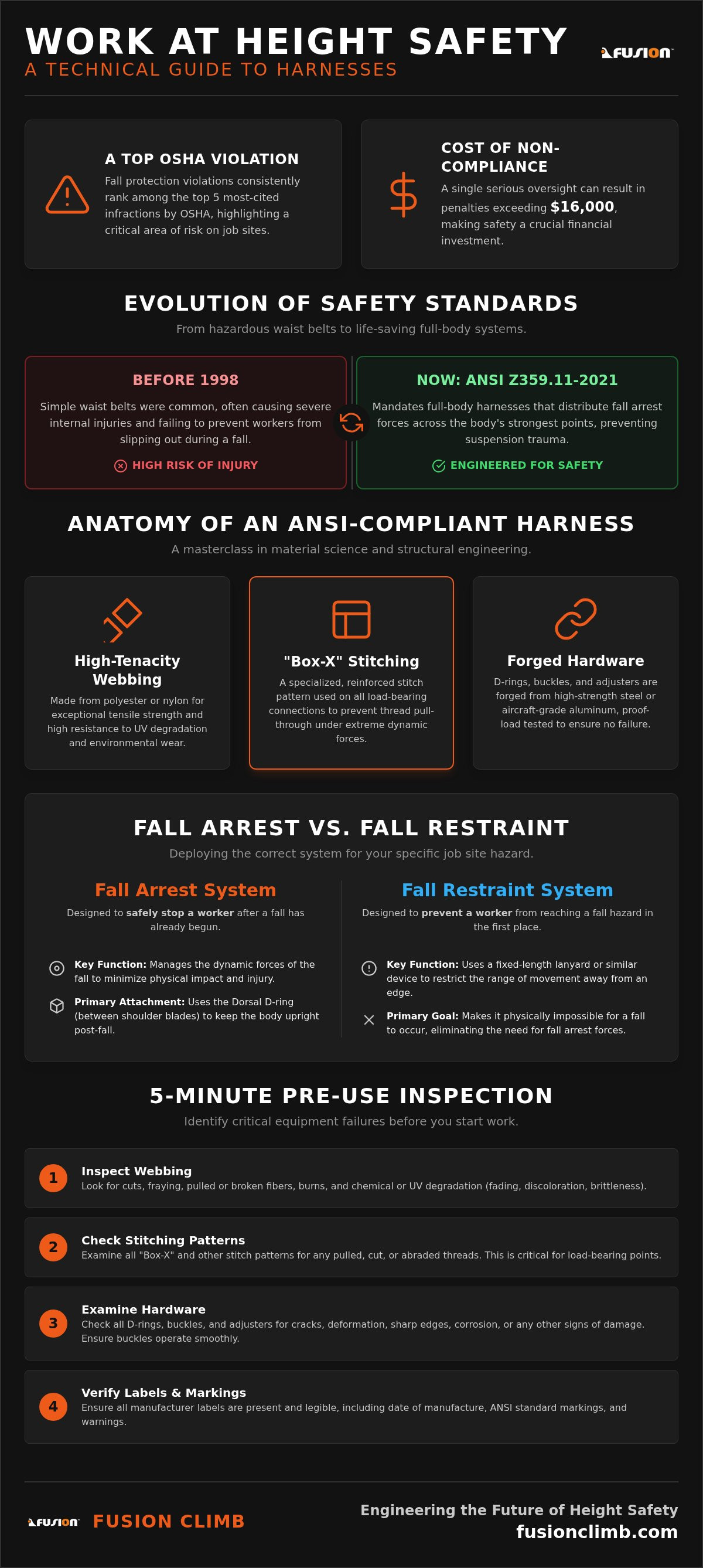
Fall protection violations consistently rank among the top five most cited OSHA infractions, and a single serious oversight can now cost your operation over $16,000 in penalties. You understand that safety isn't just a checkbox for compliance. It's a commitment to the precision engineering and material integrity that keeps your team secure in high-stakes environments. Choosing the right work at height safety harness is a decision where there's no room for error or technical uncertainty.
Eliminate the guesswork. It's natural to feel frustrated by evolving ANSI standards or the complexity of equipment retirement timelines. This guide empowers you to master the technical standards, critical components, and selection criteria for professional-grade fall protection equipment. We'll demystify the ANSI Z359.11-2021 requirements and clarify the specific utility of various D-ring configurations. You'll gain a clear understanding of harness anatomy, learn how to perform rigorous pre-use inspections, and identify exactly which gear fits the unique demands of your industry. Move with confidence. Your equipment must be as dependable as your expertise.
Key Takeaways
- Understand the technical construction of an ANSI-compliant work at height safety harness, focusing on load-bearing "box-x" stitching and high-tenacity webbing.
- Differentiate between fall arrest and fall restraint systems to ensure you deploy the correct equipment for your specific job site hazards.
- Learn how proper force distribution across the thighs and pelvis prevents suspension trauma and maintains a secure, upright position post-fall.
- Implement a rigorous five-minute pre-use inspection routine to identify critical equipment failures like UV degradation or chemical fraying.
- Recognize the value of US-based manufacturing and integrated hardware systems in maintaining total safety integrity for industrial and aerial adventure work.
Defining the Work at Height Safety Harness: Beyond Basic Fall Protection
A professional work at height safety harness isn't just a collection of straps. It's a precision-engineered system designed to save lives by distributing extreme fall arrest forces across the strongest parts of the human body: the thighs, pelvis, chest, and shoulders. While Wikipedia's guide to safety harnesses provides a broad overview of various types, industrial-grade equipment must meet far more rigorous standards than recreational gear. Every stitch and buckle serves a documented purpose in a high-stakes environment.
Recreational climbing harnesses focus on comfort and mobility for active movement. In contrast, industrial fall protection prioritizes maximum load distribution and post-fall security. The primary objective is to maintain the wearer in an upright position after a fall event. This positioning is critical because it prevents the rapid onset of suspension trauma, a life-threatening condition caused by blood pooling in the legs when a worker is left hanging. Professional gear is built to manage these physiological risks while providing the durability required for heavy industrial use.
The Evolution of Fall Protection Standards
Safety protocols have evolved significantly over the last few decades. Before 1998, simple waist belts were common, but they often caused severe internal injuries or allowed workers to slide out during a fall. Modern standards like OSHA 1926.502 and the current ANSI Z359.11-2021 mandate full body protection for a reason. These regulations ensure that every component, from the webbing to the buckles, can withstand the dynamic forces of a 6-foot drop without failure. As we move through 2026, OSHA's focus has intensified on enforcement and documentation rather than new design mandates, ensuring that existing high standards are strictly followed on every site.
Why Full Body Protection is Non-Negotiable
The physics of a fall are brutal. Without chest and shoulder support, a falling body can easily slip out of a lower-body-only system or suffer spinal trauma from uneven force application. A work at height safety harness ensures that energy is dispersed through the skeletal frame rather than soft tissue. This design mitigates the dangers of "harness hang" by allowing for a safer rescue window. Modern Full Body Harnesses are engineered to provide this security without sacrificing the range of motion needed for technical tasks.
A Personal Fall Arrest System (PFAS) is a comprehensive safety assembly consisting of four core components: an anchorage, a body harness, a connector such as carabiners, and a deceleration device like lanyards. By integrating these elements, professionals ensure that a fall is not just stopped, but managed with minimal physical impact.
The Technical Anatomy of an ANSI-Compliant Safety Harness
Every professional-grade work at height safety harness is a masterclass in material science and structural engineering. The primary structure relies on high-tenacity polyester or nylon webbing. These materials are selected for their exceptional tensile strength and resistance to UV degradation, ensuring the harness remains reliable even after prolonged exposure to the elements. Precision matters in every joint. Load-bearing connections utilize the "box-x" stitching pattern, a specialized reinforced stitch that ensures the thread won't pull through the webbing under the extreme dynamic loads of a fall event. Non-load-bearing areas use different patterns to maintain the shape of the harness without adding unnecessary bulk.
Hardware integrity is the backbone of fall protection. Connectors and adjustment points are typically forged from high-strength steel or aircraft-grade aluminum. These components must meet rigorous proof-load testing to ensure they won't deform or fail when you need them most. For professionals who demand gear that balances weight with absolute durability, exploring the technical specifications of Full Body Harnesses and high-performance carabiners is the first step toward a safer job site.
Attachment Points and D-Ring Configurations
Understanding D-ring placement is vital for safe operation. The Dorsal D-ring, located between the shoulder blades, is the mandatory primary connection point for fall arrest. It ensures the body remains upright during and after a fall. Sternal D-rings are positioned on the chest and are specifically designed for ladder climbing systems or vertical lifelines. Side (Hip) D-rings serve a different purpose entirely. According to the OSHA personal fall protection systems standard, side D-rings are for work positioning and travel restraint only. Never use them for fall arrest, as they aren't designed to manage the physiological impact of a vertical drop.
Buckle Systems: Tongue vs. Quick-Connect
The choice of buckle often depends on your environment. Tongue buckles function like a standard belt and offer traditional reliability. They're the preferred choice in high-debris environments, such as concrete work or masonry, because they won't jam when exposed to dust and grit. Quick-connect buckles prioritize efficiency. They allow for rapid donning and doffing without readjusting the fit every morning. Between these points, friction sliders allow the user to fine-tune the tension of the work at height safety harness. This ensures the gear stays snug against the body during active movement, preventing the webbing from shifting out of its optimal safety position.
Fall Arrest vs. Fall Restraint: Selecting the Right System
Choosing the correct work at height safety harness begins with understanding the specific physics of your job site. Fall restraint is your first line of defense. These systems use a fixed-length Lanyard and tether to physically prevent a worker from reaching a leading edge. It's a preventative measure that eliminates the possibility of a fall occurring in the first place. When you can't eliminate the risk, fall arrest becomes mandatory. This reactive system is engineered to stop a fall already in progress, managing the kinetic energy through deceleration devices to keep impact forces within safe physiological limits.
Work positioning and suspension systems offer specialized support for technical tasks. Positioning gear allows a worker to be supported in tension on a vertical surface, such as a telecommunications tower, which frees both hands for work. Suspension and rescue configurations are essential for confined spaces or high-angle environments where a worker must be raised or lowered vertically. These systems often require additional attachment points to ensure the user remains stable and upright during transit. Integrating the right Carabiners and hardware into these systems is vital for maintaining total structural integrity.
Specialized Harnesses for Aerial Adventure
Aerial adventure parks and zipline operations demand gear that balances rugged industrial strength with the ergonomics of active movement. Specialized zipline harnesses are designed for high-speed security and frequent use cycles. For unique applications like prone-position flight, Superman Style Harnesses provide the necessary engineering to support the torso horizontally while maintaining absolute safety. Ropes course operators prioritize high-volume throughput, selecting gear that allows for rapid adjustment across a wide range of body types without compromising the security of the connection.
Industrial vs. Tactical Applications
The environment dictates the specific material requirements of your work at height safety harness. Electrical utility workers require arc flash protection, utilizing webbing that won't melt or conduct electricity during a thermal event. In construction and road work, high-visibility straps ensure that workers remain seen by heavy equipment operators in low-light conditions. Tactical teams and theater riggers have the opposite requirement. They utilize low-profile, black-out gear designed to eliminate reflections and visual noise. Whether you're rigging a stage or navigating a job site, pairing your harness with high-performance Zipline Pulleys or specialized connectors ensures your system is optimized for the specific challenges of your vertical environment.
Reference Guide for Inspection and Maintenance Protocols
The "Pre-Use" check is a non-negotiable ritual for every professional. It's a five-minute commitment that ensures your work at height safety harness is ready for duty before you leave the ground. Inspect your gear every single time you don it. Look for obvious defects like heavy fraying, pulled fibers, or chemical burns that compromise the integrity of the synthetic webbing. These flaws aren't just aesthetic; they're structural vulnerabilities that can lead to catastrophic failure under load.
Hardware inspection requires both tactile and visual scrutiny. Run your fingers along every D-ring, buckle, and adjustment point to feel for hairline cracks, pits, or sharp burrs that could slice through webbing during a fall. Test the gate function of your Carabiners and quick-connect buckles. They must lock and unlock smoothly without sticking or requiring excessive force. Any sign of corrosion or permanent deformation is a signal for immediate removal from service. If the hardware doesn't snap shut with a crisp, metallic click, it's a liability you can't afford.
Maintain a rigorous paper trail for every piece of equipment in your kit. Every professional harness features a unique serial number and a manufacturing date. Record these in a dedicated inspection log along with the results of your monthly competent person inspections. This documentation is essential for OSHA compliance and equipment tracking. If the safety label is missing or the text is illegible, the harness is technically out of compliance and must be retired immediately.
Step-by-Step Webbing Inspection
Use the "U-Shape" test to find hidden damage within the straps. Bend the webbing into an inverted "U" every few inches to open up the fibers and reveal internal breaks or cuts that aren't visible when the strap is flat. Search for "glazing," which appears as a shiny, hard, or brittle surface caused by high-heat exposure or extreme friction. Finally, examine the load-bearing "box-x" stitching patterns. If you see even a single pulled or broken thread in these critical areas, the harness can no longer guarantee the force distribution required for safe fall arrest.
When to Retire Your Harness
Industry standards often refer to a "Five-Year Rule" for the service life of synthetic gear, but you must always defer to the manufacturer's specific guidelines. Some harsh environments, like coastal sites or chemical plants, can accelerate wear significantly. Mandatory retirement is absolute after any fall arrest event. Even if there is no visible damage, the internal fibers have been stressed beyond their design limits and cannot be trusted for a second impact. Prolonged exposure to direct sunlight causes UV degradation that progressively weakens the molecular structure of synthetic webbing.
If your current equipment shows signs of degradation or has reached the end of its service life, don't wait for a failure to happen. Upgrade to professional-grade Full Body Harnesses that are engineered for maximum durability and tested in US-based facilities.
Fusion Climb: Engineering the Future of Height Safety
Trust in your equipment is the foundation of every vertical operation. Since 1998, Fusion Climb has operated as a US-based manufacturer committed to the rugged reliability required by industrial professionals and aerial adventure operators alike. We don't just produce individual components. We engineer total safety solutions. Selecting a work at height safety harness is only the first step; the true strength of your system lies in the seamless integration of Full Body Harnesses with high-performance carabiners and lanyards. This holistic approach ensures that every connector and strap works in perfect synergy to manage fall forces.
Innovation drives our design process, especially in the specialized sector of aerial adventure. We recognized early that standard industrial gear didn't always meet the ergonomic needs of high-speed ziplines or ropes courses. Our Superman Style Harnesses represent a breakthrough in prone-position flight safety, providing the structural support needed for horizontal travel without compromising security. For professional operators managing large-scale facilities, we provide bulk hardware solutions that maintain consistency across entire fleets. Consistency saves lives by simplifying training and inspection routines.
Manufacturing Excellence and Testing
Safety is a science. Our US-based facility allows for immediate, rigorous oversight of every production batch. We perform in-house break tests to verify that every work at height safety harness exceeds the technical requirements of the ANSI Z359.11-2021 standard. This commitment to testing ensures batch consistency that many offshore manufacturers simply cannot match. We source only high-tenacity materials because rugged durability is our baseline, not an optional upgrade. Our "Dependable Guardian" philosophy means we view ourselves as a silent partner in your safety, valuing the substance of our engineering over marketing fluff.
Next Steps for Safety Professionals
Your team deserves gear that matches their expertise. We encourage safety managers and fleet coordinators to consult with our technical experts regarding custom requirements for large-scale operations. Whether you need specific technical data sheets or compliance certifications for a municipal project, we provide the transparency required for modern industrial standards. Don't settle for "good enough" when lives are on the line. Precision matters. Reliability is non-negotiable. Explore the Fusion Climb Professional Collection today to equip your crew with the industry's most dependable fall protection systems.
Elevate Your Standards with Precision Engineering
Mastering vertical safety requires more than just meeting a basic checklist. It demands an intimate knowledge of your equipment's anatomy and a relentless commitment to rigorous maintenance. You now understand how a professional work at height safety harness functions as the core of your fall protection system, precisely distributing forces to protect your body's vital structures during a fall event. From selecting the correct D-ring configuration for your specific task to executing the U-shape webbing test, every technical detail contributes to a culture of absolute security.
Don't leave your team's safety to chance or unverified imports. Choose equipment backed by ANSI Z359.11 compliant engineering and rugged US-based manufacturing. Whether you're navigating a high-stakes construction site or managing specialized aerial adventure designs, your gear must be as resilient as the experts who wear it daily. Secure your crew with Fusion Climb professional safety harnesses and move forward with the confidence that only precision craftsmanship provides. Stay focused on the task at hand; your safety is built into every stitch.
Frequently Asked Questions
How often should a work at height safety harness be replaced?
A work at height safety harness should be replaced every five years as a general industry guideline, though you must always defer to the manufacturer's specific service life. Harsh environments like chemical plants or high-UV sites can shorten this window significantly. Perform daily pre-use inspections to identify fraying or hardware corrosion. If your harness fails any inspection or has been involved in a fall, remove it from service immediately regardless of its age.
What is the maximum weight capacity for an ANSI-compliant harness?
The standard capacity for an ANSI Z359.11-2021 compliant full body harness ranges from 130 to 310 lbs (59 to 140 kg). This weight includes the user's body, clothing, and all tools or equipment carried. If a worker exceeds this range, they require a heavy-duty harness specifically rated for higher loads. Using equipment outside its rated capacity compromises the energy-absorbing capabilities of the system and increases the risk of injury during a fall.
Can I use a climbing harness for industrial work at height?
You cannot use a recreational climbing harness for industrial work at height. Recreational gear is designed for comfort during active movement and usually lacks the dorsal D-ring required for fall arrest. Industrial-grade harnesses are engineered to meet strict OSHA and ANSI standards, ensuring they can withstand the dynamic forces of a job site fall while keeping the worker upright to prevent suspension trauma. Always use equipment rated for your specific environment.
What is a dorsal D-ring and why is it located on the back?
The dorsal D-ring is the primary attachment point for fall arrest, located between the shoulder blades to ensure the body remains upright after a fall. This positioning is critical because it prevents the worker from flipping over or slipping out of the leg loops during deceleration. By keeping the spine aligned and the head up, the dorsal connection point minimizes the risk of internal injury and facilitates a safer rescue operation.
How do I know if my safety harness fits correctly?
Your harness fits correctly when the webbing is snug against your body but still allows a full range of motion. Use the "two-finger" rule: you should be able to slide two fingers between the strap and your leg or shoulder, but not a flat hand. The sub-pelvic strap should sit firmly under the buttocks, and the chest strap must be positioned across the mid-chest to prevent the shoulder straps from sliding off.
What happens to a harness during a fall arrest event?
During a fall arrest event, the harness webbing and hardware absorb a massive amount of kinetic energy to stop your descent. Even if the gear looks undamaged, the internal fibers of the work at height safety harness have been permanently stressed or stretched beyond their safety limits. You must retire the harness immediately after any fall event. Most modern designs include "load indicators" that deploy or tear to provide a clear visual signal that the equipment is no longer safe.
Are there specific harnesses for zipline and ropes course operators?
Specialized harnesses are essential for zipline and ropes course operators to balance high-speed security with user comfort. Fusion Climb manufactures dedicated zipline harnesses and Superman Style Harnesses designed specifically for prone-position flight. These models feature reinforced attachment points and ergonomic padding that accommodate the unique body positions and high-frequency use cycles found in aerial adventure parks. Standard industrial harnesses often lack the specific geometry required for these recreational applications.
What is the difference between OSHA and ANSI harness standards?
OSHA standards are federal laws that every employer must follow to avoid legal penalties and ensure basic workplace safety. In contrast, ANSI standards are voluntary industry consensus guidelines that often set a much higher bar for equipment testing and performance. While OSHA provides the legal baseline, following ANSI Z359.11-2021 ensures your equipment meets the most current and rigorous safety protocols available in the professional fall protection industry.