



The Ultimate Zipline Harness Sizing Guide: A Professional Safety Checklist
A harness that feels "secure enough" on the ground can become a liability the moment a rider leaves the platform. Operators and participants often share a common dread: the sensation of gear shifting mid-flight or the persistent, distracting ache of a poorly adjusted leg loop. You aren't just fitting a piece of equipment; you're engineering a sense of absolute security for someone suspended hundreds of feet in the air. This level of safety requires more than a quick tug on a strap. It demands a rigorous understanding of how webbing and hardware interact with the human frame under tension.
This zipline harness sizing guide provides the technical framework required to eliminate guesswork and ensure every rider is secured with industrial precision. We will master the nuances of three-dimensional fitment, move beyond simple waist measurements, and establish a repeatable safety protocol for your staff. You'll learn how to distinguish between standard climbing gear and zipline-specific requirements, ensuring your operation remains compliant with ANSI standards. By the end of this guide, your team will have the confidence to handle diverse rider demographics while maintaining the highest levels of equipment integrity and user comfort.
Key Takeaways
- Understand how proper sizing distributes fall arrest forces across the skeletal structure to maintain a stable center of gravity during flight.
- Learn the precise measurement techniques for the iliac crest and thigh circumference to eliminate gear slippage and rider discomfort.
- Use this zipline harness sizing guide to master the distinct fitment requirements for both upright full-body and prone Superman-style harnesses.
- Implement the "Four-Finger Rule" and "Flat-Hand Test" as a repeatable protocol to verify tension and security before every flight.
- Optimize your commercial fleet with professional inventory strategies, including recommended size ratios and color-coding for high-volume efficiency.
The Physics of Fit: Why Proper Zipline Harness Sizing is Critical
A harness is the primary safety interface between a human being and a high-speed cable. It isn't just a collection of straps; it's a technical system designed to translate kinetic energy into the body's strongest skeletal structures. While a standard climbing harness is engineered for vertical ascent and controlled falls, zipline equipment must withstand the unique horizontal forces of high-velocity flight and the jarring deceleration of terminal braking systems. These industrial-grade components are built to handle extreme tension, but their effectiveness depends entirely on the accuracy of the fit.
Maintaining the "Seat of Power" is the objective of every fitment. This term describes the alignment of the harness with the rider's center of gravity. When sized correctly, the harness keeps the rider in a stable, predictable position throughout the transit. If the gear is too large, the center of gravity shifts. The rider may begin to pitch or spin, which increases the risk of making contact with the trolley or the line. Utilizing a professional zipline harness sizing guide ensures that every participant is balanced and secure before they leave the platform.
The Relationship Between Sizing and Fall Protection
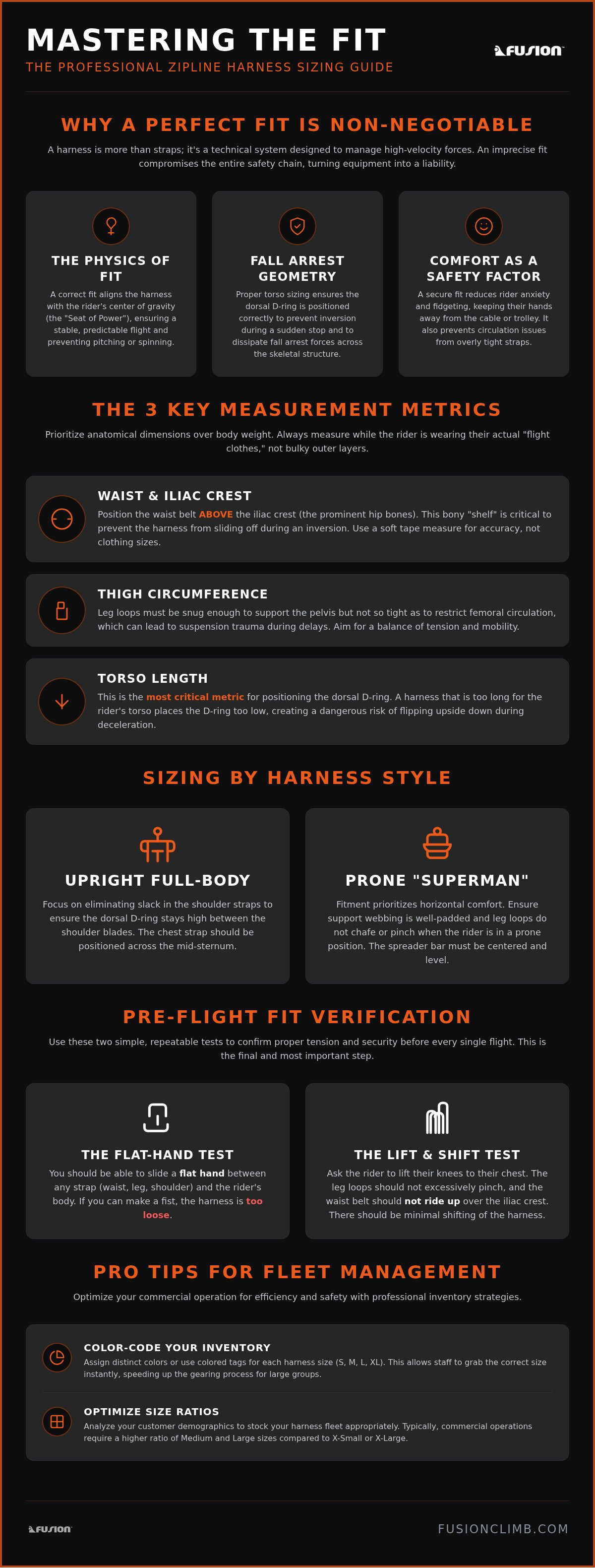
Torso length is the most critical metric for determining the height of the dorsal D-ring. If the harness is too long for the individual, the D-ring sits too low on the back, which can cause the rider to flip upside down during a sudden stop or impact. Oversized gear also introduces the risk of "sliding out" during steep descents or inversions. Fall arrest geometry is the precise alignment of high-tensile webbing against the body's primary load-bearing bones to dissipate energy without compromising spinal alignment.
Comfort as a Safety Factor
A rider's psychological state is often a reflection of their gear's fit. When a harness feels loose or shifts during the initial launch, the rider is more likely to panic and make erratic movements. They might reach for the cable or the trolley, creating an immediate safety risk for their hands and fingers. A snug, professional fit reduces "fidgeting" and keeps the rider's hands where they belong on the lanyards or handles.
Leg loop sizing is equally vital for physiological safety. Webbing that is too tight can restrict femoral circulation, while loops that are too loose fail to provide adequate support to the pelvis. This imbalance can lead to suspension trauma if a rider is left hanging for an extended period due to an operational delay. Following a zipline harness sizing guide helps operators identify these circulation risks before they become medical emergencies. Precision in sizing isn't just about comfort; it's the foundation of a compliant and safe operation.
The Measurement Checklist: 3 Key Metrics for a Perfect Fit
Weight is a deceptive metric. A 200-pound rider with a 34-inch waist requires a different setup than a 200-pound rider with a 42-inch waist. To implement a professional zipline harness sizing guide, you must prioritize anatomical dimensions over scale numbers. Measurements should always be taken while the rider is wearing their actual "flight clothes." Heavy coats or baggy sweatshirts create a false sense of volume. When the harness is under load, these fabrics compress, leaving the webbing dangerously loose against the body. Instruct participants to remove bulky outer layers before you begin the fitting process.
Waist and Hip Alignment
The waist belt must be positioned above the iliac crest. This is the flared portion of the hip bone that provides a natural shelf for the harness. Technical measurements frequently differ from "vanity sizing" used in the fashion industry. A rider might wear size 32 trousers but measure 36 inches at the iliac crest. Always use a soft tape measure to find the true circumference. If the harness sits below the hip bones, it can slide off during a fall or inversion. Ensuring the webbing passes over the bone structure is a non-negotiable safety requirement. This level of precision is consistent with OSHA guidelines for zip-line workers who rely on their gear for daily fall protection.
Thigh and Torso Scaling
Leg loops require a specific balance of tension and mobility. Before tightening the buckles, observe the "two-inch rule." There should be roughly two inches of space between the leg and the webbing. This gap ensures the rider can move their legs freely during the launch and landing phases without the harness "biting" into the skin. Once the rider is suspended, the loops should be snug enough to prevent the pelvis from shifting within the seat. If the loops are too loose, the rider's weight shifts backward, which can lead to an uncomfortable and unstable flight angle.
Torso girth is the defining measurement for full-body systems. To find this, run a tape measure from the top of the shoulder, down between the legs, and back up to the starting point. This vertical loop determines if the shoulder straps will sit correctly without compressing the spine. If the torso measurement is too short, the rider will be forced into a painful crouch. If it's too long, the dorsal D-ring will sit too low, compromising the fall arrest geometry discussed in the previous section. For operations managing diverse crowds, adjustable full body harnesses provide the necessary range to fit both tall and short riders safely. Using these three metrics allows your staff to select the correct size with industrial accuracy every time.
Sizing by Style: Full Body vs. Superman Zipline Harnesses
The selection between an upright full-body system and a prone-style harness changes the fundamental mechanics of the flight. While traditional sit harnesses prioritize pelvic support, professional operations often utilize more complex architectures to enhance the rider's experience or meet specific safety mandates. This zipline harness sizing guide highlights that a one-size-fits-all approach fails when transitioning between these two distinct styles. Each configuration demands a unique set of sizing priorities to maintain the rider's center of gravity and ensure mechanical clearance from the cable.
Full Body Harness Sizing Nuances
Full-body systems are designed to keep the rider in a strictly upright or slightly reclined position. The "Y-shape" torso straps must be adjusted to accommodate varying chest widths without pinching the neck or slipping off the shoulders. A critical verification point is the dorsal D-ring. It must sit precisely between the shoulder blades to ensure that, in the event of a fall, the force is distributed vertically through the spine. Operators must adhere to strict harness requirements for adventure parks to maintain ANSI Z359.11 compliance and ensure the attachment point remains accessible for rescue protocols. If the chest straps are too loose, the rider risks falling through the top of the harness during a sudden deceleration event.
Superman Style (Prone) Fitment Guide
Prone flight equipment, often called Superman harnesses, requires a specialized "hammock" fit that supports the rider from the chest to the mid-thigh. Unlike upright systems where the weight sits in the seat, prone gear distributes pressure across the entire anterior chain of the body. This makes torso length the most critical variable. Superman harnesses require more precise torso sizing than sit harnesses because the rider's entire weight is supported horizontally, making any slack in the length a direct risk to spinal alignment and trolley clearance.
Fusion Climb specializes in professional-grade prone flight equipment, utilizing rugged industrial webbing that maintains its shape under the constant tension of horizontal suspension. When fitting a Superman style harness, you must adjust the shoulder tethers to prevent the rider from sliding forward toward the trolley. If the torso section is too long, the rider will "sag," causing inefficient aerodynamics and potential contact with braking components. A properly sized prone harness should feel like a rigid extension of the rider's own frame. Precision here is the difference between a high-performance flight and a dangerous operational failure. By mastering these style-specific nuances, operators can provide a tailored safety experience for every participant.
The Fit Verification Checklist: Testing the Harness Before Flight
Measurements are theoretical until verified under tension. A professional zipline harness sizing guide is incomplete without a physical testing protocol to bridge the gap between donning gear and actual flight. Once the buckles are cinched, perform a series of manual checks to ensure the webbing is engaged correctly with the rider's anatomy. These tests confirm that the harness will not shift or fail when the rider transitions from the platform to the cable.
The "Four-Finger Rule" is the industry standard for leg and waist tension. Attempt to slide four fingers between the webbing and the rider's body. If you can fit a fifth finger or a whole hand, the harness is too loose and risks slippage during flight. Conversely, if four fingers cannot slide in, the fit is too tight and may cause discomfort or restricted movement. For chest and shoulder straps, utilize the "Flat-Hand Test." A flat hand should slide snugly between the chest webbing and the rider's torso. This ensures the rider can breathe deeply while remaining firmly secured within the frame.
Buckle security requires a visual and tactile audit. Every buckle must have a "tail" of excess webbing at least 3 inches long. This length provides a safety margin that prevents the webbing from unthreading under dynamic forces. If the tail is shorter than 3 inches, the harness is too small for the rider, and you must select a larger size. Consistent application of these checks ensures that every participant is secured with industrial precision.
Static and Dynamic Fit Checks
Begin with a static inspection. Trace every inch of webbing to ensure there are no twists. A twisted strap concentrates stress on a narrow section of the fabric, which can compromise the overall strength of the system. Ensure all "keepers" are securing the excess webbing to prevent it from snagging on pulleys or lanyards. Follow this with the "Jump Test." Have the rider perform three small jumps on the platform. If the waist belt migrates down toward the hips, the fit is incorrect and must be readjusted above the iliac crest.
Buckle and Hardware Security
Hardware verification is the final line of defense. If your operation uses traditional friction buckles, perform a double-back verification to ensure the webbing is locked. For auto-locking buckles, listen for the audible "click" and perform a pull-test to confirm engagement. Check every carabiner to ensure the gates are fully locked and that the hardware is not cross-loaded. For maximum reliability, equip your team with ANSI-compliant carabiners and hardware designed for high-cycle commercial use. Before the rider approaches the line, perform a "Suspension Test" using a training bar or low-clearance line. This final check allows the rider to feel the harness take their weight in a controlled environment, which reduces anxiety and confirms that the center of gravity is perfectly balanced.
Professional Inventory Management: Sizing for Zipline Operators
Efficiency in high-volume zipline operations depends on the speed and accuracy of gear selection. A robust zipline harness sizing guide is only as effective as the inventory it supports. Managing a diverse fleet requires a strategic approach to size distribution and maintenance cycles. Operators must ensure they have a sufficient quantity of gear to handle peak throughput while accounting for units that are temporarily out of service for inspection or cleaning. A common rule for commercial operators is to maintain enough harnesses for the maximum number of simultaneous riders, plus a 20 to 30 percent buffer for units in rotation.
Color-coding systems are the most effective way to manage a large fleet during high-volume periods. Assigning specific colors to different sizes, such as red for Small, blue for Medium, and black for Large, allows staff to identify the correct gear at a glance. This reduces errors during the harnessing process and ensures a smoother transition from the orientation area to the launch platform. Tracking "gear cycles" is equally vital. Every piece of equipment has a finite service life, typically 10 years from the date of manufacture. Maintaining a digital log of these dates alongside sizing data ensures that no harness remains in service beyond its safety window.
Fleet Sizing Strategy
While "Universal" harnesses claim to fit all body types, they often fail to provide a precise fit for riders at the extreme ends of the size spectrum. A professional fleet should be segmented to accommodate diverse demographics. For a standard adult-oriented course, a ratio of 20 percent Small, 50 percent Medium, and 30 percent Large or XL is a reliable baseline. Courses that welcome younger participants must prioritize junior-specific full-body harnesses. Simply tightening an adult harness to fit a child is a dangerous practice that compromises the center of gravity and safety geometry.
High weight capacity models are equally critical for inclusive operations. These specialized units ensure that riders up to 350 lbs are supported by webbing and hardware engineered to handle higher dynamic loads without sacrificing rider comfort or operational compliance. Fusion Climb provides wholesale solutions for commercial operators, offering a range of sizes that maintain industrial reliability across all rider profiles.
Inspection and Maintenance During Sizing
The fitment process serves as a final, critical checkpoint for equipment integrity. As staff adjust straps according to the zipline harness sizing guide, they must perform a tactile inspection of the webbing. Look for fraying, "fuzzing," or glazed fibers that suggest heat damage from friction. Any harness showing signs of structural wear must be pulled from the rotation immediately. Inspect carabiners, pulleys, and buckles for signs of corrosion or mechanical sluggishness. If an auto-locking gate does not snap shut instantly, the unit is a liability. Equip your course with professional Fusion Climb harnesses to ensure your fleet is built with the rugged reliability required for rigorous daily use. By integrating sizing protocols with a strict inventory management system, you protect both your riders and your business.
Standardizing Your Safety Protocol
Mastering the technical nuances of harness fitment transforms a standard zipline ride into a high-performance, compliant operation. By prioritizing anatomical measurements over generic weight ranges and implementing rigorous verification tests, you eliminate the risks associated with gear slippage and suspension trauma. This zipline harness sizing guide serves as your technical foundation for maintaining a safe, inclusive, and professional course environment. Precision in sizing is the most effective tool for reducing rider anxiety and ensuring mechanical clearance during high-velocity transits.
The integrity of your gear is the silent partner in every successful flight. Whether you're managing a high-volume commercial fleet or selecting equipment for a specialized prone experience, your hardware must meet the highest industrial standards. Fusion Climb provides the rugged industrial construction and ANSI Z359.11 compliant hardware trusted by national zipline operators to keep participants secure in vertical environments. Our specialized full-body and Superman style harnesses are engineered to withstand the rigorous demands of professional use while providing the adjustability required for diverse rider demographics.
Browse Professional Zipline Harnesses at Fusion Climb
Take the guesswork out of your safety checklist and focus on the thrill of the descent. With the right fit and professional-grade equipment, you can lead every rider into the air with absolute confidence and a sobering sense of security.
Frequently Asked Questions
How tight should a zipline harness be?
A harness must be snug enough that the webbing doesn't shift under load but loose enough to allow the rider to move their legs for landing. Apply the four-finger rule: you should be able to slide four fingers between the strap and the body, but not a whole hand. If the harness migrates down toward the hips during movement, it's too loose. Proper tension ensures fall arrest forces are distributed correctly across the skeletal frame.
Can I use a rock climbing harness for ziplining?
Professional zipline operations require gear specifically engineered for horizontal transits and terminal braking forces. While a climbing harness is designed for vertical falls, zipline-specific models often feature different attachment points and reinforced webbing. Using gear that isn't ANSI Z359.11 compliant in a commercial environment can lead to operational failure and safety violations. Always verify that your equipment is rated for the specific loads of a zipline course.
What harness size do I need for a child?
Children must be fitted with junior-specific full-body harnesses that secure the torso and shoulders. Sizing for kids is primarily determined by torso length to prevent them from slipping out during an inversion. Never attempt to "make it work" by over-tightening an adult seat harness. A dedicated child's model keeps the center of gravity stable and ensures the dorsal D-ring sits correctly between the small shoulder blades.
What is the weight limit for a professional zipline harness?
Professional harnesses typically accommodate a weight range between 40 lbs and 275 lbs, though high-capacity models can support up to 350 lbs. Always check the manufacturer's specific rating for each model in your inventory. Commercial operators must verify these limits to remain inclusive while staying within the safety margins of their braking systems. Exceeding these weight limits can cause excessive wear on webbing and hardware.
How do I know if my harness is too big?
A harness is too big if the waist belt slides below the iliac crest or if there isn't enough "tail" webbing after tightening. You should have at least 3 inches of excess webbing beyond the buckle for security. If the rider can pull the harness over their hips while it's buckled, it's a critical safety risk. Use a zipline harness sizing guide to verify that the webbing remains locked above the hip bones.
Does zipline harness sizing change for Superman style flight?
Prone flight requires a shift in measurement priorities, focusing heavily on torso length rather than just waist circumference. Because the rider is suspended horizontally, the harness must support the body like a rigid hammock. If the torso section is too long, the rider will sag, which affects aerodynamics and cable clearance. Precise sizing ensures the chest and thigh supports are perfectly aligned to handle horizontal suspension forces.
How often should zipline harnesses be inspected for safety?
Conduct a visual pre-use inspection before every session and a documented thorough inspection at least once every six months. Look for frayed fibers, glazed webbing, or sluggish hardware gates. Most professional harnesses have a maximum service life of 10 years from the date of manufacture. Retire any unit immediately if it shows structural damage or has been involved in a significant fall event, regardless of its age.
What measurements are needed for a full-body harness?
You need three primary metrics: the natural waistline at the iliac crest, the widest part of the thigh, and the total torso girth. Torso girth is measured by running a tape from the shoulder, through the crotch, and back to the shoulder. These measurements are essential for this zipline harness sizing guide to ensure the shoulder straps and dorsal D-ring are positioned correctly for maximum fall protection and rider comfort.