


The Best Harness for Zipline Riding: 2026 Buyer’s Guide for Safety and Comfort
Most riders assume a standard rock climbing harness is sufficient for a high-speed cable run; however, that mistake often leads to painful chafing and unsafe suspension angles. While climbing gear is designed for vertical falls, the best harness for zipline riding must manage sustained horizontal forces and provide hands-free stability. You deserve to focus on the view and the adrenaline, not on whether your equipment can handle the friction of a long, industrial-grade ride. We know that decoding safety specifications can feel overwhelming when you just want to get out on the line.
This 2026 guide simplifies the process by showing you exactly how to select gear based on riding style, industrial durability, and the latest ANSI Z359.11-2021 standards. You'll discover how to distinguish between recreational seat harnesses and professional-grade full-body systems that offer maximum safety assurance. We'll also explore the specialized world of Superman-style prone harnesses for those seeking a unique perspective. By the end of this article, you'll know how to invest in equipment that provides total comfort for better photos and lasts through years of heavy use.
Key Takeaways
- Understand why horizontal suspension forces demand specialized equipment over standard climbing gear to prevent chafing and maintain stability.
- Evaluate the differences between seat, full-body, and Superman-style designs to find the best harness for zipline riding based on your specific adventure goals.
- Ensure maximum safety by choosing gear that meets the ANSI Z359.11-2021 standard for industrial-grade performance and durability.
- Match your equipment to the specific line speed and braking system of your environment to guarantee a smooth, controlled experience.
- Prioritize professional-grade manufacturing to secure gear that withstands multiple seasons of heavy use in vertical environments.
The Critical Difference: Why Zipline Gear Isn’t Just Climbing Gear
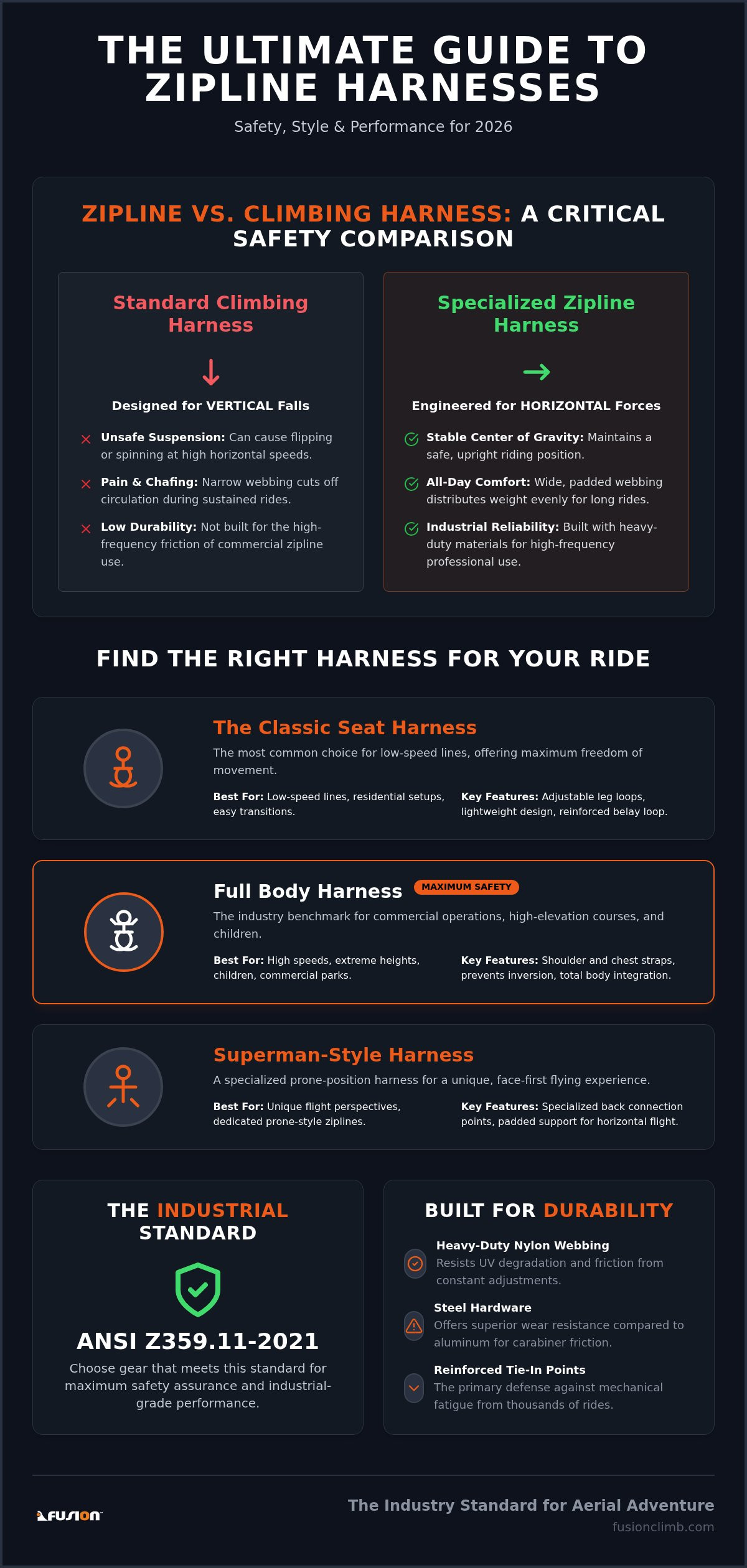
Many recreational users assume that a standard climbing seat is the best harness for zipline riding. That is a dangerous assumption. Rock climbing gear is engineered to catch a vertical fall in a static environment. In contrast, zipline equipment must manage sustained horizontal suspension and the intense deceleration forces of a zip brake. A professional safety harness for aerial adventure is designed with a specific center-of-gravity placement. This prevents the rider from flipping or spinning uncontrollably during the ride. Without this precision engineering, you aren't just uncomfortable; you're at risk of mechanical failure or impact injury.
Suspension Physics and User Comfort
Zipline runs can last several minutes and cover thousands of feet. A standard climbing harness often cuts off circulation because the webbing is narrow. It's meant for short bursts of sitting while a partner belays. Specialized zipline designs use wider, padded webbing to distribute weight across the thighs and lower back. This prevents the "numb leg" syndrome that ruins the experience. Staying upright is also a safety requirement. If you go limp or inverted during a high-speed stop, you risk serious injury. The best harness for zipline riding keeps your torso engaged and your head clear of the trolley throughout the entire descent. In the same way that the high-performance engineering from 2XU optimizes output and comfort for athletes during the most demanding segments of a triathlon, choosing the right technical equipment is essential for any high-intensity activity.
Durability Requirements for High-Frequency Use
Commercial operations don't just use gear; they punish it. A recreational climber might use their harness twice a month. A professional zipline park puts a single harness through ten cycles an hour, every day of the season. This high-frequency use requires industrial reliability. We prioritize materials that can withstand the rigors of a professional environment:
- Heavy-duty nylon: Resists UV degradation and friction from constant buckle adjustments.
- Steel hardware: Offers superior wear resistance compared to aluminum when facing constant carabiner friction.
- Reinforced tie-in points: These are the primary defense against mechanical fatigue that occurs over thousands of rides.
When you choose a harness, you're choosing the link between the rider and the cable. Industrial-grade manufacturing ensures that this link doesn't weaken after a single season. We focus on rugged construction because in the vertical world, there's no room for equipment that only works "some of the time." Every stitch and buckle must meet a standard that exceeds recreational expectations.
Comparing Harness Styles: Seat, Full Body, and Superman Designs
Selecting the correct equipment requires an understanding of how geometry affects rider stability. While many assume any strap system will do, the best harness for zipline riding is chosen based on the specific physics of the course. Whether you are managing a backyard recreational line or a high-speed commercial canopy tour, the harness style dictates both safety and comfort levels. Your choice should reflect the age of the rider, the speed of the line, and the required level of vertical security.
The Classic Seat Harness
Seat harnesses are the most common choice for low-speed lines and residential setups. They offer maximum freedom of movement, allowing riders to easily climb platforms or transition between lines. However, they rely on the rider’s ability to maintain an upright seated position. When selecting a seat harness, prioritize models with adjustable leg loops and reinforced belay loops. These features ensure a snug fit across different body types and provide a sturdy connection point that resists friction wear over time. This style is ideal for those who want a lightweight, minimalist experience without the bulk of a full-body system.
Full Body Harnesses for Maximum Security
For high-elevation courses and commercial operations, the full body climbing harness style is the industry benchmark. These systems are essential for children, whose higher center of gravity makes them prone to flipping backward in a standard seat harness. By securing the shoulders and chest, these harnesses prevent the rider from falling out if they become inverted during a sudden stop. They provide a sobering sense of security in high-consequence environments where "flip" risks are unacceptable. If your course involves active braking or extreme heights, this level of total body integration is non-negotiable.
Superman Style: The Ultimate Prone Flight Experience
The Superman style zipline harness offers a head-first, prone flight experience that traditional seats cannot replicate. This design requires specialized engineering to support the rider's weight horizontally while maintaining a safe "head-up" angle. Because of the unique orientation, these models require specialized tethers and pulleys to function correctly. They transform a standard ride into a high-intensity flight, boosting the thrill factor for adventure seekers without compromising on industrial safety standards. It's the best harness for zipline riding when the goal is pure, unadulterated speed and a bird's-eye perspective.
Choose with precision. Your gear must match the demands of the environment. For those looking for professional-grade hardware that bridges the gap between adventure and absolute safety, explore our range of zipline harnesses to find your ideal match.
Evaluating Safety Standards: ANSI Z359.11 and Manufacturing Integrity
Safety isn't a suggestion; it's a measurable standard. When you search for the best harness for zipline riding, you must look beyond the padding and aesthetics to the technical certifications that govern the gear. The ANSI Z359.11 standard is the definitive benchmark for full-body harnesses in the United States. This certification ensures the equipment can withstand the extreme forces of fall arrest and sustained suspension. Independent lab testing validates every claim. Manufacturers must prove their gear performs under pressure before it ever reaches a customer. To verify a product's integrity, check the hardware for permanent safety markings. Genuine professional gear features laser-etched or stamped certifications that won't wear off with use.
Understanding Strength Ratings (kN)
KiloNewtons (kN) represent the units of force used to measure the breaking point of safety hardware, with 23kN serving as the critical industry benchmark for structural reliability. This rating equals approximately 5,170 pounds of force. Our carabiners and pulleys are marked with these ratings to provide immediate technical assurance. It's vital to understand the difference between static and dynamic load testing. Static testing involves a slow, steady pull to find the ultimate breaking strength. Dynamic testing simulates a real-world fall or sudden stop. Both tests are essential to ensure the best harness for zipline riding can handle the unpredictable energy of a high-speed cable run.
The Value of US-Based Manufacturing
Domestic production offers a level of quality control that overseas manufacturing simply can't match. We maintain a direct line of sight from the raw materials to the finished product. This allows for total traceability. We know the origin of every yard of heavy-duty nylon webbing and every forged steel component. Fusion Climb has built a legacy of rugged confidence since 1998 by prioritizing these meticulous standards. Rigorous testing isn't a hurdle for us; it's the foundation of our craft. We act as a dependable guardian for our users. By keeping manufacturing in-house, we ensure that every piece of hardware meets the sobering demands of the vertical industry. Substance always wins over style in high-stakes environments.
- Industrial Durability: US-made gear is engineered for high-frequency commercial use.
- Material Traceability: Every component is tracked from the forge to the final stitch.
- Standard Compliance: Focus remains on meeting or exceeding ANSI Z359.11-2021 requirements.
Selection Guide: Choosing the Best Harness for Your Ride
Selecting the best harness for zipline riding requires a methodical approach that balances human factors with technical physics. You can't simply grab any strap system and head for the cable. First, determine the rider's age, weight, and experience level to establish the baseline support needed. Second, match the harness to the line speed and braking system; high-velocity runs demand more robust padding and security. Third, verify hardware compatibility between your carabiners, lanyards, and pulleys to avoid mechanical interference. Fourth, assess the need for adjustability if you're operating in a commercial environment with diverse body types. Finally, perform a sobering inspection for any manufacturing defects before that first ride.
In commercial parks, the equipment must be versatile. Gear that features quick-adjust buckles allows staff to secure riders efficiently without compromising safety. This speed is vital for maintaining throughput during peak hours. Before any gear enters service, check every stitch and forged component. Look for consistency in the webbing and ensure all buckles operate smoothly. This final check is your last line of defense. Precision in selection leads to reliability in the field.
Sizing and Fitment for Safety
Proper fit is the difference between a secure flight and a dangerous hazard. Follow the "two-finger" rule: you should not be able to fit more than two fingers between the webbing and the rider's body. Sizing for children in full-body gear is particularly critical because their smaller frames can slip through adult-sized openings. For full-body models, ensure the dorsal D-ring sits squarely between the shoulder blades. This positioning guarantees that the harness will keep the rider upright during suspension, preventing dangerous tilting or inversion. A snug fit ensures the load is distributed across the major muscle groups rather than sensitive soft tissue.
Hardware Integration
A harness is only as safe as the components attached to it. Finding the best harness for zipline riding means looking at the system as a whole. Selecting the right zipline lanyards and tethers is essential for maintaining the correct distance from the cable. We recommend auto-locking carabiners because they eliminate the risk of human error during the gate-closing process. Match your pulley speed to the harness weight distribution; a mismatch can lead to uneven wear or a jerky ride experience. Integrated systems provide the smoothest progression through the course and reduce the risk of hardware binding.
To ensure your setup meets industrial standards and provides maximum protection, buy professional zipline hardware directly from a specialized manufacturer.
Why Fusion Climb is the Industry Standard for Aerial Adventure
Fusion Climb is not a mere distributor; we are a US-based manufacturer that has served as a dependable guardian in the vertical industry since 1998. This 25-plus year legacy provides a foundation of rugged confidence for every rider and park operator. When you are looking for the best harness for zipline riding, the manufacturer's history matters. Buying directly from a specialized expert ensures that you aren't receiving a generic, mass-produced product. You are investing in gear designed with industrial reliability as the primary objective. We maintain a no-nonsense approach to manufacturing that prioritizes substance over marketing fluff. This dedication ensures our equipment supports both the high-volume demands of commercial parks and the personal safety of recreational enthusiasts.
Our status as an industry leader is rooted in our role as a silent partner in your adventure. We understand that in high-stakes environments, there's no room for equipment that only works under ideal conditions. Professional-grade engineering means our harnesses are built to withstand the relentless cycle counts of a busy commercial season. By controlling the manufacturing process from start to finish, we maintain a level of precision that resellers can't replicate. This authoritative expertise is why park managers and safety officers trust our hardware for their most demanding courses.
Innovation in the Superman Style
We have long been a leader in prone-flight harness design, pioneering the engineering required for "head-first" aerial experiences. Our Superman-style harnesses are built to enhance the user’s sense of flight without compromising the sobering security required for high-speed runs. We operate under a "silent partner" philosophy. This means our gear works seamlessly in the background, allowing the rider to focus on the thrill while we handle the technical physics of suspension. By refining the geometry of horizontal flight, we provide the best harness for zipline riding for those seeking the ultimate bird’s-eye perspective. Every stitch and buckle reflects a meticulous commitment to professional-grade craftsmanship.
A Complete Safety Ecosystem
Safety is most effective when it is integrated. A single-manufacturer safety chain ensures that every component-from commercial zipline pulleys to lanyards and carabiners-is engineered to function as a unified system. This eliminates the uncertainty that often comes from mixing hardware from different sources. When every piece of gear originates from the same rigorous testing environment, the overall integrity of the setup is significantly higher. We provide a complete vertical solution that allows you to build a safe, durable, and high-performance zipline course. Whether you're outfitting a new commercial canopy tour or upgrading a private line, our ecosystem offers the precision you need. Ready to fly? Explore the Fusion Climb zipline collection today.
Secure Your Vertical Future
Success on the cable depends on the integrity of your equipment. You now understand why the best harness for zipline riding requires specialized geometry to handle horizontal forces and sustained suspension. Whether you choose a classic seat design for recreational use or a full-body system for maximum security, prioritizing industrial standards is non-negotiable. Look for gear that meets the ANSI Z359.11-2021 certification to ensure your equipment can handle the unpredictable energy of a high-speed run.
Fusion Climb remains a dependable guardian in the industry with over 25 years of manufacturing expertise. We provide ANSI Z359.11 compliant options and specialized Superman style harnesses for those seeking a unique prone-flight experience. Our commitment to rugged, US-based manufacturing means you don't have to choose between adventure and sobriety. We build hardware that lasts through multiple seasons of heavy use; it acts as your silent partner in the vertical world.
Ready to elevate your experience? Upgrade Your Adventure with Fusion Climb Zipline Gear and enjoy the peace of mind that comes with professional-grade hardware. Step off the platform with confidence and let the thrill take over.
Frequently Asked Questions
Is a rock climbing harness safe for ziplining?
While a climbing harness provides basic fall protection, it lacks the horizontal stability and padding required for long rides. The best harness for zipline riding is engineered to manage sustained suspension and high-speed braking forces. Climbing seats can cause discomfort or "numb leg" syndrome during extended use because they aren't designed for horizontal weight distribution. Always prioritize gear built for the specific physics of the cable.
What is the weight limit for a professional zipline harness?
Professional harnesses typically support a maximum weight capacity of 310 pounds, though this varies by model. The industrial safety standard focuses more on the tensile strength of the hardware, which must meet 5,000 pounds (23kN) of force. Always check the manufacturer markings for the exact weight rating. Operating within these limits ensures the gear functions as designed during sudden stops or emergency braking scenarios.
How often should a zipline harness be inspected and retired?
You must perform a visual inspection before every ride and a thorough technical review every six months. Standard industry guidelines suggest retiring textile components after five to ten years of use, even if no damage is visible. Factors like UV exposure, chemical contact, and high cycle counts in commercial parks can accelerate this timeline. If you notice frayed stitching or glazed webbing, take the equipment out of service immediately.
What makes a "Superman style" harness different from a seat harness?
A Superman style harness utilizes a prone geometry that allows the rider to fly head-first, whereas a seat harness keeps the user upright. This specialized design requires multiple attachment points and unique tethers to maintain a safe, horizontal flight angle. It transforms the experience into a bird's-eye perspective. Because the physics of prone flight are distinct, these systems must be used with compatible high-speed trolleys and braking systems.
Do children need a special type of zipline harness?
Children require full body harnesses to account for their higher center of gravity and smaller frames. Standard seat harnesses pose a "flip" risk for kids, who may become inverted and slip out of the leg loops during a sudden stop. A full body system secures the shoulders and chest, keeping the child upright and safe. This configuration provides a sobering level of security for younger riders in high-elevation environments; additionally, parents looking to build their child's physical confidence safely at home can explore Retail of indoor home gym and playground equipment as an excellent resource.
What safety certifications should I look for when buying a harness?
Look for the ANSI Z359.11-2021 certification for full body systems and CE EN 12277 for recreational seat models. These markings prove the gear has passed rigorous dynamic and static load testing in independent labs. Professional hardware should also feature etched KiloNewton (kN) ratings. Choosing certified equipment ensures that your gear meets the industrial reliability standards required for high-stakes aerial adventure and commercial operations.
Can I use a zipline harness for other activities like rock climbing?
You should not use a dedicated zipline harness for rock climbing. Zipline gear is often too bulky for technical climbing maneuvers and lacks the specific energy-absorbing characteristics needed for lead climbing falls. While some hybrid models exist, most professional zipline harnesses are optimized for horizontal travel and suspension comfort. Using the wrong tool for the environment compromises your safety and the longevity of the equipment.
How do I clean and maintain my zipline harness for longevity?
Clean your harness using only mild soap and lukewarm water to remove dirt and salt. Never use harsh chemicals or pressure washers, as these can degrade the nylon fibers. Air dry the gear in a well-ventilated area away from direct sunlight. UV rays are a silent enemy of textile strength. Store your equipment in a cool, dry place to prevent mildew and maintain the integrity of the stitching.