


Tandem Zipline Pulleys: Professional Guide to High-Speed Stability and Safety
What if the vibration ruining your rider's experience isn't coming from the cable, but from the very tandem zipline pulleys supposed to glide across it? Professional operators understand that a twisting trolley or a jittery descent does more than just unsettle a customer; it aggressively wears down your overhead lines and inflates your maintenance budget. You need equipment that tracks straight and stays cool under the intense friction of high-velocity runs. It's a high-stakes environment where hardware failure simply isn't an option.
Mastering the technical specifications and 2026 safety standards of your hardware is the only way to ensure a stable, high-performance ride every time. This guide provides the professional insight needed to achieve a smooth, vibration-free experience while meeting rigorous industry certifications like ANSI Z359.11. We will break down the physics of dual-bearing heat management, the necessity of traceable life histories for ASTM F2959-26 compliance, and the specific engineering required to eliminate trolley twisting on the line.
Key Takeaways
- Understand how the dual-sheave configuration of tandem zipline pulleys eliminates the yaw effect and ensures a straight, stable track on the cable.
- Learn to identify the engineering differences between aluminum and stainless steel construction to match hardware durability with your course's rider volume.
- Reduce cable vibration and harmonic oscillation by selecting the optimal sheave diameter for your specific zipline length and speed requirements.
- Implement rigorous daily inspection checklists and maintain compliance with updated 2026 safety standards like ANSI Z359.11 and ASTM F2959-26.
- Build a high-performance system by integrating specialized gear such as Superman style harnesses and professional-grade steel auto-locking carabiners.
Understanding Tandem Zipline Pulleys: Why Two Wheels Are Better Than One
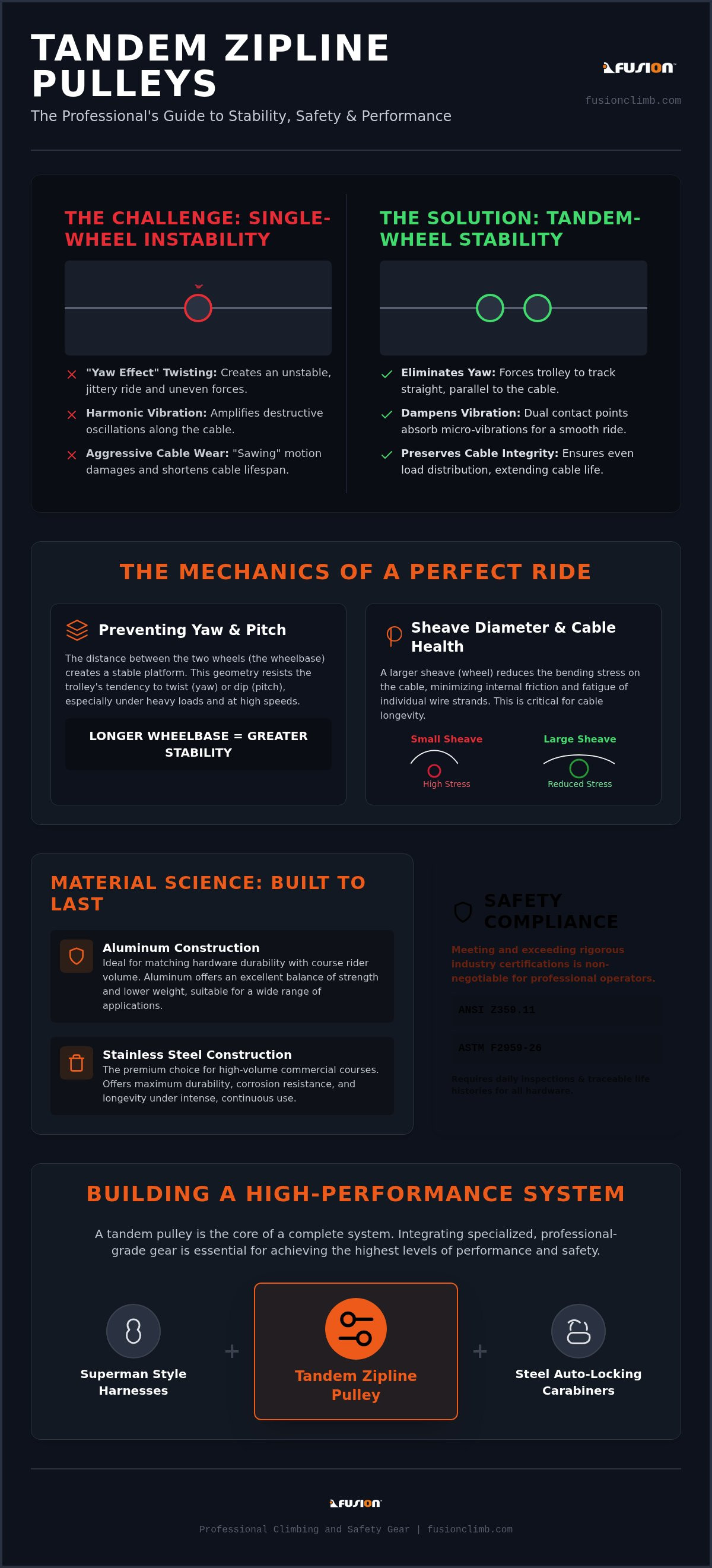
A tandem pulley is defined by its dual-sheave configuration, where two wheels are aligned in a single row within the frame. This design doesn't just double the contact points; it fundamentally changes how the hardware interacts with the cable. By distributing the load across two separate sheaves, these units provide the lateral stability required for high-velocity travel. While a single-wheel pulley might suffice for basic hauling, tandem zipline pulleys are the non-negotiable standard for professional courses where safety and ride quality are paramount.
The most critical advantage is the elimination of the "yaw" effect. In zipline mechanics, yaw refers to the tendency of a trolley to twist or pivot around the vertical axis of the cable. When a single-wheel pulley encounters a slight imbalance or a crosswind, it can oscillate, causing friction and an unstable ride. Tandem wheels act as a stabilizing track. They force the trolley to remain parallel to the cable, which prevents the "sawing" motion that destroys galvanized steel lines and unsettles riders.
Commercial operators rely on this stability for several reasons. High-speed lines, often exceeding 60 mph, generate significant kinetic energy that a single wheel cannot manage safely. Long-distance spans also benefit from reduced harmonic oscillation. When you're rigging for heavy payloads or professional tandem rider setups, the dual-point distribution ensures the hardware doesn't bite into the cable under extreme tension.
Tandem vs. Single Pulley Systems
Single pulleys are precision tools designed for vertical hauling, mechanical advantage systems, and slow-speed rescue maneuvers. They excel in static environments but fail to track accurately during rapid horizontal movement. Tandem trolleys are engineered specifically for horizontal cable travel and friction management. Tandem pulleys serve as the essential hardware for maintaining consistent cable alignment throughout the entire length of the run.
The Role of the Trolley Frame
The frame is the backbone of the assembly. Professional-grade trolleys feature reinforced side plates that provide impact resistance against braking systems and terminal structures. These plates must be rigid enough to prevent sheave misalignment under load. The geometry of the frame also dictates the center of gravity. A well-designed attachment point for carabiners and lanyards ensures that the rider's weight pulls directly downward, further stabilizing the sheaves against the cable. This alignment reduces wear on the bearings and extends the operational life of the equipment in high-volume environments.
The Mechanics of Stability and Cable Tracking
High-speed descents generate intense kinetic energy. This energy often manifests as harmonic oscillation, a destructive vibration that travels through the cable. Single-wheel pulleys exacerbate this by allowing the trolley to bounce or "skip" at peak velocities. Professional tandem zipline pulleys mitigate this by maintaining two constant points of contact. This dual-point engagement acts as a mechanical damper. It absorbs micro-vibrations before they can amplify into dangerous oscillations, protecting both the rider's comfort and the course's structural integrity.
Sheave diameter plays a decisive role in cable longevity. When a cable wraps around a small wheel, it undergoes significant bending stress. Over time, this leads to individual wire strand fatigue and eventual failure. Larger sheaves reduce the "bend radius," which minimizes internal friction within the cable core. Precision wheel alignment is equally vital. If the sheaves aren't perfectly parallel, one wheel will carry more load than the other. This imbalance causes uneven tracking and "scarring" on the cable surface. We emphasize precision-machined sheaves to ensure that every run remains smooth and every cable remains intact, even under the stress of high-volume commercial throughput.
Preventing Yaw and Pitch in Flight
Stability during flight is a function of geometry. The distance between the wheels on tandem zipline pulleys determines how effectively the trolley resists pitch and yaw. A longer wheelbase provides a more stable platform, preventing the front of the trolley from dipping or the entire unit from twisting side-to-side. This is especially critical as rider weight increases. Heavier payloads create higher tension, which makes the system more sensitive to tracking errors. Using dual-track pulleys for ultra-stable commercial lines ensures that even the most aggressive descents feel controlled and predictable. Proper tracking reduces the lateral forces that can cause a trolley to "climb" the side of the cable groove.
Cable Compatibility: Steel vs. Synthetic
Material science dictates your maintenance schedule. For standard galvanized steel zipline cables, stainless steel sheaves are mandatory. Using softer materials like aluminum on steel cables leads to rapid sheave deformation and "metal transfer," which compromises the integrity of both the pulley and the line. Proper material selection also prevents galvanic corrosion, a chemical reaction that occurs when dissimilar metals meet in humid environments. To maximize the lifespan of your course, it's essential to consult a comprehensive commercial zipline pulleys guide before finalizing your hardware choices. Investing in the right metallurgy today prevents costly cable replacements tomorrow.
Material Science: Steel vs. Aluminum and Bearing Types
The operational lifespan of tandem zipline pulleys depends largely on the metallurgy of their frames and sheaves. For recreational users or tactical applications where weight is a primary concern, aircraft grade 7075-T6 aluminum offers an ideal strength to weight ratio. This material provides the necessary rigidity to handle high loads without adding unnecessary bulk to a rider's kit. However, commercial operators running hundreds of cycles daily require the industrial resilience of stainless steel. Steel construction resists the abrasive "grind" of galvanized cables far more effectively than aluminum, ensuring the hardware doesn't deform under constant use.
Strength ratings are a non-negotiable metric for any professional rigger. Most high performance trolleys feature a Minimum Breaking Strength (MBS) ranging from 20kN to 40kN. Adhering to Critical Safety Standards requires that your pulley's MBS exceeds the maximum potential force of your system by a significant safety factor. Beyond raw strength, heat dissipation remains a silent challenge on long, fast spans. As friction builds during a 60 mph descent, the sheaves can reach temperatures that compromise internal lubricants. Stainless steel maintains its structural integrity at these higher temperatures, making it the superior choice for "big air" lines where speed and distance are maximized.
Sealed Ball Bearings vs. Bushings
Precision movement is governed by what sits inside the sheave. Sealed ball bearings are the industry standard for high speed and low friction; they utilize small steel spheres to allow the wheel to spin with minimal resistance. This is why dual bearing systems are preferred for zipline speeds exceeding 60 MPH. In contrast, self-lubricating bushings are solid sleeves designed for durability in lower speed environments or heavy material hauling. While bushings are rugged and require less maintenance, they lack the "free spin" required for an exhilarating rider experience. The direct correlation between bearing efficiency and heat management determines how long a pulley can operate at peak velocity before internal components degrade.
Sheave Hardness and Wear Patterns
Sheave hardness dictates how the hardware interacts with the cable over time. Hardened steel sheaves are designed to be tougher than the cable itself, which prevents the pulley from developing "grooves." If you notice a deep V-shaped wear pattern in your sheaves, it's a sign of material fatigue and an immediate trigger for retirement. Soft aluminum sheaves used on steel cables will "scar" quickly, leading to metal transfer that can damage the zipline. Regular tactile inspections should feel for any burrs or sharp edges that could snag a lanyard. Once a sheave shows significant grooving or the bearings feel "gritty" when spun by hand, the unit has reached the end of its safe operational life.
Critical Safety Standards and Inspection Protocols
Safety isn't a suggestion. It's the foundation of every aerial operation. Professional tandem zipline pulleys must meet rigorous certifications to ensure rider security. Standards like ANSI Z359.11 and CE EN 12278 provide the benchmarks for manufacturing quality and structural integrity. These certifications ensure that your hardware can withstand the dynamic forces encountered during a high-speed descent. We treat these standards as the absolute minimum requirement for any piece of gear that leaves the factory.
Before the first rider clips in, every pulley requires a thorough tactile and visual assessment. Operators should follow a strict daily checklist to identify potential failures before they occur. Look for the following indicators during your morning inspection:
- Check for hairline cracks or deformation in the reinforced side plates.
- Verify that both sheaves spin freely and quietly without any "gritty" sensation.
- Inspect the primary attachment point for signs of elongation or sharp burrs.
- Ensure all axle bolts are secure and show no signs of backing out.
Redundancy is the hallmark of professional rigging. A primary connection to the trolley should always be paired with a secondary backup. This usually involves a secondary lanyard and a high-strength safety carabiner. If a single component fails, this backup ensures the rider remains securely attached to the cable. Retirement criteria are equally strict. Pull a pulley from service immediately if it shows 10% material wear, has been dropped from height, or if the bearings exhibit any lateral "play."
MBS and Safe Working Load (SWL)
Strength markings are etched into the frame for a reason. In professional ziplining, we often apply a 10:1 safety factor to account for shock loading and material fatigue. If a trolley is rated for a 40kN Minimum Breaking Strength (MBS), its Safe Working Load (SWL) in a commercial environment is typically 4kN. This buffer is critical for managing the unpredictable forces of a rescue or a heavy payload. For a complete safety setup, ensure your zipline lanyards and tethers match these high engineering standards.
Hardware Maintenance and Cleaning
Environment dictates care. Pulleys used in salt-air or dusty regions require a fresh-water rinse and thorough drying to prevent pitting and corrosion. Don't fall for lubrication myths. Most high-performance tandem zipline pulleys use sealed ball bearings that are packed with specialized grease at the factory. External oiling actually attracts grit and dust, which acts like sandpaper inside the bearing race. Store your gear in a cool, dry place away from chemical fumes to prevent material degradation over time.
Optimizing Your Zipline System with Fusion Climb Gear
A high-performance trolley is only one component of a secure aerial system. To achieve the best results, tandem zipline pulleys must be integrated with hardware that matches their engineering precision. For operators looking to offer a unique experience, pairing these pulleys with Superman style zipline harnesses allows for stable, prone flight. The dual-sheave design of the trolley provides the necessary tracking to keep a prone rider perfectly aligned with the cable throughout the descent. It's about creating a seamless connection between the rider and the line.
Selecting the right connectors is equally vital. While aluminum carabiners are common in recreational climbing, professional zipline courses demand the durability of steel auto-lockers. Steel resists the constant friction and vibration of the trolley's attachment point far better than softer alloys. Integrating shock-absorbing lanyards into your setup also ensures smoother arrivals at the landing platform. These lanyards dissipate the energy of the braking system; this reduces the physical impact on the rider and extends the life of your hardware. Fusion Climb’s commitment to industrial-grade reliability ensures that every component meets the highest manufacturing standards for long-term use.
Complete System Integration
Maximum safety is achieved through a holistic approach to rigging. Connecting the tandem trolley to a full body harness provides the most secure configuration for riders of all sizes. It's essential to use professional climbing carabiners for all primary attachments to ensure the gate remains locked under dynamic loads. For commercial parks aiming for zero-failure redundancy, setting up dual-cable systems is a recommended practice. This configuration utilizes two parallel cables and two separate tandem zipline pulleys, providing a complete backup for every rider on the line.
Why Professional Operators Choose Fusion Climb
Fusion Climb embodies the personality of a dependable guardian in the vertical world. Since 1998, we've focused on manufacturing gear that stands up to the rigors of tactical and commercial environments. We don't just sell individual parts. We provide custom solutions for ropes courses and aerial adventure parks that require specialized equipment. Our manufacturing heritage is rooted in the traditional values of strength and meticulous quality control. Every piece of hardware is tested for real-world application. When your riders push their physical limits, they do so with the backing of professional-grade engineering and rugged reliability.
Securing High-Performance Descents for the Long Haul
Investing in precision-engineered hardware is the only way to ensure the longevity of your course and the safety of your riders. By utilizing tandem zipline pulleys, you eliminate the destructive yaw effect that causes cable scarring and unstable descents. Choosing the correct metallurgy, such as stainless steel for high-volume commercial lines, ensures your equipment can handle the heat and friction of peak velocities without compromise. Adhering to the updated 2026 safety standards is more than a regulatory requirement; it's a commitment to professional excellence.
Since 1998, Fusion Climb has served as a dependable guardian for the vertical industry, specializing in professional rigging and specialized zipline hardware. Our gear is trusted by commercial adventure parks nationwide to deliver consistent, industrial-grade reliability. Whether you are rigging a new long-distance span or upgrading a high-speed line, our hardware provides the rugged confidence you need for every run. Shop industrial-grade tandem pulleys at Fusion Climb and build a system that stands the test of time. Take the next step in elevating your aerial operations with equipment designed for the most demanding environments.
Frequently Asked Questions
What is the difference between a zipline pulley and a zipline trolley?
A zipline pulley usually refers to the single mechanical component consisting of a sheave and side plates, while a zipline trolley is the complete assembly engineered for horizontal travel. In the industry, "trolley" describes hardware with fixed side plates and multiple sheaves designed for rider transport. Tandem zipline pulleys serve as the core of these trolleys. While a simple pulley might be used for hauling, a trolley includes reinforced attachment points for lanyards.
Can I use a tandem pulley on a rope zipline or is it only for steel cable?
Compatibility depends entirely on the material of the sheaves. Stainless steel sheaves are designed exclusively for galvanized steel cables. If you use steel sheaves on a rope zipline, the hard metal will quickly abrade and melt the synthetic fibers. For rope applications, you must select pulleys with aluminum or plastic sheaves. Always verify the manufacturer's specifications to ensure the hardware matches your specific line material to prevent catastrophic failure.
What speed is considered 'high speed' for a tandem zipline pulley?
In professional rigging, speeds exceeding 60 MPH are classified as high speed. At these velocities, the friction between the sheave and the cable generates significant thermal energy. Tandem zipline pulleys designed for these environments utilize dual-bearing systems to manage this heat effectively. Without precision bearings, the internal lubricants can break down, leading to bearing seizure. High-speed runs also require larger sheave diameters to reduce cable fatigue and ensure a smooth rider experience.
How often should I replace the bearings in my zipline trolley?
Most professional zipline trolleys utilize sealed ball bearings that are not designed for individual replacement. Instead of a set schedule, replacement is dictated by rigorous inspection results. You should retire the entire unit if the sheaves feel "gritty" when spun by hand or if you detect lateral movement in the axle. In high-volume commercial parks, this might occur after several thousand cycles. Regular cleaning and proper storage are the only ways to extend this hardware's lifespan.
What does the kN rating on a tandem pulley actually mean for safety?
The kilonewton (kN) rating represents the Minimum Breaking Strength (MBS), which is the force required to cause structural failure. One kN is approximately 225 pounds of force. For safety, you must apply a safety factor, often 10:1 in commercial settings. This means a 40kN pulley has a Safe Working Load (SWL) of 4kN, or about 900 pounds. This buffer accounts for the dynamic "shock" loads that occur during braking or emergency maneuvers.
Is a tandem pulley safer than a single wheel for my backyard zipline?
A tandem pulley is significantly more stable than a single-wheel model for any application, including backyard setups. The dual-sheave design prevents the trolley from twisting on the cable, which is known as yaw. This stability reduces the risk of the trolley "climbing" the side of the line and jumping off. It also provides a much smoother ride by dampening the vibrations that single-wheel pulleys often transmit directly to the rider's harness.
How do I know if my tandem pulley is compatible with my carabiner?
Compatibility is determined by the size and shape of the primary attachment point on the trolley frame. Your carabiner must be able to rotate completely through the hole without binding or catching on the side plates. If the carabiner is too large, it can cause "tri-axial loading," which puts stress on the gate rather than the spine. We recommend using large-capacity steel auto-locking carabiners to ensure a secure, unobstructed connection to your tandem trolley.
What are the signs that a zipline pulley has reached its retirement age?
Retirement is mandatory when the hardware shows signs of structural fatigue or excessive wear. Look for "grooving" in the sheaves where the cable has worn a deep track into the metal. If the side plates are deformed, cracked, or show more than 10% material loss from friction, the unit is unsafe. Any pulley that has survived a significant drop onto a hard surface or an accidental impact should be pulled from service immediately, regardless of visible damage.