



Custom Fit Superman Zipline Harnesses for Zipline Operators
A custom fit Superman zipline harness needs to suit the rider’s fit and the course’s trolley connection. This face-first ride uses a three-point connection to attach the harness to the trolley, so compatibility matters alongside adjustability and safety certification.
For operators, a secure-feeling fit is only part of the decision. The harness must also work with the equipment and operating setup used on the course. This guide explains how adjustability affects fit, what to consider when reviewing safety certification, and how trolley compatibility shapes the selection. You’ll also learn how custom sizing can support a better match between rider and equipment, and where Superman-style harnesses and related zipline gear fit into the process.
Key Takeaways
- Assess adjustability alongside the rider’s fit, and treat safety certification as a separate selection criterion.
- Match the harness attachment to the course trolley setup; the described connection uses three points.
- Use the available size range, XS/S/M/L/XL, as a starting point for planning operator fit requirements.
- A consistent measuring and fitting process can help operators evaluate whether a harness suits their riders and equipment.
Harness adjustability and safety certification
The harness has a maximum weight range of 150 kg, and its listed size range is XS/S/M/L/XL. Fit also depends on body proportions; height limits aren’t established by the available specifications.
Fit Limits by Rider Size
Start with rider weight, then consider torso length, shoulder width, and leg fit. A rider within the 150 kg maximum may still need a different size for secure positioning. The harness is listed in four available sizes, shown as XS/S/M/L/XL. Use those size options to organize fit assessments, rather than treating weight as the only criterion.
For a Superman position, assess whether the harness supports the rider face-forward and stays stable on the body. Height alone doesn’t describe torso or limb proportions, so don’t infer a cutoff from size labels. Consider the rider’s fit needs and assess the fit before operational use.
Safety Certification
Certification must apply to the specific harness model and intended use. A document for another model or configuration doesn’t establish certification for this equipment. Review the certification information associated with the exact harness, including its scope and any stated use conditions. No certification standard or certificate is identified here, so don’t represent this harness as certified to a particular standard.
Keep certification and fit as separate checks. The correct size doesn’t establish compliance, and certification doesn’t show that every rider fits properly. Confirm the documentation for the harness model, then assess rider fit within the stated limits. Neither check replaces the other.
A clear fitting sequence helps staff maintain rider flow and repeat the same checks at loading. Train staff to identify adjustment points, secure closures, and confirm the rider’s position before connecting the trolley. Preparing size options in advance can reduce delays at the loading area, but never skip fit or documentation checks.
Trolley attachment and compatibility
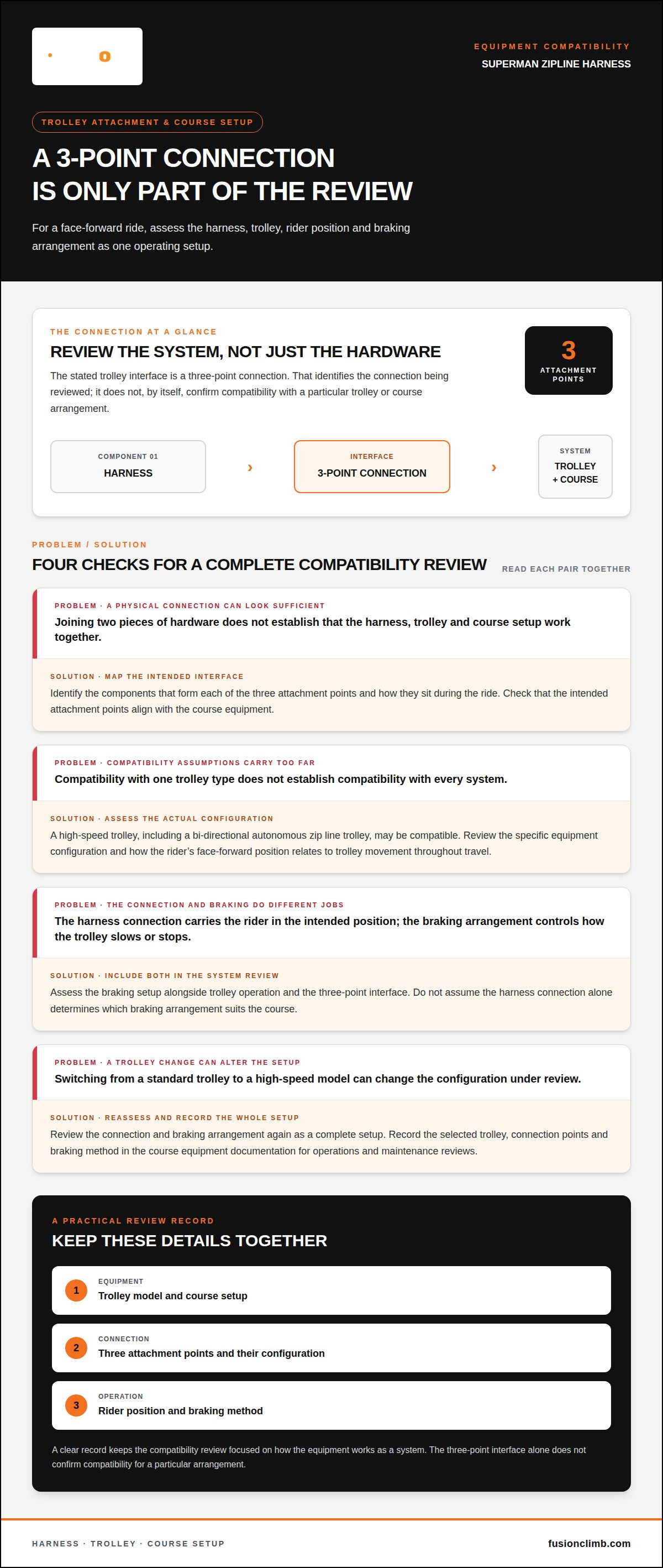
A Superman-style harness connects to its trolley through three attachment points. The connection supports the rider’s face-forward position and links the harness to the moving equipment. Compatibility means more than being able to join two pieces of hardware. The harness, trolley, and course setup need to work together, with the intended attachment points aligned.
Start by mapping the harness-to-trolley connection. Identify the components that form each attachment point and how they sit during the ride. A high-speed trolley, including a bi-directional autonomous zip line trolley, may be compatible, but compatibility with one type doesn’t establish compatibility with every system. Assess the actual equipment configuration.
Consider how the rider’s position relates to trolley movement. For a face-first ride, the connection must support the intended orientation throughout travel. When evaluating a setup, document the trolley model, attachment configuration, and rider position together. This keeps the review focused on how the equipment will work as a system, rather than on the harness alone.
Braking options also belong in the system-level review. The braking arrangement controls how the trolley slows or stops, while the harness connection carries the rider in the intended position. These functions interact but aren’t interchangeable. Assess the braking setup alongside trolley operation and the three-point interface. Don’t assume the harness connection alone determines which braking arrangement suits the course.
Changing from a standard trolley to a high-speed model can change the configuration under review. Reassess the connection and braking arrangement as a complete setup instead of carrying assumptions across. Record the selected trolley, connection points, and braking method in the course’s equipment documentation. A clear record helps staff follow the same setup during operations and maintenance reviews.
The Superman Zipline Harness’s stated trolley interface is a 3-point connection. Keep that specific interface identified when documenting a compatibility review, so the equipment record reflects the connection being considered. This clarification does not by itself establish whether any particular trolley or course arrangement is compatible.
Custom Superman zipline harnesses
Customization begins with rider fit and intended use, then takes account of harness style and the connection setup. A made-to-order harness can help align these choices without treating one size or style as suitable for everyone.
Harness Style Comparisons
A Superman harness supports a face-forward flying position, while a seated harness supports a sitting posture. A full-body harness is a broader category that doesn’t, by itself, specify the rider’s orientation. Compare the position each style supports, then consider course trolley connections and rider fit. These factors help identify the harness type for the intended experience.
Whether the harness is for personal use or an operator, the core fit and equipment considerations are the same. It needs to suit the rider and connect with the intended trolley setup.
Custom Fit and Measurement
The harness is made to order, with sizes listed as XS/S/M/L/XL. Size labels are a starting point, not a full description of an individual’s proportions. Assess how the harness sits across the torso and legs, whether its straps adjust securely, and whether the rider can maintain the intended face-forward position.
For an operator assessing fit, record the rider’s relevant measurements and chosen size, then assess the harness in its intended configuration. Weight is another fit criterion: the stated maximum weight range is 150 kg. A measurement record helps staff compare fit consistently without assuming that height or weight alone determines the right size.
Custom Harness Cost
Cost depends on the selected harness configuration and fit requirements. For operators, consider the full order scope, including the harness and any compatible equipment needed for the setup. A single generic figure can’t represent every order or configuration.
Wear clothing that lets the harness sit correctly, without bulky layers obstructing adjustment points. Secure loose items and follow the operating instructions for personal gear. Poor fit, incorrect adjustment, or a connection that doesn’t match the trolley arrangement can create risk. Assess rider fit and equipment compatibility together before use.
How do I get measured and fitted for a Superman zipline harness?
Use a repeatable fitting sequence instead of choosing by appearance. Start with the harness size range, then assess the rider’s proportions, adjustment points, and final position.
First, have the rider wear the clothing planned for the ride. Use a flexible tape to measure torso length and relevant body dimensions, keeping it level and comfortably snug. Record measurements consistently and compare the rider’s proportions with the available size guidance. Don’t estimate from height alone: riders of similar height can have different torso and leg proportions.
During the fitting, check these areas in order:
- Confirm the selected size matches the rider’s measurements and body proportions.
- Adjust the straps evenly so the harness sits securely without restricting movement.
- Check that closures are fastened and adjustment points remain accessible.
- Assess the rider’s face-forward position while the harness is connected as intended.
Next, check for movement or pressure points. Ask the rider to shift their shoulders and legs while staff observe whether the harness stays in position. If a strap loosens when the rider changes posture, adjust it before continuing the fit assessment. Recheck both sides after each change, since tightening one area can affect another.
Finish by recording the selected size, measurements, and strap adjustments. This provides a consistent reference for repeat fittings, particularly when several staff members prepare riders. Keep the assessment specific to the harness and intended trolley arrangement: fit alone doesn’t establish compatibility.
For operators selecting equipment around a fitting process, explore Superman-style harness options suited to zipline use.
Fusion Climb: Superman Style Harnesses
Fusion Climb offers Superman Style Harnesses for face-forward zipline rides. These harnesses are a relevant option when assessing rider fit, harness style, and the connection to course equipment.
For a broader equipment setup, Fusion Climb also offers Full Body Harnesses, Zipline Pulleys, and lanyards and tethers. Assess each component in relation to the course configuration and intended use. Clear requirements for rider position and trolley compatibility can guide your selection.
Contact Fusion Climb to discuss Superman Style Harnesses for your zipline operation.
Turn Your Harness Requirements Into a Clear Plan
Turn the fitting criteria into a practical equipment brief. Define the rider profile, intended Superman-style position, and course configuration. Include how staff will assess fit and how the harness will work with the rest of the equipment. A clear brief gives purchasing decisions useful operational context.
A custom-fit Superman zipline harness should meet the practical needs of your course and riders, not just look right on paper. Set requirements based on your operating environment and choose equipment that works with a fitting process your team can apply consistently.
Fusion Climb’s offerings include Full Body Harnesses, Superman Style Harnesses, and Zipline Pulleys. For a next step tailored to your operation, contact Fusion Climb about custom harnesses. Build your plan carefully, then move forward with confidence.
Frequently Asked Questions
What is a custom-fit Superman zipline harness?
A custom-fit Superman zipline harness is selected or made to suit a rider’s fit and face-forward position. Fit depends on body proportions, adjustment range, and the connection to course equipment. For example, an operator can use measurements and fitting observations to guide size selection instead of relying on height alone. Specific features vary by harness model.
Which zipline companies offer custom-fit Superman-style harnesses in the United States?
Fusion Climb offers Superman Style Harnesses across the United States, along with Full Body Harnesses and Zipline Pulleys for course equipment setups. When planning a face-forward ride, consider the harness and pulley system together, taking the intended rider position and equipment configuration into account.
What safety standards and certifications should a Superman zipline harness meet?
Use the standards and certifications identified for the exact harness model and its intended application; don’t assume one certificate applies to every Superman-style harness. Fusion Climb identifies ANSI, CE, and UIAA compliance for climbing and fall-protection gear, including ANSI Z359.11-2021 and CE EN 12277:2015. Review the model’s documentation to understand which standard applies and what use it covers.
What are the risks and contraindications for flying in a Superman zipline harness?
Poor fit, incorrect adjustment, or a connection that doesn’t match the trolley arrangement can create risks.