


Superman Style Zipline Harness: The Professional 2026 Guide to Prone Flight Gear
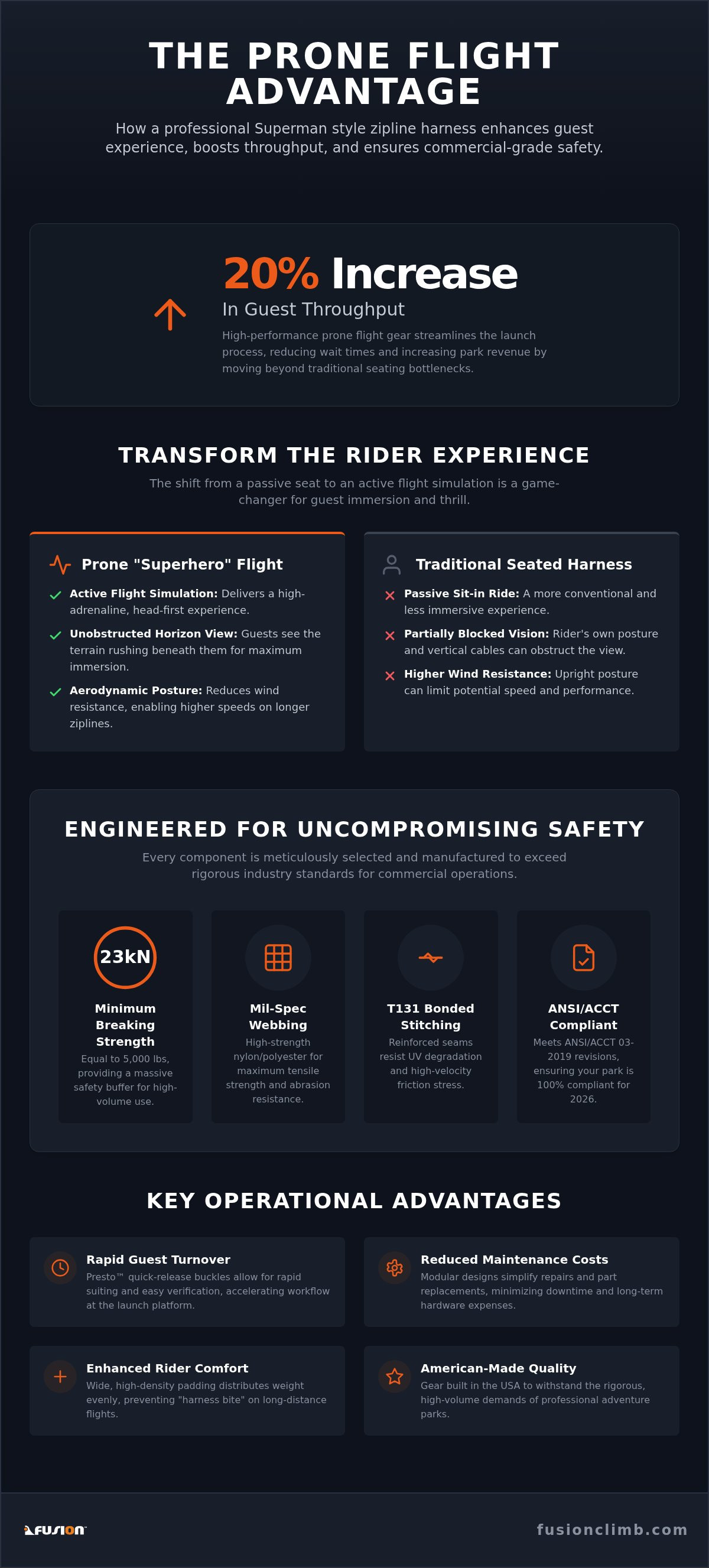
A 20% increase in guest throughput isn't just a goal; it's the operational reality for parks that move beyond traditional seating to high-performance prone flight. You understand that the primary bottleneck at the launch platform usually stems from complex gear and tedious adjustments. Every minute spent fumbling with straps is a minute of lost revenue. Transitioning to a high-quality Superman style zipline harness allows you to offer the iconic "superhero" experience while maintaining a professional, high-speed workflow.
You deserve equipment that works as hard as your crew. This guide provides a comprehensive deep dive into the engineering, safety protocols, and operational advantages of professional prone flight gear. We'll examine how modular designs and Presto™ quick-release buckles significantly reduce maintenance costs and hardware failure risks. We also cover the critical ANSI/ACCT 03-2019 revisions for 2026 to ensure your park remains 100% compliant while your guests stay secure in the air. From 5,000 lb rated hardware to mil-spec webbing, we detail the gear that protects your reputation and your bottom line.
Key Takeaways
- Understand the technical transition from seated to prone flight to ensure a stable, head-first experience for every guest.
- Identify critical safety benchmarks like 23kN Minimum Breaking Strength and mil-spec webbing required for commercial-grade hardware.
- Learn how a professional Superman style zipline harness uses rapid-adjust buckles to accelerate guest turnover and increase park revenue.
- Differentiate between standalone units and comprehensive combo kits to optimize your rigging and streamline long-term maintenance.
- Discover the operational benefits of modular, American-made gear built to withstand the rigorous demands of high-volume environments.
What is a Superman Style Zipline Harness?
A Superman style zipline harness is a technical prone flight system engineered specifically for head-first aerial travel. It isn't a modified seat; it's a dedicated piece of industrial equipment that reorients the rider's center of gravity to a horizontal plane. This mechanical shift transforms the ride from a passive sit-in experience to an active flight simulation. Commercial adventure parks and canopy tours utilize a Superman style zipline harness to differentiate their offerings, while stunt rigging teams rely on them for controlled, repeatable body positioning. The objective is to deliver a high-adrenaline sensation while adhering to the same safety standards found in professional fall protection.
Prone Flight vs. Traditional Seat Harnesses
The sensory difference between prone and seated systems is absolute. In a traditional seat harness, the rider’s vision is often blocked by their own posture and the vertical cables. Prone flight opens the horizon, allowing guests to look directly at the terrain rushing beneath them. A standard Safety harness designed for fall arrest or seated recreation cannot be safely adapted for this posture. Traditional gear lacks the necessary support to keep a rider horizontal without the risk of slipping or flipping. Professional prone systems utilize multi-point torso support to distribute weight across the chest, shoulders, and thighs. This ensures total stability, preventing the rider from pitching forward or rolling during high-speed transit.
The Evolution of Aerial Adventure Posture
Aerial adventure has evolved from basic "sit-and-zip" lines to complex "flight" experiences. This progression is driven by a demand for higher speeds and more aerodynamic ride profiles. Prone gear reduces the rider's frontal surface area, which minimizes wind resistance and allows for faster travel across longer spans. These complex rigging setups require more than just a strong belt. They integrate specialized components, such as professional climbing carabiners, to ensure every connection point meets industrial load requirements. By moving to specialized flight gear, operators can provide the high-velocity experience guests crave while maintaining the rigorous safety margins required for commercial operations in 2026.
Engineering and Safety Standards of Prone Flight Gear
Safety in prone flight is never accidental. It's the result of rigorous material selection and high-precision manufacturing. A professional Superman style zipline harness utilizes mil-spec webbing, often constructed from high-strength nylon or polyester, to ensure maximum abrasion resistance and tensile strength. Every load-bearing component must meet a Minimum Breaking Strength (MBS) of at least 23kN (5,000 lbs). This industry-standard rating provides a massive safety buffer for commercial operations. The integrity of these systems relies heavily on reinforced T131 nylon bonded stitching. This specific thread type resists UV degradation and friction, ensuring that seams don't fail under the high-velocity stresses typical of long-range lines. Adherence to ANSI compliant safety harnesses guidelines is mandatory for any operator prioritizing guest security and regulatory compliance.
Ergonomic Torso and Chest Support
Long-distance prone lines demand more than just raw strength. They require ergonomic precision to maintain rider comfort throughout the flight. Wide, high-density padding is essential to prevent "harness bite," a common issue where narrow straps dig into the rider's skin during extended flights. By distributing weight evenly across the chest, thighs, and shoulders, these harnesses prevent premature rider fatigue and allow for a more immersive "flight" sensation. Operators must follow established Zipline safety standards when selecting gear to ensure proper posture. Well-designed leg loops are equally critical. They must maintain consistent blood flow in a horizontal position, allowing guests to enjoy the experience without the tingling or numbness associated with inferior gear.
Quick-Release Hardware and Presto™ Buckles
Efficiency at the platform starts with hardware. Aluminum quick-release buckles, such as the Presto™ system, offer significant safety and speed advantages over traditional pass-through buckles. These components allow for rapid suiting while maintaining a fail-safe connection that is easy for staff to verify. Dual-action locking mechanisms ensure that the buckle cannot be accidentally opened while under load. This design choice removes the risk of human error during the tightening process. The aluminum hardware used in these systems is rated to a minimum breaking strength of 23kN to match the integrity of the webbing. For operators looking to upgrade their fleet, choosing industrial-grade Superman harnesses ensures both durability and peace of mind. Investing in high-performance hardware pays dividends in both guest safety and operational speed.
Harness Only vs. Combo Kits: Choosing Your Rigging
Selecting the right configuration for your Superman style zipline harness depends entirely on your current fleet status and infrastructure. A standalone harness is an ideal choice for operators who already own compatible rigging and simply need to replace worn soft goods. However, a comprehensive combo kit provides a fully integrated flight system designed to work in unison. These kits typically include the harness, a multi-point rigging plate, specialized lanyards, and heavy-duty carabiners. Using matching hardware ensures that every component meets the same performance thresholds. It's critical to remember that commercial zipline pulleys must be paired with the correct tether lengths to maintain the intended center of gravity. Mismatched components can lead to uneven load distribution or unpredictable rider orientation during flight.
The Role of the Rigging Plate in Prone Flight
Rigging plates serve as the mechanical foundation for head-first flight. They manage multiple attachment points to keep the rider level and stable. While some setups use a basic 2-point attachment, a professional 4-point system offers significantly better control over the rider's pitch and roll. This stability is essential for high-velocity lines where wind resistance can cause buffeting. Rigging plates also function as a spacer, preventing your lanyards from twisting or tangling during the descent. This keeps the rider's field of vision clear and ensures that the braking system engages correctly at the terminal platform.
Interchangeable Lanyard and Tether Systems
Modularity is a key advantage for modern operators. Utilizing interchangeable zipline lanyards and tethers allows for faster maintenance and lower long-term capital expenditure. You can replace a single worn tether rather than decommissioning an entire harness. Adjustable tethers are particularly valuable because they allow staff to fine-tune the "Superman" flight angle for different rider weights and cable tensions. Maintaining these systems requires strict adherence to OSHA and ANSI standards through regular inspections. Your team should follow a standardized checklist:
- Inspect webbing for glazing, fraying, or chemical discoloration.
- Check metal components for hairline cracks or significant scoring.
- Verify that carabiner gates lock and reset smoothly without sticking.
- Ensure all stitching patterns are intact and free of pulled threads.
Consistent monitoring prevents minor wear from becoming a major safety incident.
Commercial ROI: Throughput and Maintenance for Operators
High-volume parks live and die by throughput. Every second saved at the platform translates directly to higher daily capacity and increased revenue. Implementing a Superman style zipline harness equipped with Presto™ aluminum quick-release buckles reduces guest suiting time from minutes to seconds. These buckles eliminate the need for manual strap threading; staff simply click the hardware into place. To further minimize human error, professional-grade harnesses often feature color-coded straps. This visual indicator allows guides to verify secure connections at a glance, ensuring safety without slowing down the line. Beyond speed, these unique "flight" experiences allow operators to justify premium ticket prices, often positioning prone lines as a flagship attraction that commands a higher fee than standard seated zips.
Operational Efficiency and Staff Training
Training your crew to handle complex prone rigging doesn't have to be a bottleneck. A structured framework for the 4-point adjustment system focuses on a "top-down, inside-out" sequence. Guides first secure the shoulder straps, followed by the waist and chest, and finally the leg loops. This methodical approach ensures the rider is perfectly leveled before they ever reach the cable. Utilizing "one-size-fits-most" designs further simplifies logistics. You don't need to maintain a massive, tiered inventory of various sizes; a single versatile model like the Super Ripper accommodates a wide range of body types. Establishing a dedicated pre-suiting area away from the launch platform also keeps the queue moving. Guests arrive at the gate fully rigged and ready for final safety checks, maximizing the number of flights per hour.
Modular Maintenance and Gear Longevity
The financial sustainability of your gear depends on modularity. High-wear components, such as lanyards and tethers, typically reach their retirement age long before the main harness chassis. By choosing modular systems, you can replace a single lanyard for a fraction of the cost of a full harness. This strategy drastically reduces long-term capital expenditure. A professional inspection schedule is mandatory for high-volume parks: perform a tactile "bend and feel" check daily, a thorough visual inspection weekly, and a documented safety audit monthly. In typical outdoor commercial environments, mil-spec nylon webbing generally has a service life of five to seven years depending on UV exposure and cycle counts. Maintaining a rigorous maintenance log protects your investment and ensures your park remains a safe, profitable destination. For operators ready to upgrade their facility, you can shop professional Superman style harnesses to enhance your park's performance.
Why Fusion Climb Leads the Industry in Superman Gear
Fusion Climb stands as a cornerstone of the aerial adventure industry because we control every stage of production. We don't just assemble components; we manufacture specialized equipment designed for the harshest commercial environments. Our commitment to "Made in the USA" quality means every Superman style zipline harness leaving our facility adheres to domestic safety standards that international competitors often bypass. We utilize only industrial-grade webbing and hardware rated to at least 23kN (5,000 lbs). This isn't just about meeting a baseline; it's about providing a dependable guardian for your guests. As a direct manufacturer, we provide wholesale solutions that allow park operators to source professional-grade gear without the markups of third-party distributors.
The Super Ripper Advantage
The Super Ripper represents the pinnacle of prone flight engineering. Unlike generic harnesses, it features an ergonomic "v-shape" design specifically engineered to stabilize the rider during the critical high-speed braking phase. This design prevents the fishtailing effect often seen in lesser gear, giving the rider a sense of controlled, aerodynamic flight. Integration of Presto™ aluminum quick-release buckles ensures that once a rider is secured, they stay secured. These buckles are designed for high-cycle environments, resisting the grit and wear of outdoor use while maintaining a smooth, reliable locking mechanism. It's the preferred choice for operators who refuse to compromise on either throughput speed or rider security.
Partnering with a US-Based Manufacturer
Choosing a domestic partner means more than just a label. It ensures faster lead times and direct technical support when your season is on the line. Every Superman style zipline harness we produce undergoes rigorous testing protocols before it ships to your facility. We verify stitching integrity, hardware tolerances, and webbing strength to ensure 100% compliance with current industry expectations. This meticulous manufacturing process provides the peace of mind necessary to operate a high-volume attraction. You're not just buying a product; you're investing in a partnership with an innovator rooted in traditional values of strength and precision. Equip your park with Fusion Climb Superman Style Harnesses today.
Elevate Your Park's Flight Standards
Maximizing your park’s revenue requires a balance of high-speed throughput and uncompromising safety. By integrating a professional Superman style zipline harness into your fleet, you provide a flagship experience that keeps guests returning while ensuring your crew operates with maximum efficiency. We've explored how 23kN rated hardware and mil-spec webbing form the foundation of a secure flight system. These standards aren't just suggestions; they are the benchmarks of industrial reliability.
Choosing gear that is proudly Made in the USA ensures you receive the domestic support and rigorous quality control necessary for high-volume commercial operations. Fusion Climb remains a trusted partner for operators nationally, delivering the engineering precision required for head-first prone flight. Don't settle for generic rigging when you can equip your line with industry-leading technology. Shop the Super Ripper and Superman Style Harness Collection to secure your facility's future. It's time to push the limits of adventure with the sobriety of professional-grade protection.
Frequently Asked Questions
Is a Superman style zipline harness safe for beginners?
Prone harnesses are safe for beginners when used under professional supervision. The multi-point torso support actually provides a more secure feeling than a standard seat harness for many first-timers. Because the guest's center of gravity is distributed across the chest and thighs, they don't experience the tipping sensation common in vertical setups. Our Superman style zipline harness designs prioritize stability, ensuring that even a novice can enjoy the flight without technical difficulty or fear of falling out.
What is the weight capacity for a professional prone zipline harness?
Most professional prone harnesses accommodate a wide weight range, typically from 30kg (66 lbs) to 200kg (440 lbs). It's vital to check the specific manufacturer's limits for your model before operation. The hardware itself is rated to 23kN, which is approximately 5,000 lbs of force. This massive safety margin ensures the equipment can handle the dynamic loads generated during high-speed braking and terminal platform arrivals without compromising the integrity of the mil-spec webbing or aluminum buckles.
How do I adjust a Superman harness for different body types?
Adjusting a professional harness requires a methodical approach using rapid-adjust buckles. Start by securing the shoulder straps to set the vertical position, then move to the waist and chest for lateral stability. Finally, tighten the leg loops to ensure the rider remains horizontal during transit. High-quality models like the Super Ripper utilize Presto™ quick-release buckles, allowing staff to fit different body types in seconds. This speed is essential for maintaining high guest throughput during peak operational hours.
Do I need a special pulley for prone, head-first ziplining?
Prone flight requires specialized pulleys designed to interface with rigging plates and multi-point lanyards. A standard pulley may not provide the necessary clearance or attachment points to keep the rider level. These pulleys are engineered to manage the specific tension and speed profiles of head-first travel. Using the correct hardware prevents the lanyard from twisting and ensures the braking system engages correctly. Always pair your Superman style zipline harness with pulleys that are certified for prone applications.
Can Superman harnesses be used for traditional seated ziplines?
You shouldn't use a prone harness for traditional seated ziplining. These systems are specifically engineered for horizontal weight distribution and head-first orientation. Attempting to sit in a prone harness can lead to improper blood flow and localized pressure points that cause significant discomfort. More importantly, the attachment points are positioned for flight stability; using them vertically could result in an unsafe center of gravity. For seated lines, always stick to a dedicated full body or seat harness.
What safety certifications should I look for in a prone harness?
Look for certifications such as ANSI Z359.11 for webbing and ASTM F2959 for aerial adventure equipment. The industry is also moving toward revised ANSI/ACCT 03-2019 standards in 2026. These certifications ensure the gear has undergone rigorous tensile testing and environmental stress evaluations. Hardware should carry a minimum breaking strength (MBS) rating of 23kN. Choosing certified gear protects your park from liability and guarantees that your equipment meets the highest industrial safety benchmarks currently available.
How often should a commercial Superman harness be inspected?
Commercial harnesses require a tiered inspection schedule to ensure long-term reliability. Perform a visual and tactile check before every use to identify glazing or fraying. Conduct a thorough weekly inspection of all stitching and hardware. Every month, a qualified professional must perform a documented audit of the entire fleet. If a harness is involved in a significant incident or shows signs of chemical damage, retire it immediately. Consistent logs are your best defense against gear failure.
What is included in a Superman zipline harness combo kit?
A comprehensive combo kit includes everything needed to transition from a standard line to a flight experience. This typically features the harness, a specialized rigging plate, adjustable tethers, and high-strength carabiners. These components are designed to work together as a single, integrated system. By purchasing a kit, you ensure that every piece of hardware has matching load ratings and compatible attachment points. This modular approach simplifies maintenance and allows you to replace individual components as they wear out over time.