



Rescue Climbing Harness Roundup: Professional Gear for SAR and Industrial Safety
Would you trust your life to equipment designed for a twenty-minute sport climb when your shift involves a six-hour technical rescue? It's a question that separates the hobbyists from the professionals. Choosing the right rescue climbing harness is about more than just staying attached to a rope. It's about maintaining blood flow during long-duration suspension and ensuring your gear meets the rigorous NFPA 2500 and ANSI Z359.11-2021 standards.
We understand that the weight of responsibility is heavy enough without the added burden of gear fatigue or the fear of hardware failure. You need equipment that acts as a dependable guardian in high-stakes environments. This guide will show you how to achieve 100% safety compliance while reducing technician exhaustion during intense operations. We'll break down the essential differences between recreational and professional-grade hardware. You'll also discover the best full-body configurations and integrated systems to ensure your team remains safe, comfortable, and ready for any vertical challenge.
Key Takeaways
- Identify professional grade equipment by verifying compliance with ANSI Z359.11 and NFPA 2500 standards for life safety.
- Understand how specific features like sternal D-rings and reinforced leg padding differentiate a rescue climbing harness from standard industrial models.
- Discover why ergonomic suspension design is critical for preventing suspension trauma during long duration technical rope operations.
- Determine whether your mission requires the comprehensive fall arrest of a full body harness or the maneuverability of a specialized seat harness.
- Explore the benefits of an integrated system approach where harnesses and hardware are engineered for total compatibility.
Evaluating Standards: What Defines a Rescue Climbing Harness?
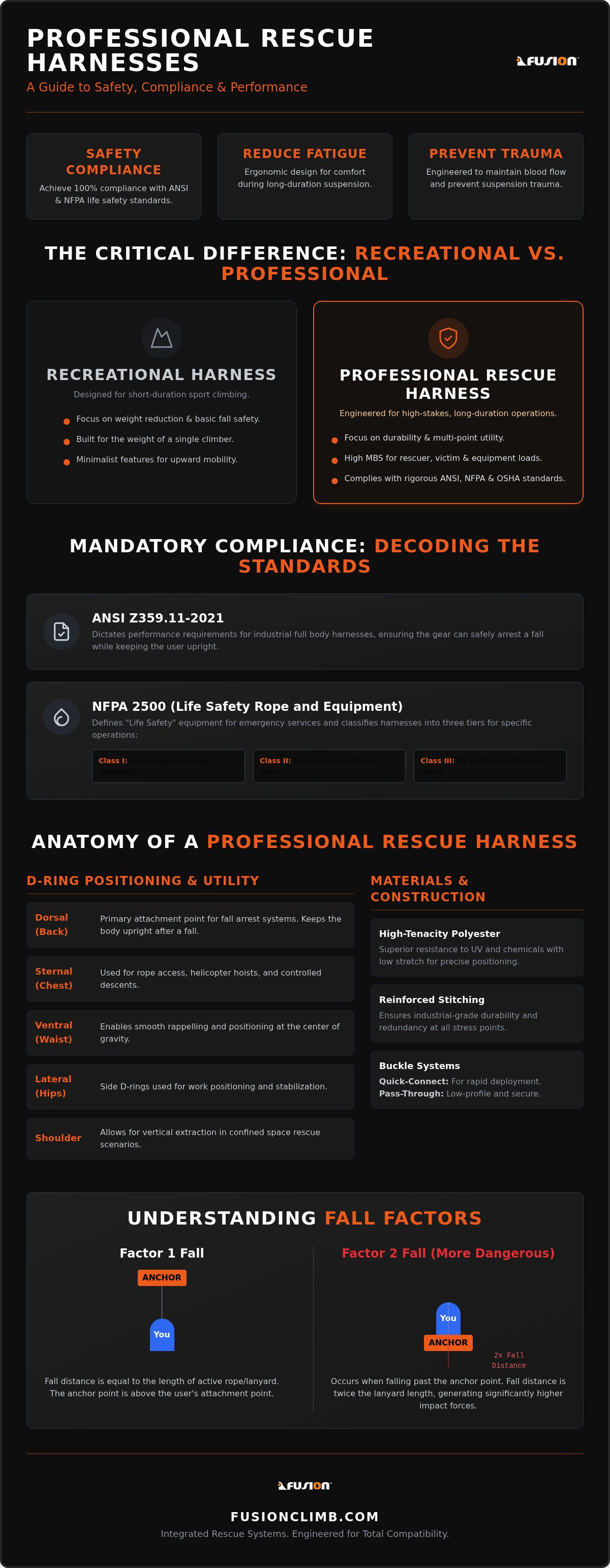
A professional rescue climbing harness serves as a specialized hybrid. It merges the ergonomic suspension needs of a technical climber with the rigorous fall arrest requirements of an industrial worker. While recreational harnesses focus on weight reduction and basic fall safety for a single climber, rescue systems are engineered for high-stakes environments where lives depend on hardware durability. Professionals don't just climb; they work while suspended for hours. Using the wrong gear in these scenarios isn't just uncomfortable, it's a liability that compromises the entire team's safety.
Understanding fall factors is essential for safe vertical operations. A Factor 1 fall occurs when the fall distance matches the length of the active rope. A Factor 2 fall is significantly more dangerous, happening when the user falls past their anchor point. Because rescue missions often involve multi-person loads and complex rope configurations, the equipment must manage these extreme forces without compromising the integrity of the system. This Safety harness overview provides additional context on how these designs apply across various industrial and rescue sectors.
ANSI vs. NFPA: Navigating Compliance
Compliance isn't optional for professional teams. The ANSI/ASSP Z359.11-2021 standard dictates the performance requirements for industrial full body harnesses. It ensures the gear can stop a fall while keeping the user upright and secure. For emergency services, the NFPA 2500 standard (formerly NFPA 1983) defines "Life Safety" equipment. It classifies harnesses into three distinct tiers: Class I for emergency escape, Class II for seat-style rescue, and Class III for full body high-angle operations. OSHA regulations further mandate that employers provide gear that meets these specific certifications to ensure operator safety in hazardous zones.
The Strength Requirements of Rescue Ops
Rescue operations demand hardware with significantly higher tensile strength than standard climbing gear. A typical sport harness is designed for the weight of one person. In contrast, a professional rescue climbing harness must accommodate the weight of a rescuer, a victim, and various technical tools. This necessitates redundant attachment points and reinforced stitching that can withstand industrial-grade wear. Every component undergoes rigorous testing to establish its limits. Minimum breaking strength (MBS) is the statistically determined force at which a piece of hardware is expected to fail during controlled testing. For rescue professionals, maintaining a high MBS ensures a critical safety margin when managing complex rope systems in rugged environments.
The Anatomy of Professional Rescue Harnesses
A professional rescue climbing harness functions as more than a simple safety device; it's a specialized mobile workstation designed for high-stress environments. While a recreational harness prioritizes a lightweight profile for upward movement, a rescue model focuses on long-duration suspension and multi-point utility. The physical architecture of these harnesses must withstand industrial-grade wear while providing the technician with the stability needed to perform complex medical or technical tasks mid-air. Every stitch and buckle serves a purpose, from weight distribution to rapid extraction capabilities.
Material choice is a critical factor in gear longevity. High-tenacity polyester is often preferred over standard nylon webbing because it offers superior resistance to UV degradation and chemicals. It also features lower stretch, which helps maintain precise positioning during a haul. For rapid deployment, many professionals opt for quick-connect buckles that allow them to don the gear over bulky turnout gear or tactical uniforms without readjusting every strap. Traditional pass-through buckles remain a staple for those who prioritize a lightweight, low-profile design that won't snag in tight quarters.
D-Ring Positioning and Utility
The placement of D-rings defines the harness's operational range. A Dorsal D-ring is the primary attachment point for fall arrest, engineered to keep the body upright after a drop. In contrast, the Sternal D-ring is the lifeline of the rescue technician, used for rope access, helicopter hoists, and controlled descents. Ventral D-rings at the waist allow for smooth rappelling, while lateral rings provide essential stabilization for work positioning. For confined space operations, shoulder D-rings enable a vertical profile for extraction through narrow hatches. Adhering to OSHA fall protection standards ensures these attachment points meet the necessary force requirements for professional use.
Suspension Ergonomics and Safety
Technicians often face the risk of orthostatic intolerance, commonly known as suspension trauma, when hanging for extended periods. Wide, heavily padded leg loops are essential because they distribute pressure across a larger surface area, helping to maintain healthy blood flow. Many high-angle specialists integrate suspension seats to provide a rigid platform during long-duration hangs. Breathable mesh liners are equally vital, as they manage moisture and heat buildup during intense operations in summer months or industrial boiler rooms. If you're building a kit for these demanding scenarios, exploring specialized full body harnesses can help you find the right balance of comfort and compliance. This ergonomic focus ensures that the rescue climbing harness remains a tool for performance rather than a source of fatigue.
Roundup: Comparing Rescue Harness Configurations
Selecting the correct configuration for a rescue climbing harness depends entirely on the operational environment and the anticipated load. Professionals don't just pick gear based on comfort; they evaluate the specific mechanical advantages of each style. Full body harnesses remain the gold standard for high-angle technical rescue because they provide multiple attachment points and superior fall arrest capabilities. However, specialized operations might require the streamlined profile of a sit harness or the unique positioning offered by prone configurations. Each choice impacts the team's ability to manage a victim while maintaining their own safety margins.
Chest harnesses serve as a critical modular component in professional kits. While a sit harness provides the foundation for suspension, adding a chest harness ensures vertical stability during a haul. This prevents a technician from flipping backward if they lose consciousness or are struck by debris. This modularity allows teams to customize their kit based on the mission's technicality without carrying unnecessary bulk during the approach. When the mission involves vertical extraction, the synergy between the upper and lower harness components becomes the difference between a controlled ascent and a hazardous one.
Full Body vs. Sit Harnesses
Full body systems offer the highest safety margins in unpredictable environments. These harnesses distribute forces across the shoulders, chest, and thighs, which is critical during an arrested fall. When operations exceed four hours, the integrated padding and wide webbing of a full body model significantly reduce user fatigue. Conversely, sit harnesses excel in low-angle SAR or scenarios where agility and weight savings are paramount. While they lack the upper body support of a full body system, they allow for a greater range of motion during strenuous approaches. For confined space entry, the choice is often dictated by legal requirements. Under OSHA 1926.1211, authorized entrants must use chest or full body harnesses with retrieval lines unless it increases the hazard to the entrant. This standard ensures that technicians can be extracted vertically without causing further injury.
Prone and Tactical Configurations
Specialized environments require hardware that breaks the traditional mold. Superman style harnesses allow technicians to work in a prone position, which is essential for certain aerial adventure park rescues or zipline maintenance. These configurations provide a stable platform for forward-facing tasks that a vertical harness cannot match. Tactical professionals often require black-out versions of these tools to maintain a low visual profile during specialized operations. Fusion Climb manufactures these unique configurations with the same rigorous attention to strength and durability as their standard industrial lines. By integrating these specialized harnesses with high-performance pulleys and carabiners, teams can build a complete system tailored to niche aerial requirements. This specialized hardware ensures that even the most unconventional rescue scenarios are managed with professional-grade precision.
Selecting Gear for the Rescue Environment
Matching the rescue climbing harness to the specific operational environment is a tactical decision that impacts both safety and mission success. High-angle rescue demands gear that balances suspension comfort with redundant attachment points. In these vertical worlds, a technician might spend hours on rope managing a patient. Conversely, Urban Search and Rescue (USAR) operations prioritize hardware that can withstand the brutal friction of crushed concrete and twisted rebar. Every environment presents unique hazards that dictate the necessary technical specifications of your kit.
Modern rescue missions often supplement ground-based gear with aerial technology; for teams integrating these tools, Caswell Aviation Ltd provides the expert drone repair and technical services required to maintain operational readiness in the field.
Maintaining operational readiness also involves ensuring the structural safety of the buildings and environments where teams work; you can learn more about Pest Elite for professional termite and pest management solutions tailored to commercial and residential sites.
Industrial safety teams face different challenges, specifically related to chemical exposure and strict regulatory oversight. For these professionals, ANSI Z359.11 compliance is the baseline requirement. Webbing must often be chemical-resistant to ensure long-term durability in manufacturing or refinery settings. Selecting a harness with high-tenacity polyester webbing provides the necessary protection against corrosive substances while maintaining the strength required for fall arrest. This technical assurance allows the team to focus on the rescue rather than gear integrity.
The Confined Space Checklist
Confined space entry is governed by tight tolerances and the need for vertical extraction. A standard harness often proves too bulky for narrow ingress points, increasing the risk of snagging. Your checklist for these environments should include several critical features:
- Shoulder D-rings: These are non-negotiable for tripod extractions, as they allow for a slim vertical profile during a haul.
- Low-profile padding: Reduces the external footprint of the technician for easier ingress and egress.
- Integrated attachment points: Ensures seamless connection to retrieval lines and mechanical winches.
Using a dedicated lanyard and tether system alongside your harness ensures that you maintain secure positioning during complex extractions. These components work in tandem to provide a complete fall protection and retrieval solution for permit-required spaces.
Durability in Harsh Environments
Hardware material choice directly impacts gear longevity. Stainless steel is the preferred choice for corrosive maritime or industrial environments, whereas aluminum offers weight savings for high-mobility SAR teams. For USAR specialists, sacrificial layers and webbing protectors help prevent premature wear from sharp edges. Abrasion resistance is a core metric that defines the webbing's capacity to maintain its structural integrity while being subjected to friction against rough surfaces like concrete or rusted steel. Ensuring your gear meets these rugged standards is the only way to guarantee performance in the field. Don't settle for recreational gear when the environment demands industrial-grade strength.
The Fusion Climb Advantage: Integrated Rescue Systems
Efficiency in the vertical environment isn't just about individual skill; it's about system integrity. A rescue climbing harness acts as the central hub of a complex safety network. When you source gear from a single, dedicated manufacturer, you eliminate the guesswork associated with hardware compatibility. Fusion Climb focuses on creating a seamless interface between full body harnesses and high-performance pulleys. This synergy ensures that mechanical advantage systems operate without friction or snagging. Professionals trust their lives to these systems because they're engineered for no-nonsense industrial reliability in the most demanding conditions.
Building a complete rescue kit requires more than just a list of parts. It requires a deep understanding of how each carabiner, pulley, and lanyard interacts under load. Our manufacturing process prioritizes this holistic view, ensuring that every piece of hardware we produce complements our harness designs. This integrated approach reduces the risk of equipment mismatch, which is a common pain point in high-stakes environments. When your hardware and webbing come from the same origin, you gain a level of technical assurance that mixed-brand kits simply can't provide.
Beyond the Webbing: Hardware Synergy
Every carabiner and pulley in your kit must meet the same uncompromising standards as your harness. We apply rigorous testing protocols to every safety connector we produce. This ensures that when a technician is suspended hundreds of feet in the air, their hardware functions with absolute precision. Our specialized "Superman" style harnesses exemplify this commitment to innovation, leading the industry in specialized aerial park safety. These unique configurations allow for stable, prone-position work that standard harnesses can't support. By matching these specialized harnesses with our high-strength pulleys and lanyards, organizations can build a complete rescue kit designed for specific aerial challenges.
Procurement for Teams and Organizations
Standardizing your team's equipment is a strategic move that improves both operational efficiency and safety compliance. When every technician uses the same rescue climbing harness and hardware, peer checks become faster and more reliable. It also streamlines your annual safety inspections, as your rigging team becomes intimately familiar with the wear patterns and maintenance requirements of a single brand. Fusion Climb serves as a national supplier for professional rigging and climbing hardware, providing the scale and reliability that large organizations demand. We don't just sell individual components; we provide the foundational tools for professional-grade safety systems. Explore our full range of professional rescue harnesses and hardware to find the right configuration for your team's specific requirements.
Elevate Your Safety Standards
Choosing a rescue climbing harness is a tactical decision that defines the safety and efficiency of your entire team. You now understand the critical role of ANSI Z359.11 compliance and the importance of matching harness configurations to your specific operational environment. High-stakes missions don't leave room for equipment failure or technician fatigue. By prioritizing ergonomic suspension and integrated hardware synergy, you ensure your team remains focused on the rescue rather than their gear.
We're committed to providing the technical assurance you need. Our focus on ANSI Z359.11 compliant manufacturing and rugged industrial-grade hardware ensures that every component meets the highest professional standards. We offer specialized designs for aerial and tactical rescue that bridge the gap between strength and maneuverability. Equip your team with Fusion Climb's professional rescue harnesses and build a system that acts as a dependable guardian in the field. Stay safe and keep pushing the limits of what's possible in vertical environments.
Frequently Asked Questions
What is the difference between a Class II and Class III rescue harness?
A Class II harness is a seat harness designed for load distribution around the waist and thighs, whereas a Class III is a full body harness that includes shoulder straps. Class III models are required for scenarios where a fall could result in an inverted position because they provide superior torso support. For technical rope operations, the Class III configuration is the preferred choice for maximum security and compliance.
How often should a professional rescue climbing harness be inspected and retired?
You must perform a visual inspection before every use and schedule a formal, documented inspection by a competent person at least once every 12 months. Most manufacturers recommend retiring a textile-based rescue climbing harness after ten years from the date of manufacture, even if it shows no visible wear. Always retire gear immediately if it's involved in a significant fall or shows signs of chemical damage.
Can I use an industrial fall arrest harness for high-angle rope rescue?
While an industrial fall arrest harness meets basic safety standards, it often lacks the ventral and sternal attachment points necessary for controlled descent and rescue. Industrial models are built to stop a fall, but they aren't always optimized for long-duration suspension. Technical rescue requires gear that mitigates suspension trauma through wider leg loops and specialized padding not found on standard fall protection equipment.
What is the weight capacity of an ANSI Z359.11 compliant harness?
The standard user weight range for an ANSI Z359.11 compliant harness is typically between 130 and 310 pounds (59 to 140 kg). This range includes the weight of the technician plus their clothing and tools. If your mission requirements exceed these limits, you must consult the manufacturer to ensure the equipment's minimum breaking strength can still provide an adequate safety margin for the intended load.
Why do rescue harnesses have multiple D-rings in different locations?
Different D-ring locations allow a technician to transition between fall arrest, work positioning, and extraction. The dorsal ring is for fall arrest, while the sternal ring is critical for helicopter hoists and ladder climbing. Lateral D-rings allow for hands-free work positioning, and ventral rings are the primary attachment point for rappelling. This versatility is what makes a professional rescue climbing harness a multi-functional tool for complex operations.
What materials are best for harnesses used in chemical or high-heat environments?
High-tenacity polyester webbing is the superior choice for chemical resistance because it withstands corrosive substances better than standard nylon. For high-heat environments or welding applications, technicians should look for harnesses featuring specialized coatings or flame-resistant fibers. These materials ensure the webbing doesn't lose its structural integrity when exposed to extreme temperatures or industrial solvents during a high-stakes mission.
How do I ensure a proper fit for a full body rescue harness?
Start by donning the harness and tightening the leg loops until you can only fit two fingers between the webbing and your thigh. Ensure the waist belt is snug and sits above your iliac crest to prevent the harness from sliding during suspension. The dorsal D-ring should be centered between your shoulder blades, and all straps must be symmetrical to maintain proper weight distribution and operator comfort.
Are Fusion Climb harnesses compatible with third-party rescue hardware?
Yes, Fusion Climb hardware is designed to be compatible with any third-party rescue gear that adheres to standardized ANSI or NFPA specifications. Our carabiners and pulleys use industry-standard dimensions to ensure they integrate seamlessly into your existing kit. While we recommend using an integrated system for maximum efficiency, our hardware's precision engineering allows it to function reliably as a silent partner with other certified equipment.