



Professional Harness vs Rock Climbing Harness for Ziplining
The rock-climbing harness you already know isn’t automatically the right choice for a zipline. When weighing a professional harness vs. a rock climbing harness for ziplining, start with the harness intended for the zipline setup and its attachment system, rather than choosing by activity label alone. Fit and compatibility matter more than familiarity.
It makes sense to compare harnesses closely: weight, materials, sizing, adjustability, construction, and features all affect how they work in use. This guide explains what to prioritize when choosing a harness for ziplining and how to assess whether a climbing harness is appropriate for that application. Use these criteria to make an informed choice before gearing up.
Key Takeaways
- Choose a harness built for the zipline system and its attachment setup, rather than relying on its label alone.
- Compare weight and materials alongside construction; lighter designs may have less padding and fewer gear loops.
- Use waist and thigh measurements to assess fit, and consider how adjustable leg loops accommodate clothing and movement.
- Review how harness features and attachment points work together before deciding which style suits your zipline application.
Which climbing harness do I need?
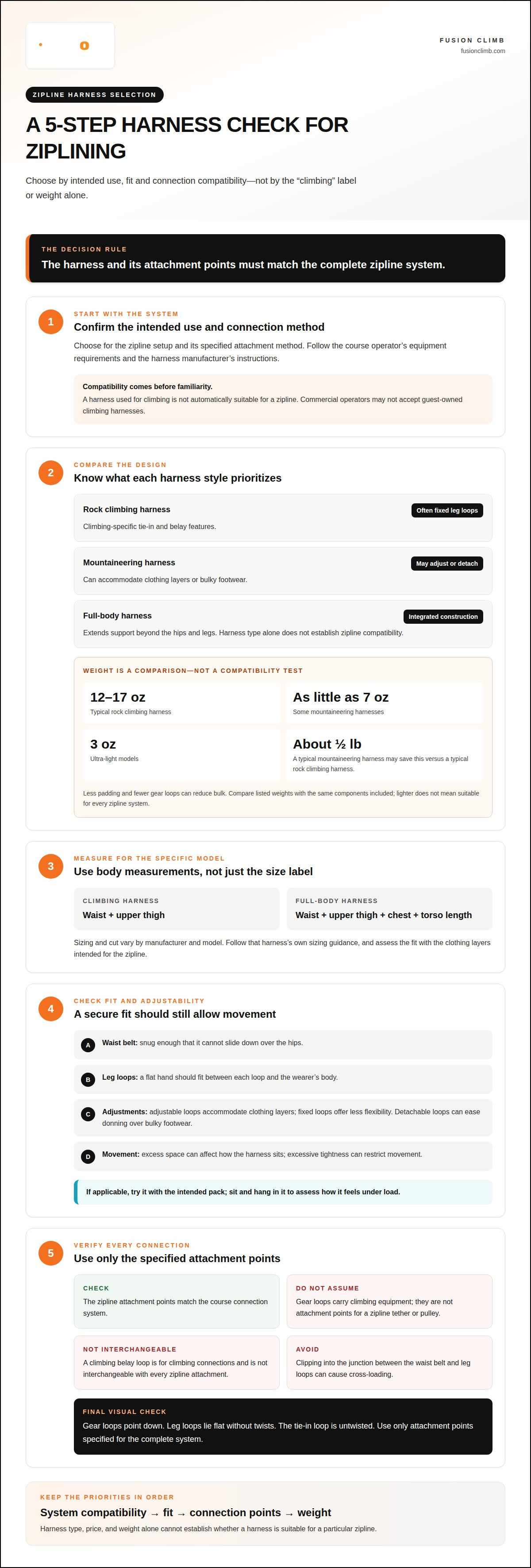
Choose a harness for the zipline system and its intended attachment method, not simply because it is designed for climbing. In a professional harness vs rock climbing harness for ziplining comparison, fit, adjustability, and compatible connection points matter more than the label.
Harness Features and Gear Loops
Gear loops carry climbing equipment; they are not attachment points for a zipline tether or pulley. Buckles secure and adjust the harness, and their position affects fit. Fixed leg loops can be harder to put on over bulky footwear, while adjustable loops accommodate clothing layers. Detachable loops on some mountaineering harnesses can make donning easier over large boots, crampons, or skis.
Check that gear loops point down and leg loops lie flat without twists. A flat hand should fit between each leg loop and the wearer’s body. These checks help assess fit, but do not establish whether a harness suits a particular zipline.
Attachment Points and Belay Loops
Zipline attachment points must match the course’s connection system; climbing harness tie-in points are designed for climbing connections. A belay loop is for connecting climbing equipment and is not interchangeable with every zipline attachment. Clipping a carabiner into the junction between the waist belt and leg loops can cause cross-loading.
Type II harnesses wrap around the hips and legs, while Type III harnesses have full-body construction. Neither type alone establishes zipline compatibility. Use only the attachment points specified for the complete system, and keep the tie-in loop and leg loops untwisted.
Zipline Rules and Climbing Harness Use
Commercial operators set equipment rules for their courses, so they may not accept guest-owned climbing harnesses. Follow the operator’s requirements and the manufacturer’s instructions. The key question in a professional harness vs rock climbing harness for ziplining decision is whether the manufacturer’s directions support that use. Applicable standards and certifications depend on the equipment and operation.
Harness prices vary with design and features, but price alone cannot establish suitability. Operators select equipment for their systems. An incompatible or poorly fitted harness can compromise fit or connection security.
| Option | Leg loops | Primary distinction |
|---|---|---|
| Rock climbing harness | Often fixed | Climbing-specific tie-in and belay features |
| Mountaineering harness | May adjust or detach | Can accommodate layers or bulky footwear |
| Full-body harness | Integrated construction | Extends support beyond hips and legs |
Choose a harness by matching its intended use, fit, and connection points to the zipline system.
Harness weight and materials
Weight is useful for comparing harnesses, but it doesn’t determine whether one suits ziplining. A typical rock climbing harness weighs about 12-17 ounces. Mountaineering harnesses are generally lighter, with less padding and fewer gear loops. Some weigh as little as 7 ounces, while ultra-light models can weigh 3 ounces. Those designs prioritize carrying less on mountain objectives, not automatic compatibility with a zipline system.
Weight can matter when wearing a harness over a long approach. A typical mountaineering harness may save about ½ pound compared with a typical rock climbing harness. This comparison concerns harness weight, not a reason to choose the lightest option for every activity.
Materials and construction help explain weight differences. Less padding and fewer gear loops can reduce bulk, while a more substantial design may include extra material for support or equipment-carrying features. The effect depends on the model. Compare like with like: check whether listed weights include the same components, then consider whether the construction suits the intended use.
For ziplining, weigh weight alongside fit, connection design, and compatibility with the complete system. A lightweight climbing harness may still be unsuitable if its intended use and attachment arrangement do not match the setup. A heavier harness is not automatically the right choice, either. Specified use and compatibility matter more than ounces alone.
- Compare: use the listed harness weight and check which components it includes.
- Assess: consider whether reduced padding or fewer gear loops suit the intended activity.
- Prioritize: match the harness’s intended use to the zipline system before weighing small differences.
For zipline-focused equipment, explore full body harnesses as one option to consider alongside weight and intended application.
A mountaineering harness may save about ½ pound compared with a typical rock climbing harness, even without choosing an ultra-light model. That saving does not require an ultra-light design.
Harness sizing and adjustability
Start with measurements, not a size label. Measure waist and upper thigh for a climbing harness; a full-body harness also requires chest size and torso length. Sizing varies by manufacturer, and each model’s cut affects fit. A medium from one maker may fit differently from a medium from another, so follow the sizing guidance for the specific harness.
The waist belt should fit snugly enough that it cannot slide down over the hips. Leg loops should allow a flat hand between the loop and the wearer’s body. Excess space can affect how the harness sits, while excessive tightness can restrict movement. Assess fit with the clothing layers intended for the zipline.
Adjustable leg loops accommodate changes in clothing, while fixed loops offer less flexibility. In cold conditions, semi-adjustable loops can make it easier to fit thicker layers for alpine climbing. Detachable leg loops on mountaineering harnesses can ease donning over large boots, crampons, or skis. Choose adjustments based on the clothing and footwear involved.
If applicable, try the harness on with the pack intended for use. Sit and hang in it to assess how it feels under load. Check that gear loops point down, the tie-in loop is untwisted, and both leg loops lie flat. For ziplining, the operator’s fitting process should also account for the connection system.
- Measure: waist and upper thigh; add chest and torso length for full-body designs.
- Adjust: set the waist and leg loops over the clothing worn for the activity.
- Inspect: check loop position and twists, then sit and hang to assess fit.
Size charts and measurements help narrow the options, but actual fit matters. Compare the manufacturer’s guidance with the wearer’s measurements, then assess the adjusted harness with the intended clothing. A climbing harness should remain secure over the hips, with leg loops positioned comfortably and without twists.
Climbing harness construction and features
Harness construction reflects its intended application. Climbing harnesses are commonly grouped into three categories: Type I, Type II, and Type III. Type I is not a full-strength harness; it was designed specifically for rescue applications. Type II describes a recreational climbing harness that wraps around the hips and legs. Type III has full-body construction and was designed primarily for rope rescue and industrial rope work.
These categories describe construction; they do not automatically approve a harness for every activity. A rock climbing harness typically supports the wearer around the waist and leg loops, while a full-body design adds torso components. That distinction can matter when selecting gear for a wearer and connection system. For example, some recreational Type III harnesses were designed for small children, whose hips may not be defined enough to retain other harness styles securely.
Lightweight construction reflects a different priority. Mountaineering harnesses generally use less padding and fewer gear loops than rock climbing harnesses. This can reduce carried weight and bulk for mountain travel, but does not establish zipline compatibility. A climbing harness’s belay loop and tie-in points are designed for climbing connections; the zipline system must use attachment points intended for its setup.
Assess construction in context. First, identify the harness category and intended use. Next, consider whether its waist, leg, and torso structure suit the wearer and activity. Then match its connection points to the complete system’s specified arrangement. A Type III label alone does not make a harness suitable for a zipline, just as lightweight construction alone does not make a Type II harness the right choice.
- Type I: rescue-specific design, not a full-strength harness.
- Type II: recreational climbing construction around hips and legs.
- Type III: full-body construction associated primarily with rescue and industrial rope work.
Use the category to understand construction, then choose according to intended use and system compatibility.
Fusion Climb
Fusion Climb offers equipment to consider alongside the rest of a zipline setup. Its range includes Full Body Harnesses, Superman Style Harnesses, Zipline Pulleys, and lanyards and tethers. Review harnesses and connection equipment as related parts of your gear selection, rather than judging a harness by its climbing label alone.
Use the distinctions in this guide to identify what matters for your application: construction, fit, intended use, and compatibility with the system. Then explore the relevant Fusion Climb equipment categories to find options that match your needs. The right choice depends on the complete setup and how each component is intended to be used.
For questions about equipment options, contact Fusion Climb.
Choose Gear That Moves You Forward
Your professional harness vs rock climbing harness for ziplining decision should lead to a clear next step: select equipment for the intended application and complete setup. Keep the operator’s requirements and the manufacturer’s instructions central, rather than assuming a familiar climbing harness is suitable.
Fusion Climb offers Full Body Harnesses, Superman Style Harnesses, and Zipline Pulleys. Consider how these categories fit your setup and equipment needs before choosing a configuration. The goal is a considered choice that supports the activity, not simply the lightest or most familiar piece of gear.
For help exploring harness options, contact Fusion Climb about harnesses. Take the next step with a clear understanding of your application, and move toward your zipline plans with purpose.
Frequently Asked Questions
What is the difference between a professional zipline harness and a rock climbing harness?
A professional zipline harness is intended for zipline use, while a rock climbing harness is designed for climbing applications. The difference is the intended use, not simply the harness’s appearance or weight. For example, Fusion Climb’s TCH-109-3 “Leap of Faith” Zipline Harness has an H-style chest strap and steel buckle options. It meets CE EN 12277:2015 and ANSI Z359.11-2021 and is intended for use under qualified supervision.
What harness features are required or recommended for ziplining?
Prioritize suitable adjustment, connection points compatible with the zipline system, and construction intended for the activity. As a specific example, the TCH-109-3 uses 1.75 in (44.5 mm) MIL-SPEC polyester webbing, heavy-duty bartack stitching, and corrosion-resistant steel hardware. Its front main belay loop, rear safety secondary belay loop, and back steel D-ring are rated 5,000 lb (23 kN). Use under qualified supervision.
What do manufacturer instructions say about using climbing harnesses for ziplining?
Follow the manufacturer’s instructions, and use a climbing harness for ziplining only when those instructions support that application.