



Positioning Lanyards for Work Safety: Uses and Backup Systems
The lanyard that holds you steady isn’t the system that stops a fall. Positioning lanyards for work safety support a worker in a defined position, often leaving both hands free, but they aren’t designed to arrest a fall. A positioning lanyard should be used as part of a broader fall-protection plan.
At height, support and fall protection serve different purposes. This article explains how positioning lanyards work, how adjustable lines and connectors are designed, and how positioning differs from restraint and fall arrest. It also covers why a separate backup system needs to be planned alongside the positioning setup, with a clear role for every component before work begins.
Key Takeaways
- Understand how lanyard attachment points and anchor transitions affect a work-positioning setup.
- Distinguish positioning equipment from fall arrest protection, and learn why each system has a separate role.
- See how lanyard materials and construction influence suitability for different work conditions.
- Recognize how an adjustable positioning lanyard helps maintain a stable working position while keeping both hands free.
What Is a Lanyard in Fall Protection?
A lanyard connects a worker’s harness to an anchor or another part of a fall-protection system. Its connection point, length, and intended function determine whether it provides positioning, restraint, or fall arrest.
Double-Legged Lanyard Transitions
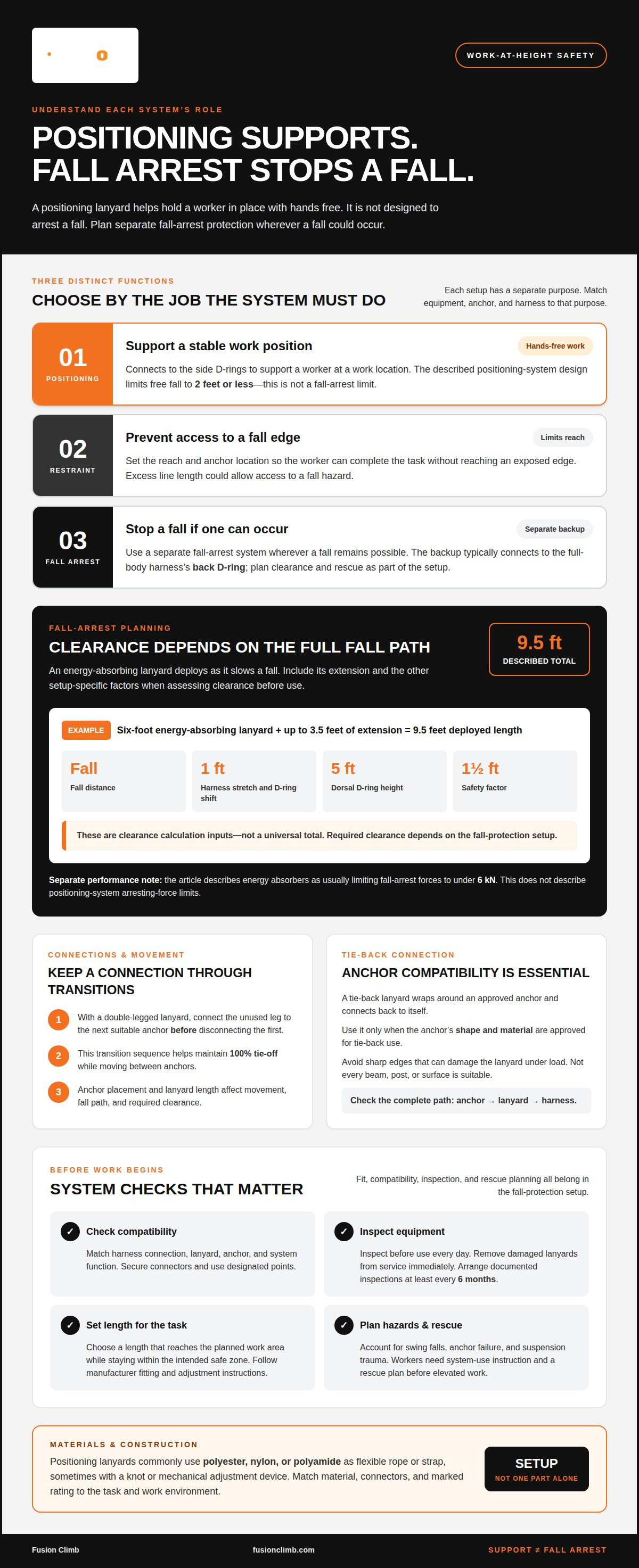
A double-legged lanyard has two legs that let a worker move between anchors while maintaining 100% tie-off. During a transition, the worker connects the unused leg to the next suitable anchor before disconnecting the first. This sequence helps avoid an unprotected gap between anchor points. The lanyard’s length and the placement of each anchor affect how the worker can move between them.
For example, a worker moving along an elevated structure may connect one leg of a lanyard to the next anchor, transfer the connection, then continue. A double-legged lanyard can help maintain a connection while changing anchors, reducing the chance of being unprotected during the transfer.
Tie-Back Lanyards and Compatible Anchors
A tie-back lanyard wraps around an approved anchor and connects back to itself. It may suit a structure without a separate attachment point, but only if the anchor’s shape and material are approved for tie-back use. Avoid sharp edges, which can damage the lanyard under load.
Check the entire connection path: the anchor, lanyard, and harness must function together as intended. A tie-back connection is not suitable for every beam, post, or surface. Anchor compatibility matters as much as the lanyard itself.
Anchor Location, Fall Clearance, and Hazards
Anchor location affects the worker’s fall path, required clearance, and exposure to hazards. A low anchor near the worker’s feet can increase fall distance and place excessive force on the body. A floating anchor moves along a support, while a suspension point bears the worker’s load. Account for how each moves and connects when assessing clearance.
Common positioning-lanyard hazards include swing falls, anchor failure, and suspension trauma. A swing can occur when the anchor is off to one side. An unsuitable or compromised anchor can fail, and suspension after a fall requires a planned rescue response.
Positioning lanyards connect to side D-rings, while separate fall-arrest backup typically connects to the back D-ring of a full-body harness. Where the system design requires it, keep the anchor above or near the connection point, and account for the full fall path before work begins.
Positioning lanyards and required backup fall arrest systems
A positioning system supports hands-free work but does not arrest a fall. Pair it with separate fall-arrest protection, and plan for clearance, rescue, and equipment compatibility.
Energy Absorption and Fall Clearance
An energy-absorbing lanyard slows a fall by deploying an expansion pack, so clearance must account for its extension. A six-foot lanyard can extend by up to another 3.5 feet, and the described total deployed length is 9.5 feet.
A minimum clearance calculation includes the fall distance, 1 foot for harness stretch and D-ring shift, 5 feet for dorsal D-ring height, and a 1½-foot safety factor. Required clearance depends on the fall-protection setup and should be assessed before use. A work-positioning system is designed to limit free fall to two feet or less; this is distinct from fall-arrest limits.
Fall Prevention and Movement Restraint
A restraint system limits a worker’s reach to prevent access to an area where a fall could occur. Use restraint when the work area and lanyard length let the worker complete the task without reaching an exposed edge.
Positioning supports a worker at a work location; fall arrest is needed if a fall remains possible. Use restraint when it can be set up correctly. Before work, check the system’s reach and anchor placement: excess length could allow access to a fall hazard.
Equipment Compatibility and System Choice
Choose compatible equipment by matching the harness connection, lanyard, anchor, and system function. Use positioning for supported, hands-free work; restraint to prevent access to a fall edge; and a separate fall-arrest system wherever a fall could occur.
Inspect before use every day, remove damaged lanyards from service immediately, and arrange documented inspections at least every 6 months. Follow the manufacturer’s instructions for fitting and adjustment: connect to the designated points, secure connectors, and set length for the task. Price varies by equipment type and features, so compare adjustability, connection design, material, and intended use rather than relying on an unsupported average.
OSHA Rules and Fall Limits
OSHA requirements depend on the work and the applicable fall-protection setup, so don’t treat a performance description as a specific OSHA rule. The available positioning-system criterion describes a design intended to limit free fall to two feet or less. No corresponding OSHA arresting-force limit for positioning systems is provided here.
Fall-arrest lanyards serve a different function: shock absorbers reduce deceleration forces, and the described energy absorbers usually limit forces to under 6 kN. Workers need instruction in system use and a rescue plan before elevated work; arborists should also have a means of descent if their climbing system fails. For equipment selection, explore lanyard and tether options.
Lanyard materials and construction
A positioning lanyard is commonly made from polyester, nylon, or polyamide. These materials form a flexible rope or strap, which may include a knot or mechanical device for adjustment, as described in ANSI Z133. Construction affects how the lanyard handles, adjusts, and connects to the harness and anchor. The correct choice depends on the work environment and the task’s positioning requirements.
Choose a length that lets the worker reach the planned work area while staying within the intended safe zone. An adjustable design allows the worker to shorten or lengthen the connection as the task changes. Match the connectors to the designated harness points and a compatible anchor; fit and locking action matter as much as the line. Follow the equipment’s marked rating and instructions rather than assuming one rating applies to every setup.
Connector requirements can vary by work context. For a climber’s work-positioning system, ANSI Z133 section 8.2.8 specifies self-closing, self-double-locking carabiners, with a gate-locking mechanism requiring at least two consecutive, deliberate actions to unlock. ANSI Z133 section 8.2.7 specifies that snap hooks used in a climber’s work-positioning system must be self-closing, self-locking, and have a minimum tensile strength of 5,000 pounds (22.24 kN). These specifications apply to the described climbing context, not automatically to every lanyard application.
Hot work requires materials suited to the exposure. For welding, torch-cutting, or burning, choose lanyard material that won’t burn through if struck by slag. Fiber line exposed to sparks or slag may be unsuitable. Assess the task, contact hazards, and connector compatibility together: material alone does not establish that the complete system is appropriate.
Choose a lanyard by matching its length to the work zone, its material to environmental exposure, and its connectors to the harness and anchor. Use the rating specified for the complete application, and don’t infer a load limit from the material type or appearance.
Positioning lanyards for work positioning
A positioning lanyard holds a worker in a defined place at height, leaving both hands free for the task. ANSI Z133 describes this as a flexible rope or strap that may use a knot or mechanical device for adjustment. The worker leans into the harness and braces their feet against the structure to maintain stability. This support helps with controlled work, but it doesn’t replace fall-arrest protection.
Adjustable length sets the worker’s reach within a predetermined safe zone. For example, a worker on a vertical surface can shorten the line to stay close to the structure, then adjust it to reach another work area. The right length supports stability without excess slack or access beyond the intended position. At height, the anchor, stance, and task location all affect system performance.
Connection details matter. The lanyard attaches to side D-rings on a suitable harness for work positioning, while its other end connects to the anchor. For climbing saddles, ANSI Z133 section 8.2.17 requires the non-working end to have a fixed termination or be securely connected to a rated connection point on the saddle. That connection must stay secure as the worker shifts weight or changes stance.
A waist-level connection supports this positioning setup, while the worker presses their feet against the structure to help maintain position. Adjust the lanyard so the worker can complete the task without relying on it to catch a fall. That distinction is central to positioning lanyards for work safety: stable support enables hands-free work, while a separate fall-arrest system addresses fall exposure.
Choose a lanyard and tether suited to the intended work-positioning setup, then match its connection and adjustment to the harness and anchor. Explore lanyard and tether options for your equipment planning.
Fusion Climb: Lanyard and tether
Fusion Climb offers lanyards and tethers for equipment planning where a secure connection is part of the work-positioning setup. Choose components with the system’s purpose in mind: the lanyard supports positioning, while a separate fall-arrest system provides fall protection. Match connection points and adjustment needs to the harness, anchor, and task. Fusion Climb also offers full body harnesses, Superman Style Harnesses, and zipline pulleys for relevant equipment applications. These products don’t replace careful system selection, compatibility, or a planned backup. If you’re ready to discuss equipment for your setup, contact Fusion Climb.
Plan the Next Move with Confidence
Turn your understanding of positioning lanyards for work safety into an equipment plan for the task ahead. Start with the work, the worker’s movement, and the conditions in the area. Then assess how each component fits into the complete setup instead of choosing a lanyard in isolation. A deliberate plan clarifies what the system must support and where equipment guidance can help.
As you plan, consider how equipment suited to the application can support the work. Fusion Climb offers gear for vertical and aerial environments, including harnesses and zipline pulleys. Focus on fit, compatibility, and the role of each component.
Contact Fusion Climb to discuss equipment for your application. Take the next step with a considered plan and move forward prepared.
Frequently Asked Questions
Positioning Lanyard: What is it and what is it used for?
A positioning lanyard is an adjustable connection that supports a worker at a set location while working at height. On an elevated vertical surface, for example, it can help the worker maintain a stable stance and keep both hands free. Work-positioning systems are designed to limit free fall to two feet or less, but the lanyard does not replace separate fall-arrest protection.
What is a work-positioning lanyard and how does it differ from a fall-arrest lanyard?
A work-positioning lanyard supports the worker’s position; a fall-arrest lanyard is part of a system designed to stop a fall. When reaching across a structure, for example, positioning equipment supports the work stance, while fall-arrest equipment addresses the risk of falling. Plan these functions separately, and ensure the fall-arrest setup is compatible with the harness and available clearance.
How should a work-positioning lanyard be attached to an anchorage and full-body harness?
For positioning, connect the lanyard between a suitable anchor and the harness’s designated side D-rings. Use an anchor compatible with the lanyard, and keep the connection clear of sharp edges. When moving between anchors with a double-legged lanyard, connect the free leg to the next anchor before releasing the first. Keep any separate fall-arrest connection on its designated harness point.
How much do work-positioning lanyards cost, and which types or features are worth comparing?
Equipment prices vary by type and features. Compare adjustability, connection design, material, and intended use instead of relying on an average price.