



Professional Guide to Adjustable Climbing Tethers: Setup, Safety, and Standards
Precision positioning at an anchor isn't a luxury; it's a fundamental safety requirement that dictates your efficiency in high-angle environments. When you're suspended at height, being "close enough" rarely suffices. Fixed lanyards often leave you struggling with excess slack or awkward tension, but professional-grade adjustable climbing tethers solve this by allowing for millimetre-perfect adjustments. You already know the frustration of wrestling with a lanyard that's just a few inches too long for a stable, comfortable work stance.
This guide will help you master the technical setup and safety protocols of these systems to ensure your gear enhances your security rather than compromising it. We'll examine the critical differences between DIY setups and manufactured certifications. We will also explain how to identify hardware that meets ANSI standards and provide a roadmap for maximizing your reliability in vertical terrain. Mastering these tools ensures you remain focused on the task, not the gear.
Key Takeaways
- Understand how adjustable climbing tethers provide precise work positioning and reduce slack to minimize potential fall factors.
- Learn the mechanical principles behind camming and friction-based adjustment devices to ensure reliable locking under load.
- Identify the safety risks of DIY solutions and why commercial operators prioritize certified, professional-grade hardware for compliance.
- Master the proper inspection and connection protocols, including secure girth hitching methods, to maintain system integrity.
- Recognize the importance of selecting heavy-duty components like auto-locking carabiners to prevent accidental gate opening during technical maneuvers.
Understanding the Role of Adjustable Climbing Tethers in Modern Rigging
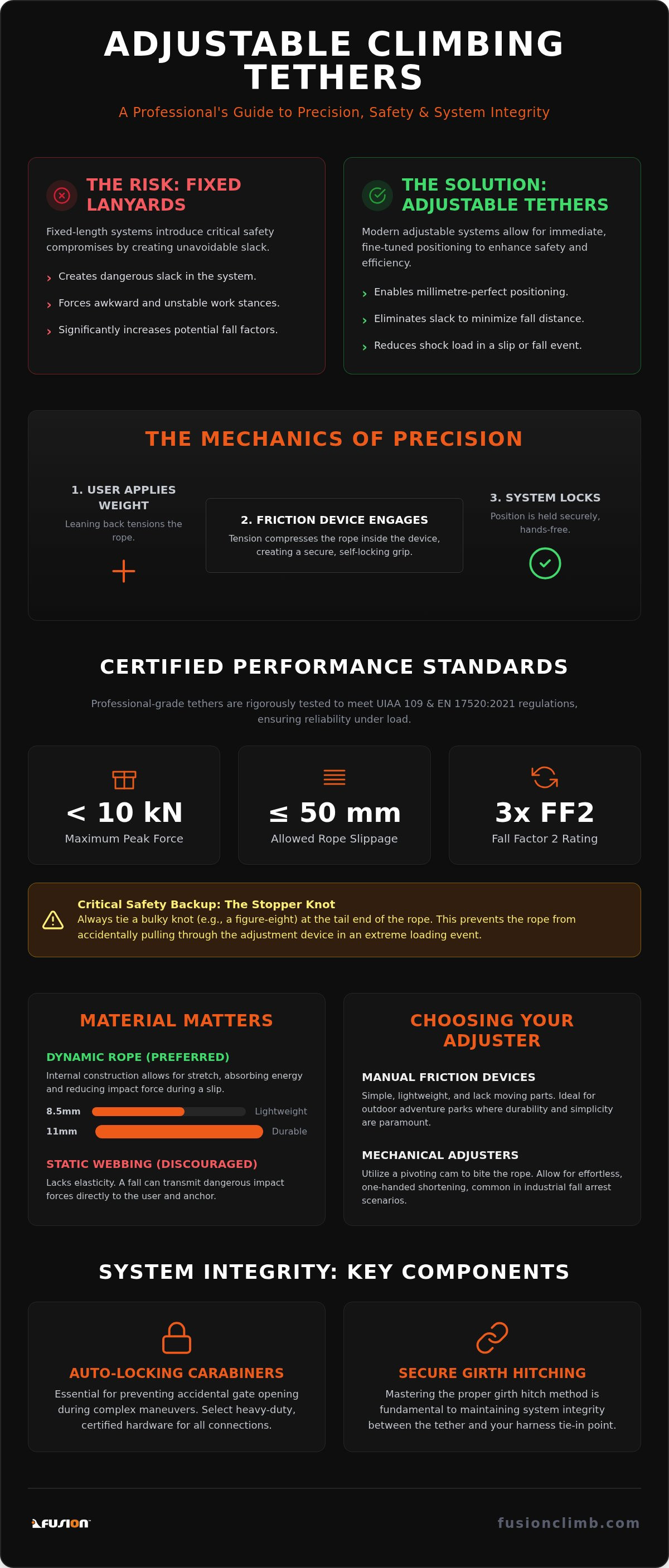
Safety in the vertical world isn't about guesswork; it's about precision. An adjustable tether is a specialized dynamic or semi-static lanyard that allows a user to vary their distance from an anchor without the need to untie or re-tie knots. Unlike traditional fixed-length systems, these tools provide millimetre-perfect positioning. Within the broader scope of climbing equipment, the lanyard serves as the primary link between a professional's harness and a secure anchor point. By allowing for immediate length adjustments, adjustable climbing tethers significantly reduce slack. This minimizes potential fall factors and ensures that any slip results in a minor loading event rather than a catastrophic shock load.
The industry has seen a massive transition from fixed-loop Personal Anchor Systems (PAS) to these more versatile adjustable lanyards. While a PAS offers multiple loops for different lengths, it lacks the fluid adjustability required for complex rigging. Professional environments, including aerial adventure parks, commercial zipline operations, and professional tower climbing, now demand gear that adapts to the environment. Whether you're transitioning between platforms or stabilizing yourself for a technical repair, the ability to fine-tune your position is a functional necessity.
The Evolution of Work Positioning
Fixed lanyards often force workers into awkward, unstable stances because the tether is either too long to provide tension or too short to allow for a full range of motion. This limits efficiency and increases fatigue. Modern rigging prioritizes the "tight" anchor principle, where the user remains under slight tension to prevent any momentum from building during a slip. Work positioning is the ability to maintain a stable posture while hands-free. Achieving this state requires a tether that can be shortened with a single hand, locking the user into a secure work tripod with their feet.
Dynamic vs. Static Tether Materials
The choice of material dictates how the system handles energy. Dynamic rope is the preferred choice for adjustable climbing tethers because its internal construction allows it to stretch, absorbing energy during a minor slip or fall. Static webbing is generally discouraged for personal tethers because it lacks this elasticity; a fall on a static system can transmit dangerous impact forces directly to the harness and the user's body. Standard diameters typically range from 8.5mm to 11mm. While an 8.5mm rope offers a lightweight profile for high-mobility tasks, an 11mm rope provides superior durability and a more substantial grip for industrial applications where gear abrasion is a constant threat.
The Mechanics of Precision: How Adjustable Systems Function
Precision in a vertical environment relies on the predictable physics of friction. Most adjustable climbing tethers operate on a simple yet effective principle: the more tension applied to the system, the harder the device grips the rope. This is typically achieved through a tortuous path where the rope bends around the hardware. When you lean back, the rope is compressed against the device's edges or the spine of a carabiner. This creates a self-locking mechanism that holds your weight without constant manual input. It's a balance of geometry and force that allows for millimetre-perfect positioning at an anchor.
According to UIAA Safety Standards, specifically the UIAA 109 and EN 17520:2021 regulations, these systems must meet rigorous performance benchmarks. For instance, slippage during testing must not exceed 50 mm. This ensures that even under a sudden load, the system remains stable. However, this mechanical advantage requires a critical safety backup: the stopper knot. Without a bulky knot at the end of the rope, there's a remote but lethal risk of the tail pulling through the device under extreme tension or if you're using an undersized rope diameter. Professional systems are engineered to withstand three successive falls of fall factor 2 with an 80kg mass while keeping peak forces below 10 kN.
Friction Devices vs. Mechanical Adjusters
Manual friction devices are the workhorses of the industry. They're simple, lightweight, and lack moving parts that can clog with grit or ice. These are ideal for outdoor adventure parks where durability is paramount. Mechanical adjusters utilize a pivoting cam to bite into the rope. These are frequently found in industrial fall arrest scenarios because they allow for effortless, one-handed shortening. Your choice should reflect how often you need to change positions; mechanical systems offer speed, while manual friction plates provide unmatched reliability in harsh conditions.
Carabiner Interaction and Device Performance
The performance of your tether isn't just about the rope and the plate. The carabiner you choose acts as the second half of the braking system. Carabiners with a round cross-section generally provide smoother adjustment and more consistent locking than H-frame or I-beam designs. If the carabiner is too thin, the device might not "pinch" the rope effectively, leading to excessive creep. The tether and carabiner must act as a single, synchronized unit. To ensure your system meets these high-stakes requirements, it's vital to source professional-grade carabiners designed for industrial rigging.
Cross-loading remains a significant danger in these setups. If the carabiner rotates and the load is applied to the gate rather than the spine, the entire system can fail. Using non-certified, "home-made" setups increases the risk of slippage beyond the 50 mm safety threshold. This is why manufacturers emphasize using components that have been tested together as a unified system. When you're suspended hundreds of feet in the air, the mechanics of your gear shouldn't be a mystery; they should be a guarantee.
Manufactured vs. DIY Tethers: Evaluating Safety and Compliance
In the vertical industry, the line between a calculated risk and an avoidable hazard often comes down to equipment certification. While recreational forums frequently promote "home-made" solutions as cost-effective alternatives, professional environments operate under much higher stakes. Using adjustable climbing tethers that haven't been factory-tested introduces variables that no professional rigging system should tolerate. For commercial zipline operators and aerial adventure parks, the choice isn't just about preference. It's about insurance compliance and the rigorous demands of high-volume usage. Commercial insurance providers rarely cover incidents involving uncertified, user-assembled gear. They require equipment that meets recognized industrial standards to ensure that every component has undergone dynamic drop tests and static pull tests.
The Limits of DIY Reliability
DIY tethers rely on the integrity of hand-tied knots. Even for an expert, knots are subject to human error and can loosen over time due to cyclic loading. This repeated process of tensioning and releasing during a shift can cause certain knots to "crawl" or untie entirely. Non-professional ropes also react unpredictably to environmental stressors. Consider these three primary failure points:
- UV Degradation: Standard hardware store or non-climbing ropes lack the specialized coatings that protect professional gear from sun damage.
- Friction Heat: DIY setups often use incompatible materials that can glaze or melt under the heat generated by rapid adjustments.
- Unknown Break-Strength: A custom-built system has no verified peak force rating. You're essentially betting your safety on a theoretical calculation rather than a laboratory-verified test.
The Value of Professional Certification
Standardization is the bedrock of professional safety. When every tether in a fleet performs identically, training becomes streamlined and inspections are more effective. Professional-grade hardware is manufactured to meet specific benchmarks, such as ANSI Z359.11 standards. This compliance ensures the gear integrates seamlessly with your full body harness and other fall-arrest components. It removes the guesswork from the rigging equation.
Every manufactured unit carries a unique serial number. This traceability is vital for maintaining accurate inspection logs and identifying specific batches in the event of a manufacturer recall. For operators, using certified adjustable climbing tethers transfers a significant portion of technical liability to the manufacturer. It provides a documented "paper trail" of safety that DIY gear simply cannot match. Trust your life to gear that has been proven in a lab before it's ever used in the field. Investing in certified equipment isn't just about following rules; it's about providing a sobering sense of security for every person who clips into your system.
Step-by-Step: Setting Up and Using Your Adjustable Tether
Safety starts before you leave the ground. A meticulous inspection of your adjustable climbing tethers is non-negotiable for every shift. Run your fingers along the entire length of the rope to feel for core shots, flat spots, or stiff sections that indicate internal damage. Check the metal adjustment device for sharp burrs or deep grooves. These defects can sever the rope sheath under the heat and pressure of a fall. If the rope shows significant glazing from friction or the hardware is deformed, retire the unit immediately. Your gear is a life-support system; treat it with the sobriety the environment demands.
Connecting to the harness requires a clean, secure girth hitch. Thread the loop end of the tether through the belay loop or the designated attachment points of your harness. Pull the adjustment device and rope through the loop, then dress the knot until it's tight and symmetrical. Ensure the 'load' end of the rope is oriented toward the anchor and the 'tail' end is positioned for easy manual adjustment. Before you ascend, perform a weight test at ground level. Lean back into the system to confirm the device locks instantly and the knots are fully seated. Shortening the system is instinctive; simply pull the tail end. To lengthen the tether while under tension, use your thumb to pivot the adjustment plate away from the carabiner spine to release the friction lock.
Attachment Protocols for Professional Harnesses
Professional rigging often involves specialized equipment like a Superman style harness for prone ziplining. In these configurations, the tether must be connected to the primary spreader bar or the main attachment point to maintain the correct center of gravity. For tower work or aerial parks, utilize the sternal or dorsal D-rings on full body harnesses to ensure your positioning doesn't interfere with your fall-arrest system. Avoid 'daisy-chaining' multiple lanyards together. This practice creates unnecessary points of failure and complicates your visual safety checks during transitions.
Managing the Tail and Stopper Knots
A stopper knot is your final line of defense against a catastrophic system failure. Tie a secure double fisherman's knot or an overhand knot at the very end of the rope tail. This prevents the rope from accidentally pulling through the adjustment device if you reach the maximum extension. In commercial zipline environments, managing this excess tail is critical. A loose tail can easily become entangled in zipline pulleys or high-speed hardware. Use a dedicated clip or elastic keeper to secure the tail close to your harness. Monitor the sheath for 'fuzzing' or discoloration; if the outer fibers are worn down to the point that the white inner core is visible, the tether has reached the end of its service life.
Selecting Professional-Grade Hardware for Your Tether System
Selecting the right components for your adjustable climbing tethers is about more than just matching brands. It's about engineering a system where every piece of hardware complements the next. Industrial environments demand heavy-duty lanyards that can withstand the abrasive nature of steel cables and constant friction. While recreational gear often prioritizes weight savings, professional-grade hardware focuses on longevity and mechanical consistency. Fusion Climb’s approach centers on this rugged reliability. We provide no-nonsense tools for professionals who require their gear to perform in high-wear, high-stakes scenarios day after day.
Pairing your tether with high-performance zipline pulleys is essential for smooth transitions between lines. A pulley that chatters or drags can cause jerky movements that shock-load your tether system. By using standardized, professional components, you ensure that the interaction between the pulley, the carabiner, and the tether remains predictable. This synergy prevents the "creep" or unexpected slippage discussed in previous sections, allowing you to maintain precise positioning without constant readjustment.
Carabiner Selection for Tethers
The carabiner is the critical interface between your tether and the anchor. In high-wear rigging environments, steel carabiners are the preferred choice. They resist the grooving and material loss that aluminum suffers when subjected to constant friction from rope or cable. Security is equally vital. Auto-locking carabiners are mandatory to prevent accidental gate opening caused by vibration or gear rub. While double-locking gates provide a standard level of safety, triple-locking gates offer the maximum security required for industrial fall arrest. For a deeper look at your options, consult our Guide to Professional Climbing Carabiners.
Comprehensive Systems for Zipline Operators
Standardization is the hallmark of a professional operation. Integrating lanyards and tethers with full-body harnesses creates a unified safety profile for your entire team. When every staff member uses an identical gear kit, peer inspections become faster and more accurate. This systematic approach reduces the likelihood of "gear drift" where incompatible components are swapped into service. Building a kit that includes ANSI-compliant harnesses and heavy-duty tethers ensures your team is protected by the highest manufacturing standards. Ready to upgrade your fleet? Explore Fusion Climb’s full range of professional lanyards and tethers to find the right fit for your vertical environment.
Elevate Your Safety Standards
Precision in the vertical world isn't achieved by chance. It's the result of technical mastery and the use of certified equipment designed for high-stakes environments. You've learned that adjustable climbing tethers provide the millimetre-perfect positioning needed to reduce slack and manage fall factors effectively. You also understand that the synergy between your harness, carabiner, and tether is what creates a truly dependable safety system. Choosing the right gear means trusting the manufacturer behind the hardware.
Fusion Climb has been a dedicated manufacturer in the USA for over 25 years. We conduct rigorous testing to meet commercial zipline and rigging standards, earning the trust of aerial adventure park operators nationwide. Don't leave your safety to uncertified DIY setups or inconsistent rigging. Equip your team with Fusion Climb's professional-grade tethers and hardware to ensure every transition is secure and every position is precise. Focus on the challenge ahead and let our gear provide the sobering sense of security you need to perform at your peak.
Frequently Asked Questions
Can I use an adjustable tether as my primary fall arrest lanyard?
No, you shouldn't use an adjustable tether as a primary fall arrest system in industrial or construction settings. These tools are designed for work positioning and personal anchorage at a station. While they meet UIAA 109 standards for limited dynamic loads, they lack the energy-absorbing components found in dedicated fall arrest lanyards. Always use a shock-absorbing system if there's a risk of a fall greater than factor 0.5.
What is the best rope diameter for an adjustable climbing tether?
Most professional adjustable climbing tethers utilize rope diameters between 8.5mm and 11mm. An 8.5mm rope offers a lightweight, high-mobility profile for aerial park staff. In contrast, an 11mm rope provides superior durability and a more substantial grip for heavy-duty industrial rigging. Your choice must match the specific diameter requirements of your adjustment hardware to ensure the friction lock functions correctly.
How often should I inspect my adjustable tether for wear?
Perform a visual and tactile inspection before every single shift. Run your hands along the rope to feel for core shots or flat spots and check the hardware for sharp burrs. Professional operators should also conduct a documented, thorough inspection every six to twelve months. High-use environments like commercial ziplines often require more frequent retirement of textile components to maintain peak safety margins.
Is it safe to girth hitch an adjustable tether to my harness?
Yes, girth hitching is the standard and safe method for connecting a tether to a harness belay loop or designated attachment point. Ensure the hitch is dressed tightly and sits squarely without overlapping itself. This connection method is preferred because it eliminates unnecessary carabiners at the harness. It also reduces the risk of accidental gate loading or mechanical interference during complex maneuvers.
Do adjustable tethers work with all types of locking carabiners?
No, the shape and diameter of the carabiner spine are critical to the device's locking performance. Carabiners with a round cross-section provide the most consistent friction and reliable locking action. I-beam or H-frame carabiners can sometimes prevent the adjustment plate from "pinching" the rope effectively. Always verify that your carabiner matches the hardware manufacturer's specifications to prevent dangerous slippage under load.
What is the difference between a personal anchor system and an adjustable tether?
A Personal Anchor System (PAS) uses a chain of fixed-length loops, while an adjustable tether provides a continuous, millimetre-perfect range of motion. The tether allows you to stay under constant tension at an anchor, which is safer than the "stepped" lengths of a PAS. Eliminating slack is vital because it prevents the buildup of momentum during a slip, keeping impact forces on your body to a minimum.
Can an adjustable tether be used for zipline rescue operations?
Yes, these tethers are highly effective for positioning a rescuer during zipline operations. They allow the technician to fine-tune their height relative to the victim or the trolley for better leverage. However, the tether should only support the rescuer's weight. The victim and the total rescue load must be secured by a primary life-safety system that meets specific multi-person load ratings and industrial safety factors.
What safety certifications should I look for in a professional tether?
Look for UIAA 109 or EN 17520:2021 certifications to ensure the tether has passed standardized dynamic and static tests. For professional operators in the United States, it's also important to verify that the hardware is compatible with ANSI Z359 standards for industrial fall protection. These certifications guarantee that the equipment has been laboratory-tested to withstand the peak forces encountered in professional vertical environments.