



Industrial Safety Harness Guide: Standards, Selection, and Fit (2026)
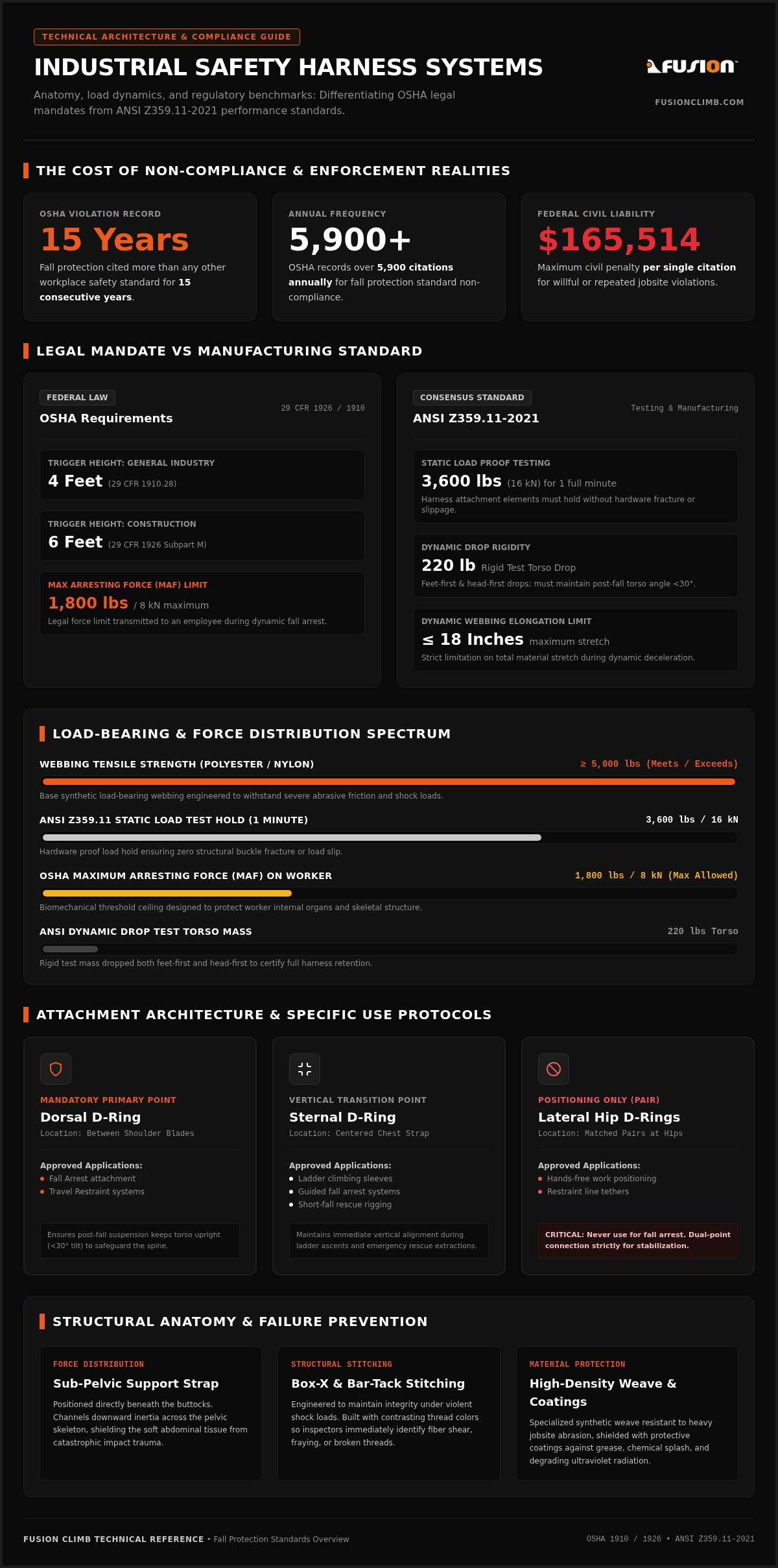
OSHA has cited fall protection violations more than any other workplace safety standard for 15 consecutive years, recording over 5,900 citations annually. Clearly, strapping into any generic industrial safety harness isn't enough to guarantee real jobsite protection. Deciphering the technical divide between baseline OSHA mandates and rigorous ANSI Z359.11-2021 standards is frustrating, especially when poorly configured gear pinches, restricts mobility, or leaves your crew second-guessing D-ring placements. You shouldn't have to choose between strict compliance and all-day mobility.
This guide cuts through the regulatory noise so you can master the technical specifications, ANSI standards, and selection criteria required to choose the right industrial safety harness for vertical work. We break down task-matched D-ring configurations, critical sizing and donning protocols, seamless hardware integration, and mandatory pre-shift inspection standards. Here is everything you need to know to equip your crew with dependable, professional-grade gear built to withstand the rigorous demands of the modern industrial jobsite.
Key Takeaways
- Understand how load-bearing webbing, high-tensile alloy hardware, and sub-pelvic designs distribute arrest forces across skeletal contact points.
- Differentiate OSHA enforcement thresholds from ANSI Z359.11-2021 manufacturing and static load criteria to ensure site compliance.
- Match specific D-ring configurations to jobsite hazards, from dorsal fall arrest to lateral work positioning and confined space retrieval.
- Select the right industrial safety harness by mastering anatomical fit checks, systematic donning steps, and mandatory pre-shift hardware inspections.
- Integrate compatible lanyards, tethers, and carabiners to establish an uncompromising, high-strength vertical safety system.
Anatomy and Mechanics: Understanding Industrial Safety Harness Architecture
An industrial safety harness is not just a cluster of straps; it is the vital link securing a worker inside a personal fall arrest system. When a slip occurs at height, the harness channels violent deceleration energy safely across the body's skeletal frame. Modern designs rely on heavy-duty webbing and precision alloy hardware to dissipate dynamic shock across the pelvis, thighs, chest, and shoulders before peak loads cause internal trauma. Understanding fundamental industrial safety harness mechanics ensures crews select gear engineered for dynamic survival rather than simple catalog compliance.
Load-Bearing Webbing and Structural Stitching
Synthetic polyester and nylon webbing form the backbone of any commercial harness, delivering tensile ratings that meet or exceed 5,000 lbs. High-density weaves resist harsh jobsite abrasion, while specialized coatings shield load-bearing fibers from grease, chemical exposure, and degrading ultraviolet radiation. Precision bar-tack and box-X stitch patterns hold these assemblies together under violent shock loads. Using contrasting thread colors provides an immediate safety benefit: inspectors can spot broken threads, fraying, or fiber shear during pre-shift visual checks.
D-Ring Configurations and Functional Attachment Points
Hardware placement dictates how a worker interfaces with rigging and anchorage connectors:
- Dorsal D-Ring: Centered between the shoulder blades, this is the mandatory primary attachment point for fall arrest and travel restraint.
- Sternal D-Ring: Located on the chest strap, this point secures ladder climbing sleeves, guided fall arrest systems, and short-fall rescue rigging.
- Lateral Hip D-Rings: Positioned in matched pairs at the hips, these rings support hands-free work positioning and restraint lines; they must never be used for fall arrest.
Biomechanical Force Distribution During Dynamic Arrest
Concentrating fall energy in the soft tissue of the abdomen can cause severe internal injuries. A properly positioned sub-pelvic strap sits beneath the buttocks, directly supporting the pelvis to absorb the brunt of downward inertia during deceleration. Under federal OSHA standards 29 CFR 1926.502 and 29 CFR 1910.140, personal fall arrest systems must limit the maximum arresting force on an employee to 1,800 lbs (8 kN). Premium harness geometry controls body position during deceleration, maintaining an upright posture that shields the spine from catastrophic whiplash.
Compliance and Standards: Navigating OSHA and ANSI Z359 Requirements
Workplace fall protection requires separating legal baselines from voluntary engineering benchmarks. Federal law dictates what an employer must enforce on a jobsite. Voluntary consensus standards define how manufacturers build and test the equipment itself. Grasping this distinction ensures your gear choices eliminate jobsite hazards rather than simply satisfying minimum legal thresholds.
OSHA 1910 and 1926 Fall Protection Mandates
OSHA regulations carry the weight of federal law. Under 29 CFR 1926 Subpart M for construction, fall protection triggers at 6 feet, while general industry rules under 29 CFR 1910.28 enforce a 4-foot threshold. Both standards demand that any personal fall arrest system utilizing a full-body industrial safety harness limit maximum arresting force to 1,800 lbs. Employers must comply strictly with OSHA 1926.502 fall protection criteria, because willful or repeated violations carry federal civil penalties up to $165,514 per citation.
ANSI Z359.11 Design and Testing Protocols
While OSHA sets legal limits, ANSI/ASSP Z359.11-2021 governs dynamic performance, labeling, and structural testing. The standard subjects harnesses to severe testing regimes:
- Static Load Testing: Harness attachment elements must hold a 3,600 lb (16 kN) static load for one minute without hardware fracture or excessive webbing slippage.
- Dynamic Drop Testing: Rigorous feet-first and head-first drops using a 220-lb rigid test torso ensure impact forces remain within acceptable thresholds while keeping the torso post-fall angle under 30 degrees.
- Webbing Elongation: The standard restricts total webbing stretch to no more than 18 inches during dynamic impact.
For operations involving complex vertical systems, review our professional guide to ropes course safety equipment standards to see how complementary hardware fits into these testing protocols.
Worker Capacity Ratings and Certification Markings
Standard ANSI Z359.11 certified units are rated for a total working capacity between 130 and 310 lbs, which accounts for the worker's body weight plus all clothing, PPE, and tool belts. Any configuration supporting loads above 310 lbs requires documented manufacturer testing to verify compliance. Every compliant industrial safety harness must feature permanent, legible labels showing:
- Manufacturer name, part number, and year of production.
- Clear load capacity limits and fiber materials.
- Visual pictograms indicating the approved purpose for each D-ring.
- Dedicated inspection tracking blocks for logging pre-shift checks.
If your jobsite demands hardware built to these exact testing benchmarks, explore commercial gear engineered by Fusion Climb to equip your workforce with dependable vertical safety solutions.
Industrial Harness Types: Matching Configurations to Site Hazards
Every vertical worksite brings distinct environmental hazards. A framing carpenter navigating floor joists faces entirely different exposure risks than a utility technician servicing high-voltage lattice towers. Relying on a one-size-fits-all build compromises both safety and mobility. Matching the structural layout of your industrial safety harness directly to site tasks prevents premature gear abrasion, minimizes worker fatigue, and keeps your operations aligned with federal OSHA fall protection standards across distinct industrial environments.
Construction and General Fall Arrest Harnesses
General construction demands rugged simplicity. Standard commercial units feature a solitary dorsal D-ring designed exclusively for primary fall arrest on residential roofs, steel structures, and elevated scaffolding. Heavy-duty back pads and integrated tool-belt loops carry pouches directly on the hips, preventing tool weight from shifting the primary webbing alignment. Tightly woven, treated polyester webbing shrugs off concrete dust, paint overspray, and moisture without stiffening or premature fiber breakdown under punishing jobsite abrasion.
Tower Maintenance and Work Positioning Systems
Tower climbers, telecommunications specialists, and wind turbine technicians operate at heights for hours at a time. These demanding environments require specialized equipment configurations:
- Frontal Sternal D-Rings: Connect smoothly to vertical ladder-climbing sleeves and rope grabs to protect workers during ascent and descent.
- Lateral Positioning D-Rings: Allow workers to lean back securely into pole straps or positioning lanyards, freeing both hands for technical installation work.
- Supportive Ergonomics: Reinforced lumbar back supports and rigid seat boards distribute pressure evenly, preventing leg numbness and suspension fatigue.
To ensure high-angle hardware functions as an integrated unit, review our zipline lanyards and tethers guide for technical insights into connecting equipment to specialized commercial harnesses.
Confined Space and Retrieval Equipment
Entering storage tanks, sewer manholes, and processing silos introduces restricted clearance risks. Confined space full body harnesses incorporate twin shoulder-mounted D-rings designed specifically for spreader bar connections. This configuration pulls an injured or incapacitated worker straight up through narrow hatches in a strictly vertical orientation. Streamlined webbing profiles eliminate bulky tool loops or protruding hardware that could snag on structural internal framing, high-pressure pipes, or mechanical obstructions during extraction.
Fitting, Donning, and Pre-Shift Inspection Procedures
Even premium equipment fails if it fits improperly or enters service with undetected structural damage. A loose strap or misaligned chest buckle can cause a worker to slip free during an inverted drop or suffer severe soft-tissue trauma during dynamic arrest. Precision fit and rigorous inspection protocols transform an industrial safety harness from a passive compliance item into a functional, lifesaving system.
Step-by-Step Donning and Sizing Protocol
Methodical donning ensures symmetrical load distribution when arrest forces hit. Follow this field protocol every time you gear up:
- Shake and Untangle: Grasp the dorsal D-ring, shake the harness gently, and allow all webbing straps to fall naturally into place.
- Shoulder Alignment: Slip the harness over your shoulders like a vest, verifying the straps sit flat across the back without twists.
- Leg Strap Fit: Reach between your legs, secure the mating or quick-release buckles around your thighs, and verify tension. Apply the flat-hand rule: you should slide a flat open hand snugly between the strap and your thigh, but a closed fist must not fit through.
- Chest Strap Positioning: Fasten the chest strap across your mid-sternum, roughly 6 to 8 inches below your clavicle, adjusting tension so it lies flat without pulling the shoulder straps inward.
- D-Ring Centering: Snug the torso adjusters symmetrically until the dorsal D-ring rests squarely between your shoulder blades.
Pre-Shift Inspection Checklist and Hardware Checks
Under OSHA 29 CFR 1910.140 and 1926.502, workers must inspect personal fall arrest gear prior to every work shift. Bend webbing into an inverted U-shape at six-inch intervals to expose hidden fiber cuts, chemical burns, or core friction damage. Check structural stitch blocks for broken, pulled, or missing threads. Inspect all stamped alloy D-rings, grommets, and buckle frames for microcracks, sharp burrs, deformation, or deep pitting corrosion. Examine internal impact deployment indicators; if the warning flag or stitch cluster has deployed, pull the unit from service immediately. Complete your tie-off setup by securing reliable anchor connections with professional climbing carabiners for industrial rigging.
Suspension Trauma Mitigation and Emergency Response
Arresting a fall is only half the battle. When a worker hangs motionless, gravity pools venous blood in the lower extremities, which can induce orthostatic shock, loss of consciousness, and cardiovascular collapse in as little as 15 to 30 minutes. Equipping your crew with deployable foot-loop trauma relief straps provides immediate relief, allowing suspended personnel to stand up in stirrups and pump their leg muscles while awaiting recovery. Jobsites must maintain written rescue plans capable of retrieving fallen workers within fourteen minutes.
Ensure your crews operate with dependable, field-tested protection every shift. Explore professional gear built for demanding worksites at fusionclimb.com to secure certified protection today.
Selecting Professional Industrial Harness Systems with Fusion Climb
Selecting vertical safety gear requires absolute confidence in the manufacturer behind the stitching. When working hundreds of feet above grade, gear cannot merely pass tests on paper; it must endure daily jobsite abuse. Fusion Climb brings dedicated manufacturing discipline to the industrial market, building commercial-grade fall protection equipment engineered for unforgiving high-angle environments. By pairing heavy-duty webbing with precision-milled hardware, every industrial safety harness provides the rugged durability and biomechanical support needed on critical jobsites.
Industrial-Strength Engineering and Robust Manufacturing
Fusion Climb leverages over two decades of specialized precision manufacturing experience across tactical, commercial, and technical climbing hardware. Production focuses on heavy-duty, tightly woven synthetic webbing delivering exceptional tensile resilience against concrete edges, structural steel friction, and abrasive airborne grit. High-tensile alloy D-rings and reinforced bar-tack stitching create dependable structural anchor points. Stringent in-house quality control systems ensure every seam and buckle assembly holds up under severe dynamic loads.
Integrated Systems: Connecting Harnesses, Lanyards, and Hardware
A harness performs only as well as the rigging connected to it. System incompatibilities introduce dangerous cross-loading risks, gate-loading hazards, and accidental roll-out failures. Fusion Climb designs vertical safety gear as a unified ecosystem:
- Full Body Harnesses: Commercial-grade architectures built with reinforced sub-pelvic straps, heavy-duty leg webbing, and balanced D-ring geometry.
- Lanyards and Tethers: Engineered shock-absorbing lanyards and positioning tethers that mate cleanly with harness D-rings without binding.
- Carabiners: High-tensile steel and aluminum locking carabiners designed to seat properly on attachment points, eliminating dangerous side-loading forces.
- Specialized Rigging: High-capacity zipline pulleys and heavy-duty hardware built for aerial rigging, horizontal travel, and controlled gear movement.
Reliable Sourcing for Demanding Work at Height
Sourcing vertical PPE directly from a focused vertical equipment manufacturer ensures your crew uses gear purpose-built for high angles. Rather than treating safety hardware as an afterthought within a sprawling catalog of disposable supplies, Fusion Climb builds equipment around high-tensile strength and functional durability. Pair your full body harnesses with compatible lanyards, tethers, and certified carabiners, while keeping daily inspection logs current to ensure complete operational readiness on every shift.
Elevate Your Jobsite Safety with Task-Tested Protection
True protection at height demands more than checking off minimum regulatory baselines. It requires purposeful D-ring alignment, exact anatomical fit, and unyielding hardware compatibility. When your crew steps onto elevated scaffolding or ascends structural steel, a properly selected industrial safety harness absorbs violent dynamic arrest forces, preserves crucial mobility, and keeps workers focused on the task at hand.
With over two decades of precision manufacturing experience in vertical operations, Fusion Climb crafts commercial-grade fall protection gear built for punishing jobsite environments. Our heavy-duty, high-tensile webbing and reinforced structural stitching integrate seamlessly across commercial carabiners, tethers, and rigging pulleys. Equip your vertical crew with professional-grade Fusion Climb full body harnesses to establish a rugged, fully compliant personal fall arrest system that delivers absolute confidence on every single shift.
Frequently Asked Questions
How often must an industrial safety harness be officially inspected?
An industrial safety harness requires two distinct inspection cadences: user inspection before every single shift, and a formal inspection by a designated Competent Person at least annually. OSHA mandates pre-shift visual and tactile checks by the worker to catch immediate hazards. ANSI standards recommend formal, documented inspections every six to twelve months, depending on jobsite severity. Always log every formal review on the permanent harness tag.
What is the standard lifespan of an industrial fall protection harness?
Most manufacturers specify a maximum lifespan of five years from the date of first use, or up to ten years from the manufacture date if stored unissued in optimal conditions. Practical service life depends on working conditions rather than calendar time alone. Acid mist, ultraviolet sun exposure, welding slag, or persistent abrasion can degrade synthetic webbing in months. Physical condition during pre-shift checks always overrides maximum shelf life.
Can an industrial safety harness be reused after arresting a fall?
No, an industrial safety harness must never be reused after arresting a fall. Federal regulations and ANSI standards mandate that any unit subjected to dynamic impact loading must be tagged out and removed from service immediately. Dynamic arrest stretches load-bearing stitching, stresses synthetic webbing fibers, and triggers visual load indicators. Cut the webbing straps immediately after the event to prevent anyone from accidentally reissuing the retired gear.
What is the practical difference between OSHA compliance and ANSI certification?
OSHA regulations are mandatory federal laws enforced by jobsite inspections and civil fines, while ANSI Z359 standards are voluntary consensus benchmarks that define equipment engineering and dynamic testing criteria. OSHA establishes minimum legal operational rules, such as capping fall arrest forces at 1,800 lbs. ANSI specifies exact static drop tests, manufacturing tolerances, and standardized labeling protocols that manufacturers engineer gear to meet or exceed.
How tight should the leg straps be on a full body harness?
Leg straps should fit snugly against your thighs without pinching skin or restricting circulation. Use the flat-hand rule to verify tension. You should be able to slide a flat, open hand snugly between the strap and your leg, but you should not be able to push a closed fist through the gap. Excessively loose leg straps cause severe soft-tissue trauma during dynamic deceleration.
What causes suspension trauma and how do relief straps prevent it?
Suspension trauma occurs when hanging motionless causes gravity to pool venous blood in your lower extremities, starving the brain and heart of oxygen in as little as 15 minutes. Deployable trauma relief straps unroll from compact side pouches to create an adjustable foot stirrup. Stepping into this loop allows you to stand, engage leg muscles, and restore normal venous blood return while awaiting high-angle extraction.
What is the purpose of having multiple D-rings on an industrial harness?
Multiple D-rings provide dedicated connection points engineered for specific loading directions and task hazards. The dorsal ring handles primary fall arrest, while the sternal ring secures ladder safety sleeves and guided ascenders. Matched lateral hip rings support positioning lanyards for hands-free structural work, and shoulder rings facilitate upright confined-space retrieval. Primary fall arrest lanyards must connect exclusively to the dorsal ring.