



Industrial Carabiners: Professional Buying Guide 2026
A 5,000-pound breaking strength isn't just a technical specification; it's the mandatory baseline for safety in professional rigging and rescue operations. If you're confused by the difference between kilonewtons and pound-force, or if you're struggling to choose between the durability of steel and the weight savings of aluminum, you aren't alone. Selecting the right industrial strength carabiners requires more than a quick look at a price tag. It demands a deep understanding of how hardware performs under the tension and friction of real-world industrial environments.
We know that the pressure to maintain strict safety compliance while managing high-stakes equipment can be overwhelming. This guide will help you master the engineering standards and material science required to choose the best connectors for your team. You'll gain a clear path through current ANSI and OSHA regulations, learn why gate-loading ratings matter just as much as major-axis strength, and discover the specific indicators that signal it's time to retire your gear for good. Whether you are managing a commercial zipline or a technical rescue squad, this is your roadmap to total hardware reliability.
Key Takeaways
- Identify hardware that meets rigorous ANSI and NFPA standards to ensure your equipment is rated for life-safety rather than general utility.
- Evaluate the performance trade-offs between high-tensile steel and lightweight aluminum to select the right material for your specific operating environment.
- Master the technical requirements for industrial strength carabiners, including the three-action locking rule and the load-bearing advantages of D-shape geometry.
- Implement a professional inspection protocol and learn the critical "Drop Rule" to determine exactly when gear must be removed from service.
- Understand how precision engineering and rigorous testing standards provide a foundation of reliability for high-stakes rigging and zipline operations.
Defining Industrial Strength: More Than Just a Heavy-Duty Label
In the retail market, "heavy-duty" is a vague marketing term often applied to hardware that shouldn't hold more than a tool bag. For professional riggers, rescue teams, and zipline operators, industrial strength carabiners represent a verified engineering standard. This isn't about how the metal looks; it's about how it performs under life-critical loads. While a utility-grade clip might look similar to a professional connector, the two belong to different worlds of manufacturing and testing. Utility clips are designed for gear management; life-safety connectors are engineered to save lives.
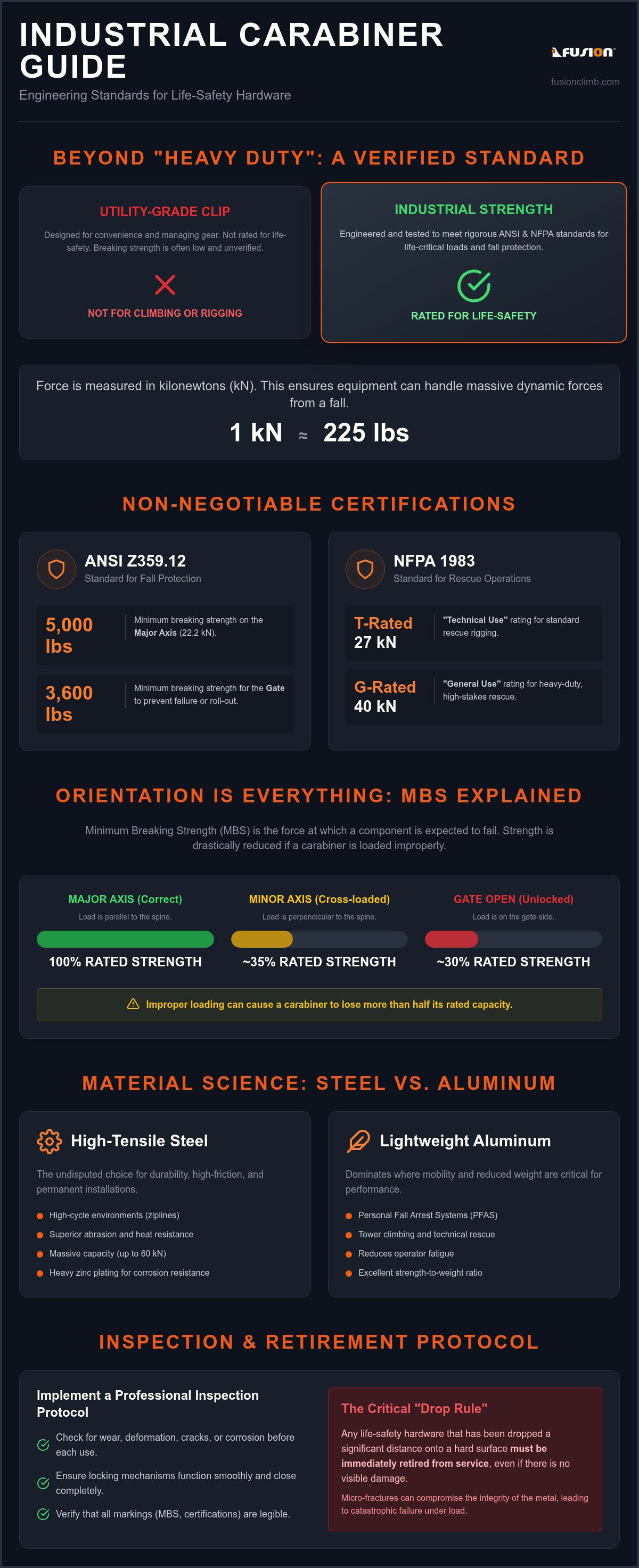
Professional force is measured in kilonewtons (kN). One kilonewton equals roughly 225 pounds of force. While a standard Carabiner for recreational use might be rated for 20 kN, industrial standards often demand higher thresholds to account for the safety factor. This safety factor is the gap between the expected load and the hardware's breaking point. It ensures the equipment can handle massive dynamic forces. A fall doesn't just apply the static weight of a person; it generates a sudden, violent surge of energy that can easily exceed 10 kN in a fraction of a second.
Key Certifications: ANSI Z359.12 and NFPA 1983
ANSI Z359.12 is the definitive standard for fall protection connectors in the United States. It mandates that the connector's major axis can withstand 5,000 pounds (22.2 kN). Crucially, it also requires the gate to hold 3,600 pounds (16 kN), which prevents accidental roll-out or gate failure during a fall. For rescue professionals, NFPA 1983 provides two distinct categories. "Technical Use" (T) ratings require a minimum breaking strength of 27 kN, while "General Use" (G) ratings demand 40 kN for heavy-duty rescue rigging. For commercial zipline and rigging operators, utilizing gear that carries these specific stamps is a non-negotiable requirement for managing professional liability and ensuring worker safety.
Understanding Minimum Breaking Strength (MBS)
Working with high-stakes rigging requires a clear understanding of Minimum Breaking Strength (MBS). You shouldn't confuse this with the Working Load Limit (WLL), which is the much lower weight recommended for daily operations. MBS is the statistically determined force where a component is expected to break. This rating is typically tested across three axes. The major axis is the strongest orientation, where the load runs parallel to the spine. Strength is significantly compromised if the hardware is cross-loaded on the minor axis or if the gate is left open. In these weakened states, even the most robust industrial strength carabiners can lose more than half of their rated capacity, making proper orientation just as important as the metal itself.
Material Science: High-Tensile Steel vs. Lightweight Aluminum
Selecting the correct material for industrial strength carabiners is a decision rooted in the specific physics of your work environment. It isn't just about weight. It's about how the metal interacts with other hardware, the weather, and the human body. High-tensile steel provides the mass and hardness needed for high-friction, abrasive contact. In contrast, aircraft-grade aluminum offers the mobility required for long-duration vertical movement. Understanding these differences ensures your gear doesn't just meet a standard; it thrives in the field.
When to Choose Steel Carabiners
Steel is the undisputed choice for high-cycle environments. In commercial zipline operations, the constant friction from steel trolleys would quickly erode softer aluminum connectors. Large steel D-shaped models often boast a massive 60kN capacity, providing a sobering sense of security for heavy rigging and permanent anchors. These connectors are built for high-stakes installations where the hardware stays put for the season. To combat rust and chemical exposure, professional steel gear utilizes heavy zinc plating. This creates a rugged, sacrificial barrier against moisture and salt air, making it the no-nonsense choice for hardware that must endure years of outdoor exposure. Beyond corrosion resistance, steel also handles the heat generated by friction more effectively than aluminum, maintaining its structural integrity during high-speed operations.
When to Choose Aluminum Carabiners
Aluminum dominates the world of personal fall arrest systems (PFAS). For a tower climber or rescue technician, reducing the weight of a harness kit is a matter of both safety and physical stamina. High-end aluminum connectors typically offer ratings between 24kN and 30kN. This comfortably exceeds the 5,000-pound requirement for OSHA personal fall protection systems while remaining remarkably light in the hand. Anodized aluminum also provides excellent natural resistance to corrosion, which is vital for rescue kits stored in humid or coastal conditions. The anodizing process creates a hard surface that resists minor scratches, ensuring the gear stays functional even after heavy use. When you are building a mobile kit for rapid response, these lightweight industrial strength carabiners act as a silent partner in your mobility.
You can explore a variety of these specialized carabiners designed to meet the rigorous demands of professional rigging and rescue.
Locking Mechanisms and Shape Geometry for Professional Rigging
The mechanical design of a connector is your primary defense against accidental detachment. While a simple gate might suffice for a tool lanyard, life-safety operations demand a more rigorous standard. Many industrial job sites now enforce the "Three-Action" rule. This safety protocol requires three distinct, deliberate movements to open the gate: typically sliding the sleeve, rotating it, and then pulling the gate back. This mechanism effectively eliminates the risk of "roll-out," where a rope or piece of hardware accidentally presses against the gate and forces it open. If your operation involves high-frequency movement or complex rigging, these industrial strength carabiners provide the fail-safe security you need.
Geometry also plays a vital role in how a connector handles a load. Beyond the locking sleeve, the shape of the frame determines how force is distributed across the metal. Modern professional hardware also utilizes a "Keylock" nose design. Unlike older styles that use a small hook to catch the gate, the Keylock system uses a smooth, interlocking slot. This eliminates snags when you are clipping into steel cables, bolt hangers, or textile slings, ensuring that your transitions are fluid and snag-free. Furthermore, gate opening clearance is a practical necessity. Large-opening connectors allow you to clip directly onto thick structural anchors or heavy-duty steel cables that would be inaccessible to smaller, recreational hardware.
Auto-Locking vs. Screw-Lock Gates
Auto-locking gates are the industry standard for zipline operations and high-stakes rescue. They rely on internal springs to snap the sleeve shut the moment the gate closes, removing the "human error" factor from the safety equation. In a fast-paced commercial environment, a guide might forget to manually tighten a screw-lock, but an auto-locker ensures the system is always secure. Screw-locks still have a place in the professional world, particularly in semi-permanent rigging. They are ideal for static environments where vibrations are minimal and the connector won't be handled frequently. However, for any application involving dynamic movement, the triple-action auto-lock remains the superior choice for professional liability and user safety.
The Functional Geometry of D, Offset-D, and Pear Shapes
The D-shape is the strongest configuration for industrial strength carabiners because it naturally shifts the load toward the spine, which is the strongest part of the frame. Offset-D shapes improve on this by providing a wider gate opening while maintaining that spine-loading advantage. For rescue technicians, the Pear shape (also known as HMS) is essential. Its wider top allows for the use of specialized hitches and provides enough space to rig multiple lines into a single point. In contrast, Oval carabiners are indispensable for use with pulleys. Their symmetrical shape keeps the load centered, preventing the pulley from shifting or tilting under tension, which is critical for maintaining mechanical advantage in hauling systems.
The Professional Checklist: Inspection, Maintenance, and Retirement
Safety starts before the first load is ever applied. For teams relying on industrial strength carabiners, a rigorous inspection protocol is the only way to ensure hardware integrity over time. In high-use commercial environments, gear isn't just subject to static loads; it faces abrasive dust, salt air, and mechanical vibration. You must treat every connector as a life-safety component that requires documented oversight. Neglecting a single hairline crack or a sluggish gate spring can lead to catastrophic failure when the stakes are highest.
The "Drop Rule" is a critical standard for industrial teams, particularly those using aluminum. While steel is more resilient to impact, aluminum can develop internal micro-fractures after a single fall onto a hard surface like concrete or steel grating. These fractures are often invisible to the naked eye but significantly compromise the metal's structural capacity. If an aluminum connector takes a significant tumble, retire it immediately. It's a small price to pay for the sobriety of knowing your gear is sound. For steel components, inspect for deformation or deep gouges that might indicate the metal has reached its elastic limit.
Visual and Functional Inspection Points
Begin your inspection by looking for "grooving," which is the wear caused by rope or cable friction. Follow the 10% rule: if the wear exceeds 10% of the original cross-sectional diameter, the connector must be removed from service. Check for stress cracks around the gate pin and look for any pitting caused by chemical corrosion. Test the gate action to ensure it snaps shut and locks without hesitation. Gate lash is the momentary opening of a gate due to vibration or impact. This phenomenon can occur during a fall, making a perfectly functioning locking mechanism vital for preventing accidental opening under tension.
Cleaning and Storage for Longevity
Keeping your industrial strength carabiners functional requires regular maintenance, especially in muddy or dusty environments. Wash your hardware in warm, soapy water after exposure to salt air or industrial chemicals. Rinse thoroughly and dry completely before storage. When lubricating gate springs, use a dry-film lubricant like PTFE or graphite. Avoid heavy oils that attract grit and turn into an abrasive paste inside the mechanism. Store your gear in a cool, dry place and keep steel and aluminum components separate to prevent galvanic corrosion, which occurs when moisture creates an electrical bridge between different metals.
Ensure your team is equipped with the most reliable hardware by browsing our selection of professional carabiners built for the toughest industrial applications.
Fusion Climb: Engineering Reliability for High-Stakes Environments
In the vertical world, your equipment is more than a tool. It's a silent partner that stands between professional success and catastrophic failure. Fusion Climb occupies this space as a dependable guardian, manufacturing hardware that exceeds the rigorous demands of industrial rigging and commercial zipline operations. We don't rely on marketing fluff or trendy aesthetics. Instead, we focus on no-nonsense engineering and meticulous manufacturing standards. Every piece of hardware we produce is built to endure the harsh, high-cycle environments where reliability is the only metric that matters.
Our commitment to safety is grounded in the reality of the field. We understand that a rigger in a high-wind environment or a guide at a busy aerial park needs hardware that works intuitively and stays secure. This is why we prioritize industrial reliability over style. By maintaining a serious, safety-first tone in our design process, we ensure that every connector leaving our facility is ready for the physical challenges of professional use. You can trust that our industrial strength carabiners are tested to meet the sobriety of technical specifications required for life-safety applications.
The Fusion Edge in Zipline and Climbing Hardware
Designing for aerial parks and commercial ziplines requires a deep understanding of mechanical fatigue. Our connectors are engineered to withstand the constant friction and repetitive loading cycles unique to these high-volume environments. We don't just sell individual components; we build integrated safety systems. There is a deliberate synergy between our zipline pulleys, lanyards, and connectors. When you pair a Fusion carabiner with one of our specialized zipline harnesses or full body harnesses, you are utilizing a system where every gate, frame, and stitch has been tested to work in harmony. This holistic approach to craftsmanship ensures that your gear remains a secondary thought, allowing you to focus entirely on the task at hand.
Sourcing for Commercial and Industrial Fleets
Managing a large-scale gear deployment requires consistency you can trust. Commercial operators choose Fusion Climb because we provide uniform quality across every fleet purchase, ensuring that every technician or guest is protected by the same high standard of hardware. Navigating the complexities of US-based safety compliance is a daunting task for many managers. Our expertise in ANSI and OSHA requirements acts as a resource for your operation, helping you select the right industrial strength carabiners for specific environmental challenges. We remain rooted in the traditional values of strength and precision, providing the technical assurance required for high-stakes vertical work. It's time to move beyond guesswork and invest in hardware that is proven in the field.
Equip your team with Fusion Climb's industrial strength carabiners and experience the difference that professional-grade engineering makes in your daily operations.
Elevate Your Safety Standards for 2026
Selecting hardware for life-safety operations is a commitment to engineering precision and professional accountability. You've mastered the technical distinction between kilonewtons and pound-force, ensuring your team relies on hardware that meets current ANSI and NFPA benchmarks. Whether you deploy high-tensile steel for abrasive zipline environments or lightweight aluminum for rapid rescue response, your choice defines the safety margin of your entire rigging system. Maintaining a strict retirement protocol is the final, essential step in protecting your crew and your clients from the risks of equipment fatigue.
Fusion Climb stands as your silent partner in these high-stakes environments. We offer ANSI & NFPA compliant options and rugged steel and aluminum designs that are trusted by commercial zipline operators nationwide. Don't leave your hardware reliability to chance when professional-grade craftsmanship is within reach. Shop Fusion Climb's Professional Carabiner Collection today. Stay focused on the vertical challenge ahead, knowing your industrial strength carabiners are built to endure the toughest conditions.
Frequently Asked Questions
What is the difference between a 25kN and a 60kN carabiner for industrial work?
A 25kN rating is the standard for personal fall arrest, providing approximately 5,620 pounds of breaking strength. In contrast, 60kN connectors are engineered for heavy rigging, rescue anchors, and permanent installations where massive safety factors are required. While 25kN models are lighter for individual workers, 60kN industrial strength carabiners offer the rugged durability needed for high-cycle commercial environments and multi-person loads.
Are steel carabiners always safer than aluminum ones for rigging?
Steel isn't inherently safer, but it's far more resilient in high-friction environments. Steel is the professional choice for permanent anchors and zipline trolleys because it resists the abrasive wear that would quickly erode aluminum. However, aluminum is often safer for mobile workers because its lighter weight reduces physical fatigue during long shifts. Choose steel for durability and aluminum for portability.
What does ANSI Z359.12 compliance actually mean for a carabiner?
ANSI Z359.12 compliance signifies that a connector meets strict strength requirements for both the frame and the gate. It mandates a 5,000-pound major axis strength and a 3,600-pound gate face rating to prevent accidental roll-out. This certification ensures the hardware is a verified life-safety component capable of withstanding the violent forces of an industrial fall.
Can I use a climbing carabiner for industrial fall arrest?
You shouldn't use recreational climbing gear for industrial work unless it explicitly carries ANSI or OSHA certifications. Most climbing carabiners lack the 3,600-pound gate strength required by industrial safety regulations. Using uncertified hardware can lead to regulatory fines and, more importantly, equipment failure in a professional rigging scenario. Stick to hardware designed for the job site.
How often should industrial carabiners be inspected in a commercial setting?
OSHA regulations require a visual inspection before every single use. Beyond these daily checks, commercial operators should conduct documented, thorough inspections at least every six months. If your industrial strength carabiners are used in harsh conditions like salt air or chemical plants, increase that frequency to quarterly. Documenting these inspections is vital for maintaining your safety records and liability protection.
What is a 'keylock' gate and why is it preferred for industrial use?
A keylock gate uses a smooth, interlocking slot instead of a traditional hook-and-pin design on the nose. This prevents the carabiner from snagging on cables, bolt hangers, or textile slings during critical transitions. In professional rigging, a snag-free nose ensures faster movement and eliminates the risk of the gate being held open by a caught rope or wire.
How do I know if my carabiner is worn out and needs to be retired?
Retire any connector that shows more than 10% wear in the metal's cross-section or displays visible cracks and pitting. Test the gate action; if the sleeve is sluggish or fails to lock automatically, the hardware is compromised. Remember the drop rule for aluminum. If a connector falls from height onto a hard surface, remove it from service immediately to avoid risks from invisible micro-fractures.
Is a screw-lock carabiner safe for zipline operations?
Screw-locks are generally discouraged for life-safety connections in zipline operations due to the high risk of human error. Guides or guests may forget to manually lock the sleeve, leaving the system vulnerable to accidental opening. Auto-locking, triple-action gates are the industry standard because they ensure the connector is always secure the moment the gate snaps shut. Reserve screw-locks for semi-permanent rigging where they won't be frequently handled.