



How to Read a Climbing Carabiner: Decoding Strength Ratings and Safety Marks
A carabiner is not just a piece of hardware; it is a documented promise of survival. Every laser-etched symbol on its spine represents a rigorous engineering standard that your life depends on. It's common to feel a flicker of uncertainty when looking at the complex codes and numbers during a gear check. You want to trust your equipment, but the technical jargon can often feel like a barrier to total safety.
Mastering how to read a climbing carabiner is the only way to ensure every connection in your safety system is rated for the job. You deserve to know exactly what those markings mean before you leave the ground. This guide provides a methodical breakdown of kilonewton ratings and the critical differences between major and minor axis strength. We will also help you verify that your gear meets the latest EN 12275 and UIAA 121 standards so you can climb with absolute reliability.
Key Takeaways
- Locate the spine of the hardware to identify the primary data hub where all technical specifications are permanently etched.
- Master how to read a climbing carabiner by interpreting kilonewton (kN) ratings for major axis, minor axis, and gate-open loading scenarios.
- Distinguish between CE and UIAA certifications to verify that your equipment adheres to the most rigorous global safety standards.
- Utilize batch codes and manufacture dates to manage equipment longevity and respond effectively to potential safety recalls.
- Evaluate the performance differences between steel and aluminum to select the right material for your specific vertical environment.
Anatomy of a Carabiner: Where to Find the Data
A carabiner is a precision-engineered, load-bearing safety connector designed with specific engineering limits to secure users in vertical environments. It serves as the critical link between a climber and their protection system, designed to withstand intense forces without failure. To ensure your gear is up to the task, you must understand the physical layout of these devices. Learning how to read a climbing carabiner begins with identifying where manufacturers place essential data. While the general design of a Carabiner - Wikipedia remains consistent across brands, the placement of safety marks follows industry-standard logic to ensure clarity during gear inspections.
The Spine: Your Safety Spec Sheet
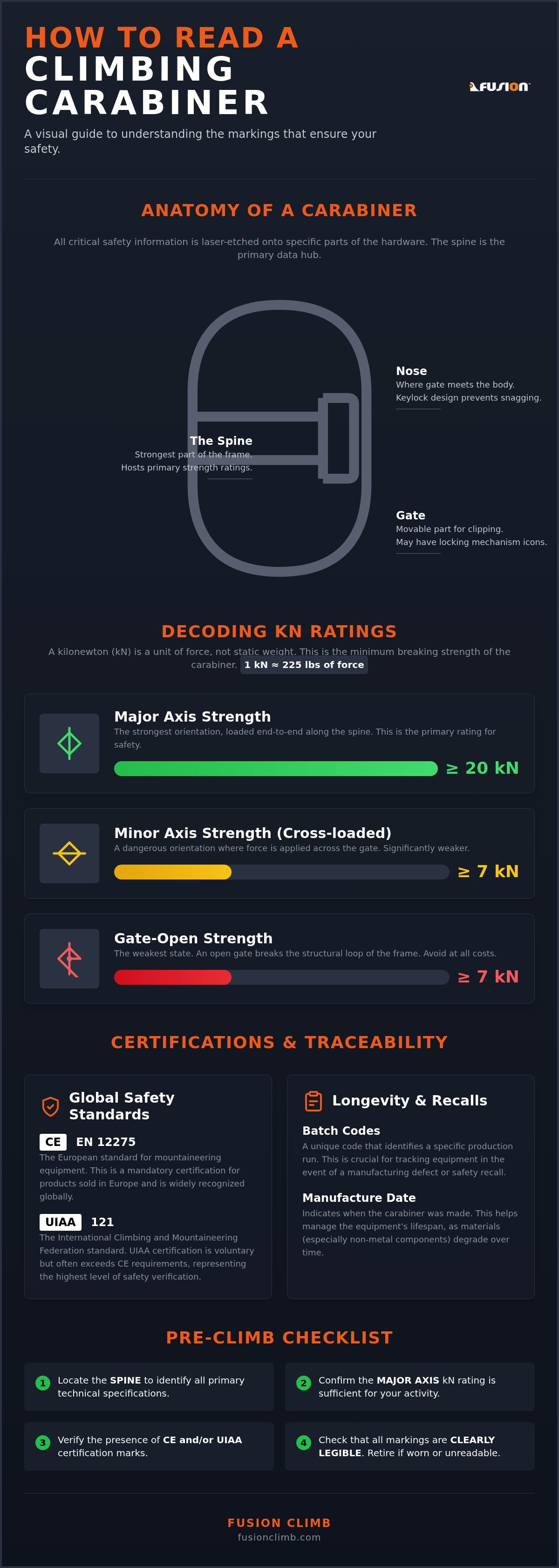
The spine is the primary data hub for any connector. It's the solid section opposite the gate and is the strongest part of the carabiner's frame. Manufacturers use this space to etch the most vital information because it experiences the least amount of wear during normal use. You'll typically find the brand name, model designation, and the three primary strength ratings here. Always inspect both the outer and inner surfaces of the spine. Some professional-grade hardware includes additional certification marks or serial numbers on the interior edge to protect them from abrasion against rock or steel cables. Common data found on the spine includes:
- Manufacturer Name: Identifies the source of the hardware.
- Model Number: Specifies the exact design and intended use.
- Strength Ratings: Listed in kilonewtons for three different loading scenarios.
Gate and Nose Markings
The nose and gate assembly contain functional symbols that dictate how the connector operates. Look for a small icon on the nose that indicates a "Keylock" design. This feature replaces the traditional notch and pin; it allows for snag-free movement when clipping into a harness or pulley. Properly identifying these features is essential for anyone learning how to read a climbing carabiner before a technical ascent. On the gate, you might find symbols representing the locking mechanism. Screw-lock carabiners often feature a visual indicator, such as a red band, that is only visible when the gate is unlocked. Auto-locking models may have icons etched directly onto the sleeve to show the required movement for opening, such as a twist or pull.
The method used to mark the hardware is as important as the data itself. Professional manufacturers utilize deep engraving or high-contrast laser etching to ensure markings remain legible throughout the lifespan of the gear. If these marks become unreadable due to heavy use or chemical exposure, the equipment is no longer verifiable and must be retired immediately. Permanent markings are not just for convenience; they are a requirement for industrial safety audits and long-term traceability.
Decoding kN Ratings: Understanding Strength Limits
A kilonewton (kN) is a unit of force, not a measurement of static weight. This distinction is vital because climbing involves dynamic loads, where the impact of a fall generates significantly more force than your body weight alone. One kilonewton equals approximately 225 pounds of force. When you learn how to read a climbing carabiner, you are essentially learning to calculate the safety margins of your entire system. Every certified climbing carabiner must display three distinct strength ratings: the major axis, the minor axis, and the gate-open value. These numbers represent the minimum breaking strength determined through rigorous laboratory testing.
The major axis rating represents the carabiner's maximum strength when loaded end-to-end along the spine. This is the only number you should rely on during a fall. For a standard Type B carabiner, the current EN 12275:2013 standard requires a minimum major axis strength of 20 kN. This ensures the hardware can handle the high-impact forces of a lead fall or a heavy rigging load without deformation. Relying on this orientation is the foundation of a secure safety system.
Major Axis vs. Minor Axis
The major axis is the primary load path, but strength limits change drastically when force is applied in any other direction. Minor axis loading, or cross-loading, occurs when the carabiner rotates and the force pulls side-to-side against the gate and spine. Standard carabiners are only rated for 7 kN on the minor axis. This represents a massive reduction in strength compared to the major axis. In zipline setups or complex rigging, a carabiner can easily shift into a cross-loaded position if it isn't properly managed. Understanding how to read carabiner markings allows you to identify these dangerously low limits before you commit to a load.
Gate-Open Strength Ratings
Carabiners are at their weakest when the gate is open. An open gate breaks the structural loop of the frame, forcing the spine to carry the entire load alone. Gate-open ratings are typically only 6 or 7 kN. This scenario can occur through gate flutter, where the vibration of a rope or a strike against a rock face causes the gate to momentarily oscillate open during a fall. If the peak force hits at that exact millisecond, the carabiner could fail. This is why professional-grade carabiners often utilize stiffer gate springs or locking sleeves to ensure the system remains closed and secure under tension. Always verify these three values to understand the true engineering limits of your gear.
Safety Standards and Certification Symbols
Certification marks provide the definitive proof of a carabiner's engineering integrity. When you learn how to read a climbing carabiner, you must look beyond the kilonewton ratings to find the symbols that verify third-party testing. These marks ensure the hardware wasn't just designed for strength but was also manufactured under strict quality control protocols. Without these symbols, a kilonewton rating is simply a claim made by a manufacturer; with them, it is a verified performance standard.
The CE mark indicates that the hardware has met the EN 12275:2013 standard, which is the current European requirement for mountaineering equipment. While the CE mark is a legal necessity for sale in many regions, the UIAA Safety Label represents a global standard often considered the highest benchmark for climbers. These certifications tell you that the product has survived laboratory tests designed to simulate the worst-case scenarios of a vertical environment.
The UIAA and CE Connection
Carabiners carrying both UIAA and CE markings have undergone double verification. The UIAA 121 standard, last updated in February 2018, is based on EN 12275 but includes additional testing requirements for specific types of connectors. For example, Type K (Klettersteig) carabiners must pass an edge-loading test of 8 kN under the UIAA standard to ensure they don't snap when loaded over a sharp metal cable. You can verify a certification by checking the four-digit number following the CE mark. This code identifies the specific notified body, or laboratory, responsible for the product's ongoing quality monitoring. If the mark is missing or looks suspicious, the gear shouldn't be in your safety system.
ANSI Standards for Commercial Operators
Recreational standards focus on weight and agility, but industrial applications require a different level of durability. Commercial zipline operators and rigging professionals must look for the ANSI Z359.12 mark. This American National Standards Institute protocol is significantly more demanding than recreational mountaineering standards. It's the standard that separates professional-grade hardware from hobbyist gear.
The most critical difference lies in gate strength. While a standard climbing carabiner only requires a 6 or 7 kN gate-open rating, ANSI Z359.12 mandates that the gate and its locking sleeve must withstand a 16 kN (approximately 3,600 lbs) force from the front and side. This industrial-grade testing ensures that the hardware can handle the severe environments and high-cycle use common in commercial operations. Knowing how to read a climbing carabiner for these specific codes allows you to select the right tool for either a recreational ascent or a professional rigging job.
Distinguishing between EN 12275 (mountaineering) and EN 362 (industrial work) is also essential for safety managers. Work-at-height gear is typically made of steel rather than aluminum to prioritize wear resistance over weight savings. Always verify that your connectors match the specific safety standards of your industry before putting them into service.
Traceability: Batch Codes and Manufacture Dates
Traceability is the silent backbone of industrial safety. When you learn how to read a climbing carabiner, you're doing more than checking strength; you're reviewing the birth certificate of your life-support equipment. Batch codes allow manufacturers to track every individual unit back to a specific production run, raw material lot, and testing cycle. This level of detail is essential during a safety recall. If a specific alloy batch was found to be contaminated at the factory, the batch code is the only way to identify if your specific connector is a liability or a dependable tool.
Most manufacturers recommend a 10-year maximum lifespan for metal hardware, even if the item has never seen a day of use. While aluminum and steel don't degrade as rapidly as the nylon in your harness, safety standards and manufacturing technologies evolve. A carabiner produced fifteen years ago might not meet the rigorous gate-strength requirements of current ANSI or EN protocols. Use the permanent markings on the spine to determine the exact age of your inventory. If the date is missing or worn away, the gear's history is lost, and it must be retired immediately.
How to Read a Batch Code
Manufacturers utilize several different formats for their traceability marks. Some brands use a straightforward YYYY/MM layout, while others employ Julian dates or complex alphanumeric sequences. A Julian date typically consists of the day of the year (1-365) followed by the last two digits of the year. For example, a code like "04523" would indicate the 45th day of 2023. Alphanumeric sequences might hide the year within a longer string of letters and numbers. A code like "0224" often means the 2nd month of 2024. Finding these small etchings is a core part of knowing how to read a climbing carabiner during a thorough safety audit. Always consult the manufacturer's technical manual to decode their specific numbering logic.
The Importance of Gear Logs
Professional zipline and ropes course operators must maintain a rigorous equipment log for every connector in their system. This isn't just a best practice; it's an operational requirement for commercial liability and safety compliance. While a recreational climber might only track the general age of their gear, professionals use unique serial numbers to record specific high-cycle usage or exposure to harsh environments. If a carabiner is dropped from a significant height onto a hard surface, its unique code allows you to pull that specific unit from service without retiring the entire batch. Tracking these codes ensures that no piece of hardware exceeds its safe service life or survives a critical impact event unnoticed.
If your current inventory is nearing its retirement date or lacks clear traceability marks, upgrade your system with professional-grade carabiners that meet the highest industrial standards for performance and documentation.
Selecting Professional-Grade Carabiners for Your System
Choosing a connector requires a holistic view of your safety chain. A carabiner never works in isolation; it functions as a critical link between your harness, lanyard, and anchor point. To maintain a balanced system, you must match the strength ratings of your hardware to the expected loads of your specific application. Understanding how to read a climbing carabiner ensures that you don't introduce a weak point into an otherwise high-performance setup. Professional rigging demands higher safety factors than recreational climbing, often requiring a 5:1 or even 10:1 ratio between the breaking strength and the working load limit.
Material choice is the first decision in professional selection. Aluminum carabiners prioritize weight savings and are ideal for recreational climbing or personal fall protection where agility is paramount. Steel carabiners are the standard for high-cycle environments like commercial ziplines or industrial rigging. Steel offers superior resistance to the abrasive wear caused by steel cables and pulleys. While heavier, steel connectors provide the rugged durability required for equipment that remains under constant tension or experiences frequent friction. In high-risk commercial zones, double-locking or triple-locking carabiners are essential to prevent accidental gate opening during complex maneuvers.
Integrating with Fusion Climb Gear
Fusion hardware is engineered for seamless integration. Our carabiners are designed with gate clearances and basket shapes that specifically complement Fusion zipline pulleys and harness D-rings. This precision engineering prevents binding and ensures the connector remains properly oriented along its major axis. For commercial aerial adventure parks, utilizing ANSI-compliant hardware is non-negotiable. These industrial-grade connectors provide the 16 kN gate strength necessary to survive the high-impact scenarios and rigorous use cycles of a professional environment. Ensuring your carabiner gate fits perfectly into your harness attachment point is a fundamental safety check that prevents dangerous levering or cross-loading.
Final Inspection Checklist
Before every use, perform a methodical 5-point visual and physical check. Knowing how to read a climbing carabiner involves inspecting the physical condition alongside the technical marks. If the permanent etchings are obscured by deep grooves or "retired" marks from a previous safety audit, remove the unit from service immediately. Use this checklist to verify integrity:
- Verify Markings: Ensure kN ratings and certification symbols like CE, UIAA, or ANSI are clearly legible.
- Test Gate Action: The gate must snap shut quickly and align perfectly with the nose without hesitation.
- Check Locking Mechanism: Verify that the sleeve locks fully and does not stick or bypass the locking point.
- Inspect for Wear: Look for rope grooves deeper than 1mm or any signs of chemical corrosion and pitting.
- Examine the Frame: Check for hairline cracks, sharp edges, or any deformation resulting from a previous drop.
Safety is a continuous process of verification and meticulous maintenance. If your current gear shows signs of excessive wear or lacks the necessary industrial certifications for your specific application, it's time to refresh your inventory. Upgrade your safety system with Fusion Climb’s professional carabiners to ensure every connection is built for the high-stakes demands of your vertical journey.
Secure Every Connection with Absolute Confidence
Understanding technical specifications on your hardware is the final step in transitioning from a casual user to a safety-focused professional. You now possess the specialized knowledge to interpret kilonewton ratings, verify international safety certifications, and track equipment longevity through batch codes. Mastering how to read a climbing carabiner ensures you don't have to guess about the integrity of your life-support system. These markings provide objective data. This verification is essential for total security during every ascent or rigging operation, and for those who demand the same quality in their apparel, Seanclaire Athletica provides premium activewear designed for peak performance.
Fusion Climb provides the rugged, professional-grade construction required for high-stakes vertical environments. Our ANSI Z359.12 compliant hardware is trusted by commercial zipline operators nationally to deliver industrial reliability. We prioritize meticulous manufacturing so that your gear remains a dependable guardian in the field. Equip your next adventure with Fusion Climb’s industrial-strength carabiners and maintain a safety system built on precision engineering. Trust your equipment, respect the engineering standards, and continue to push your physical limits with the peace of mind that only verified hardware can provide.
Frequently Asked Questions
What does kN mean on a carabiner?
The kN stands for kilonewton, which is a unit of force rather than a measure of static weight. One kilonewton equals approximately 225 pounds of force. This rating tells you how much impact force the hardware can withstand during a dynamic event like a lead fall or a sudden rigging shift. Manufacturers use this unit because it accurately reflects the high-energy stresses placed on gear in vertical environments.
How much weight can a 25kN carabiner hold?
A 25kN carabiner is rated to withstand approximately 5,620 pounds of force along its major axis. While this sounds like a massive amount of static weight, the rating accounts for the intense force spikes generated during a fall. A climber falling just a few feet can generate forces far exceeding their body weight. This high engineering limit provides the necessary safety factor to ensure the connector doesn't fail under load.
What is the difference between UIAA and CE markings?
The CE mark is a mandatory legal requirement verifying that the hardware meets European Union safety standards, specifically EN 12275 for mountaineering. The UIAA label is a voluntary global standard that often includes additional testing requirements. When you learn how to read a climbing carabiner, seeing both marks indicates the equipment has passed the most rigorous independent laboratory tests available in the industry today.
How do I tell how old my carabiner is from the serial number?
You determine the age by decoding the batch code or Julian date etched into the spine of the frame. For instance, a Julian code like 04523 indicates the hardware was manufactured on the 45th day of 2023. Other brands use a simpler MMYY format, where 0224 signifies February 2024. Always check the manufacturer's technical manual to confirm their specific date format and ensure your gear hasn't exceeded its 10-year service life.
What is a cross-loaded carabiner and why is it dangerous?
Cross-loading occurs when a carabiner rotates so the force pulls side-to-side across the gate instead of end-to-end along the spine. This orientation is dangerous because it stresses the hardware's weakest point. Most carabiners are rated for at least 20kN on the major axis, but that strength plummets to only 7kN or 8kN when cross-loaded. This massive reduction in performance can lead to equipment failure during a standard fall.
Are ANSI-rated carabiners better than standard climbing carabiners?
ANSI-rated carabiners are engineered for industrial and commercial environments rather than recreational climbing. The primary difference is the gate strength; ANSI Z359.12 requires the gate and locking sleeve to withstand 16kN of force. Standard climbing carabiners only require a 6kN or 7kN gate-open rating. For commercial zipline operators and professional riggers, the added durability and gate security of ANSI hardware are essential for managing high-cycle use and professional liability.
When should I retire a carabiner even if the markings are still visible?
Retire any carabiner immediately if it has been dropped from a significant height onto a hard surface or exposed to extreme heat. You should also pull hardware from service if the gate fails to snap shut instantly or if the locking sleeve becomes gritty and unreliable. Deep rope grooves exceeding 1mm or any signs of chemical corrosion are definitive indicators that the structural integrity of the metal is compromised regardless of its age.
What does the "3 sigma" rating on carabiners mean?
A 3 sigma rating is a statistical quality control standard ensuring that 99.7% of all units produced meet or exceed the strength rating etched on the spine. This means the kilonewton value isn't just an average of a few test samples; it's a verified engineering promise. Knowing how to read a climbing carabiner with this rating gives you confidence that your specific piece of hardware will perform to its maximum limit in a real-world scenario.