



High Weight Capacity Zipline Harness Guide: Safety for Every Rider in 2026
Does a higher weight rating on your gear actually guarantee a safer ride, or is it just a marketing label? You've likely felt the anxiety of wondering if standard equipment can truly handle the dynamic forces of a high-speed descent. It's a valid concern. Standard harnesses often fail to provide the necessary support for larger frames, leading to uncomfortable pinching or, worse, legitimate doubts about structural integrity under load.
We understand that safety is non-negotiable. This guide will show you exactly how a high weight capacity zipline harness utilizes industrial-grade load distribution and redundant safety certifications to protect every rider. You'll discover the engineering behind 5,000-pound minimum breaking strengths and learn how to distinguish between static and dynamic load ratings. We'll explore the importance of ANSI Z359.11-2021 compliance and how to select professional-grade gear that balances rugged durability with the comfort required for long, secure descents in any commercial environment.
Key Takeaways
- Learn the critical difference between static mass and dynamic kinetic forces to ensure your equipment handles the stress of high-speed braking.
- Identify the industrial engineering requirements for a high weight capacity zipline harness, including ANSI Z359.11 compliance and box-X reinforced stitching.
- Compare the benefits of sitting harnesses against full-body models to determine which design provides the best torso support and inversion protection.
- Use professional measurement techniques to achieve a secure, two-finger snug fit that prevents gear shifting during long descents.
- Understand why US-based manufacturing and rigorous testing protocols are essential for maintaining safety standards in commercial zipline operations.
Understanding High Weight Capacity in Zipline Systems
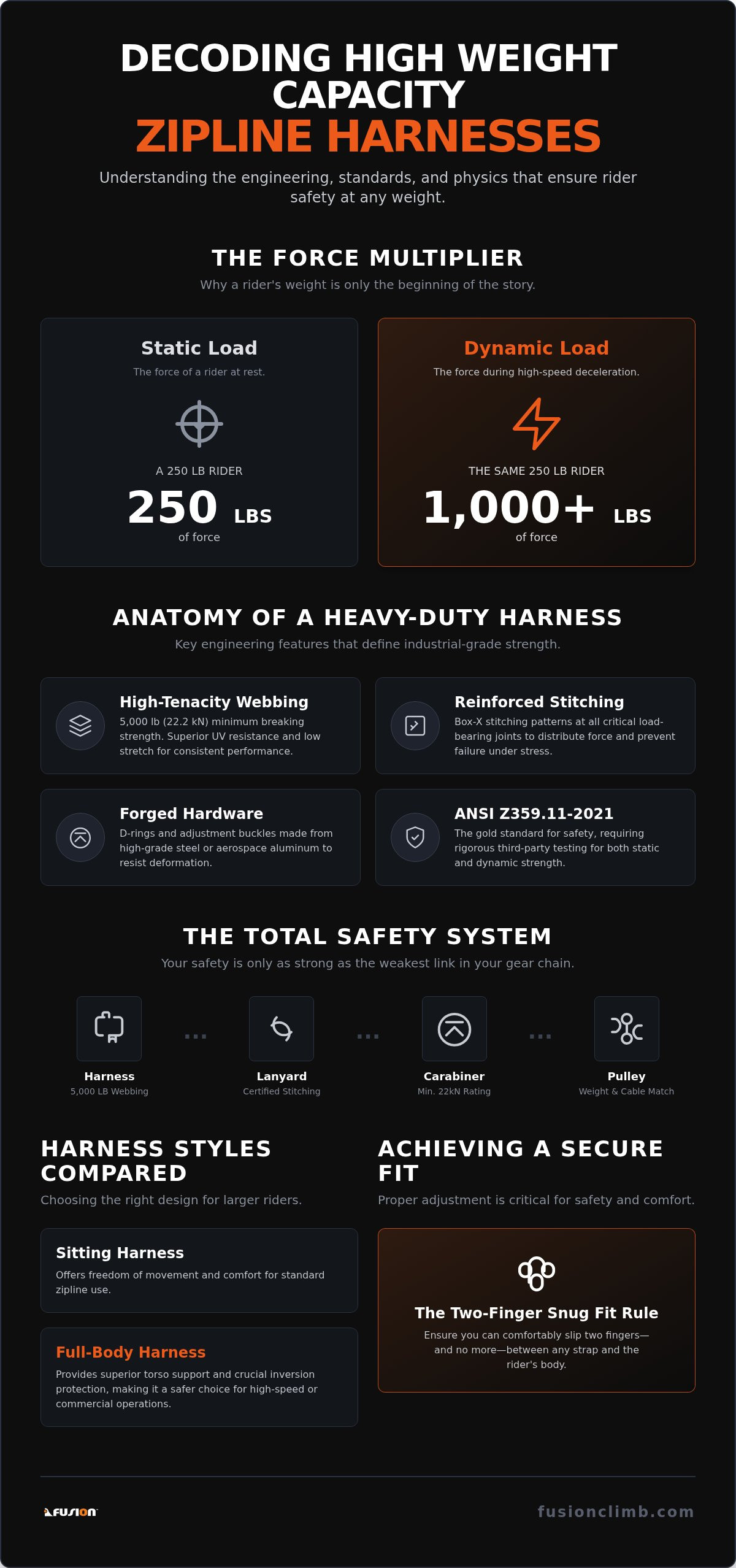
High weight capacity isn't just a static number printed on a product tag. In the context of vertical environments, it represents a system's ability to manage the combined stress of rider mass and kinetic force. A professional high weight capacity zipline harness is engineered to withstand not only the person's weight while hanging but also the extreme energy spikes that occur during a high-speed descent. You don't just need gear that holds you; you need gear that protects you when the physics of the ride get intense.
Professional safety webbing typically features a 5,000 lb (22.2 kN) minimum breaking strength. This rating establishes a "Safety Factor," ensuring the equipment remains structural even if it experiences minor wear or UV degradation over time. Hardware is rated significantly higher than the rider's actual weight to provide a massive buffer against the unexpected. This redundancy is what separates industrial-grade equipment from recreational alternatives. It's the difference between gear that simply works and gear that ensures survival under duress.
Static vs. Dynamic Load Requirements
Gravity changes the math as soon as you leave the platform. While a 250 lb rider exerts a static load of 250 lbs while hanging still, that same rider can exert over 1,000 lbs of force during a sudden deceleration or stop at the end of the line. Dynamic load is the force generated by a body in motion during a fall or deceleration. To manage these dangerous spikes, high-capacity systems often integrate shock-absorbing lanyards. These components elongate under specific force thresholds to dissipate energy, which prevents the high weight capacity zipline harness from transferring bone-breaking levels of force directly to the rider’s body.
The Total System Approach
Your safety depends on the weakest link in your gear chain. A heavy-duty harness is only as strong as the carabiner, lanyard, and pulley it connects to. If you use a high-tensile harness but pair it with a recreational-grade connector, you've compromised the entire safety margin. Operators must evaluate the cumulative weight capacity of the entire zipline trolley system to ensure every component can handle the same dynamic forces.
Understanding Safety harness design and components helps operators identify why specific stitching and D-ring placements are required for high-tensile applications. When selecting gear, prioritize the following industrial-grade components:
- Industrial-Grade Carabiners: Look for steel or high-strength aluminum with gate-locking mechanisms rated for at least 22kN.
- Heavy-Duty Pulleys: Ensure the side plates and bearings are designed for the specific cable diameter and rider weight.
- Reinforced Lanyards: Use tethers with certified stitching patterns that match the harness's load-bearing capacity.
By treating the harness as one part of a unified safety system, you ensure that the equipment works in harmony to protect the rider. Don't settle for mismatched gear when lives are on the line. Precision engineering and rigorous testing are the only ways to guarantee performance at height.
Engineering Standards: What Makes a Harness 'Heavy Duty'?
Engineering a high weight capacity zipline harness requires more than just thickening the straps. It demands a sophisticated understanding of material science and structural load paths. When a rider's safety is on the line, the difference between recreational gear and industrial-grade equipment becomes life-saving. True heavy-duty harnesses rely on high-tenacity polyester webbing rather than standard nylon. Polyester offers superior UV resistance and significantly lower stretch, ensuring the harness maintains its shape and security even under extreme tension or prolonged sun exposure.
Structural reliability is built at the stitch level. Professional manufacturers utilize reinforced box-X stitching patterns at every critical load-bearing joint. These patterns distribute force across a wider surface area of the webbing, preventing individual threads from snapping under sudden dynamic loads. This level of precision is a core requirement of ACCT industry standards, which dictate how challenge course equipment must perform in the field. Hardware components like D-rings and buckles must be forged from high-grade steel or aerospace-quality aluminum alloys to prevent deformation during high-speed braking maneuvers.
The Importance of ANSI and OSHA Compliance
Industrial standards are the benchmark for professional safety. ANSI Z359.11-2021 is the gold standard for full-body harnesses, requiring rigorous testing for both static and dynamic strength. Unlike "backyard" gear, a compliant high weight capacity zipline harness must include fall arrest indicators. These small, stitched sections deploy if the harness experiences a significant impact, providing a clear visual cue that the equipment is no longer safe for use. Operators must stay current with the latest 2026 ANSI updates to ensure their hardware meets modern commercial requirements.
Load Distribution and Pressure Points
Comfort is a safety feature, not a luxury. When webbing is too narrow, it acts like a dull blade against the rider's skin. Heavy-duty designs utilize webbing that is 1.75 inches or wider to spread the rider's weight across a larger area. This reduces localized pressure and prevents the "pinching" common in cheaper models. Sub-pelvic straps are equally vital. These straps ensure the rider's weight is supported by the skeletal structure rather than soft tissue, which is essential for preventing suspension trauma during extended periods of hanging. Commercial operators looking for gear that exceeds these standards often choose full body harnesses designed for maximum industrial reliability.
By balancing padding technology with structural integrity, high-capacity designs allow for long descents without compromising the rider's physical well-being. It's about providing a secure, stable platform that lets the rider focus on the experience rather than the discomfort of their gear.
Comparing Harness Styles for Heavier Riders
Selecting the right geometry for a high weight capacity zipline harness is as critical as the tensile strength of the webbing itself. Different body types require specific load paths to ensure both safety and comfort during high-velocity transits. While standard sitting harnesses offer a familiar entry and exit process for recreational courses, they often concentrate pressure in the upper thighs and groin. For heavier riders, this concentration can lead to significant discomfort or restricted circulation during longer descents. Professional operators must evaluate harness styles based on the rider's center of gravity and the physical demands of the specific zipline course.
Superman Style: The Professional Choice for Aerial Flight
Aerial flight in a prone position isn't just about the thrill; it's about superior physics. Superman Style Harnesses distribute a rider's weight across the entire length of the torso and thighs rather than suspending it from a single point at the waist. This horizontal orientation reduces the strain on any single muscle group or pressure point. It's the ideal configuration for long, high-speed commercial lines where comfort is paramount. Fusion Climb specializes in prone flight technology, utilizing specialized engineering to maintain a stable, aerodynamic profile. These harnesses ensure that even at peak speeds, the rider remains securely cradled within a reinforced structural frame.
Full Body vs. Waist-Only Harnesses
Waist-only harnesses are often insufficient for high weight capacity safety in professional environments. They lack the necessary upper body support to prevent inversion. If a rider's center of gravity shifts during a sudden stop, a waist harness provides no protection against flipping backward. Full Body Harnesses solve this problem by incorporating shoulder straps that keep the rider in a permanent, upright position. This design is essential for maintaining torso stability and protecting the spine from jarring forces.
Multi-point attachment systems further enhance this stability. By connecting the rider to the trolley at several reinforced points, the system prevents the harness from shifting or "creeping" under heavy loads. Consider these criteria when choosing a style:
- Rider Mobility: Sitting harnesses allow for easier movement on platforms; prone styles are dedicated to the flight itself.
- Inversion Risk: High-speed lines with aggressive braking require the torso support found only in full-body models.
- Weight Distribution: Prone styles offer the most surface area for load spreading, which is vital for rider comfort.
Reliability starts with the right design choice. Don't compromise on the harness style when the physics of the ride demand industrial-grade support. A secure rider is a confident rider.
Sizing and Fitting for Maximum Security
Precision in fitting is the final barrier between a safe descent and a catastrophic failure. While generic gear often relies on "one-size-fits-most" marketing, a professional high weight capacity zipline harness requires exact adjustment to function as intended. If the harness is too large, the load-bearing points shift. If it is too small, it restricts the rider's movement and breathing. Achieving a secure fit is a methodical process that begins on the ground and ends with a suspension check. Follow these steps to ensure every rider is locked in correctly.
- Step 1: Measurement. Use a soft tape to measure the waist, thighs, and torso length. Do not rely on pant sizes. High-capacity gear must sit over the iliac crest (hip bones) to prevent the harness from sliding down during a descent.
- Step 2: The Two-Finger Rule. Tighten the waist and leg loops until you can only fit two fingers between the webbing and the body. This ensures the harness is snug enough to prevent shifting without cutting off circulation.
- Step 3: Suspension Test. Before leaving the platform, the rider should hang in a controlled environment. This allows the gear to settle and reveals "hotspots" or pressure points that require adjustment.
- Step 4: Hardware and Strap Management. Verify that all buckles are double-backed or locked. Tidy up excess webbing to ensure it cannot catch on the pulley or cable.
The Dangers of Improper Fitting
Loose straps are more than just a nuisance. They are a significant safety hazard. When webbing is slack, it allows the harness to jerk during sudden braking, which leads to friction burns and uneven load distribution across the rider's frame. In low-tension scenarios, such as when a rider is waiting on a platform or transitioning between lines, loose leg loops increase the risk of slipping out of the gear entirely. A harness must be tight enough to stay in place during a flip but loose enough to allow full respiratory expansion. Proper tension ensures the safety system moves with the body rather than against it.
Adjustability Features to Look For
The hardware on a high weight capacity zipline harness should prioritize both security and ease of use. Quick-connect buckles allow for rapid entry and exit, but they must be inspected for grit or debris that could compromise the locking mechanism. Pass-through buckles offer a more traditional, fail-safe connection that many commercial operators prefer for high-use environments. Look for gear that includes elastic strap keepers. These small components prevent dangling webbing from becoming a snag hazard during flight. For professional-grade equipment that balances these features with industrial strength, explore the range of zipline harnesses manufactured to rigorous safety standards.
Reinforced gear loops are another essential feature for heavy-duty applications. These provide secure attachment points for secondary lanyards or rescue equipment. By choosing gear with comprehensive adjustability, you ensure that every rider, regardless of their build, receives the same level of protection and comfort.
The Fusion Climb Standard: Industrial Reliability
Reliability in the vertical world is born from direct oversight and uncompromising manufacturing standards. Fusion Climb stands apart by manufacturing high-tensile safety gear in the USA, ensuring that every high weight capacity zipline harness meets strict quality control benchmarks before it ever reaches a platform. Unlike resellers who lack influence over the production process, we maintain total authority over the materials, stitching, and hardware integration of our products. This hands-on approach allows us to deliver gear that commercial operators trust for high-volume, high-weight applications where equipment fatigue is a constant variable.
Our commitment to safety is backed by rigorous testing protocols. Every harness style we produce undergoes destructive testing to verify minimum breaking strengths and ensure compliance with ANSI Z359.11 standards. We understand that a commercial environment demands more than just meeting a baseline; it requires equipment that can withstand thousands of cycles without compromising structural integrity. By integrating our harnesses with Fusion pulleys and carabiners, operators create a unified safety solution where every component is engineered to work in harmony under heavy dynamic loads.
Rugged Confidence in Every Stitch
We build our full-body lines with a "silent partner" philosophy. Your gear should work so effectively that you can focus entirely on the progression of the ride or the management of your course. This professional-grade craftsmanship is evident in our reinforced attachment points and industrial-grade webbing. For a deeper look at how these engineering choices impact long-term safety, we recommend reviewing our comprehensive guide on full body climbing harnesses. Our goal is to provide the sobering sense of security required when lives are suspended hundreds of feet in the air.
Ready for Adventure
Fusion Climb gear supports the full spectrum of vertical challenges, from recreational thrills to the most demanding commercial safety requirements. We don't just sell equipment; we provide the foundational strength that makes adventure possible. If you are managing a high-traffic course, our experts are available to consult on bulk operator orders to ensure your fleet meets the specific demands of your terrain and rider demographics. Taking the next step in course safety means choosing gear that prioritized substance over style.
Secure your operation with professional-grade hardware:
- Explore Fusion Climb's High-Capacity Harness Collection
- Consult with our engineering team for specialized commercial configurations
- Verify your fleet's compliance with the latest 2026 industrial safety standards
Safety at height is a calculated discipline. By choosing a high weight capacity zipline harness engineered with industrial reliability, you ensure that every rider experiences the thrill of flight with the backing of world-class manufacturing. Trust the experts who build the gear that keeps the industry moving forward.
Elevate Your Safety Standards for the 2026 Season
Understanding the physics of dynamic load is the first step toward a safer zipline experience. Safety requires precision. A high weight capacity zipline harness is more than just reinforced webbing; it's a precision-engineered safety system designed to manage extreme kinetic forces. By prioritizing ANSI Z359.11 compliance and professional fitting techniques, you ensure that every rider remains secure, regardless of their build or the speed of the line.
Reliability comes from gear that is tested under real-world conditions. As a USA-based manufacturer, we specialize in Superman style flight gear and full-body systems that distribute weight across the torso to prevent discomfort and injury. Don't settle for equipment that barely meets the minimum. Choose hardware built with industrial-grade materials and a "dependable guardian" philosophy. You're ready to push the limits of adventure with the sobering confidence that your gear won't fail you.
Secure Your Ride with Fusion Climb High-Capacity Harnesses
Step onto the platform with total peace of mind. The horizon is waiting, and with the right equipment, the sky is open to everyone.
Frequently Asked Questions
What is the maximum weight capacity for a professional zipline harness?
Standard professional harnesses certified under ANSI Z359.11-2021 have a user weight capacity between 130 and 310 pounds. However, OSHA regulations permit a user weight capacity of up to 420 pounds if the manufacturer specifically rates the equipment for that load. It's vital to check the specific rating on your high weight capacity zipline harness tag. Never exceed the manufacturer's stated limit as it accounts for the safety factor during dynamic deceleration.
Is a full-body harness better than a sitting harness for heavy riders?
Full-body harnesses are significantly safer for heavier riders because they provide essential torso support and prevent accidental inversion. A standard sitting harness concentrates force in the groin and thighs, which can lead to discomfort or restricted circulation. By using shoulder straps, a full-body system keeps the rider in a stable, upright position. This design is critical for managing the higher center of gravity often found in larger body types during sudden stops.
How often should a high-capacity zipline harness be inspected?
You must perform a visual inspection of your harness before every single use. Formal, documented inspections by a competent person should occur at least every six to twelve months, depending on the volume of use. Look for frayed webbing, pulled stitches, or deformed hardware. If the fall arrest indicator has deployed or if the harness has experienced a severe dynamic event, you must remove it from service immediately to maintain operational integrity.
Can I use a climbing harness for ziplining if I am over 300 lbs?
Standard climbing harnesses are typically not the best choice for riders over 300 pounds on a commercial zipline. Climbing gear is engineered for vertical falls, while ziplining involves horizontal speed and aggressive braking systems. A specialized high weight capacity zipline harness is designed with reinforced load-bearing joints to handle these specific horizontal forces. Always use gear that's certified for the specific activity to ensure the safety factor remains intact.
What does ANSI Z359.11 compliance mean for zipline safety?
ANSI Z359.11 compliance signifies that the harness has passed rigorous industrial-grade testing, including holding a static load of 3,600 pounds for one minute. This standard is the benchmark for professional safety in the United States. It ensures the hardware and webbing can withstand the extreme dynamic forces generated during a fall or rapid deceleration. Choosing ANSI-compliant gear provides a sobering sense of security that the equipment meets recognized engineering requirements for commercial use.
Do high weight capacity harnesses come in different sizes?
Yes, high-capacity harnesses are available in various sizes to ensure a precise and secure fit. Proper sizing is critical because the waist belt must sit firmly over the hip bones to prevent the rider from slipping out. Most professional manufacturers offer adjustable ranges from Medium to Extra-Large. Don't rely on "one-size-fits-most" gear if you're approaching the upper weight limits. A tailored fit is essential for both comfort and structural safety.
Why is the Superman style harness recommended for long ziplines?
Superman style harnesses are recommended for long, high-speed lines because they distribute the rider's weight across the entire length of the torso and thighs. This prone orientation eliminates the pressure points found in sitting harnesses, which can become painful during extended descents. By cradling the body in a horizontal frame, the Superman style provides superior weight distribution and aerodynamic stability. It's the professional choice for maximizing comfort without compromising industrial-grade security.
What materials are best for heavy-duty zipline webbing?
High-tenacity polyester is the preferred material for heavy-duty webbing due to its low stretch and superior UV resistance. Unlike standard nylon, polyester maintains its structural integrity when exposed to prolonged sunlight and moisture. This durability is essential for commercial operators who need gear that performs consistently over thousands of cycles. Forged steel or high-grade aluminum alloy hardware must accompany this webbing to ensure the entire system can withstand the 5,000-pound minimum breaking strength requirement.