



Heavy Duty Climbing Lanyards: 2026 Buyer’s Guide
True durability isn't measured by the thickness of a rope; it's defined by the precision of its engineering under extreme tension. When you're suspended in a high-stakes vertical environment, the distinction between recreational gear and professional heavy duty climbing lanyards becomes a matter of mission success and personal safety. You need equipment that survives relentless friction without forcing you to carry dead weight. Secure your team with gear built for the rigors of the field.
It's exhausting to replace gear that frays too soon or to lose sleep over the nuances of ANSI versus OSHA compliance during a workplace safety audit. You deserve equipment that works as hard as you do. This guide empowers you to master the technical specifications and safety standards necessary to select the most durable lanyards for industrial use. We'll examine the integration of high-modulus fibers, clarify modern regulatory requirements, and show you how to ensure your work positioning systems remain fail-safe for years to come. Prepare to extend your equipment lifespan and eliminate the risk of catastrophic failure.
Key Takeaways
- Identify the specific ANSI and OSHA standards that define professional-grade gear versus recreational equipment to ensure total workplace compliance.
- Evaluate the trade-offs between wire core, synthetic rope, and webbing constructions to find the optimal balance of cut resistance and flexibility.
- Master the functional differences between shock-absorbing fall arrest systems and static tethers used for precise work positioning.
- Learn how to select heavy duty climbing lanyards based on environmental factors like chemical exposure, extreme heat, and daily abrasion cycles.
- Discover why US-based manufacturing and rigorous quality control are essential for equipment used in safety-critical industrial applications.
Defining Heavy Duty: Standards and Tensile Strength
"Heavy duty" is often used loosely in marketing, but in industrial rigging, it represents a specific threshold of mechanical performance. For professionals working at height, heavy duty climbing lanyards aren't just thicker versions of recreational gear. They are engineered to survive high-friction environments where standard ropes would fray or melt. These tools prioritize superior abrasion resistance and tensile ratings that far exceed the weight of a single user. Secure your team with hardware that treats safety as a technical requirement, not a suggestion.
In high-use commercial operations, equipment longevity is measured by "Cycle to Failure." This metric tracks how many times a lanyard can be loaded, flexed, or dragged over an edge before its structural integrity is compromised. While a recreational lanyard might suffice for occasional weekend use, industrial lanyards must withstand daily cycles of tension and exposure without losing their safety margin. This focus on durability ensures that your gear remains a silent partner in your daily operations rather than a liability.
ANSI vs. OSHA: Understanding Compliance
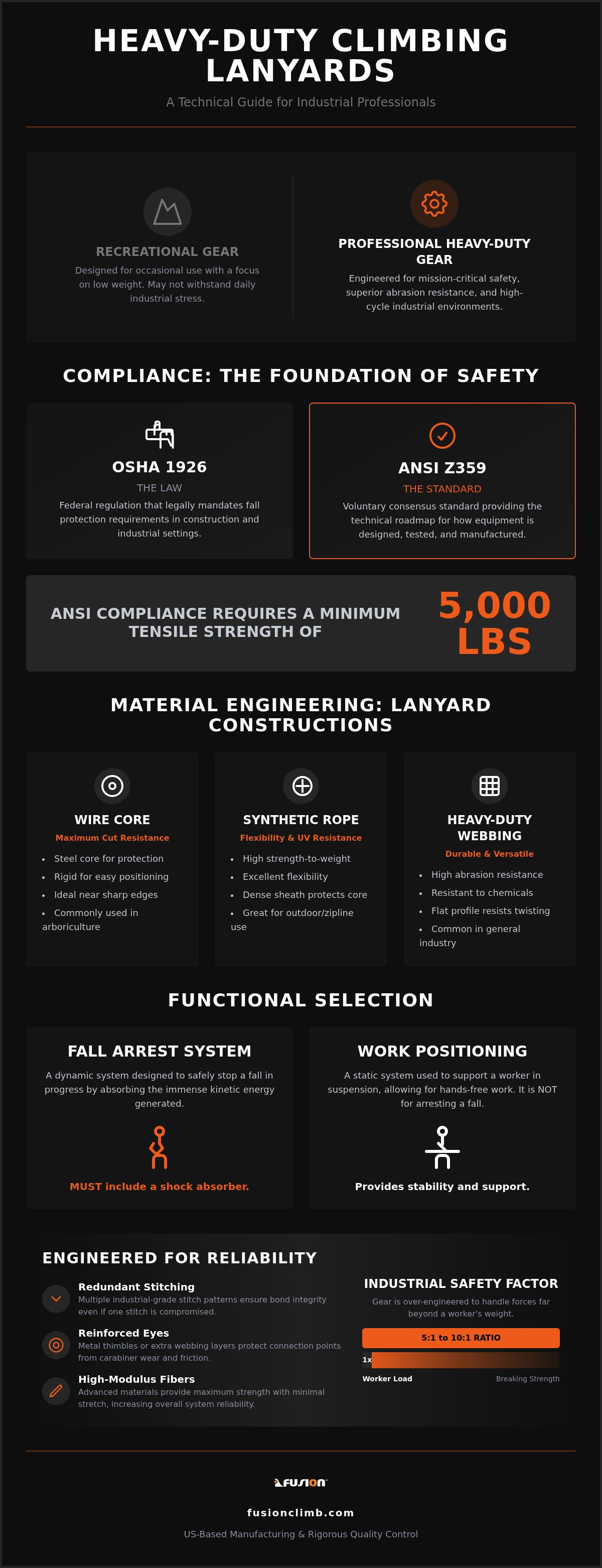
It is vital to distinguish between regulatory law and industry best practices. OSHA 1926 is the federal law that mandates fall protection in construction and industrial settings. ANSI Z359 is a voluntary consensus standard that provides the technical roadmap for how manufacturers build and test their equipment. True heavy duty gear typically meets or exceeds ANSI standards because they represent the most rigorous testing protocols available. Any lanyard claiming ANSI compliance must maintain a minimum tensile strength of 5,000 lbs. This ensures the equipment can handle the massive dynamic forces generated during a fall arrest event without failure.
The Role of Safety Factors in Industrial Rigging
Professional rigging relies on safety factors to account for unpredictable variables like environmental degradation or knots. Most industrial systems utilize a 5:1 or 10:1 safety factor. This means if a lanyard is rated for a 310 pound worker, its actual breaking strength is significantly higher to provide a sobering sense of security. Heavy duty climbing lanyards achieve this through several key manufacturing choices:
- Redundant Stitching: Multiple patterns of industrial-grade thread ensure that if one stitch is nicked, the overall bond remains secure.
- Reinforced Eyes: Metal thimbles or extra layers of webbing protect the connection points from internal friction and carabiner wear.
- High-Modulus Fibers: Utilizing materials that offer high strength with minimal stretch reduces fall distances and increases reliability.
By over-engineering these components, manufacturers ensure that your equipment stands up to the rigors of the field. This meticulous approach to manufacturing is what separates professional-grade gear from the rest of the market.
Material Engineering: Comparing Lanyard Constructions
Every vertical mission begins with a critical material choice. Heavy duty climbing lanyards must withstand more than just body weight; they face jagged metal, abrasive concrete, and relentless UV radiation. Understanding construction helps you balance safety with operational efficiency. The foundation of any professional safety system is the raw material, and generally, these tools fall into three categories: wire core, synthetic rope, and heavy duty webbing. Each serves a distinct purpose based on the environment and the specific mechanical stresses expected during the shift.
In outdoor aerial parks and commercial zipline operations, UV resistance is a critical factor for equipment longevity. Constant exposure to the sun degrades synthetic fibers over time. Choosing materials with UV-stabilized coatings is essential for maintaining tensile strength across multiple seasons. For rope-based systems, sheath density is the primary defense. A dense kernmantle weave protects the load-bearing core from both sunlight and grit penetration. When selecting heavy duty climbing lanyards, the interaction between the fiber and the hardware determines the system's ultimate reliability. Explore our range of lanyard and tether options to find the right construction for your specific work environment.
Wire Core vs. Rope Lanyards
Steel-core fliplines are the gold standard for maximum cut resistance. Use these when working near sharp industrial edges or power saws where a severed line would be catastrophic. The rigid core allows for easy one-handed positioning, as the lanyard stays open rather than flopping against the structure. For zipline or rescue applications, high-visibility kernmantle rope is superior. It offers better knotability and handles smoothly through pulleys and descent devices. While rope is significantly lighter, it can't match the structural security of steel in high-risk cutting environments.
Integrated Hardware: Carabiners and Snaps
The lanyard is only as strong as its terminal connections. Double-locking and triple-locking carabiners are non-negotiable for professional security because they prevent accidental gate rollout. For heavy duty industrial wear, steel hardware is the preferred choice over aluminum. Steel handles the repetitive stress of daily use without the fatigue issues associated with lighter alloys. Ensure your assembly features a gate strength rating of at least 3,600 lbs. This rating is a technical necessity for professional assemblies to withstand side-loading forces during a fall arrest event. Steel doesn't quit. While aluminum saves weight, steel hardware provides the necessary fatigue resistance for daily industrial use.
Functional Selection: Fall Arrest vs. Work Positioning
Selecting the right tool depends entirely on your objective: stopping a fall or preventing one from occurring in the first place. Heavy duty climbing lanyards are categorized by these two distinct functions. Fall arrest systems are designed to engage after a slip occurs; work positioning systems allow you to lean back and work with both hands. In many industrial environments, professionals utilize a combination of both to maintain constant security while moving through vertical structures. Don't compromise by using a tool for a purpose it wasn't engineered to handle.
Hardware configurations differ significantly between these roles. Fall arrest lanyards often feature large rebar hooks for anchoring to structural steel. Positioning tethers typically utilize smaller, high-strength carabiners designed for attachment to lateral D-rings on a harness. Combining these systems ensures that you stay stable during the task while remaining protected against the unpredictable. It's about building a redundant safety profile that accounts for every movement on the job site.
The Mechanics of Shock Absorption
Shock-absorbing lanyards utilize an internal "tear-away" webbing that progressively shears during a fall. This process dissipates kinetic energy; it converts the violent force of a sudden stop into a controlled deceleration. Calculating Fall Clearance is a life-critical task that accounts for the lanyard length, the deployment of the shock pack, and a necessary safety buffer. For a heavy duty shock-absorbing lanyard, the maximum arrest force is strictly limited to 1,800 lbs to prevent catastrophic internal trauma. This engineering protects your body as much as it protects the anchor point.
Work Positioning and Restraint Systems
Work positioning tools, such as adjustable tethers or fliplines, create a tensioned system that supports your weight against a vertical surface. These allow for efficient, hands-free operation in towers, trees, or industrial scaffolding. For these systems to function safely, your harness must feature compatible hip D-rings designed to distribute the load across the waist belt. This setup provides the stability required for precision work while reducing fatigue during long shifts.
Never confuse a static tether with a fall arrest device. Static heavy duty climbing lanyards lack the energy-dissipating components required to handle dynamic loads. Using a positioning lanyard in a potential free-fall scenario can lead to equipment failure or severe physical injury. Always verify that your gear matches the specific hazard profile of your work site. Professional safety requires a sobering understanding of your equipment's mechanical limits.
Buying Guide: Matching Gear to Your Environment
Selecting heavy duty climbing lanyards requires a sober assessment of your specific work environment. A lanyard that thrives in a dry, indoor warehouse will fail rapidly if exposed to the corrosive chemicals of a refinery or the high-heat sparks of a welding deck. For extreme abrasion, look for reinforced webbing or specialized coatings that prevent the core from fraying against concrete or steel. Your choice must reflect the reality of your daily mission. Gear that isn't matched to its environment isn't just inefficient; it's a liability.
Frequency of use is the silent killer of equipment. Daily commercial operations demand a higher cycle-to-failure rating than occasional maintenance tasks. If you're clipping and unclipping hundreds of times a week, prioritize steel hardware and high-density sheaths. Don't forget to account for total user weight. Standard ratings often assume a 310 pound limit, but a professional carrying heavy tools or rescue gear can easily exceed this. Always verify that your equipment's capacity matches your fully loaded weight to ensure the safety factors discussed earlier remain intact. Equip your team with professional-grade carabiners and lanyards designed for maximum load-bearing precision.
Zipline and Aerial Adventure Park Requirements
High-volume rider turnover in aerial parks puts unique stress on safety equipment. Tethers in these environments must be easy to inspect at a glance. Look for stitching patterns that utilize contrasting colors to make wear indicators obvious during morning safety checks. Compatibility is another technical hurdle. Your lanyards must interface seamlessly with commercial zipline pulleys and trolleys without causing binding or premature wear on the attachment points. Efficient operation depends on hardware that works in harmony.
Inspection and Retirement Criteria
Safety is a continuous process. Perform a tactile and visual inspection before every shift to identify glazing, which indicates heat damage, or fuzzing, which signals core-damaging abrasion. Chemical exposure often manifests as stiffness or discoloration in synthetic fibers. Metal connectors require equal scrutiny. Check for gate malfunctions, spring fatigue, or signs of corrosion that could compromise the locking mechanism. While some industries follow a five year rule for retirement, professional standards prioritize condition-based retirement. If the gear shows signs of structural compromise, pull it from service immediately. It's better to replace a lanyard early than to discover its limits during a fall.
The Fusion Climb Advantage: Industrial Reliability
Fusion Climb isn't just a gear distributor; we are a dedicated US-based manufacturer defined by industrial reliability. Since our founding in 1998, we've focused on the specific technical requirements of professional safety. We recognize that in high-stakes vertical environments, your equipment is your most critical partner. Our heavy duty climbing lanyards represent the intersection of rugged confidence and precise engineering. We embrace the persona of the dependable guardian. This means we provide gear that works as hard as you do, regardless of the environment or the intensity of the shift.
Manufacturing safety-critical equipment requires absolute oversight. By maintaining US-based production, we ensure that every stitch and every connection point meets our exacting standards. Retailers often lack the ability to influence the manufacturing process, but we control every variable from design to final testing. This factory-direct expertise allows us to innovate quickly and maintain a level of quality control that provides a sobering sense of security for the end user. We don't just build gear; we build a foundation for mission success.
Engineered for Commercial Operators
Professional operators face mechanical challenges that recreational users never encounter. High-volume zipline parks and commercial climbing sites require equipment that survives thousands of cycles of tension and friction. We actively integrate feedback from zipline operators into our product development cycle. This collaboration leads to designs that prioritize both user safety and operational efficiency. There is a calculated synergy between our full body harnesses, zipline pulleys, and heavy duty climbing lanyards. When these components are used as a unified system, they provide a level of reliability that minimizes downtime and equipment failure. We also offer custom solutions for commercial fleets to ensure that every member of your team is protected by the same high-performance standards.
Quality You Can Trace
Reliable equipment must be backed by verifiable data. Every lanyard we manufacture includes clear labeling and unique serial numbers to facilitate meticulous equipment tracking. This traceability is essential for maintaining compliance during workplace safety audits and managing retirement schedules. We don't rely on generic industry assumptions. Instead, we subject every lanyard category to rigorous testing protocols that simulate real-world stress and environmental exposure. This methodical approach ensures that our gear remains fail-safe in the most demanding industrial applications. We invite you to Explore the full range of Fusion Climb heavy duty lanyards and experience the difference that industrial-grade craftsmanship makes in the field.
Secure Your Mission with Precision Engineering
Mastering vertical safety requires more than just purchasing equipment; it demands a technical understanding of how tensile strength and environmental stressors interact. You now have the knowledge to navigate ANSI compliance and select the specific material constructions that define a long equipment lifespan. Whether you manage high-volume commercial ziplines or perform precision industrial maintenance, choosing the right heavy duty climbing lanyards is the foundation of a fail-safe work positioning system.
Since 1998, Fusion Climb has operated as a dependable guardian for professionals who refuse to compromise on safety. Our manufacturer-direct quality control provides a level of oversight that retail-only brands cannot match. We specialize in rugged, safety-first engineering designed specifically for the rigors of industrial and zipline operations. Equip your team with Fusion Climb's industrial-grade lanyards and experience gear that is built to endure. Face your next challenge with the sobering security of professional craftsmanship.
Frequently Asked Questions
What is the difference between a climbing lanyard and a flipline?
A flipline is a specialized sub-category of positioning lanyards designed with a stiff core to help it move up vertical structures like trees or poles. While all fliplines are lanyards, not all lanyards are fliplines. Fliplines provide the rigidity needed for one-handed adjustments during ascent. Standard climbing lanyards are typically more flexible, making them better suited for general work positioning where a stiff core isn't required for movement.
How often should I inspect my heavy duty climbing lanyards?
You must perform a visual and tactile inspection of your heavy duty climbing lanyards before every single shift. This pre-use check identifies immediate hazards like nicks, glazing, or gate malfunctions. In addition to daily checks, industrial standards require a documented, thorough inspection by a competent person at least once every twelve months. Rigorous environments may require these formal audits more frequently to ensure total mechanical integrity.
Can I use a positioning lanyard for fall arrest?
No, you must never use a positioning lanyard to arrest a fall. Positioning lanyards are designed to keep you in tension and prevent a fall from starting; they lack the energy-absorbing components found in true fall arrest systems. If you use a static tether during a free-fall event, the resulting impact forces can cause catastrophic equipment failure or severe internal injury. Always match the tool to the specific hazard.
What does ANSI Z359.13 compliance mean for a lanyard?
ANSI Z359.13 is the specific industry standard that governs the performance and testing of personal energy absorbers. Compliance means the lanyard has passed rigorous dynamic drop tests to ensure it can dissipate fall energy effectively. It mandates that the maximum arrest force remains below 1,800 lbs during a fall. This technical assurance is a critical requirement for any equipment used in professional industrial fall arrest systems.
Are steel-core lanyards better than rope lanyards?
Steel-core lanyards are superior only when your environment involves a high risk of cutting or extreme abrasion. These fliplines provide essential protection when working near chainsaws or sharp metal edges that would sever a standard rope. Synthetic rope lanyards are the better choice for rescue and zipline applications where weight reduction and knotability are priorities. Your choice should be based on a sobering assessment of the hazards present.
When should I retire a climbing lanyard from service?
Retire a lanyard immediately if it fails a pre-shift inspection or has been involved in a fall arrest event. Look for glazing, excessive fuzzing, or chemical discoloration in synthetic fibers. Metal hardware must be retired if you find cracks, corrosion, or sluggish gate action. While many manufacturers suggest a maximum service life of five to ten years, the actual physical condition of the gear always dictates the final retirement date.
Does Fusion Climb offer lanyards for zipline commercial use?
Yes, Fusion Climb manufactures specialized heavy duty climbing lanyards and tethers specifically for commercial zipline operations. These products are engineered to handle the high-cycle use and rider turnover common in professional aerial parks. Our designs prioritize ease of inspection and seamless compatibility with commercial pulleys. This focus on specialized hardware ensures that zipline operators can maintain a high standard of safety and efficiency throughout the season.
What is the maximum weight capacity for a professional grade lanyard?
Professional grade lanyards are typically rated for a maximum capacity of 310 lbs, which includes the weight of the user and their tools. Some heavy duty models are engineered for higher capacities up to 420 lbs when used in conjunction with a compatible harness. Always check the manufacturer's technical label to verify the specific rating. Exceeding these limits compromises the safety factors built into the equipment's design and increases the risk of failure.