



Heavy Duty Carabiners: The Professional Guide to High-Strength Rigging Hardware
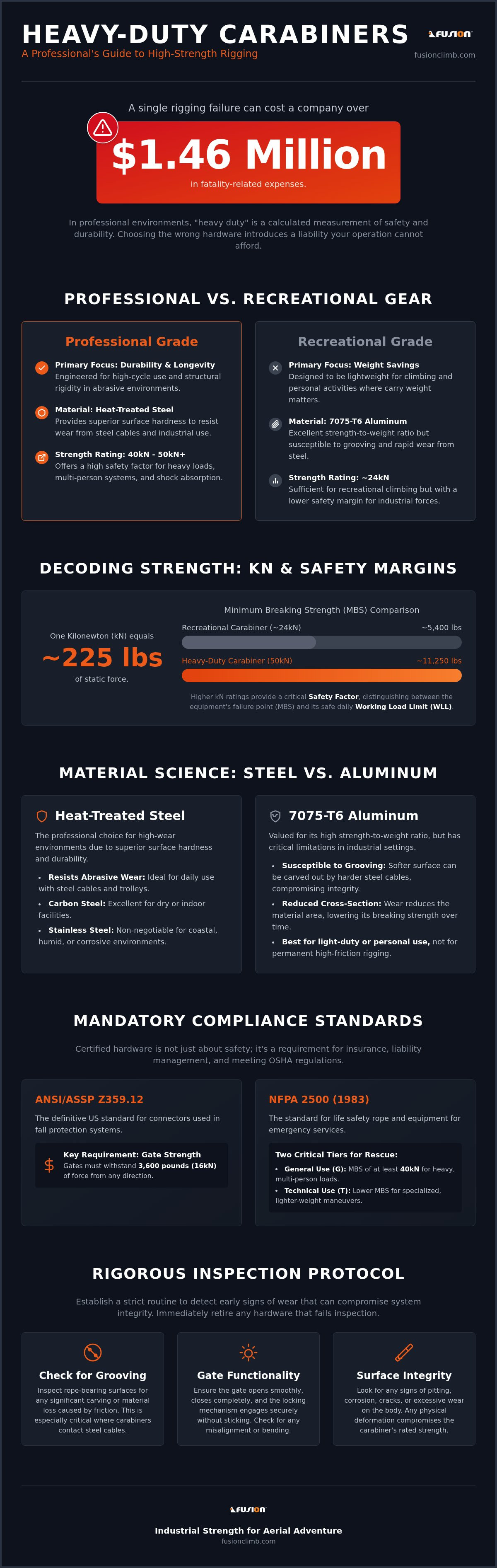
A single rigging failure can cost a company over $1.46 million in fatality-related expenses, yet the integrity of an entire system often rests on a single gate and hinge. In professional environments, "heavy duty" isn't a marketing buzzword. It's a calculated measurement of safety margins and lifecycle durability. You understand that choosing the wrong heavy duty carabiners creates more than just a replacement cost. It introduces a liability that your operation simply can't afford. Selecting hardware for industrial use requires a move beyond recreational standards toward a rigorous understanding of material science and load limits.
This guide provides the technical clarity you need to master high-strength rigging hardware. We'll bridge the gap between theoretical kN ratings and real-world load limits to ensure your gear performs under pressure. You'll learn to navigate the complexities of ANSI/ASSP Z359.12-2019 and the 2022 edition of NFPA 2500 with absolute confidence. We examine the specific environments where steel outlasts aluminum and how to maintain compliance with the latest OSHA safety standards. Prepare to select hardware that protects your crew, your equipment, and your bottom line.
Key Takeaways
- Identify the technical requirements that define professional-grade connectors, focusing on the high kN ratings and extended cycle life necessary for industrial safety.
- Compare the molecular durability of heat-treated steel versus 7075-T6 aluminum to determine the best material for high-wear environments and steel cable applications.
- Evaluate gate configurations and locking mechanisms to maximize security when managing heavy rigging ropes and large-diameter pulleys.
- Establish a rigorous inspection protocol for your heavy duty carabiners to detect early signs of pitting, grooving, or gate misalignment that compromise system integrity.
- Gain the confidence to select hardware that meets ANSI and NFPA compliance standards while lowering the long-term cost of equipment replacement.
Defining Heavy Duty: What Sets Professional Carabiners Apart?
In professional rigging, the term "heavy duty" describes a specific class of hardware engineered for high-cycle use and extreme static loads. It isn't a marketing label. It's a technical designation. While recreational gear focuses on weight savings for climbers, industrial hardware prioritizes material longevity and structural rigidity. True heavy duty carabiners must withstand the abrasive environment of construction sites, the high-velocity friction of commercial ziplines, and the unpredictable forces of technical rescue operations. This Carabiner overview provides a foundational look at how these connectors evolved to meet such demanding needs.
The distinction between recreational and professional hardware starts with material choice. Aluminum is excellent for weight reduction, but it lacks the surface hardness required for daily contact with steel cables or grit-heavy ropes. Industrial steel and heat-treated alloys provide the necessary wear resistance. Beyond materials, professionals evaluate three critical strength ratings: Major Axis, Minor Axis, and Open Gate. A professional connector ensures that even in sub-optimal loading scenarios, the safety margin remains intact. High-strength hardware is the standard for several key industries:
- Commercial Ziplines: Requires connectors that can handle thousands of cycles against steel trolleys without significant material loss.
- Technical Rescue: Demands high Minimum Breaking Strength (MBS) to support multi-person loads and complex haul systems.
- Tower Construction: Relies on hardware that meets strict fall protection standards while resisting impact and environmental corrosion.
The Role of Kilonewtons (kN) in Safety Margins
Understanding kilonewtons is vital for safe rigging. One kN represents approximately 225 pounds of static force. While a standard climbing carabiner might be rated at 24kN, professional heavy duty carabiners often target ratings of 40kN to 50kN. This higher threshold isn't about expecting a 9,000-pound load. It's about maintaining a high safety factor. You must distinguish between Minimum Breaking Strength (MBS), which is the point of documented failure, and the Working Load Limit (WLL). The WLL is the maximum mass the gear should actually support during daily operations, typically calculated as a fraction of the MBS to account for dynamic shocks.
Industrial Standards: ANSI vs. NFPA
Compliance is the backbone of professional liability management. ANSI Z359.12 is the definitive standard for fall protection connectors, requiring gates to withstand 3,600 pounds of force from any direction. For rescue professionals, NFPA 2500 (the 2022 consolidation of NFPA 1983) provides two critical tiers. General Use (G) ratings require an MBS of at least 40kN, while Technical Use (T) ratings are set lower for specialized maneuvers. Commercial operators must demand certified hardware. It isn't just about safety; it's a requirement for insurance compliance and meeting OSHA's rigorous workplace fit and protection rules.
Material Science: Steel vs. Aluminum for High-Load Environments
Selecting the right material for heavy duty carabiners requires an understanding of how metals behave under friction and tension. While 7075-T6 aluminum is praised in the aerospace industry for its high strength-to-weight ratio, its surface hardness is relatively low compared to heat-treated steel. In a laboratory setting, both materials might meet the same kilonewton rating. However, the real-world performance diverges when these connectors encounter abrasive surfaces like steel zipline cables or concrete edges. Aluminum is susceptible to "grooving" where the harder steel cable physically carves into the carabiner body. This degradation reduces the cross-sectional area and compromises the structural integrity of the connector over time.
Steel provides the surface hardness necessary to resist this abrasive wear. Carbon steel, typically finished with zinc plating, offers excellent durability for indoor facilities and dry outdoor environments. For coastal installations or high-humidity adventure parks, stainless steel becomes the non-negotiable choice to prevent stress corrosion cracking. Following OSHA carabiner standards ensures that your chosen material meets the minimum 5,000-pound tensile strength required for fall protection systems. If your operation demands high-cycle reliability, investing in quality Carabiners made from heat-treated steel is the most effective way to reduce long-term replacement costs.
Carbon Steel: The Workhorse of Rigging
Carbon steel is the industry standard for permanent rigging and commercial zipline operations. It manages heat dissipation more effectively than aluminum. This is critical during high-speed transitions where friction can cause rapid temperature spikes. In a high-volume aerial adventure park, a steel connector can often endure thousands of cycles before showing measurable wear. This longevity makes steel the most cost-effective solution for stationary systems where weight is not a primary concern for the operator. It remains the most dependable choice for high-load, high-frequency applications.
High-Strength Alloys: The Middle Ground
Specialized alloys offer a middle ground for professionals in tactical, rescue, or arboriculture fields. These users often carry gear for miles or climb hundreds of feet. Every ounce matters. Forged components are superior to cast alternatives because the forging process aligns the grain structure of the metal to enhance fatigue resistance. When weight-to-strength ratios are the priority, these high-strength alloys provide the necessary safety margins without the bulk of traditional steel. You must simply inspect them more frequently for surface wear compared to their steel counterparts.
Locking Mechanisms and Gate Configurations for Maximum Security
Mechanical reliability is the final safeguard in any rigging system. While the material strength of the spine provides the load-bearing capacity, the locking mechanism ensures that strength is actually accessible during a dynamic event. You must choose a gate configuration that balances speed of use with absolute security. Screw-gate mechanisms are traditional and reliable, but they're susceptible to "vibration roll-out" in high-friction environments. In contrast, triple-lock (3-stage) auto-locking gates require three distinct movements to open: slide, twist, and pull. This complexity is a deliberate design feature that virtually eliminates accidental openings caused by rope drag or contact with structural edges.
Modern heavy duty carabiners often incorporate a snag-free Keylock nose. Traditional carabiners use a small hook in the nose to capture the gate, which can snag on bolts, pulleys, or webbing during critical transitions. A Keylock design uses a smooth, interlocking interface that allows for seamless clipping and unclipping. This isn't just a matter of convenience; it's a safety requirement in technical rescue where every second counts. Meeting OSHA safety standards for carabiners requires more than just raw tensile strength; it demands that the locking mechanism remains functional under adverse conditions.
The physics of gate flutter is another critical consideration for high-impact rigging. When a carabiner spine strikes a hard surface during a fall, inertia can cause the gate to momentarily open. This phenomenon, known as gate lash, significantly reduces the strength of the connector to its "open gate" rating. Professional-grade heavy duty carabiners utilize higher-tension internal springs to mitigate this risk, ensuring the gate stays closed even during violent dynamic shocks.
Auto-Locking Mechanisms: Reducing Human Error
Auto-lockers are the standard for commercial zipline operations and fall protection. These mechanisms reset to the locked position the moment the user releases the gate. A 2-stage locker requires a twist and pull, while a 3-stage locker adds a vertical slide for maximum security. While these systems reduce human error, they require a more disciplined maintenance schedule. You must regularly clean the internal spring housing to prevent grit or salt spray from compromising the "auto" return function. A sluggish gate is a failed gate.
Gate Opening and Capture Features
Gate clearance determines the versatility of your hardware. Large gate openings are essential when you're connecting to structural beams or thick steel cables that a standard carabiner can't accommodate. For permanent lanyards and tethers, "Captive Eye" carabiners are the preferred choice. These feature a secondary internal loop that captures the lanyard, preventing the carabiner from rotating and ensuring it remains loaded along its major axis. Gate lash is the vibration-induced opening of a carabiner gate caused by the metal spine striking a hard surface during a dynamic load event, and it's best prevented by using high-tension locking gates.
Inspection and Maintenance: Ensuring Rigging Reliability
Rigging reliability isn't a static state. It's the result of disciplined maintenance and a rigorous inspection culture. For commercial operators, the total cost of ownership for heavy duty carabiners is directly tied to the consistency of their safety protocols. Neglecting hardware doesn't just invite risk; it leads to premature retirement and increased operational expenses. You must establish a clear cadence that includes pre-use checks, periodic deep inspections, and thorough documentation to manage your fleet effectively. To maintain a high-performance fleet, source your heavy duty carabiners from manufacturers who provide full traceability and batch testing data.
Identifying "red flag" wear patterns is the first line of defense. Grooves often develop on the load-bearing radius where steel cables or grit-laden ropes create friction. Pitting is another concern, signaling environmental or chemical corrosion that can compromise the metal's surface. Perhaps most critical is gate misalignment. If the gate doesn't seat perfectly in the nose, the connector can't reach its rated strength. The "retire upon drop" debate is nuanced. While aluminum is prone to invisible micro-fractures after a hard impact, steel hardware is more resilient. However, any drop from significant height onto a hard surface warrants an immediate, detailed inspection for deformation or burrs.
The 5-Point Daily Inspection Checklist
Professional safety officers rely on a structured approach to ensure nothing is overlooked. Every connector should pass these five steps before it enters the system:
- Step 1: Perform a visual check for hairline fractures, significant burrs, or sharp edges that could damage ropes.
- Step 2: Test the gate action. It must snap back to the closed position instantly without hesitation or sticking.
- Step 3: Verify the locking sleeve. It should move freely through its entire range and align perfectly with the nose.
- Step 4: Measure the groove depth. Any wear exceeding 10 percent of the original material thickness requires retirement.
- Step 5: Check for cleanliness. Remove any salt spray, grit, or mud using warm water and mild soap, then dry the hardware thoroughly.
When to Retire Your Hardware
Knowing when to pull a connector from service is a critical skill for any rigger. Material loss is the most objective trigger. Once a groove reaches that 10 percent threshold, the structural safety margin is officially compromised. Chemical exposure is another immediate cause for retirement. If a carabiner is splashed with battery acid, harsh solvents, or exposed to extreme heat events like a nearby fire, it must be destroyed. Documentation is your best ally in liability management. Log the serial numbers of all your gear. This allows you to track the age and service history of every component, ensuring that no piece of hardware stays in the field past its reliable lifespan.
Fusion Climb: Industrial Strength for Aerial Adventure
Fusion Climb builds hardware for those who operate where the margin for error is zero. Since our founding in 1998, we've focused on the intersection of tactical precision and industrial durability. Our manufacturing process integrates decades of expertise into every connector, ensuring that our heavy duty carabiners exceed the expectations of commercial operators. We don't just sell individual components. We provide integrated safety systems where our full body harnesses, zipline pulleys, and lanyards work in total synergy. This systems-based approach is why national-scale adventure parks and industrial rigging teams trust us as their primary hardware partner. When you choose Fusion, you're choosing gear designed to perform under the most demanding vertical conditions.
Professional operators face unique challenges that recreational gear simply can't solve. We address these needs by offering custom solutions for complex rigging and zipline environments. Whether you're managing a high-volume commercial park or a specialized industrial site, our hardware provides the structural integrity required for long-term reliability. We focus on reducing your total cost of ownership by manufacturing connectors that resist the abrasive wear of steel cables and harsh outdoor elements. Our commitment to quality control ensures that every gate, spring, and spine meets our rigorous internal standards before it ever reaches your site.
Our Commitment to ANSI and NFPA Excellence
Every piece of Fusion hardware undergoes rigorous testing phases to ensure it meets the highest industry benchmarks. We're a national supplier of ANSI-compliant safety connectors, providing the technical data and bulk hardware required for large-scale commercial operations. As a "dependable guardian" in the vertical world, we understand that safety isn't a one-time achievement. It's a continuous commitment. Our team supports operators with the necessary documentation for insurance compliance and current OSHA fit rules. We prioritize substance over style, focusing on meticulous manufacturing that protects your crew and your guests in high-stakes environments.
Finding the Right Connector for Your Operation
Choosing the right hardware means selecting from specialized categories designed for specific environmental challenges. Our heat-treated steel connectors offer the longevity required for high-volume ziplines, while our high-strength alloy carabiners provide the portability needed for tower work or technical rescue. We also offer specialized equipment like Superman style harnesses and high-speed pulleys that integrate seamlessly with our heavy duty carabiners. If your operation faces a unique rigging challenge, our technical team is available to help you select the ideal hardware configuration. We're here to help you push physical limits without compromising security. Equip your team with Fusion Climb professional carabiners to ensure your gear is as resilient as the professionals who use it.
Build Your System on Industrial Reliability
Selecting the right hardware is a commitment to the safety of your crew and the longevity of your operation. You now understand that heavy duty carabiners are defined by more than just raw strength; they require the surface hardness of heat-treated steel and the security of triple-lock mechanisms. Moving beyond recreational gear means prioritizing ANSI Z359.12 and NFPA 1983 compliance to manage liability and ensure performance in high-cycle environments. A disciplined inspection culture ensures that every component in your system remains a dependable link in the chain.
Fusion Climb provides the precision engineering required for national-scale safety. Our heavy-duty steel construction is designed for maximum lifecycle, making it the preferred choice for professional zipline operators nationwide. Don't settle for hardware that compromises your safety margins. Secure your rigging with Fusion Climb's industrial carabiners and experience the difference that professional-grade craftsmanship makes. It's time to push your limits with the confidence that your gear is built to hold. Stay safe and keep climbing toward new heights.
Frequently Asked Questions
What is the difference between a climbing carabiner and an industrial carabiner?
Industrial carabiners prioritize material longevity and strict regulatory compliance over the weight savings found in recreational gear. While climbing carabiners often utilize 7075-T6 aluminum to reduce carry weight, industrial versions typically use heat-treated steel to resist the abrasive forces of steel cables and grit. These professional connectors are built to meet ANSI or NFPA standards rather than just UIAA climbing specifications.
How many kilonewtons (kN) should a heavy duty carabiner be rated for?
Professional heavy duty carabiners should target ratings between 40kN and 50kN for general rigging and rescue applications. OSHA 1910.140 requires a minimum tensile strength of 5,000 pounds, which is approximately 22.2kN, for fall protection components. However, higher ratings provide essential safety margins that account for dynamic shock loads and the gradual material wear common in high-cycle commercial environments.
Are steel carabiners always better than aluminum for commercial use?
Steel is the superior choice for permanent rigging and high-friction environments like ziplines because it resists grooving and heat better than aluminum. Aluminum is only preferred when a worker must carry a large volume of gear over long distances, such as in technical rescue or tower climbing. For any application involving contact with steel cables, the surface hardness of carbon or stainless steel is non-negotiable for safety.
What does ANSI Z359.12 compliance mean for my business insurance?
ANSI Z359.12 compliance verifies that your connectors meet the 3,600-pound gate strength requirement mandated for industrial fall protection. Using certified hardware demonstrates to insurance providers that your operation follows the highest safety standards, which can lower your liability profile. Many commercial policies require the use of ANSI-rated hardware to validate that your safety system meets current workplace fit and fitting regulations.
Can I use a screw-gate carabiner for a zipline trolley?
Screw-gate carabiners are generally discouraged for zipline trolleys because high-frequency vibrations can cause the locking sleeve to unscrew. This phenomenon, known as vibration roll-out, compromises the security of the connection during the ride. Professional operators mandate the use of triple-locking auto-lockers. These mechanisms require three distinct movements to open and will automatically return to the locked position upon closure.
How often should I replace heavy duty carabiners in a high-volume park?
You must replace heavy duty carabiners immediately if material wear exceeds 10 percent of the original cross-sectional area or if the gate action becomes sluggish. High-volume parks should implement a daily visual inspection protocol and a quarterly deep-dive audit of all hardware. Sluggish gates, deep grooves from cable friction, or any visible pitting from corrosion are absolute triggers for retirement and destruction of the hardware.
What is a 'captive eye' carabiner, and when should I use one?
A captive eye carabiner features a secondary internal loop that permanently traps a lanyard or tether to the connector. You should use these for any permanent attachment point to prevent the carabiner from rotating or flipping during use. This ensures the load always remains aligned with the major axis of the spine, effectively eliminating the risk of dangerous cross-loading or minor-axis loading during a fall event.
How do I clean carabiners used in salty or coastal environments?
Rinse your hardware with fresh, warm water after every shift to remove salt deposits and corrosive ocean spray. Salt crystals can act as an abrasive inside the gate hinge and locking sleeve, leading to premature mechanical failure. Dry the components thoroughly with a clean cloth. Apply a small amount of dry-film lubricant to the hinge to maintain smooth action without attracting sand or grit to the mechanism.