



Ergonomic Full Body Harness Design: The Science of Safety and Comfort
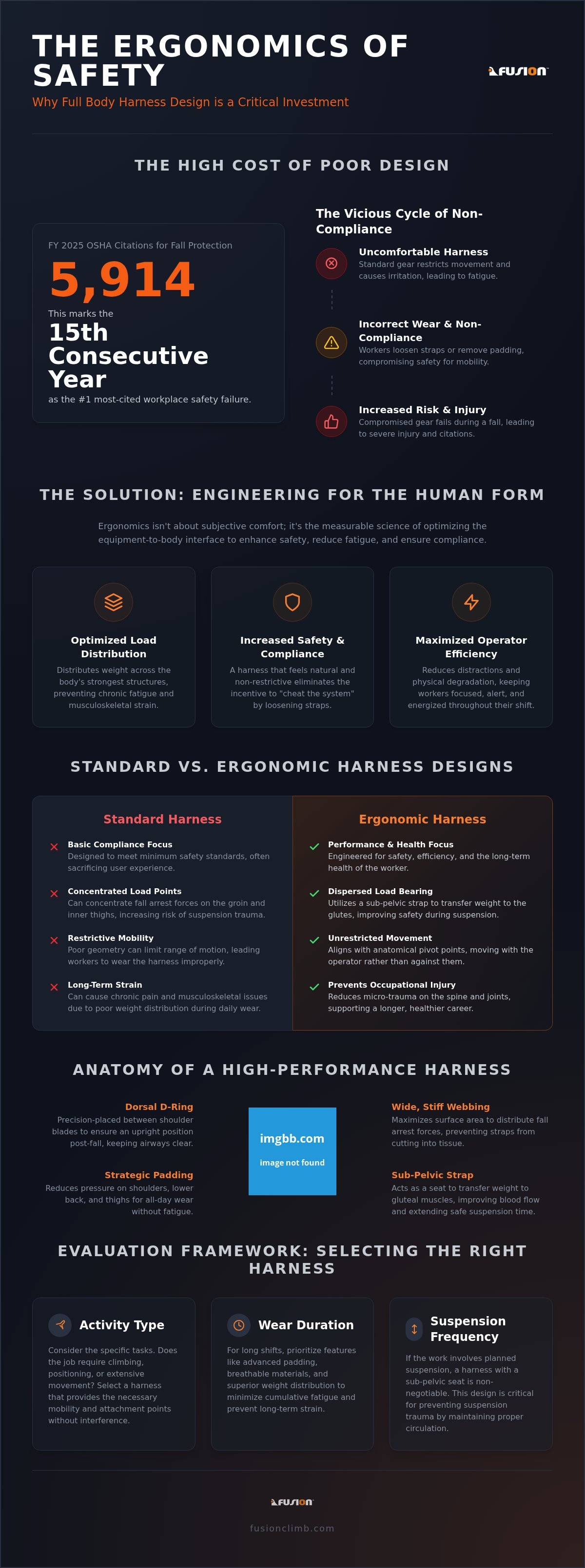
In fiscal year 2025, OSHA issued 5,914 citations for fall protection violations, marking the 15th consecutive year it topped the list of workplace safety failures. Many of these incidents stem from a simple, frustrating truth: if a harness is uncomfortable, workers are less likely to wear it correctly. You've likely seen it on the job site. Crew members loosen straps to regain their range of motion or skip essential padding to shed weight, unknowingly compromising their lives. Effective ergonomic full body harness design isn't a luxury for the comfort-minded; it's a critical safety requirement that ensures compliance and prevents long-term physical strain.
We understand that your gear shouldn't be your enemy during a ten-hour shift. This guide breaks down how ergonomic engineering minimizes fatigue and maximizes operator efficiency by working with the body's natural mechanics. You'll discover the science behind weight distribution, the importance of ANSI-compliant hardware, and how specialized padding can prevent harness-induced exhaustion. We'll show you how to select equipment that meets the highest industrial standards while providing the mobility your team needs to get the job done safely.
Key Takeaways
- Learn how ergonomic full body harness design optimizes load distribution across the human frame to prevent chronic fatigue and workplace injury.
- Distinguish between superficial comfort and functional ergonomics to ensure your gear provides both mobility and industrial reliability.
- Master the evaluation framework for selecting a harness based on specific activity types, wear duration, and suspension frequency.
- Discover how specialized components like dorsal D-rings and precision webbing stiffness maintain safety standards without sacrificing operator efficiency.
Defining Ergonomics in Full Body Harness Engineering
Ergonomic engineering is often misunderstood as a simple pursuit of comfort. In the industrial world, comfort is subjective and fleeting; ergonomics is functional and measurable. While basic compliance ensures a harness will hold a load, ergonomic full body harness design ensures the worker can perform their duties without physical degradation. It's the science of optimizing the interface between the human body and the equipment required to keep it safe. By aligning hardware and webbing with anatomical pivot points, manufacturers create tools that move with the operator rather than against them.
A safety-first mindset recognizes that a comfortable worker is a focused worker. When a harness causes constant irritation or restricts movement, it becomes a distraction. Distractions lead to operational errors, and in high-stakes environments, those errors can be fatal. True ergonomic design reduces user fatigue by distributing weight across the strongest muscle groups and skeletal structures. This keeps the worker energized and alert throughout their shift, which is a fundamental requirement for maintaining a secure job site.
The Intersection of Biomechanics and Safety
The way a harness interacts with the musculoskeletal system determines its long-term impact on a worker's health. Poor harness geometry often places unnecessary stress on the lumbar and cervical spine, leading to chronic pain and reduced mobility. A harness is the primary interface between a worker and their fall arrest systems. If the weight isn't balanced correctly, the spine compensates, causing micro-trauma over months of daily use. In the context of ANSI Z359.11 compliance, ergonomic design is defined as the strategic placement of load-bearing components to prevent musculoskeletal injury while maintaining reliable fall protection.
Why Ergonomics is a Safety Requirement
Safety managers often struggle with PPE non-compliance, and the root cause is frequently uncomfortable gear. Workers don't intentionally choose to be unsafe; they choose to be mobile. If a standard harness limits their range of motion, they might loosen straps or remove padding to compensate. This creates a dangerous gap in protection. Ergonomic full body harness design eliminates the incentive to cheat the system. By providing a fit that feels natural and non-restrictive, companies see higher compliance rates and lower injury reports. Beyond immediate fall protection, these designs serve as a preventative measure against long-term occupational strain, ensuring that workers remain physically capable for years to come.
Critical Load Distribution: Anatomy of a High-Performance Harness
The effectiveness of any harness relies on how it manages force. In a fall event, thousands of pounds of energy must be dissipated across the user's frame. Ergonomic full body harness design achieves this by utilizing webbing width and material stiffness to maximize pressure distribution. Wider webbing increases the surface area of the straps, which prevents the material from cutting into soft tissue during a fall or long periods of suspension. Manufacturers utilize complex engineering processes for designing FBH to ensure every strap and buckle serves a dual purpose: arrest and endurance.
The dorsal D-ring is the silent commander of post-fall safety. Its primary role is to maintain the worker in an upright, vertical position after a fall has occurred. If the D-ring is poorly positioned, the user may tilt backward or forward, increasing the risk of suspension trauma or secondary impact. High-performance harnesses ensure the D-ring stays centered between the shoulder blades, keeping the airway clear and the spine aligned while waiting for rescue. When selecting your next piece of gear, look for Full Body Harnesses that prioritize these anatomical considerations.
Leg loop design is where biomechanics meets life-saving engineering. Standard harnesses often restrict the femoral artery during suspension, which can lead to a rapid onset of suspension trauma. Ergonomic designs incorporate sub-pelvic straps that act as a seat, transferring the user's weight to the gluteal muscles rather than the groin. This shift in load-bearing allows for better blood flow and significantly extends the time a worker can safely remain suspended.
Pressure Point Mitigation and Padding Placement
Identifying key anatomical zones is the first step in effective padding placement. Shoulders, the lower back, and the thighs bear the brunt of the harness's weight throughout a shift. High-quality designs use a combination of closed-cell and open-cell padding. Closed-cell foam provides firm support and won't absorb moisture, while open-cell layers allow for breathability. Contour-cut padding is essential; it follows the natural curves of the body to prevent chafing during repetitive movements like climbing or reaching.
The Role of Adjustable Suspension Systems
Multi-point adjustment is a necessity, not an option. Because no two bodies are shaped exactly the same, a harness must offer precision tuning at the torso, legs, and chest. Torso length adjustment is particularly critical for maintaining center-of-gravity stability. A harness that is too long will sag, while one that is too short will pull the user into a crouch. A snug but not restrictive fit ensures that the harness stays in place without hindering the operator's range of motion or causing distraction on the job.
Ergonomic vs. Standard Designs: A Comparative Analysis
Entry-level harnesses are built for one thing: meeting the minimum legal standard. These are often called "compliance harnesses" because they satisfy OSHA requirements without considering the worker's daily experience. They typically feature stiff webbing and basic hardware that can dig into the shoulders and legs during movement. In contrast, premium ergonomic full body harness design prioritizes the user's physiological needs. These models incorporate features that reduce friction and improve weight distribution, turning a piece of safety equipment into a high-performance tool that supports the body's natural movement.
Selecting the right equipment requires a calculated balance between mass and endurance. Standard harnesses often use heavy steel hardware to achieve necessary strength ratings. Ergonomic models frequently utilize high-strength aluminum alloys and precision-engineered webbing to shed weight without sacrificing integrity. Understanding how these components work together is vital, as explored in the Professional Guide to Full Body Climbing Harnesses. A lighter harness reduces the metabolic cost of movement. This is essential for operators working at height for eight to ten hours a day.
Range of Motion and Occupational Longevity
The architecture of the harness dictates how well an operator can move. X-back designs are popular for their ability to keep shoulder straps centered during reach-intensive tasks. H-back designs often provide superior comfort for those with broader builds by preventing the straps from pinching the neck. Riggers must be able to reach, bend, and twist without the harness fighting their every move. Testing these motions in a controlled environment reveals the true value of ergonomic engineering. It preserves the worker's physical health over a long career by preventing repetitive strain and allowing for a full range of motion.
Material Selection: Breathability vs. Tensile Strength
Advanced material science has transformed the industrial landscape. Modern ergonomic harnesses often feature moisture-wicking linings that pull sweat away from the body. This prevents the "hot spots" and chafing that lead to skin irritation during intense physical activity. While tensile strength remains the non-negotiable priority, the introduction of high-tenacity synthetic fibers allows for thinner, more flexible webbing. Additionally, UV-resistant coatings are applied to maintain long-term flexibility. Standard webbing can become brittle and stiff after prolonged sun exposure, but ergonomic designs are built to withstand the elements without losing their anatomical fit.
Evaluation Framework: Selecting the Right Ergonomic Design
Choosing a harness isn't as simple as picking a catalog item that meets a weight rating. Effective ergonomic full body harness design must be evaluated based on the specific physical demands of the task and the individual operator's anatomy. A systematic selection process ensures the gear works with the user, not against them. Follow this four-step framework to ensure your equipment provides maximum protection and operational efficiency.
First, identify the primary activity. A harness optimized for tower climbing will perform poorly in a zipline environment because the suspension points and center of gravity requirements differ. Second, assess the duration of wear and frequency of suspension. If a worker is in the harness for a full shift, features like moisture-wicking linings and weight-reducing aluminum hardware become non-negotiable. Third, verify that the equipment meets rigorous standards for ropes course safety equipment or industrial fall arrest. Finally, conduct a physical fit-test. Focus on the four points of contact: the shoulders, the chest, the waist, and the leg loops.
Matching Design to Activity
Zipline operations require harnesses that prioritize upright stability and ease of entry to handle high-volume throughput. For specialized aerial adventures, Superman style harnesses offer unique ergonomics for prone flight. These distribute pressure across the torso to allow for a comfortable, face-down experience without restricting the airway. Industrial applications, conversely, require integrated support for tool belts and heavy-duty fall arrest points. Selecting a design that isn't tailored to the activity leads to premature fatigue and decreased safety compliance.
Sizing and Adjustment Precision
The idea that one size fits all is a dangerous fallacy in professional safety. A harness that is too large allows for excessive movement during a fall, while one that is too small restricts blood flow and range of motion. Look for models with quick-connect buckles. These allow for a consistent, repeatable fit every time the gear is donned. Hardware weight also plays a critical role in the selection process. While steel provides maximum durability in abrasive environments, high-grade aluminum carabiners and D-rings significantly reduce the load on the user's spine during long-duration tasks.
Ready to upgrade your team's gear? Explore our professional-grade Full Body Harnesses built for rugged reliability.
The Fusion Climb Approach: Engineering for the Human Form
Fusion Climb operates with a singular focus: the safety of the individual in vertical environments. Since our founding in 1998, we've specialized in safety gear that bridges the gap between industrial strength and anatomical engineering. Our ergonomic full body harness design isn't about luxury; it's about providing a sturdy, reliable interface that allows professionals to push their physical limits without compromising security. We reject the "extreme" marketing fluff prevalent in the industry, opting instead for a no-nonsense manufacturing philosophy that prioritizes product integrity and user longevity.
Rugged Reliability Meets Anatomical Fit
Maintaining a balance between heavy-duty hardware and user comfort is a technical challenge we meet through precision engineering. While our harnesses utilize professional-grade materials designed for high-stakes environments, they're shaped to follow the human form. This is especially evident in our specialized Superman style harnesses. These prone flight designs represent a unique pinnacle of ergonomic full body harness design, as they must support the user in a face-down position while ensuring even weight distribution across the torso. By integrating our designs with zipline lanyards and tethers, we create a unified safety system where every component works in harmony to reduce physical strain and maximize mobility.
Quality Control and Real-World Testing
Substance matters more than style when you're suspended hundreds of feet in the air. Every design that leaves our factory floor undergoes rigorous testing protocols to ensure it meets or exceeds ANSI Z359.11 requirements. Our verification process isn't just a laboratory exercise; it's a commitment to industrial reliability. We test for tensile strength, UV resistance, and hardware durability under high-volume use conditions. This methodical approach is why professional operators across the USA trust Fusion Climb for their most demanding aerial adventure and industrial applications. We don't just build gear; we build the confidence required to operate in high-risk environments.
Explore Fusion Climb Full Body Harnesses and discover the difference that professional-grade engineering makes on the job.
Investing in Long-Term Operational Excellence
Safety is a non-negotiable standard, but the tools used to achieve it shouldn't hinder the user's performance. Moving beyond basic fall protection requires a commitment to ergonomic full body harness design that respects human anatomy and biomechanics. By prioritizing effective load distribution and specialized padding, operators can reduce fatigue and ensure consistent compliance across the team. Whether you're managing a high-volume zipline course or a complex industrial site, the right gear serves as a silent partner in every vertical journey.
Fusion Climb has been a dependable guardian for professional operators since 1998. We provide rugged, no-nonsense hardware including specialized prone flight hardware and ANSI Z359.11 compliant designs. Substance always trumps style when lives are on the line. Equip your crew with gear that is built to endure the rigors of the field while maintaining the mobility required for success. Our focus on meticulous manufacturing ensures that every component meets high-stakes safety needs without sacrificing the user's physical longevity.
Secure Your Team with Fusion Climb Professional Harnesses and push your limits with the confidence of industrial-grade reliability. Stay focused, stay mobile, and stay secure.
Frequently Asked Questions
What are the most important ergonomic features in a full body harness?
The most critical features include wide webbing for load distribution, strategically placed padding at the shoulders and thighs, and multiple adjustment points. High-performance models also incorporate sub-pelvic straps to shift weight during suspension. These elements work together to ensure that an ergonomic full body harness design supports the skeletal structure while protecting soft tissue. Precision-cut contours prevent the hardware from digging into the body during repetitive movements.
How does an ergonomic harness help prevent suspension trauma?
Ergonomic designs prevent suspension trauma by maintaining healthy blood circulation during a fall event. Specialized leg loops and sub-pelvic straps transfer the user's weight to the gluteal muscles rather than the groin. This prevents the webbing from constricting the femoral arteries, which can lead to a rapid loss of consciousness. By providing a seated position after a fall, these harnesses extend the safe window for rescue operations to reach the worker.
Does adding padding to a harness affect its safety rating?
Integrated padding doesn't compromise a safety rating if it's part of an ANSI Z359.11 compliant design. In fact, padding is often a requirement for specialized gear to meet ergonomic standards. It serves to dampen impact forces and prevent skin irritation during long shifts. You should never add aftermarket padding that isn't approved by the manufacturer. Unauthorized modifications can interfere with buckle function or strap movement during a fall arrest event.
Can a harness be too tight for proper ergonomics?
Yes, a harness that's overly tight can be just as dangerous as one that's too loose. Excessive tension restricts your range of motion and can lead to muscle fatigue or pinched nerves. Professionals often use the two-finger rule to ensure a proper fit. You should be able to slide two fingers between the strap and your body at the legs and shoulders. This maintains comfort without sacrificing the security of the connection.
What is the difference between an H-back and an X-back harness design?
The primary difference lies in strap geometry and shoulder mobility. An X-back design crosses the webbing between the shoulder blades, which keeps the straps from sliding off during reaching tasks. An H-back design runs the straps vertically, which is often more comfortable for operators with broader frames. Both designs are effective, but the choice depends on the specific range of motion required for your daily tasks and your individual body type.
How often should an ergonomic harness be inspected for wear?
You must perform a pre-shift inspection before every single use to check for webbing frays, buckle corrosion, or damaged stitching. Beyond these daily checks, a formal inspection by a competent person is required at least once every six to twelve months depending on the intensity of use. Since 1998, we've emphasized that regular maintenance is the only way to ensure the long-term reliability of your safety hardware in high-stakes environments.
Are aluminum buckles as safe as steel for ergonomic harnesses?
High-grade aluminum hardware is just as safe as steel provided it meets the required industrial tensile strength standards. Aluminum is a popular choice for ergonomic full body harness design because it significantly reduces the overall weight of the gear. This reduction in mass lowers the physical toll on the operator's spine and shoulders during long shifts. Steel remains the preferred choice only in highly abrasive environments where weight is less of a concern.
How do I know if a harness is properly fitted to my body?
A properly fitted harness should feel snug and secure without causing any pinching or restricted breathing. The dorsal D-ring must sit squarely between your shoulder blades, and the chest strap should be positioned at mid-chest level. When you move, the webbing should stay in place without sagging. If you feel the hardware digging into your hips or neck, the harness likely requires further adjustment at the torso or leg loops to achieve balance.