



Engineering Safety: The Professional Guide to Adjustable Leg Loop Harnesses
Can a few inches of precision-engineered webbing be the difference between a secure shift and the onset of suspension trauma? For professionals working at height, gear that doesn't fit perfectly isn't just uncomfortable; it's a critical failure point. Relying on an adjustable leg loop harness for safety ensures that your fall protection adapts to your body and your environment. You've likely dealt with the frustration of harnesses that pinch during summer months or refuse to close over heavy winter workwear. These fit issues compromise your focus and your safety margins.
This guide explores why adjustable designs are essential for maintaining proper load distribution across diverse body types and varying layers of gear. You'll learn how these harnesses compare to fixed designs, how they help standardize equipment for large teams, and how to ensure a professional-grade fit that meets strict compliance standards. We'll provide the technical insight needed to improve user comfort while reinforcing the security of your vertical operations. Understanding these mechanics is the first step toward a safer, more efficient job site.
Key Takeaways
- Understand how leg loops function as the primary load-bearing component to protect the spine by redirecting fall forces to the large muscle groups of the thighs.
- Learn why choosing an adjustable leg loop harness for safety is critical for maintaining a professional-grade fit across diverse body types and seasonal workwear.
- Master the "Flat Hand" rule and proper donning sequences to ensure maximum user comfort and eliminate the risks of improper tension.
- Identify key industrial-grade features, such as UV-resistant webbing and ANSI-compliant buckles, that ensure long-term durability in commercial environments.
- Compare the performance trade-offs between adjustable and fixed designs to effectively standardize equipment for your specific operational needs.
The Role of Leg Loops in Fall Protection Safety
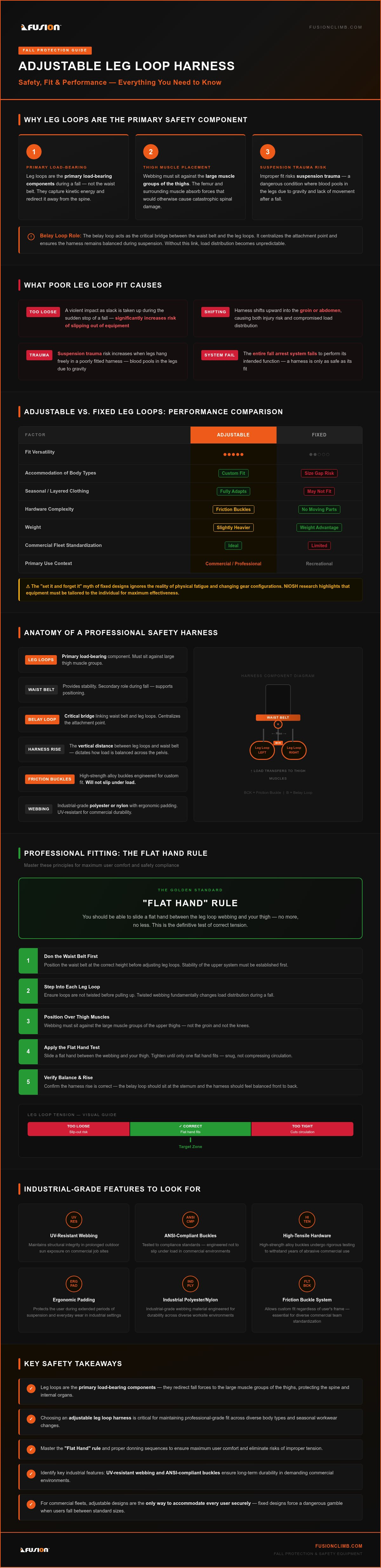
A safety harness is a complex assembly of high-strength webbing and precision hardware. While the waist belt provides stability, the leg loops serve as the primary load-bearing components during a fall. They don't just hold you in; they are designed to capture the kinetic energy of a descent and redirect it. Relying on an adjustable leg loop harness for safety ensures that this webbing sits exactly against the large muscle groups of the thighs. This placement is critical because the femur and surrounding muscle can absorb significant force that would otherwise cause catastrophic damage to the spine or internal organs.
The belay loop acts as the critical bridge between the waist belt and the leg loops. It centralizes the attachment point and ensures the harness remains balanced during suspension. Without this structural link, the load distribution becomes unpredictable. A harness is only as safe as its fit. If the connection between these components is compromised by poor adjustment, the entire system fails to perform its job.
Anatomy of a Professional Safety Harness
Professional harnesses utilize industrial-grade polyester or nylon webbing, high-tensile buckles, and ergonomic padding to protect the user. Fixed designs offer a slight weight advantage but lack the versatility needed for commercial environments where users wear different clothing layers. Adjustable versions use friction buckles to allow for a customized fit regardless of the user's frame. The rise of a harness is the vertical distance between the leg loops and the waist belt, and it dictates how the load is balanced across the pelvis during suspension. Every component must work in unison with the fall arrest system components and safety principles to provide a dependable guardian for the worker at height.
Why Leg Loop Fit Dictates Fall Safety
Fit is the ultimate arbiter of safety. If leg loops are too loose, the sudden stop of a fall creates a violent impact as the slack is taken up, which significantly increases the risk of the user slipping out of the equipment. Proper tension ensures the harness stays in place and prevents it from shifting upward into the groin or abdomen. This security is vital for preventing suspension trauma, a dangerous condition where blood pools in the legs due to gravity and lack of movement. By maintaining a snug, professional fit, you ensure the gear functions as a cohesive unit. The benefits of an adjustable leg loop harness for safety become clear when you consider the varied environments of a commercial job site. Don't settle for gear that almost fits. Precision in adjustment is the only way to guarantee a sobering sense of security in vertical environments.
Adjustable vs. Fixed Leg Loops: A Safety and Performance Comparison
Fixed leg loops offer simplicity, but they lack the precision required for diverse professional teams. Sewn loops eliminate adjustment hardware to reduce weight. This is a common choice for recreational users who prioritize speed over versatility. However, professional-grade friction buckles provide a level of adaptability that fixed webbing cannot match. Many operators fall for the "set it and forget it" myth of fixed designs. This assumption ignores the reality of physical fatigue and changing gear configurations. Consistent adherence to NIOSH workplace fall prevention and harness safety research highlights that equipment must be tailored to the individual for maximum effectiveness. Modern adjustment buckles are engineered from high-strength alloys and undergo rigorous testing to ensure they won't slip under load. While sewn loops have fewer moving parts, the hardware on an adjustable harness is built to withstand years of abrasive commercial use.
Versatility Across Body Types and Sizes
In commercial fleets, an adjustable leg loop harness for safety is the only way to accommodate every user securely. When a user falls between standard sizes in a fixed loop, they're often forced to choose between gear that's too tight or dangerously loose. This gamble is unacceptable in high-stakes environments. Adjustable loops allow for a custom fit that respects unique leg-to-waist ratios. This ensures the harness remains centered and the load-bearing webbing stays positioned over the large muscle groups of the thighs. Integrating these harnesses with high-performance commercial zipline pulleys creates a comprehensive safety system that protects every participant, regardless of their frame.
Seasonal Adaptability and Layering
A harness that fits perfectly over summer shorts will likely restrict femoral circulation when forced over heavy winter coveralls. Fixed loops create a binary choice: they're either too loose in the summer or too tight in the winter. This restriction isn't just a comfort issue. It's a safety hazard that can lead to premature fatigue or reduced mobility. Adjustable harnesses are the year-round professional choice because they adapt to the gear you're wearing today, not the gear you wore last season. They allow for a snug fit over lightweight moisture-wicking fabrics in July and provide the necessary expansion for insulated bibs in December. This adaptability ensures that safety margins remain consistent throughout the year, providing a sobering sense of security in any weather condition.
Critical Safety Standards and Load Distribution Mechanics
Industrial safety isn't a suggestion; it's a rigorous engineering requirement. The ANSI Z359.11 standard dictates the performance of full body harnesses used in fall arrest systems. These regulations ensure that every component, from the webbing to the buckles, can withstand the dynamic forces of a fall. An adjustable leg loop harness for safety is designed to meet these benchmarks by providing a secure fit that keeps the user upright. During a fall event, the harness must redirect energy away from the vulnerable spine and toward the large, resilient muscle groups of the thighs. This transition of force is achieved through meticulous manufacturing and reinforced stitching at every load-bearing junction.
Hardware integrity is equally vital. Adjustable buckles undergo extensive testing to ensure zero slippage under extreme tension. Unlike recreational gear, industrial hardware is built for repeated use in harsh environments. Manufacturers subject these components to rigorous trials, including:
- Dynamic drop tests to simulate real-world fall events
- Salt spray exposure to verify corrosion resistance
- Static load testing to confirm the webbing's breaking strength
This precision ensures that the harness doesn't loosen during a shift, maintaining the sobering sense of security professionals demand. When hardware is tested to these extremes, it acts as a silent partner in the user's safety journey.
Understanding ANSI and OSHA Compliance
Commercial operators face different risks than recreational climbers. While recreational standards focus on lightweight versatility, industrial ANSI and OSHA requirements prioritize maximum durability and predictable performance. Compliant hardware is non-negotiable for commercial fleets. A complete safety system requires every link to be professional-grade, including the use of professional climbing carabiners to secure the harness to the anchor point. Standardizing your team on ANSI-rated equipment ensures that your gear meets the highest manufacturing standards and reduces liability for the operator.
The Science of Suspension Trauma Prevention
Suspension trauma occurs when a person remains upright and motionless after a fall. Gravity causes blood to pool in the lower extremities, which can lead to fainting or more severe physiological failure within minutes. An adjustable leg loop harness for safety allows the user to adjust their position and potentially sit back into the harness to alleviate pressure on the femoral arteries. This adjustability is a critical factor in rescue scenarios. When combined with properly rated zipline lanyards and tethers, these harnesses provide the necessary support to keep a user stable until help arrives. Proper leg loop tension facilitates better circulation, extending the window for a successful rescue and reducing the immediate physiological impact of suspension.
Professional Fitting: How to Adjust Your Harness for Maximum Security
Donning a harness requires a methodical approach. It's not enough to simply step into the gear; you must follow a specific sequence to ensure the components align with your skeletal structure. Always secure the waist belt first. This establishes the primary anchor point on your body before you move to the lower extremities. Once the waist is set, you can fine-tune your adjustable leg loop harness for safety to match your specific leg circumference. This order ensures the harness doesn't sag or sit too low, which would compromise the load distribution physics required for a secure arrest.
The "Flat Hand" rule is the industry standard for verifying tension. You should be able to slide a flat hand between the webbing and your thigh, but you shouldn't be able to turn that hand into a fist. If it's too loose, the harness will shift violently during a fall. If it's too tight, you risk restricting circulation during long periods of suspension. Symmetry is your final check. Ensure the belay loop is perfectly centered. An off-center harness pulls unevenly, which can cause the user to spin or tilt during a fall event. Finally, manage your excess webbing. Snagging a loose "tail" on a structure or piece of hardware can lead to accidental buckle release or restricted movement.
The Step-by-Step Adjustment Protocol
Position the waist belt above the iliac crest, the top of your hip bones. Tighten it until it's snug enough that it cannot be pulled down over your hips. Next, adjust the leg loops to eliminate any significant thigh gap. This prevents the harness from sliding upward into the groin area during suspension. Finally, verify your buckles. Whether you're using traditional double-back buckles or modern auto-locking hardware, a visual and physical check is mandatory. For those managing high-volume operations, choosing a professional-grade full body harness with intuitive adjustment points can significantly reduce donning time without sacrificing security.
Safety Checks for Commercial Operators
In commercial environments, individual checks aren't sufficient. Implement a "Buddy Check" system where guides or operators verify each other's gear before every session. This secondary inspection catches missed buckles or twisted webbing that the user might overlook. Inspect the webbing for "fuzzing," cuts, or chemical stains. Check metal hardware for cracks, deformation, or sluggish spring action in buckles. For a comprehensive overview of maintaining gear integrity, refer to the zipline safety inspection checklist. Consistent vigilance is the only way to maintain a professional-grade safety margin and ensure your gear remains a dependable guardian for your team.
Selecting Industrial-Grade Harnesses for Commercial Operations
Selecting an adjustable leg loop harness for safety requires a deep understanding of material science and environmental resilience. Commercial webbing must resist UV degradation and mechanical abrasion to maintain its integrity over hundreds of cycles. High-exposure environments, such as outdoor zipline tours or aerial adventure parks, subject gear to constant friction and sunlight. Industrial-grade polyester webbing is often preferred for its low-stretch properties and superior resistance to moisture. When you integrate these harnesses with commercial zipline pulleys, you ensure the entire safety chain is built to the same rigorous standards. Lifespan evaluation is a daily responsibility for any professional operator. While a recreational harness might last several years, a commercial unit in high-use settings may need replacement much sooner to maintain strict safety margins.
Durability isn't just about the webbing; it's about the hardware. Buckles must operate smoothly even when exposed to dust, grit, or salt air. High-strength alloys provide the necessary security without adding excessive weight to the system. Choosing professional-grade equipment means investing in gear that has been tested for real-world application. This methodical approach to equipment selection provides a sobering sense of security for both the operator and the end user. It's about building a system that acts as a dependable guardian in vertical environments.
Full Body vs. Seat Harnesses in Professional Settings
Full body fall arrest systems are the gold standard for maximum safety in commercial operations. They prevent the user from slipping out during an inverted fall and distribute impact forces across the shoulders, chest, and thighs. In contrast, seat harnesses offer greater range of motion for technical climbing or low-altitude ropes courses. For specialized attractions, Superman style harnesses allow participants to experience prone flight while remaining fully supported by reinforced webbing. These specialized tools ensure that the thrill of the activity doesn't come at the expense of security. Providing an adjustable leg loop harness for safety allows your staff to quickly adapt the gear to a wide range of body types, ensuring every user is locked in securely before they leave the platform.
Why Fusion Climb is the Choice for Professionals
Fusion Climb brings over two decades of manufacturing expertise to the commercial market. We've been building safety hardware since 1998 with a focus on industrial reliability and safety-first engineering. Our designs don't rely on marketing fluff; they rely on precision manufacturing and high-tensile materials. We provide high-weight capacity options to ensure that your operation can safely serve a diverse range of guests. This commitment to strength and meticulous craftsmanship makes our gear a staple in professional aerial parks nationwide. Don't compromise on the integrity of your safety system. Explore our full body climbing harnesses to find the right solution for your commercial operation.
Standardize Security with Precision-Engineered Gear
Precision in equipment selection is the foundation of a secure vertical operation. The mechanical advantage of an adjustable leg loop harness for safety lies in its ability to adapt to the individual, ensuring that fall forces are captured by the strongest parts of the body. Proper load distribution isn't just about comfort; it's a critical engineering requirement that prevents suspension trauma and maintains compliance with rigorous ANSI Z359.11 standards. Whether you're managing a high-volume aerial park or a professional rigging crew, your gear must be as resilient as the professionals who wear it.
Fusion Climb has been manufacturing safety gear since 1998, providing the industrial-grade webbing and hardware that commercial operators trust nationwide. Our ANSI Z359.11 compliant designs offer the durability and precision adjustment needed for year-round reliability in harsh environments. Don't leave your team's security to chance with generic solutions. Take the next step in standardizing your equipment and enhancing your safety margins. Upgrade your fleet with Fusion Climb professional safety harnesses and build your operation on a foundation of industrial strength. Your pursuit of vertical excellence deserves a partner committed to your safety.
Frequently Asked Questions
Are adjustable leg loops safer than fixed leg loops?
Adjustable designs are often superior in commercial contexts because they ensure a proper fit for every user. Fixed loops rely on the user perfectly matching a specific size chart, which is rarely the case for diverse teams. Using an adjustable leg loop harness for safety allows for precision tension, which is critical for preventing the user from slipping out during a fall. This adaptability significantly reduces the risk of injury caused by poorly distributed impact forces.
How tight should the leg loops be on a safety harness?
You should follow the "Flat Hand" rule for professional-grade security. This means you can slide your flat hand between the webbing and your thigh, but you cannot rotate it into a fist. This tension is snug enough to prevent the harness from shifting upward during a fall event, yet loose enough to maintain femoral circulation during periods of suspension. Always check tension after adding or removing clothing layers to maintain your safety margins.
Can I use a recreational climbing harness for industrial work at height?
No, you must use equipment that meets specific industrial standards like ANSI Z359.11. Recreational harnesses are designed for lightweight performance and often lack the durability or specific load-bearing certifications required for commercial job sites. Fusion Climb has been manufacturing safety gear since 1998, focusing on industrial reliability. We build hardware that withstands the high-cycle demands of professional aerial adventure parks and commercial rigging operations where recreational gear would fail prematurely.
How do I know if my harness leg loops are too loose?
If the webbing slides down your leg or leaves a visible gap when you sit back, the fit is dangerously loose. Loose loops allow the harness to jerk upward during a fall, which can cause severe groin injuries or internal damage. Your harness should stay in place against the large muscle groups of your thighs without shifting when you move through vertical environments. Precision adjustment is the only way to guarantee a sobering sense of security.
What is the lifespan of an adjustable leg loop harness in a commercial setting?
Most manufacturers recommend a maximum service life of five to ten years, but high-use commercial environments often require earlier retirement. Constant exposure to UV rays, abrasion, and heavy loads can degrade webbing faster than recreational use. You must perform daily inspections and retire any harness that shows signs of "fuzzing," significant discoloration, or hardware deformation. Don't wait for a failure; retire gear as soon as it shows signs of industrial wear.
Do adjustable leg loops increase the risk of buckle failure?
No, provided you use professional-grade hardware that is properly maintained and inspected. Modern friction and auto-locking buckles are engineered to hold thousands of pounds of force without slipping. These components undergo rigorous dynamic and static testing to ensure they won't fail under load. The versatility of an adjustable leg loop harness for safety far outweighs any perceived risk, as a perfect fit is the best defense against fall-related injuries on a professional job site.
How do I inspect the buckles on my adjustable harness?
Start with a visual check for cracks, corrosion, or bends in the metal. Ensure that the springs in auto-locking buckles move freely and snap shut with a distinct click. For traditional friction buckles, verify that the webbing is threaded correctly and shows no signs of slippage or fraying at the contact points. If any hardware feels sluggish or shows visible deformation, you must remove the harness from service immediately to protect your team.
Why do some harnesses have fixed leg loops if adjustable ones are more versatile?
Fixed leg loops are primarily designed to reduce weight and simplify the harness for specific recreational applications like high-performance rock climbing. They eliminate the weight of metal adjustment buckles and the complexity of managing excess webbing. However, for commercial operators managing a diverse team or participants in varying seasonal gear, the versatility of adjustable hardware is essential. It's the only way to ensure a professional-grade fit and maintain consistent safety standards across your operation.