

Commercial Zipline Hardware Prices for Operators
The lowest listed price isn’t always the best price on commercial zipline hardware. Commercial operators should compare equipment by intended use, ratings, and operational needs, then check what each proposal includes. Start with fit and scope, not just the price tag.
Price matters, but so do the components and services behind a proposal. This guide explains where operators can buy equipment, how to compare listed kit prices with larger project costs, and what to look for in intended-use ratings. You’ll also learn how to assess proposal scope, including whether items such as platforms, braking systems, installation, and inspection are included, so you can evaluate options with a clear view of what each covers.
Key Takeaways
- Compare commercial equipment by intended use and overall fit, not price alone.
- Review kit options and listed prices alongside what each package covers.
- Use applicable safety standards and intended-use ratings to assess equipment suitability.
- Compare proposal scope, including platforms, braking systems, installation, training, and inspection.
Where Should Commercial Zipline Operators Buy Equipment?
Compare suppliers by equipment function, intended-use ratings, and course requirements. Request itemized options that distinguish guest equipment from broader project costs.
Commercial-Grade Equipment at Different Price Points
Compare each option by the job it performs, not by price alone. A pulley, harness, lanyard, or carabiner serves a different role in a guest system. Suppliers can organize choices by component and explain how each fits the course design. This helps operators see what changes between proposals, rather than treating different equipment as interchangeable.
Share the course layout, operating conditions, and equipment requirements when requesting options. Compare like-for-like configurations, including the components covered. Each item should match its role in the operation and intended use, making it easier to judge whether a lower-cost configuration meets the same need.
Ratings and Manufacturer Documentation
Match each item’s identification and intended-use rating to the manufacturer’s requirements. Commercial zipline equipment should meet applicable standards, manufacturer requirements, and intended-use ratings. Ask the supplier to identify the documentation associated with each equipment option, so ratings and product details can be reviewed together.
Organize records by equipment type and follow the manufacturer’s instructions for use and care. Remove damaged, expired, or questionable items from service. Documentation supports equipment tracking, but it does not replace inspections or condition checks.
Course requirements shape equipment selection. Use the course layout and planned equipment roles to distinguish guest harnesses, pulleys, and connection components. This keeps the proposal grounded in the actual operation rather than a generic equipment list.
Replacement timing depends on use, condition, manufacturer limits, and inspection findings. Busy commercial operations may need to replace some guest gear after a year or two, while lower-use camps and seasonal programs may use guest equipment for several years. Another option is to replace a portion annually, guided by condition and inspection results.
Care affects equipment condition. Wash and dry gear according to the manufacturer’s instructions, then store it clean, dry, and organized. Keep it away from direct sunlight and extreme temperatures. These steps support consistent management of guest gear between operating periods.
Zip line kits and listed prices
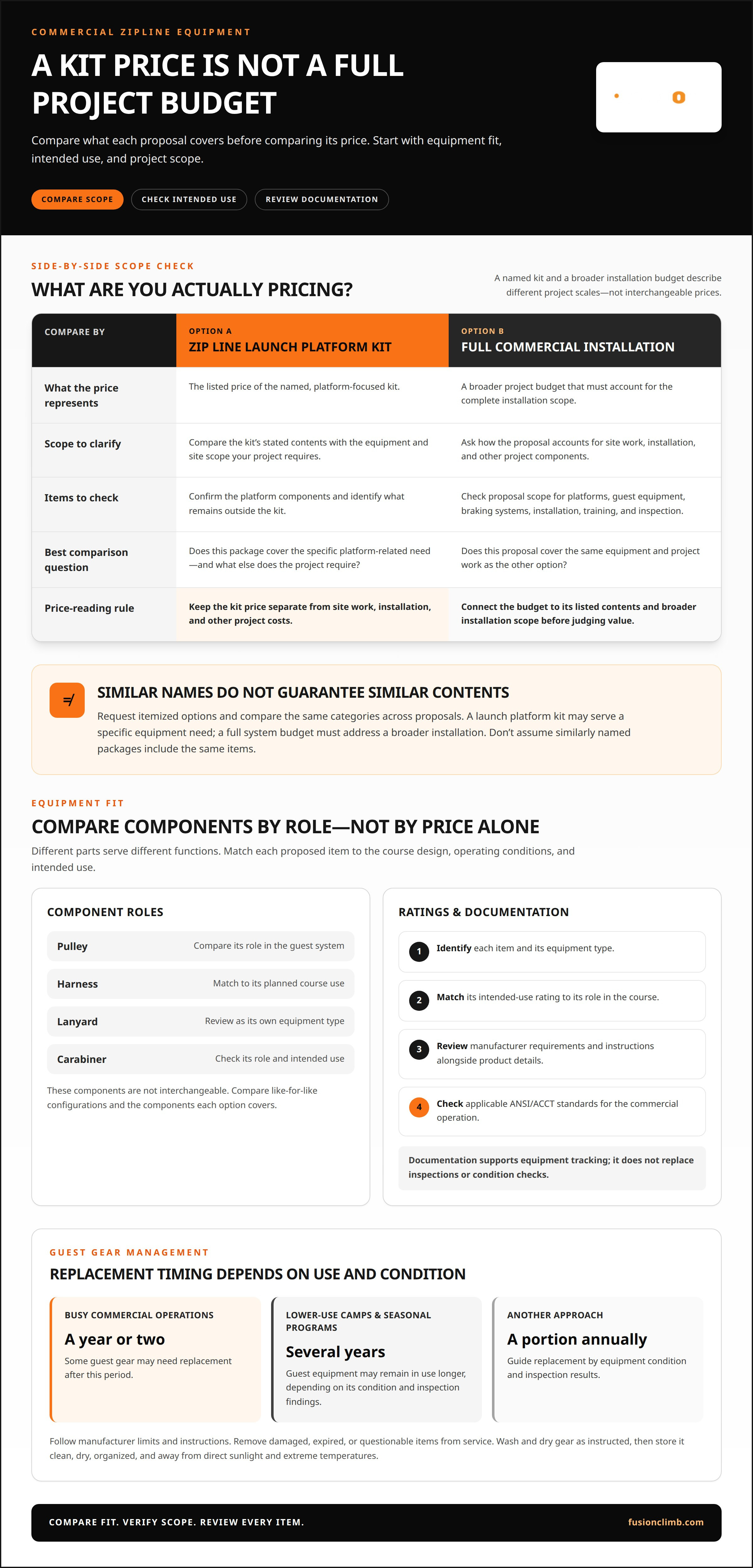
Kit prices depend on package contents and the portion of the course the kit serves. Keep a listed kit price separate from the budget for a complete commercial installation.
Zip Line Kit Options
A ZIP LINE LAUNCH PLATFORM KIT is one listed option. Its name indicates a platform-focused package, not a complete commercial zipline system. Compare its stated contents with the equipment and site scope your project requires.
When requesting kit options, describe the planned course and ask for itemized package contents. Compare the same categories across proposals, such as platform components, guest equipment, and braking systems. A side-by-side scope review shows whether prices cover equivalent work or leave project needs outside the kit.
Listed Kit Prices
Treat this as the price of the named kit, not a complete commercial installation. Keep the kit price separate from site work, installation, and other project components.
These figures describe different project scales, not interchangeable kit prices. A proposal should distinguish equipment costs from costs for broader project work.
Send the same project description with each request for supplier options. Include the course layout, intended use, and components under consideration. Ask for itemized kit contents and a clear separation between equipment and installation scope. This gives you a consistent basis for comparing prices without assuming similarly named packages include the same items.
Assess each proposal against the project itself. A launch platform kit may suit a specific equipment need, while a full system budget must account for a broader installation. Connect each price to its contents and role before deciding which option offers the best value for the course.
Applicable safety standards and intended-use ratings
Commercial zipline operations follow industry safety standards, including ANSI/ACCT standards. Equipment selection also depends on manufacturer requirements and intended use.
Applicable Safety Standards
Use ANSI/ACCT standards as part of the safety framework for commercial zipline operations. A standards reference alone does not establish that every item suits every course. Review the equipment’s role, supporting documentation, and manufacturer’s instructions together.
Identify which standards and manufacturer requirements apply to the proposed equipment. A proposal might list a pulley, harness, and lanyard, but each item must be considered for its specific role. Keep applicable documentation with purchasing and inspection records so staff can identify each product and its relevant instructions.
Intended-Use Ratings
An intended-use rating indicates whether equipment is designed for the use being considered. Match it to the component’s role in the course. A guest harness and a pulley perform different functions, so review their ratings and manufacturer requirements separately.
Connect each proposed item to its course application and review the corresponding manufacturer information. Consider product identification, intended use, and instructions together. For proposals with several equipment types, organize the review by component to spot mismatches between planned use and stated limits.
Use a consistent review process: identify the equipment, match its rating to its intended role, and compare that use with manufacturer requirements. Confirm that the proposal addresses applicable ANSI/ACCT standards for the commercial operation. Keep records accessible for inspections and replacement decisions. Remove damaged, expired, or questionable equipment from service, even if its original rating appears suitable.
A lower listed price doesn’t settle the safety question. Compare equipment by intended use, manufacturer information, and fit with the course. This gives operators a practical basis for assessing whether each component belongs in the planned setup.
Comparing commercial zipline proposals
A useful proposal makes scope clear, allowing operators to compare equivalent project elements. Review each line against the course plan and intended operation.
Shipping, Installation, and Maintenance Costs
Shipping, installation, and maintenance costs depend on what a proposal covers. Shipping relates to the equipment supplied, installation to the work included, and maintenance to ongoing equipment care. The proposal should separate these categories rather than burying them in one total.
Commercial proposals should state whether site clearing, engineering, platforms, gear, braking systems, installation, training, and inspection are included. These items affect the scope being compared. A proposal with platforms and installation, for example, is not directly comparable to an equipment-only quote. Consider maintenance separately from initial installation.
Warranty and Replacement-Parts Options
Terms for warranties, replacement parts, and technical support vary by proposal. Compare any stated coverage period, parts covered, replacement process, and support scope, then consider how those terms relate to the equipment’s planned service life.
Keep those terms distinct from manufacturer requirements and intended-use ratings. A warranty does not establish that equipment suits a particular course, and a replacement-parts policy does not replace inspection decisions. Review these details alongside the equipment and installation scope.
For a clear comparison, organize proposals into common categories: site preparation, engineering, platforms, gear, braking, installation, training, and inspection. Mark each as included, excluded, or separately priced. This reveals differences in scope before price becomes the deciding factor.
Compare the same course requirements across proposals. A clear breakdown connects each component and service to the planned operation and shows where maintenance and support terms apply. This helps distinguish a complete project proposal from a partial equipment quote.
Explore commercial zipline hardware options as you assess equipment needs.
Fusion Climb
Fusion Climb supplies equipment for commercial operators to evaluate against course needs, intended-use ratings, and project scope. Its offerings include Full Body Harnesses, Superman Style Harnesses, Zipline Pulleys, and Lanyard and tether. Each serves a different role in a zipline setup, so match selections to the operation rather than treating hardware as interchangeable.
Turn to Fusion Climb when sourcing these equipment categories for a commercial operation or planning a new setup. Use the course requirements and purchasing priorities established during planning to guide your selection, including which categories fit the intended use. This keeps the decision grounded in the project, not price alone.
Contact Fusion Climb to discuss equipment for your commercial zipline operation.
Plan Your Next Equipment Decision
Build the purchase around a clear operational priority: match equipment to its intended role, then assess the proposal against that need. The best price on commercial zipline hardware matters most when the equipment fits the course and purchasing scope. This turns price comparison into a decision based on operational fit.
Fusion Climb offers Full Body Harnesses, Superman Style Harnesses, and Zipline Pulleys for commercial operators assessing equipment needs. Consider each category in relation to its intended role and the course equipment plan, rather than deciding from a single line item.
Use your course requirements to define the next procurement priority. Keep the decision tied to operational fit, intended use, and proposal scope as the operation develops. For a focused next step, contact Fusion Climb about equipment. Move forward with a deliberate purchasing plan and build the adventure on sound decisions.
Frequently Asked Questions
What information should you provide a supplier before asking for a quote?
Provide the course layout, intended equipment roles, and a clear list of components needed. Include the operating context, such as whether equipment serves a guest line or a specific course element. Share relevant manufacturer requirements or intended-use ratings established for the operation. These details help Fusion Climb prepare an itemized proposal that reflects your requirements and supports your search for the best price on commercial zipline hardware.
What is the current price of commercial zipline hardware kits in the United States?
There isn’t one price for every commercial kit. Check the package contents and scope before comparing its price with another kit or a larger project proposal.
How much do commercial zipline trolleys, harnesses, pulleys, and braking systems cost?
Prices depend on the specific item and system scope. These are individual product prices, not prices for trolleys, pulleys, or braking systems. Keep item categories distinct when comparing quotes.
Which commercial zipline hardware suppliers offer the best prices and discounts?
To find the best price on commercial zipline hardware, compare itemized proposals with matching package scope. Without comparable quotes, no supplier can be identified as the lowest-priced choice. Review equivalent equipment, included services, and any stated discounts. A reduced price on a partial package may not mean a lower overall project cost, so assess the full scope and intended equipment use.
What is included in a commercial zipline hardware package, and what must be purchased separately?
Package contents depend on the specific kit. A platform-focused kit, for example, should not be assumed to include guest equipment, braking systems, installation, engineering, or inspection. Look for each item or service to be listed clearly. Treat anything excluded as a separate project requirement instead of assuming the package covers the entire course.
How do commercial zipline hardware prices compare by capacity, line length, and duty rating?
Compare options using the same stated capacity, line length, and intended-use rating. A difference in any of these may mean proposals describe different equipment or project scopes. Request itemized specifications alongside prices and compare matching configurations. A lower figure is not a direct comparison if the equipment serves a different course requirement.