



Certified Fall Arrest Harness Systems: Uses and Limits
For construction work in the United States, OSHA generally requires fall protection when workers are six feet or more above a lower level. Certified fall arrest harness systems are part of a setup designed to stop a fall before a worker reaches the level below. The harness must work with compatible connectors and suitable anchorage.
A harness can look secure yet still be part of an unsafe setup if the system cannot manage fall forces or there is not enough clearance below. Understanding these limits matters as much as knowing where fall protection is required.
This guide explains where fall arrest systems are used and how they differ from restraint and work-positioning systems. It also covers inspection, equipment capacity, and free-fall distance, helping you understand what affects safety before work at height begins.
Key Takeaways
- Distinguish fall arrest, restraint, and work positioning by what each system is designed to do: stop a fall, prevent access to a fall hazard, or support work at height.
- Inspect harnesses and other system components before use, and understand how condition, fit, and documentation contribute to safe use.
- Account for the forces involved: according to the Occupational Safety and Health Administration, a personal fall arrest system must limit maximum arresting force on an employee to 1,800 pounds.
- Plan for adequate clearance and controlled stopping distance; the Occupational Safety and Health Administration sets a maximum deceleration distance of 3.5 feet under 29 CFR 1910.140.
- Use OSHA requirements to understand the regulatory baseline, then match the harness and connected equipment to the work task and system design.
Annual equipment inspections and documentation
Reliable protection depends on a sound harness, correct fit, and documented inspections. In construction and other work-at-height settings, employees also need to understand the hazards and how to use the complete protection system.
Inspection Frequency and Service Removal
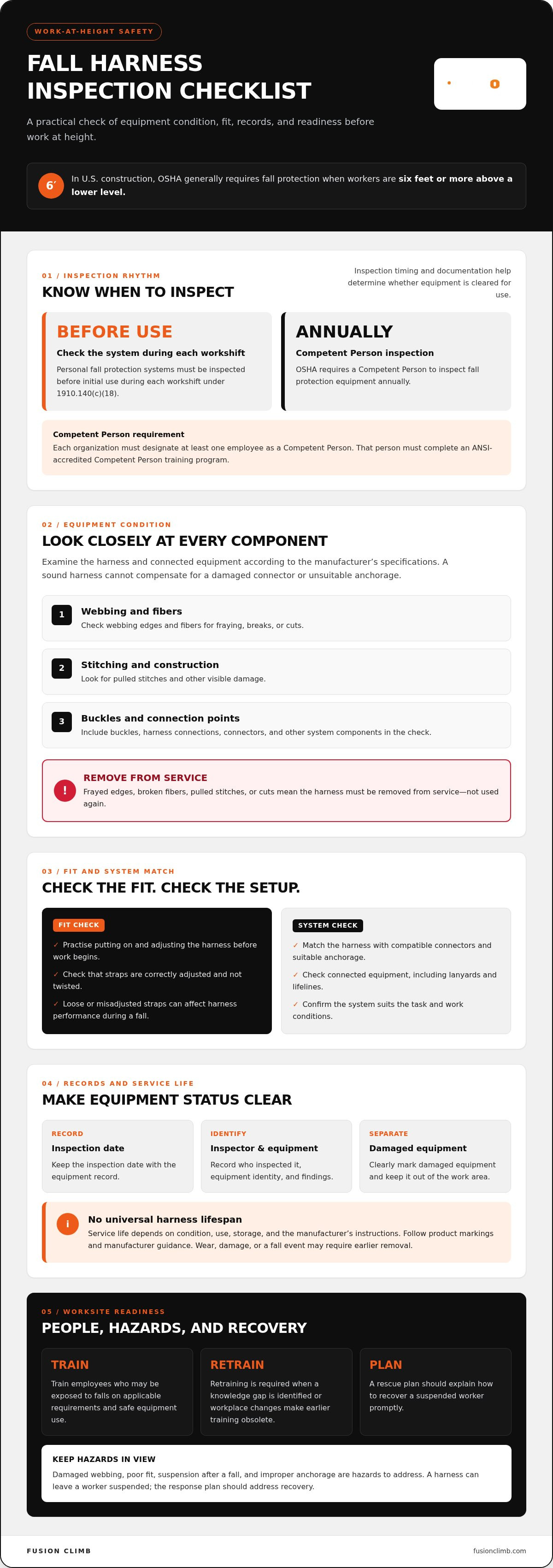
OSHA requires a Competent Person to inspect fall protection equipment annually, and personal fall protection systems must be inspected before initial use during each workshift under 1910.140(c)(18). Harnesses should be removed from service if inspection reveals frayed edges, broken fibers, pulled stitches, or cuts.
A regular inspection schedule matters because damage can weaken webbing or stitching before it becomes obvious during a task. Record the inspection date, inspector, equipment identity, and findings so employees can tell whether a harness is cleared for use. Clearly mark damaged equipment and keep it out of the work area to prevent accidental reuse.
Each organization must designate at least one employee as a Competent Person, who must complete an ANSI-accredited Competent Person training program. Inspection records help that person track equipment condition and identify hazards across the applicable worksite.
Wear Checks and Proper Fitting
Before use, examine the body harness and its components for visible damage. Check webbing edges, fibers, stitching, buckles, and connection points closely. Cuts or pulled stitches mean the harness must be removed from service, not used again.
Fit matters because loose or misadjusted straps can affect harness performance during a fall. Employees should practise putting on the harness, adjusting it, and checking the fit before work begins. For example, a twisted strap can interfere with a secure, consistent fit.
Inspect components according to the manufacturer’s specifications, and include connected equipment in the check. A sound harness cannot compensate for a damaged connector or unsuitable anchorage.
Harness Lifespan and Expiration Dates
A harness’s service life depends on its condition, use, storage, and the manufacturer’s instructions, not on a universal lifespan. Follow the instructions and product markings to determine how to evaluate the equipment and when to retire it.
Some manufacturers provide service-life or expiration guidance, but wear, damage, or a fall event may require earlier removal. Keep equipment records with the harness identity and inspection findings so employees can distinguish active equipment from a retired harness.
OSHA requires employers to train employees who may be exposed to falls. Training should cover applicable requirements and safe equipment use. Retraining is required when an employer identifies a knowledge gap or workplace changes make earlier training obsolete. A Competent Person should oversee hazard identification and corrective action, and a rescue plan should explain how to recover a suspended worker.
Common hazards include damaged webbing, poor fit, suspension after a fall, and improper anchorage. A harness can leave a worker suspended without restoring safe access, so the response plan should address prompt recovery. Anchorage must suit the protection system and work conditions; an unsuitable connection can compromise the entire setup.
Fall arrest, restraint, and work positioning systems
Fall protection systems serve different purposes: stopping a fall, preventing access to an edge, or supporting a worker during a task. Choose the type that matches the worksite hazards and recovery plan.
System Types and Their Functions
A fall arrest system stops a worker after a fall begins; restraint equipment prevents the worker from reaching the fall hazard. Work positioning supports a worker in place, such as a technician leaning back to use both hands. These functions are not interchangeable: a restraint setup is not designed to arrest a fall.
Suspension systems support workers while they hang from a lifeline, while retrieval equipment helps recover a suspended person. Under OSHA construction requirements, workers generally need fall protection at six feet or more above a lower level. A qualified person should match system type, anchorage, and rescue planning to the task.
Positioning systems also have specific test criteria. Under OSHA 29 CFR 1910.140, general positioning systems must withstand a 4-foot drop test using a 250-pound weight. Window-cleaner positioning systems must withstand a 6-foot drop test using a 250-pound weight. Those tests distinguish positioning equipment from systems designed primarily for fall arrest.
Brands and Models Compared
Compare harness brands and models by intended use, design, compatible connectors, and applicable standards, not by name alone. A model designed for work positioning may not suit a task requiring fall arrest, even if both include a body harness.
Compare the complete protection system, including the harness, lanyard, lifeline, and anchorage. The equipment instructions and task requirements determine whether the components work together as intended. For example, a worker moving between work areas needs a setup that allows movement without compromising fall protection.
Certification Standards
OSHA Standard 1910.140 covers personal fall protection systems, including fall protection harnesses, according to the Occupational Safety and Health Administration. Construction fall-arrest requirements are also addressed in 29 CFR 1926 Subpart M. These rules help define performance expectations for system components and use.
Certification or compliance relates to specific equipment and system criteria, not simply the harness’s appearance. Check the equipment markings and manufacturer instructions against its intended application. A qualified person can assess how the equipment, anchorage, and work conditions fit together.
Costs and Inspection Services
How much do certified fall arrest harness systems cost in the United States? Cost depends on the harness design, compatible components, and intended application. Compare the requirements for the complete system, not just the harness.
Where can you find systems and inspection services near you? Use equipment documentation to identify suitable systems, and arrange workplace inspections through a designated Competent Person. For a product reference, review fall protection equipment options alongside the task and system requirements.
A brand or model does not replace a site-specific decision. The lanyard, lifeline, anchorage, and retrieval plan must work together to protect workers and support recovery if a fall occurs.
Fall arrest physics and equipment capacity
A fall arrest system manages energy, not just a worker’s height. As a worker falls, the harness, connector, lifeline, and anchor must work together to stop the movement while limiting force on the body. This coordinated response is central to workplace safety around fall hazards.
Under OSHA 29 CFR 1910.140, a personal fall arrest system must limit the maximum arresting force on an employee to 1,800 pounds, according to the Occupational Safety and Health Administration. The limit concerns force during arrest, not the worker’s body weight or the load rating of one component. A harness alone can’t control those forces if the rest of the system is unsuitable.
Anchorage capacity is a separate requirement. Under OSHA 29 CFR 1910.140, anchorages generally must support at least 5,000 pounds for each employee attached, according to the Occupational Safety and Health Administration. That figure applies to anchorage, while the 1,800-pound limit applies to force on the employee. Treating them as interchangeable can lead to a system designed around the wrong constraint.
Where a structure cannot withstand a 5,000-pound load, it must be rated to withstand twice the anticipated maximum arresting force of the personal fall protection system. The system’s expected forces and the structure’s capacity therefore need to be considered together. An anchor that appears substantial may still be unsuitable if its connection point or supporting structure cannot handle the anticipated load.
Worker and tool weight also affects system criteria. Under OSHA 29 CFR 1910.140, Appendix D criteria for certain personal fall arrest systems apply when an employee’s combined body and tool weight is less than 310 pounds. Systems used at 310 pounds or more require appropriately modified criteria and protocols. Include tools in the load assessment, not just the worker.
For example, a worker carrying equipment may exceed the weight range used for a system’s standard evaluation. Account for the combined load and the system’s permitted configuration when selecting equipment. Follow the manufacturer’s instructions for compatible components, connection methods, and intended use. Mixing a harness, lanyard, or lifeline without considering how they interact can change the system’s behaviour during a fall.
Capacity is only one part of protection. The anchor’s location, connector compatibility, and available clearance all affect whether a fall can be arrested before the worker reaches a lower level. Evaluate the complete arrangement for each task. A properly selected personal fall system connects rated equipment to a structure capable of supporting its role.
Free-fall distance limits
Free-fall distance is how far a worker drops before the personal fall arrest system begins slowing the descent. Under OSHA 29 CFR 1910.140, personal fall arrest systems generally must be rigged so an employee cannot free fall more than 6 feet or contact a lower level, according to the Occupational Safety and Health Administration. Both limits matter: contact with a lower level can cause injuries before the system arrests the fall.
Deceleration distance describes the distance traveled while the system slows the worker after free fall ends. Under OSHA 29 CFR 1910.140, a personal fall arrest system must limit the employee’s maximum deceleration distance to 3.5 feet, according to the Occupational Safety and Health Administration. This measurement is separate from the free-fall limit. A correct setup accounts for both phases, rather than treating the stopping distance as one figure.
Attachment location affects how a system behaves. Under OSHA 29 CFR 1910.140, the body-harness attachment point generally must be centered on the employee’s back near shoulder level. A pre-sternal attachment is permitted when free fall is limited to 2 feet or less. The appropriate connection therefore depends on the harness design and permitted system configuration, not just where a worker finds a convenient clip point.
Available clearance must account for the entire movement before the worker stops. Consider the work position, anchor location, connector length, free-fall distance, and the system’s deceleration distance. A setup that meets the 6-foot free-fall limit could still allow contact with a lower level if the space below is insufficient. A competent person should assess these workplace conditions when selecting and arranging fall protection equipment.
Self-retracting lifelines have their own criteria under OSHA 29 CFR 1910.140. A self-retracting lifeline or lanyard that limits free fall to 2 feet or less must have components capable of sustaining a minimum tensile load of 3,000 pounds when fully extended. That requirement concerns component strength; it does not replace the need to control free-fall distance and prevent contact below.
For example, a worker connected to an overhead anchor may have a different fall path from one connected at foot level. Anchor position and connector configuration affect the distance before arrest begins. Assess the work area, then confirm that the setup follows the equipment instructions and applicable regulations. The goal is to prevent contact with an obstruction while the system arrests the fall.
Free-fall planning is a system decision, not a harness-only check. A competent person can assess the anchor, attachment point, connector, and available clearance together. This review helps identify workplace hazards before work begins and supports proper use of personal fall arrest equipment to reduce injury risk.
What standards certify fall arrest harness systems in the United States (OSHA and ANSI)?
In the United States, OSHA regulations set requirements for personal fall protection systems, while standards also describe equipment performance. OSHA Standard 1910.140 covers personal fall protection systems, including fall protection harnesses, according to the Occupational Safety and Health Administration. The distinction matters: regulatory compliance concerns the complete system and its use, not simply a label on one harness.
Anchorage strength is one part of that system. Under OSHA 29 CFR 1910.140, anchorages generally must support at least 5,000 pounds for each employee attached, according to the Occupational Safety and Health Administration. Consider the anchor, the structure supporting it, and the number of employees connected. A compliant connector cannot compensate for an anchorage that fails to meet the applicable requirement.
Connectors have their own criteria. Under OSHA 29 CFR 1910.140, D-rings, snaphooks, and carabiners must be capable of sustaining a minimum tensile load of 5,000 pounds, according to the Occupational Safety and Health Administration. This strength requirement is distinct from inspection, compatibility, and correct connection. For example, a connector with adequate capacity can still be unsuitable if it does not properly engage its mating component.
Lanyards and vertical lifelines used in personal fall protection systems must have a minimum breaking strength of 5,000 pounds under OSHA 29 CFR 1910.140. D-rings, snaphooks, and carabiners also have proof-testing requirements, including a minimum tensile load of 3,600 pounds without cracking, breaking, or permanent deformation. These component requirements address different performance measures, so don’t treat breaking strength and proof-test load as interchangeable.
ANSI standards add technical criteria for specific equipment types. An ANSI standard addressing self-retracting lifelines for personal fall arrest and rescue was released in August of 2012. That is relevant when evaluating self-retracting equipment, but it does not mean every harness or assembled system follows identical criteria. Match the standard and product documentation to the component and intended use.
For a practical review, identify the work application, read the equipment markings, and compare each component’s documentation with the applicable OSHA requirement. Check the harness, connectors, lifeline, and anchorage as a system. A full-body harness may meet its applicable criteria, but the complete setup still depends on compatible components and a suitable structure.
Use the relevant standard as a selection baseline, then assess the actual work configuration. To explore fall protection equipment options, compare component types against the system requirements and manufacturer instructions.
Fusion Climb: Full Body Harnesses
Fusion Climb offers full-body harnesses for fall protection setups. Match the harness to the work or activity, compatible components, and applicable system requirements. A harness is one part of the complete arrangement, so consider how it connects to an anchor and other equipment.
For aerial adventure applications, Fusion Climb also offers Superman-style and zipline harnesses, zipline pulleys, and lanyards and tethers. Choose equipment according to its intended use rather than treating every harness or connector as interchangeable. Follow the equipment instructions when assessing fit and compatibility.
Review Fusion Climb’s harness and related equipment options for your application. For more information, visit Fusion Climb.
Make Your Next Equipment Choice Deliberate
Choosing certified fall arrest harness systems is part of building a work-at-height approach suited to the task, equipment, and people using it. Start by defining the application and identifying the equipment categories needed. This gives your selection process a clear focus and keeps the intended use at its centre.
Fusion Climb offers full-body harnesses and Superman-style harnesses, as well as zipline pulleys. These products serve different equipment needs, so focus on the application and how each component fits into the overall setup. Keep manufacturer instructions and workplace requirements in view as you evaluate your options.
For a practical next step, connect your equipment needs with the right product category. Contact Fusion Climb for harness help and move forward with a more informed selection.
Frequently Asked Questions
Why Are Safety Harnesses and Fall Protection Harnesses So Important and Where are They Used?
Harnesses help protect workers from fall hazards in construction, maintenance, and other elevated work. OSHA generally requires fall protection in construction when workers are six feet or more above a lower level. Protection may also be needed near dangerous equipment, such as machinery or open vats containing hazardous materials. The right setup depends on the hazard, work area, and system function.
What Is a Personal Fall Arrest System (PFAS)?
A personal fall arrest system, or PFAS, is a connected arrangement designed to stop a worker’s fall. Its core components are a body harness, anchorage, and connector, such as a lanyard or lifeline. For example, a worker on an elevated platform may connect a harness through a compatible lanyard to a suitable anchor. Every component must suit the application and work as part of the system.
What Should I Look for When Buying Fall Protection Equipment?
Start with the task: identify whether workers need fall arrest, restraint, or work positioning, then select equipment designed for that function. Compare manufacturer instructions, applicable standards, component compatibility, fit, and the combined weight of the worker and tools. For example, a setup used while carrying tools must account for their added load. Review how the equipment connects to the planned anchor and confirm that workers can use it as intended.
What components are required in a complete personal fall arrest system?
A complete personal fall arrest system includes a body harness, anchorage, and connector. The connector may be a lanyard or lifeline selected for the system design and work conditions. The anchor must suit the structure and connection method, and the harness must be compatible with the connector. For example, a worker using a lanyard between a harness and a suitable anchor needs every link in place for a complete system.
How do I choose the correct size and fit for a fall arrest harness?
Choose a size using the manufacturer’s sizing guidance and the user’s measurements, then assess the fit while wearing the clothing and equipment used on the job. Adjust the straps so the harness sits securely without restricting necessary movement. Check that buckles engage correctly and straps lie flat without twists. For example, a winter jacket can change the fit, so test the harness with the clothing intended for the task.
What is the maximum arresting force and free-fall distance allowed for a personal fall arrest system?
Under OSHA 29 CFR 1910.140, maximum arresting force on an employee is limited to 1,800 pounds, and free fall generally cannot exceed 6 feet or reach a lower level. The Occupational Safety and Health Administration also sets a maximum deceleration distance of 3.5 feet. These are separate limits: the first concerns force on the worker, while the others govern fall and stopping distances.
How do I calculate fall clearance for a fall arrest harness system?
Estimate clearance by adding the system’s free-fall distance, deceleration distance, connector or lifeline deployment, harness movement, and a safety margin. Compare the total with the unobstructed space below the worker, using the equipment instructions to determine each component’s contribution. Consider the anchor location and any ledges, platforms, or machinery below. If clearance is insufficient, change the setup or choose a system suited to the available space.