



Critical Life Safety Equipment Traceability: Data and IDs
A label on a piece of gear isn’t end-to-end traceability. Traceability for critical life safety equipment connects each item’s unique identity to records of its origin, movement, condition, and use throughout its lifecycle. That connection lets teams follow an item’s history, not just locate it in storage.
Reliable tracking takes more than assigning an ID. The identifier must remain connected to accurate, consistent records, and the system must make those records usable across the people and processes responsible for the equipment. When details are incomplete or disconnected, the trail can break just when teams need a clear picture of an item’s status.
This article explains what end-to-end traceability means and how it works in practice. You’ll learn which data supports a trustworthy record, how unique identification and technologies such as barcodes and RFID help, and how system design can connect information across equipment lifecycles and supply chains.
Key Takeaways
- Build records that connect each item to its origin, movement, condition, and use, and keep the data consistent across its lifecycle.
- Use identifiers that distinguish equipment, organizations, and locations so records point to the right item and its history.
- Choose barcode or RFID methods around how equipment is handled and where it needs to be tracked.
- Design systems to exchange usable information across teams and supply-chain partners, then test the process for gaps.
- Explore Fusion Climb Full Body Harnesses when selecting life safety equipment for climbing or zipline applications.
Traceability data quality and precision
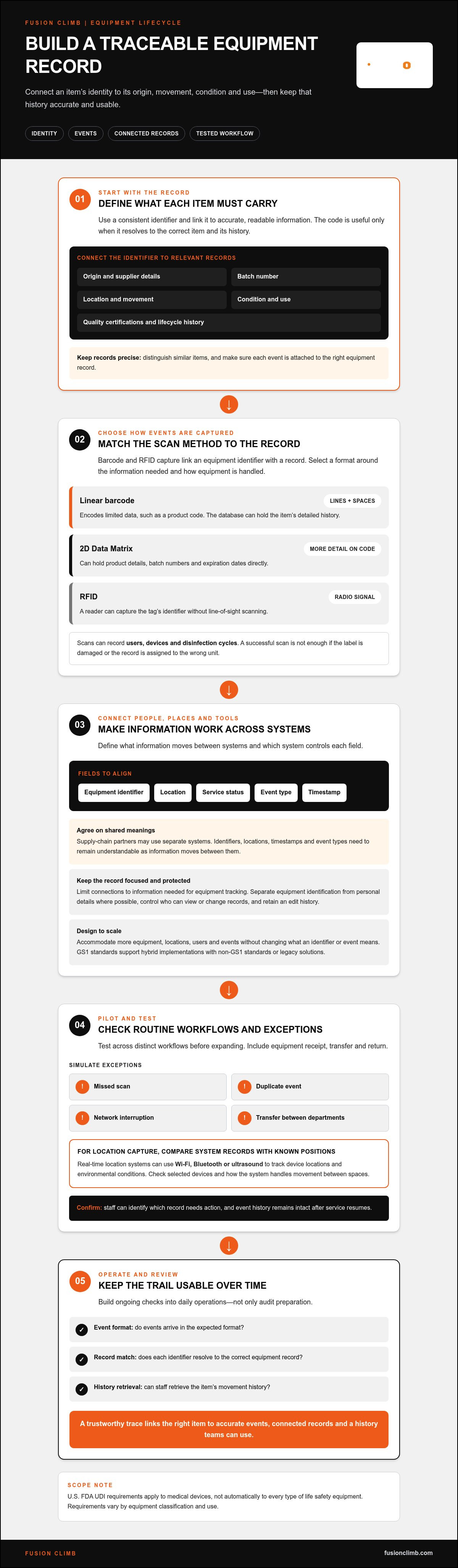
Accurate records connect an equipment identifier to its history, location, and use. A code is useful only when the information linked to it is complete and readable.
In the United States, FDA UDI requirements apply to medical devices, not automatically to every type of life safety equipment. For medical devices, the U.S. FDA UDI system requires identifiers readable by people and machines; ISO 13485 provides a quality-management framework for medical-device manufacturing.
Traceability requirements vary by equipment classification and use. The federal UDI framework covers medical devices, but it does not set one traceability rule for every state, city, or building type.
Precision in Traceability Records
Data precision means recording equipment details consistently enough to identify the correct item and follow its lifecycle history. This matters when teams need to distinguish similar items, trace a production batch, or review distribution records.
Use a consistent identifier and connect it to relevant records, such as supplier details, batch numbers, and quality certifications. The Global UDI Data Base (GUDID) is the U.S. database for device identification; medical devices must be registered there before sale in the American market. Healthcare distributors such as Novus Medical rely on these standardized records to maintain verification across the supply chain. In healthcare records, keep equipment identification separate from personal information and limit access to staff who need it.
Barcode and RFID Data Capture
Barcode and RFID data capture use scans or radio signals to link an equipment identifier with a record. The method affects how reliably staff can record equipment movement and use.
A linear barcode encodes limited data, such as a product code, with parallel lines and spaces of varying widths. A 2D Data Matrix code can hold product details, batch numbers, and expiration dates. RFID tags communicate with a reader using radio waves, so staff can capture an identifier without line-of-sight scanning. Barcode and RFID scans can record users, devices, and disinfection cycles.
Choose a code format based on the record’s purpose. A linear barcode can identify an item while a database stores its detailed history; a Data Matrix code can encode more product and batch information directly. In either case, keep the identifier linked to the correct item record. If a label is damaged or a record is assigned to the wrong unit, even a successful scan can produce an inaccurate trail.
Protect data as carefully as labels. Separate equipment records from personal details where possible, control who can view or change records, and retain an edit history. For example, a record of a device moving between storage and use should identify the item and event without exposing unnecessary healthcare or user information. These controls support review while limiting access to sensitive details.
Traceability system design, testing, and deployment
A traceability system must connect equipment events across people, locations, and digital tools. Effective traceability for critical life safety equipment starts by defining what teams need to record and how those records inform decisions.
Connect the systems that hold the record
Hospital Information System connectivity can link equipment records with healthcare team workflows. Define which fields move between systems, such as an equipment identifier, location, or service status, and which system controls each field. For example, a scan at a treatment location could capture the equipment ID and update its location in the appropriate record.
Protect patient information by limiting connections to data needed for equipment tracking. An equipment record can capture the item and its movement without copying unrelated patient details. Clear field ownership also helps prevent conflicting edits when staff update records in different systems. These design choices keep records focused on equipment status while supporting related workflows.
Design for interoperability and scale
Supply-chain partners may use separate traceability systems, so information must remain understandable as it moves between them. Agree on shared meanings for identifiers, locations, timestamps, and event types. GS1 standards support hybrid implementations that combine GS1 methods with non-GS1 standards or legacy solutions.
Scalability means accommodating more equipment, locations, users, and event records without changing what an identifier or event means. Test a pilot across distinct workflows, such as equipment receipt, transfer, and return. Then expand while preserving data definitions and access controls. This helps identify integration gaps before they affect wider operations.
Test location capture and system behavior
Real-time location systems can use Wi-Fi, Bluetooth, or ultrasound to track device locations and environmental conditions. The right setup depends on where equipment moves and which conditions matter. Compare captured locations with the known positions of selected devices, and review how the system handles movement between spaces.
During deployment, test routine use and exceptions. Simulate a missed scan, duplicate event, network interruption, and transfer between departments. Confirm that staff can identify which record needs action and that event history remains intact after service resumes. Integrated tools can automate tracking, reordering, and serialization to support compliance when they fit the organization’s workflow.
Plan ongoing checks as part of system operation. Review whether events arrive in the expected format, identifiers resolve to the correct records, and staff can retrieve movement history. A well-designed process makes traceability for critical life safety equipment usable in daily operations, not just during an audit. Keep equipment records aligned with the physical safety equipment they describe.
Traceability technologies, including bar codes and RFID
Barcode and RFID technologies turn equipment movement into recorded events. The right application depends on where items travel, what information teams need, and how scans enter the traceability system.
Barcode and RFID Scanning
Barcode scanning reads a printed identifier, while RFID captures an identifier through radio communication with a reader. Both methods can record users, devices, and disinfection cycles, making equipment events visible across a supply chain.
For example, a scan when equipment is issued can associate an item with its new location and responsible user. A scan after cleaning can record that cycle against the same identifier. RFID can capture tags without line-of-sight scanning, which helps when staff cannot point a scanner directly at each item.
QR Codes and RFID Tags
A QR code is a two-dimensional barcode that can encode information or point to a digital record; an RFID tag communicates wirelessly with a reader. Both approaches help teams identify equipment during manufacturing, distribution, and use.
Use a QR code when staff can reach and scan a visible label. Use RFID when readers need to capture tagged items without direct visual alignment. The choice affects the scan workflow, the information captured, and how easily staff can connect an event to the correct equipment record.
Barcode formats serve different data needs. A linear barcode encodes limited data, such as a product code, through parallel lines and spaces of varying widths. A 2D Data Matrix code can store product details, batch numbers, and expiration dates. QR codes are another two-dimensional option, but the data encoded should match the application and the system receiving it.
Keep the identifier consistent from manufacturing through distribution. For example, a supplier’s product code should resolve to the same equipment record after receipt, transfer, and inspection. If each stage creates a new, disconnected identifier, scans may create separate histories instead of one traceable record.
Scanning creates value only when it captures a meaningful event. A device scan without an event, location, or responsible process may confirm identity but reveal little about movement. Configure the application to associate each scan with the event being recorded, such as receipt, issue, cleaning, or storage.
Visibility also depends on readable labels and reliable capture practices. Place codes where staff can scan them during the actual workflow, and ensure the linked record is accessible to authorized users. Barcode scanners and RFID readers should send information into a shared record system rather than leaving scan data isolated on separate devices.
During implementation, test each technology in its real operating environment. Scan a sample item through the intended steps, then confirm that the identifier, event, and resulting record align. Following one tagged item from receiving to storage and later retrieval can expose gaps before the process is applied across the equipment inventory.
Risks of inadequate traceability
Incomplete records can leave teams unable to identify an item’s origin, location, or movement history. For example, if a storage transfer isn’t recorded, staff may search the wrong area or mistake one unit for another. A consistent history helps reveal these gaps and supports timely decisions about equipment status.
An effective recall response depends on accurately identifying affected equipment. If a production batch or supplier record can’t be connected to individual items, teams may struggle to determine which units need attention. That uncertainty can widen a recall’s scope or leave potentially affected equipment outside the response. A usable audit trail links each action to the equipment record.
Disconnected records also make counterfeit products harder to identify. A code that doesn’t resolve to a trustworthy product and batch history provides limited evidence of origin. Teams need records connecting supplier details, manufacturing batches, and distribution events. When those links break, it becomes harder to compare an item’s history with expected records.
Medical device manufacturers face a particular compliance challenge: without traceability, achieving regulatory compliance or passing an audit is nearly impossible. Inadequate compliance may result in Form 483s or Warning Letters from regulatory bodies. Missing records can make it difficult to show how a device’s requirements, testing, materials, and production history connect.
Operational gaps can compound the problem. Consider equipment moved from storage to use and then returned after cleaning. If a staff member records the cleaning event under the wrong identifier, the record may falsely show that another unit was processed. Reviewing event sequences and correcting mismatches helps maintain an accurate history.
Weak access controls create another risk. If users can overwrite equipment records without an edit history, teams may lose the ability to tell who changed a location or status. Keep a record of changes, limit editing rights to appropriate roles, and review unusual updates. These controls help distinguish a genuine equipment event from a data-entry error.
Inconsistent data can also undermine decisions during an audit or investigation. Different names for the same location, such as “north storage” and “north equipment room,” can split searches across separate records. Standardized location labels and identifiers make retrieval more reliable. Test whether staff can find an item’s history using its identifier.
Address failures where they occur. When a scan fails, record the event through a defined alternate process and reconcile it with the system record afterward. For medical devices, records should support recall management, counterfeit prevention, and an audit trail for regulators, manufacturers, and healthcare providers. Traceability is useful only when the history remains accurate and retrievable.
Unique identification of equipment, parties, and locations
Critical life safety equipment is gear relied on to prevent serious harm during work or recreation. Examples include fall-protection equipment and components such as harnesses, lanyards, and carabiners. The specific equipment in scope depends on its use and the risks its failure could create.
Give each tracked item an identity that distinguishes it from similar equipment. A model number identifies a product type, while an item-level identifier distinguishes one unit from another. When items are tracked by batch, connect the batch identity to individual units or records so a recall can identify affected equipment precisely.
For medical devices in the United States, the FDA’s Unique Device Identification system uses a Device Identifier (DI) and Production Identifiers (PI). The DI identifies the device labeler and specific version or model; the PI can identify production details such as a lot or serial number. Medical devices must carry a Unique Device Identification (UDI) to support traceability, post-market surveillance, and recall efficiency.
Keep equipment identity separate from the identities of its parties and locations. A supplier, distributor, inspection team, storage area, and operating site each need a consistent record identifier. For instance, when coordinating with international suppliers such as IMT Medical Devices, recording a transfer between named storage locations connects the equipment’s movement with the responsible parties and event.
ISO 13485:2016 Section 7.5.9 addresses traceability requirements for medical-device manufacturers. The EU Medical Device Regulation also requires unique identification of medical devices throughout their lifecycle. These medical-device frameworks don’t automatically establish requirements for every type of life safety equipment, so identify the applicable category before selecting a compliance approach.
Build records around relationships, not isolated codes. Link an equipment ID to its manufacturer, supplier, batch or serial details, current location, and relevant components. If a component is replaced, record the relationship to the primary device. This preserves the item’s history without treating the component as unrelated equipment.
Use controlled names for parties and places. If one site appears as “warehouse,” “central store,” and “building A,” searches may miss records despite accurate scans. Assign a consistent identifier to each location and organization, then use it in transfer and custody records. This structure helps teams follow equipment from receipt to storage, use, and return.
To apply these identification principles to equipment selection, explore life safety equipment options and consider how each item will be identified in your records.
Fusion Climb: Full Body Harnesses
Fusion Climb offers Full Body Harnesses for teams selecting equipment for climbing and aerial applications. Match the equipment record to the specific item, and connect its identifying details to its lifecycle history. This makes equipment easier to distinguish during inventory reviews, transfers, and inspections.
For different operational needs, Fusion Climb also offers Superman Style Harnesses, Zipline Pulleys, and lanyards and tethers. These product categories help equipment planners select relevant gear while keeping each item identifiable in their tracking system. Record the item, its location, and its movement using consistent identifiers.
For equipment options that fit your application, visit fusionclimb.com.
Put Your Traceability Plan Into Practice
The next step is to make your records work alongside real equipment decisions. As you plan traceability for critical life safety equipment, define how each item will be identified, assigned, and reviewed throughout its use. A consistent process gives teams a practical basis for managing records as operations change.
Equipment selection belongs in that planning conversation. Fusion Climb offers Full Body Harnesses, Superman Style Harnesses, and Zipline Pulleys. Consider how the equipment you select fits your application and how your organization will maintain its records over time. Clear ownership of those records helps turn a tracking approach into a routine teams can follow.
Ready to discuss equipment for your application and traceability needs? Contact Fusion Climb to discuss traceability. Take the next step with a deliberate plan, and keep safety decisions grounded in clear, dependable records.
Frequently Asked Questions
What is End-to-End Traceability?
End-to-end traceability follows an item through relevant stages, from material sourcing and production to distribution and use. The record connects events so someone can understand what happened, where, and when. For example, if a component is replaced, its record can show which device received it and where that device went next. The goal is a coherent history, not a list of disconnected scans.
What traceability records should be kept for life safety equipment?
Keep records that identify an item and explain its history: product description, manufacturer, model, serial or asset ID, acquisition details, location changes, inspections, repairs, and retirement status. For batch-controlled items, link the batch to the equipment record. A practical check is whether a staff member can distinguish two similar items and understand why one is unavailable using the record.
How do organizations track life safety equipment by asset ID, serial number, and location?
Assign each tracked item an internal asset ID, then store the manufacturer’s model and serial number separately. Connect these details to a controlled location record, such as a named storage area or worksite. For example, an asset transfer should record the item’s ID, its former and new locations, and the event date. This keeps internal inventory labels distinct from manufacturer identifiers.
What software and systems are used to manage life safety equipment traceability?
Organizations can use an equipment or asset-management system to maintain item records and capture events through barcode or RFID readers. The system should support searches by identifier, location, or status, with controlled editing and an event history. Medical-device manufacturers may also use Application Lifecycle Management tools integrated with Product Lifecycle Management systems to connect design, manufacturing, and post-market information.
How should equipment repairs, replacements, and recalls be documented?
For a repair, record the affected item, reported issue, work performed, parts changed, date, and resulting status. If a component is replaced, link its identity to the primary device’s record. For a recall, document how affected items were identified, located, isolated, and dispositioned. Keep the source notice and each action together so the record shows what was addressed and what remains unresolved.
What are the risks and penalties of incomplete life safety equipment records?
Incomplete records can slow an investigation, complicate a recall, and leave teams unable to establish an item’s history. For medical-device manufacturers, regulatory non-compliance may result in Form 483s or Warning Letters. Consequences depend on the applicable product category and requirements; there is no single penalty that can be applied to every type of life safety equipment. Clear records help demonstrate what actions were taken.
What steps are involved in creating a life safety equipment traceability program?
Build the program around the equipment and events your organization needs to track. Start with a defined sequence:
- Set the equipment scope and identifier rules.
- Choose record fields and location names.
- Select a capture method and assign record owners.
- Test receipt, transfer, use, repair, and retirement events.
- Review exceptions and update the process.
A pilot with representative equipment can reveal missing fields before wider deployment.