



Arborist Climbing Harness Guide: Professional Gear 2026
Your climbing harness isn't just a piece of gear; it's a structural investment in your career longevity. You know the toll a grueling day in the canopy takes on your body. Lower back pain from poorly distributed weight and restricted leg movement during complex navigation aren't just inconveniences. They're physical warnings that your equipment is failing your physiology. Finding the right arborist climbing harness is the difference between retiring early and staying agile for decades.
This guide helps you master the technical nuances of modern saddles and harnesses to maximize your safety, comfort, and productivity in the vertical environment. You'll learn to identify ergonomic designs that protect your spine while maintaining the mobility required for SRS and MRS climbing styles. We'll also verify the latest industrial safety standards, including the 2026 ANSI Z133 updates and minimum breaking strength requirements for hardware. This overview provides the technical assurance you need to choose gear that acts as a silent partner in your daily operations, ensuring every tie-in is secure and every movement is efficient.
Key Takeaways
- Differentiate between standard climbing gear and specialized arborist saddles to ensure your equipment supports the unique demands of professional work-positioning.
- Evaluate the mechanical differences between sling saddles and leg strap designs to optimize your mobility and comfort during complex canopy navigation.
- Master the technical requirements for rope bridges and attachment points to maintain a high-performance arborist climbing harness that meets 2026 safety standards.
- Select equipment based on specific job tasks and work duration to achieve the ideal weight-to-support ratio for long-term career health.
- Verify industrial manufacturing standards and ANSI Z359.11 compliance to ensure your rigging components provide a sobering sense of security in high-stakes environments.
The Foundation of Every Climb: Why Your Arborist Harness Matters
The arborist harness is the central hub of your entire work-positioning system. It serves as the primary interface between your body and the rigging that keeps you aloft. Every movement in the canopy depends on the structural reliability of this single piece of equipment. Choosing the right arborist climbing harness isn't just about meeting safety codes; it's about ensuring your body can withstand the physical rigors of the job for decades. Precision matters when you're suspended fifty feet in the air. Your harness must act as a silent partner that supports your weight without compromising your focus.
Design dictates productivity. A harness that pinches or restricts movement forces your muscles to work harder than necessary. This leads to premature fatigue and increased risk of error. By selecting gear focused on ergonomic weight distribution, you invest in your career longevity. Professional climbers don't just look for a seat; they look for a structural tool that enhances their ability to navigate complex tree architectures efficiently.
Arborist Saddle vs. Climbing Harness: Key Differences
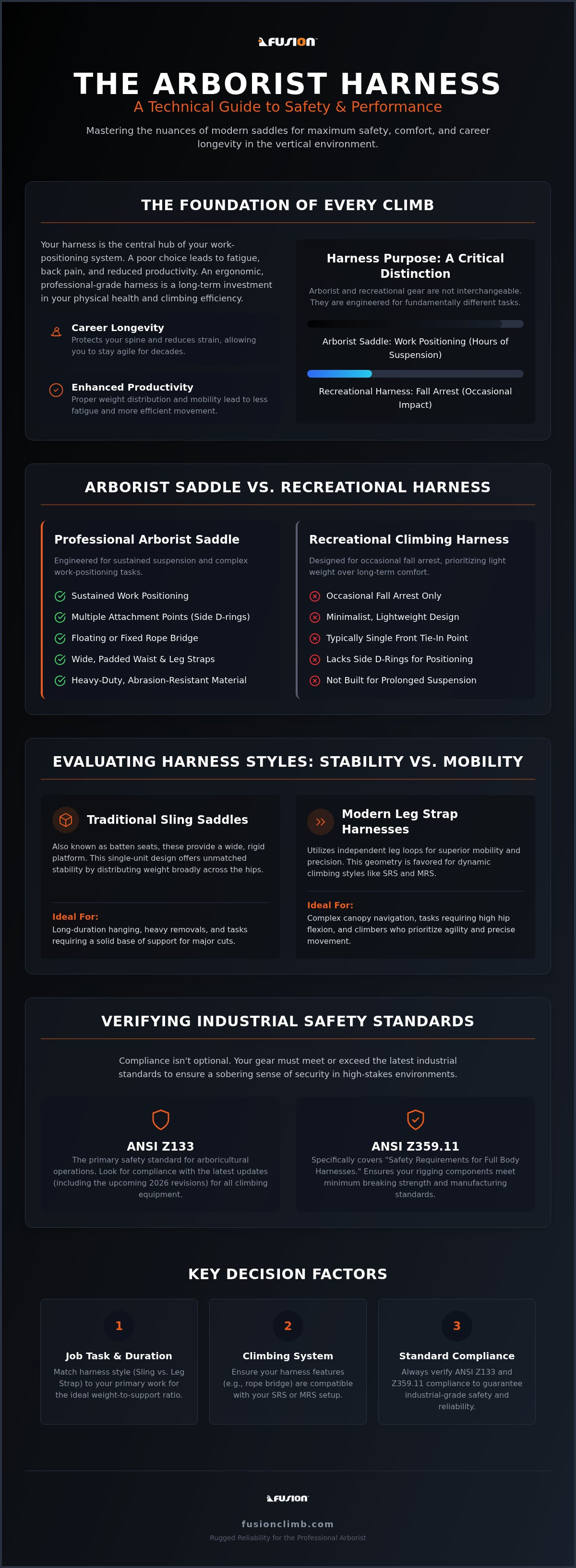
While they share a common lineage, a professional arborist saddle and a standard recreational harness are built for fundamentally different tasks. You can explore the Climbing harness history and types to see how these designs diverged over time. Rock climbing harnesses are engineered for occasional, high-impact fall arrest. They're lightweight and minimalist because they're meant to be worn while moving, not sat in for hours. In contrast, an arborist saddle is engineered for sustained suspension. You aren't just wearing it; you're working from it.
Work positioning requires multiple attachment points, such as side D-rings and floating bridges. These allow for lateral movement and precise placement during a cut. Standard harnesses lack these critical features. Arborist gear also prioritizes wider waist belts and heavy-duty leg padding to distribute weight across larger surface areas. This specialized construction prevents the circulation issues and lower back strain common in less sophisticated gear.
The Economics of Quality: Why to Invest in Professional Grade
Think of your harness as a five-year investment in your physical health. While the upfront cost of industrial-grade gear may seem high, the cost-per-climb tells a different story. Professional harnesses utilize reinforced webbing and abrasion-resistant materials that significantly extend their service life. Rugged construction pays for itself by reducing the frequency of gear failure and inspection flags.
Cheap equipment wears out faster. It leads to frequent replacements and dangerous downtime. High-quality gear builds safety confidence, which is a tangible asset on a job site. When you trust your equipment, you work faster and more decisively. You focus on the task at hand rather than the discomfort in your hips. This efficiency directly impacts your daily earnings, making professional-grade equipment the most logical choice for any serious climber.
Evaluating Harness Styles: Sling Saddles vs. Leg Strap Designs
The evolution of the arborist climbing harness reflects a shift from basic fall protection to sophisticated work-positioning geometry. Early designs prioritized a "sit" position, which was stable but rigid. Modern engineering now offers a choice between traditional sling saddles and independent leg strap designs. Your choice depends on your primary climbing system, whether you prefer the Moving Rope System (MRS) or the Stationary Rope System (SRS). Each geometry distributes forces differently across your musculoskeletal system, impacting how you feel after eight hours in the canopy.
Traditional Sling Saddles: Stability and Simplicity
Traditional sling saddles, often called batten seats, provide a wide, rigid platform for the hips. This design excels during long-duration hanging tasks like heavy removals. Because the seat is a single unit, it offers unmatched stability when you're making major cuts and need a solid base of support. The physics of the batten seat prevents the "nutcracker" effect common in lower-quality gear. However, this stability comes at a cost. These saddles are often heavier and more restrictive when walking on the ground or navigating tight limb junctions where extreme hip flexion is required.
Modern Leg Strap Harnesses: Mobility and Precision
Modern leg strap harnesses prioritize precision. By using independent leg loops, these designs allow your legs to move through a full range of motion without the harness shifting across your waist. This is essential for intricate canopy work and fine pruning where you need to reach distant tips. Many professionals now integrate these features into a full body climbing harness to ensure maximum security in high-stakes environments. The Tree Care Industry Association emphasizes that proper gear selection should align with the specific safety risks of your environment. These leg strap models are the preferred choice for climbers using SRS, as they facilitate a more natural walking motion during the ascent.
To verify the fit of your harness, perform a "hang test" in a controlled environment before heading to the job site. A well-fitted harness should not ride up into your ribs or pinch your femoral arteries. Check your range of motion by performing a high-step and a lateral lunge; the bridge should track smoothly without binding. If you feel any pressure points during a five-minute hang, those will become agonizing after an hour. Explore the range of professional gear at Fusion Climb to find a system that matches your specific climbing style and provides the industrial reliability you demand.
Critical Technical Features: Bridges, Rings, and ANSI Standards
Technical mastery in the canopy begins with understanding the hardware that keeps you suspended. Your arborist climbing harness is a complex assembly of textile and metal, where every component must work in unison to ensure safety. The most critical of these is the suspension bridge, which acts as the primary connection between your climbing line and your body. This component allows for the lateral rotation and "swivel" movement necessary for reaching distant limbs. Because it's a dynamic part subject to constant friction, its condition is paramount. Any sign of glazing, fiber separation, or core deformation requires immediate replacement to maintain the integrity of your system.
Industrial safety is defined by rigorous testing. For professionals, adhering to ANSI Z359.11 is non-negotiable for full-body systems. This standard dictates the performance requirements for harnesses used in fall arrest and work positioning. According to current ANSI Z133 standards, all hardware used in your climbing system must maintain a minimum breaking strength of 5,000 lbs. When making bridge connections, always utilize professional climbing carabiners that meet these specific industrial ratings. This technical assurance provides a sobering sense of security when you're working at height.
Understanding Bridge Variations: Rope vs. Webbing
Choosing between a rope bridge and a webbing bridge is a matter of prioritizing adjustability or durability. Rope bridges offer the advantage of length customization, allowing you to fine-tune your center of gravity for better balance during a cut. They're also easily replaceable when they show signs of wear. Webbing bridges, while less adjustable, offer superior resistance to abrasion and a lower profile. To prevent bridge twisting and reduce wear on the textile components, many professionals integrate high-strength rings or swivels. These hardware additions ensure that your rope bridge tracks smoothly regardless of your body's orientation in the tree.
Hardware and Attachment Points: The Rigging Perspective
Each attachment point on your harness serves a specific functional role in your rigging setup. Ventral points are designed for main suspension, while lateral "D" rings are essential for work-positioning lanyards. If you're using a full-body system, the dorsal point provides critical fall arrest capabilities. High-strength hardware is a requirement, not a suggestion. For those working in mixed environments, ensure your gear is compatible with ropes course safety equipment standards. This cross-compatibility ensures that your harness remains a dependable guardian across various vertical applications, from technical removals to industrial rigging tasks.
Selecting Your Gear: Professional Matching by Job Type
Selecting the correct arborist climbing harness requires a methodical analysis of your daily workflow. One size doesn't fit every job site. A climber performing fine pruning in the outer canopy has different physiological needs than a professional managing heavy removals with a large chainsaw. Your gear must balance the weight of the hardware against the level of lumbar support provided. High-quality harnesses offer modular gear loops and tool attachment points. These allow you to distribute the weight of saws and rigging blocks evenly, preventing the asymmetrical loading that leads to chronic hip and back issues. Efficiency in the canopy is often dictated by how quickly you can access your tools; a well-organized harness acts as a mobile workstation.
Task-Based Selection Framework
- Pruning and Fine Work: Prioritize lightweight leg-strap designs. These facilitate the lateral reach and high-step movements needed to navigate tip-growth and tight limb junctions. Mobility is the primary requirement for these tasks.
- Removals and Rigging: Opt for wider waist belts and robust bridge attachments. You need a stable platform to handle the reactive forces of a large saw and the weight of heavy rigging gear like pulleys and slings. Robust padding is essential for weight distribution.
- Instruction and Rescue: Full-body systems are the standard here. They provide the necessary fall-arrest security and dorsal attachment points required for those in training or high-risk rescue scenarios where maximum safety is non-negotiable.
Harness Sizing and Fine-Tuning Your Fit
Proper fit is a matter of industrial safety, not just comfort. When sizing, measure your waist above the iliac crest and your thighs at their widest point to ensure the harness sits correctly on your skeletal structure. A harness that's too loose will shift during a fall. This increases the risk of suspension trauma, a dangerous condition where blood pools in the legs due to gravity and harness pressure. A precise fit, combined with a correctly adjusted bridge length, optimizes your center of gravity. This ensures you remain upright and stable during long-duration suspension. Invest in your career longevity by selecting a professional arborist climbing harness that matches your specific task requirements.
The Fusion Climb Advantage: Rugged Reliability for the Arborist
Fusion Climb operates on the principle that industrial reliability is non-negotiable. When you're suspended in the canopy, you need equipment that acts as a silent partner. Since 1998, we've focused on meticulous manufacturing and high-performance engineering. Our arborist climbing harness designs aren't just assembled; they're engineered to withstand the harshest vertical environments. Buying directly from a safety-focused manufacturer means you're getting gear that has been rigorously tested for consistency and strength. We don't just follow trends. We set the standard for rugged, no-nonsense equipment that professionals trust with their lives.
Manufacturing Excellence and Safety Testing
Our commitment to safety is rooted in traditional values of strength and modern precision. Every Fusion Climb full-body harness undergoes rigorous testing protocols to ensure absolute product integrity. We prioritize ANSI Z359.11 compliance to provide the technical assurance required for industrial fall arrest and work positioning. This focus on rigorous quality control means every stitch and buckle is verified before it reaches your hands. This is the sobriety of technical specification that separates professional gear from recreational equipment. Explore our professional-grade solutions in the Arborist Collection to see the results of our engineering-first approach.
Building Your Complete Professional Climbing Kit
A harness is only as strong as the components it connects to. Achieving a unified safety system requires synergy between your saddle, lanyards, and rigging hardware. Using a single trusted brand for your entire kit ensures that every carabiner and pulley is designed to work together seamlessly. This reduces the risk of hardware incompatibility and simplifies your inspection routines. It's about creating a dependable guardian for your vertical journey. Before you head back into the canopy, use this final checklist to verify your gear selection:
- Verify ANSI Z359.11 compliance for all full-body systems.
- Ensure all hardware has a minimum breaking strength of 5,000 lbs.
- Check for specialized attachment points like ventral and lateral D-rings.
- Inspect the bridge for signs of friction-related wear or glazing.
- Confirm the harness sizing aligns with your waist and thigh measurements.
Safety in the canopy is the result of deliberate choices and professional gear. Don't compromise on the equipment that protects your future. Shop the professional arborist gear collection at Fusion Climb today to secure your vertical journey.
Secure Your Future in the Canopy
The right equipment transforms a high-stakes environment into a controlled workspace. You've seen how a precision-engineered arborist climbing harness dictates your mobility, productivity, and physical health over a long career. By prioritizing ergonomic weight distribution and verifying ANSI Z359.11 compliance, you eliminate the mechanical failures and chronic pain that often sideline less-prepared climbers. Whether you're navigating complex canopy architectures with a leg-strap system or performing heavy removals from a stable sling saddle, your gear must provide a sobering sense of security.
Fusion Climb has delivered industrial-grade durability since 1998, providing professional gear for rigging and rescue that stands up to the most demanding real-world applications. Our ANSI Z359.11 compliant designs ensure that your safety system remains a dependable guardian during every ascent. Don't leave your safety to chance or settle for equipment that compromises your physical integrity. It is time to invest in gear that works as hard as you do.
Upgrade Your Gear: Shop Professional Arborist Harnesses
Step into the season with the confidence that your equipment is as rugged and reliable as the work you perform. Your journey in the vertical world deserves nothing less than professional excellence.
Frequently Asked Questions
What is the difference between a tree saddle and a climbing harness?
A tree saddle is a specialized work-positioning tool designed for long-duration suspension, whereas a standard climbing harness is built for occasional fall arrest. Saddles feature multiple attachment points like floating bridges and side D-rings that allow for lateral movement. These features are absent on recreational gear. The arborist climbing harness also includes wider waist belts and heavy padding to distribute weight across the hips and thighs, preventing circulation issues during extended tasks.
How long does a professional arborist climbing harness last?
A professional arborist climbing harness typically lasts between five and ten years, depending on the environment and frequency of application. Industrial-grade gear is built for durability, but UV exposure, chemical contact, and mechanical abrasion eventually degrade the fibers. You must replace any gear that shows signs of significant wear, regardless of its age. Always check the manufacturer's specific retirement date located on the product's identification tag to ensure industrial reliability.
Can I use a rock climbing harness for professional tree work?
No, you should never use a rock climbing harness for professional tree work. Recreational harnesses lack the lateral attachment points and structural support required for work-positioning. They're designed for vertical falls, not for sitting in while operating a chainsaw or managing heavy rigging. Using the wrong equipment violates safety standards and puts your body at risk for suspension trauma and chronic back pain due to poor weight distribution.
What does ANSI Z359.11 compliance mean for my safety?
ANSI Z359.11 compliance signifies that a full-body harness meets rigorous industrial standards for fall arrest, work positioning, and rescue. It ensures the gear has undergone dynamic and static strength testing to handle the forces of a fall while keeping the user in an upright position. For professionals, this certification provides the technical assurance that their equipment is engineered for high-stakes environments where industrial reliability is non-negotiable and safety is the top priority.
How often should I inspect my arborist harness bridge?
You should inspect your harness bridge before every single climb. Because the bridge is a dynamic component subject to constant friction from carabiners and rings, it wears faster than any other part of the system. Look for signs of glazing, fiber separation, or core deformation. If the bridge shows any significant abrasion, replace it immediately using manufacturer-approved components. Regular inspection ensures your silent partner remains a dependable guardian during complex canopy navigation.
What are the best attachment points for work-positioning in a tree?
The best attachment points for work-positioning are the lateral D-rings and the ventral bridge. Lateral points allow you to secure a work-positioning lanyard around a trunk, providing stability for hands-free cutting. The ventral bridge facilitates smooth lateral rotation, which is essential for reaching distant limbs. In a full-body system, the dorsal point is reserved for fall arrest. Using these points correctly maximizes your productivity and ensures your weight remains balanced throughout the day.
Do I need a full-body harness for arborist work or is a sit-harness enough?
The choice depends on the specific task and local safety regulations, but full-body harnesses offer superior protection. While a sit-harness provides excellent mobility for pruning, a full-body system is often required for industrial rigging, rescue, or training scenarios. Full-body models distribute fall forces across the entire torso and include a dorsal attachment point for fall arrest. For maximum security in high-stakes environments, a full-body system is the professional standard for comprehensive protection.
How do I clean and maintain my arborist climbing gear?
Clean your gear using mild soap and lukewarm water to remove dirt and sawdust that can abrade the fibers. Avoid harsh chemicals or high-heat drying, as these can compromise the structural integrity of the webbing. After washing, hang the harness to air dry in a well-ventilated area away from direct sunlight. Maintenance also includes lubricating metal components like buckles and carabiner gates with a dry-film lubricant to ensure they function smoothly and reliably.