



Zipline Pulleys for Adventure Parks: 2026 Buying Guide
A pulley that looks strongest on paper may create more friction in daily operations. Choosing a Zipline pulley for adventure park operations means looking beyond a single specification. The right fit depends on each line’s conditions, how the pulley handles through a full operating cycle, and how it works with your connectors and procedures.
Speed, handling, durability, and maintenance all matter, but their importance varies by route. A pulley decision also needs to fit the equipment system already in use. Even a capable pulley may not serve the course as intended if it is assigned to the wrong line or connection setup.
This guide offers a repeatable way to compare pulley options with your operating needs. Assess line conditions, rider flow, handling, maintenance, connector fit, and deployment before narrowing your choices. The goal is to evaluate each pulley as part of the full operating cycle and make an equipment decision grounded in how your park runs.
Key Takeaways
- Start with each line’s documented specifications and operating needs to define what a suitable pulley must do.
- Compare construction, sheave arrangement, bearing design, attachment interfaces, and handling features using verified product information.
- Assess single- and double-sheave configurations by intended line use and system fit, not assumed speed advantages.
- Evaluate a Zipline pulley for adventure park operations as part of a complete equipment system, including connectors and established procedures.
- Plan deployment with clear line assignments, staff briefings, and traceable equipment records to support consistent operations.
Zipline Pulley Selection Starts with Your Adventure Park Operation
Start with the line, the people using it, and the work required to keep the course moving. Weigh line conditions, participant handling, expected throughput, and established procedures before comparing pulley features. A model that suits one route may not suit another, even within the same park.
An adventure park zipline pulley is a moving component selected to travel on a specific line and function within that line’s operating system. It supports movement, but it doesn’t determine the performance or safety of the complete zipline system on its own. The line, attachments, connected equipment, course design, and operating procedures all matter. For foundational context on pulley mechanics and configurations, see Understanding the mechanics of pulleys.
That distinction changes the buying question. Rather than asking only, “Which pulley should we buy?” build a plan for assigning suitable equipment across the park’s lines. Evaluate a Zipline pulley for adventure park operations against a defined use case, not as a stand-alone purchase based on a short list of features.
What operating conditions shape the pulley decision?
Build a line-by-line inventory before reviewing candidates. Record each line’s material, dimensions, layout, and manufacturer-specified limits. Include attachment interface details and the operating procedure for that route. Compare product documentation with these requirements rather than assuming similar-looking lines need the same equipment.
Next, describe the work cycle. Note how often equipment is used and what handling the route requires. Separate participant-facing use from staff tasks such as setup, transfer, or equipment movement. These activities may have different handling priorities, so record them as distinct use cases. Avoid universal thresholds: duty cycle and operating demands depend on the park and the equipment’s documented limits.
Why one park may need more than one configuration
Routes can differ in layout, role, line interface, and staff procedures. Compare those differences instead of assuming every course needs an identical configuration. A consistent plan doesn’t mean identical pulleys everywhere; it means each assignment has a clear reason tied to its line and operating procedures.
For example, a route’s layout may make a particular handling feature useful, while another line’s attachment interface may be the deciding factor. Treat these as evaluation questions, not proof that one configuration is universally faster or better. Record each line’s operational priority, then assess pulley options against it.
Keep the wider equipment system in view as you set priorities. This ropes course safety equipment guide provides broader context for considering hardware alongside the rest of the course setup. A park-wide plan gives your team a practical basis for the compatibility and construction checks that follow.
Evaluate Zipline Pulley Compatibility, Construction, and Handling
Once each line’s role is clear, compare pulley candidates with documented requirements, not broad product labels. Check compatibility first: a pulley that doesn’t match the line and connection system is not a practical option, regardless of its other features.
Selection rule: Verify compatibility against the exact line and equipment documentation before weighing preferences. Use current documentation for the specific pulley model and compare it with the line records. Don’t infer compatibility from appearance, a similar model name, or a general product category. Assess a Zipline pulley for adventure park operations within the precise equipment configuration where it will be used.
Match the pulley to the line and connection system
Build a checklist for each candidate. Record the manufacturer-stated rope or cable type and diameter for the exact model, then compare them with the line specification. Check attachment points, connector requirements, clearance, and orientation against the system design. Make the review traceable by noting the source document and model information beside each finding.
- Line: Does the documentation identify the line type and dimensions used?
- Connection: Do the attachment interface, connector, and orientation align with the system design?
- Limits: Are the manufacturer’s stated use conditions consistent with the intended application?
Check standards references just as carefully. A mention of ANSI/ACCT or ASTM isn’t proof by itself that a particular pulley is suitable or meets an application requirement. Determine whether a standard applies to the course and equipment decision, then verify the relevant edition and scope. ASTM International's F2959-23a Standard Practice for Aerial Adventure Courses provides course-level context, but it doesn’t replace the pulley manufacturer’s documentation or an application-specific review.
Compare sheaves, bearings, and handling features
After confirming compatibility, compare construction and handling. Single- and double-sheave arrangements are different configurations, but neither is automatically the better choice. Assess each against the intended line use and system design. For bearing descriptions, use the manufacturer’s published information and consider how the stated design relates to the park’s duty cycle and handling needs. A bearing label alone doesn’t predict how a pulley will behave in your operation.
Review side plates and attachment interfaces for documented construction and connection details. Then consider practical handling: how staff position, connect, transfer, and manage the equipment within established procedures. Terms such as “high efficiency” and “heavy duty” need supporting context. Look for product information, limits, intended use, and verifiable test or standards statements. Treat unsupported adjectives as descriptions, not selection evidence.
For more construction and standards context, the commercial zipline pulley engineering guide can help frame your documentation review. Once your checklist separates compatibility requirements from handling preferences, compare those requirements with Fusion Climb’s zipline pulley options.
Compare Zipline Pulley Configurations for Different Park Needs
Configuration is a system-fit decision, not a shortcut for ranking pulleys as faster, stronger, or better. Compare each option with its intended line use, documented compatibility, and the handling needs identified for that route. Requirements may differ between lines in the same park.
Single and double sheaves: what changes for operators?
A single-sheave pulley has one sheave, while a double-sheave configuration has two. That difference can affect how a pulley fits into a system, but it doesn’t establish which option is right for a particular course. Use the manufacturer’s documentation to check the exact model’s stated line compatibility, attachment arrangement, and limits.
Assess each configuration against the intended setup. A double-sheave candidate isn’t automatically preferable, and a single-sheave option isn’t automatically simpler to deploy. The relevant trade-offs depend on line and connector requirements, equipment handling, and how park procedures account for the configuration.
| Configuration | Typical operational consideration | Compatibility check | Limitation |
|---|---|---|---|
| Single sheave | May suit a system designed around one sheave. | Match the exact model’s stated line type, dimensions, and connection interface to the route documentation. | Not suitable by default for every line or system arrangement. |
| Double sheave | May fit a setup designed to use two sheaves. | Confirm that the model’s dimensions, attachment points, and stated limits suit the line and system. | The additional sheave doesn’t prove better performance or broader compatibility. |
| Swivel or other handling feature | May address a specific orientation or handling need in a defined setup. | Check how the feature functions and whether the system design accommodates it. | An unnecessary feature can add complexity without solving an identified need. |
When do swivel or specialized handling features matter?
Start with the handling problem. If a route or connection procedure creates a specific orientation concern, a swivel may be relevant when the manufacturer’s documentation supports that use and the system is designed to accommodate it. Don’t treat it as a general upgrade. Confirm the feature’s purpose, interface, and limits for the exact pulley model.
Apply the same test to other specialized features: name the operational need, then check whether the documented design addresses it. This keeps the comparison focused on useful features rather than extras that don’t support the route’s use case. The deciding factors remain the exact line requirements and the pulley’s documented compatibility, not its configuration label alone.
Use this comparison to screen options, then carry the requirements into your purchasing review. To compare available configurations with your park’s defined needs, explore Fusion Climb zipline pulleys.
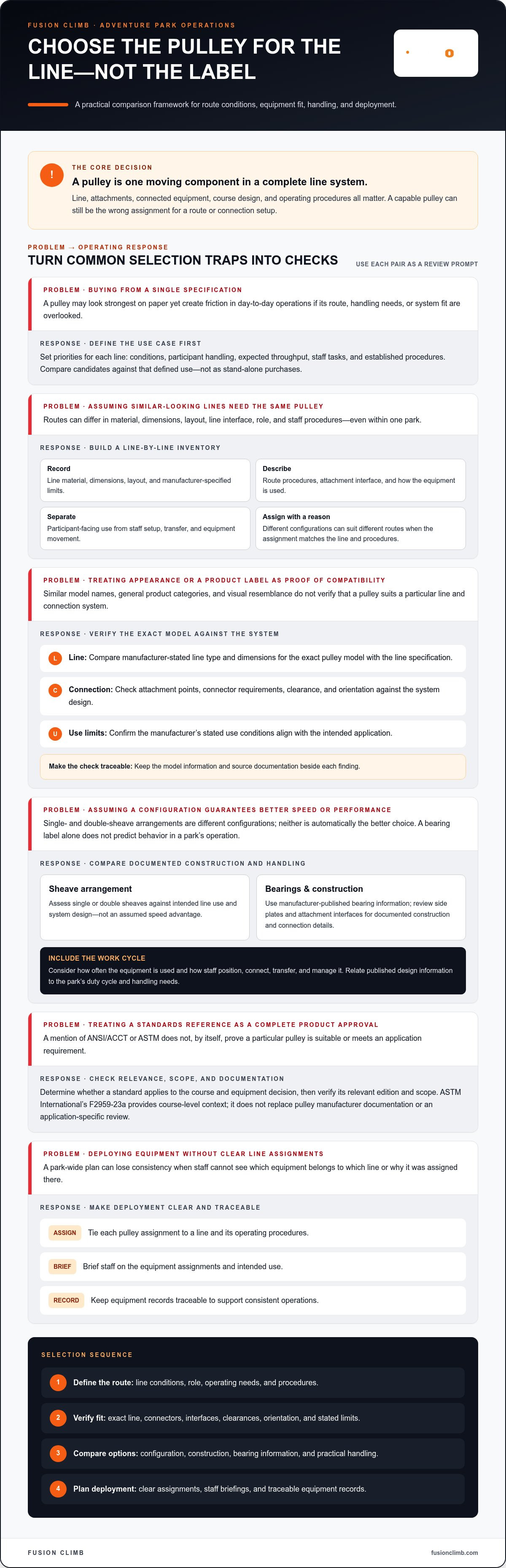
Plan Pulley Deployment Across Lines, Staff, and Spare Inventory
A sound pulley choice needs a clear assignment plan. Consistent records help staff identify which equipment belongs with each line, align handoffs with operating procedures, and retrieve product documentation. Standardize the process, not the assumption that every route uses identical equipment.
Use this rollout to connect procurement with day-to-day operations:
- Map the lines. Give each route or line a clear identifier and record its relevant specifications and operating role.
- Confirm compatibility. Match the selected pulley and connected equipment to the line using current manufacturer documentation.
- Assign equipment. Record the approved pulley model and associated connectors for each line or use case.
- Brief staff. Communicate the assignment, handling procedure, and escalation process for damaged or uncertain equipment.
- Document decisions. Keep assignment details and supporting product documents traceable and accessible to the appropriate staff.
Standardize equipment assignments without assuming every line is identical
For each line, record the pulley model, compatible line, connectors, and relevant product documentation. Use consistent identifiers and handoff steps so staff can distinguish approved equipment from items assigned elsewhere. This supports clear assignments, but it doesn’t replace formal inspections. Keep inspection findings and retirement decisions within the park’s established safety program and the manufacturer’s guidance.
Connected components matter, too. If lanyards or tethers form part of the equipment interface, document their intended relationship to the pulley and connector arrangement. The zipline lanyards and tethers guide offers additional context for considering these interfaces as part of the broader setup.
Prepare spares and staff workflows for consistent operation
Plan spare inventory around the park’s operating plan, documented equipment needs, and procurement lead times. No universal spare quantity or replacement interval fits every operation. Identify which line assignments could be affected if equipment is removed from use, and define how staff will source an approved replacement without making an undocumented substitution.
Brief staff on the assigned configuration and what to do if a pulley appears damaged, its identity is unclear, or its documentation doesn’t match the record. Keep uncertain equipment out of service in line with park procedures, then follow the established escalation and inspection process. Clear instructions reduce guesswork during busy handoffs.
A traceable deployment plan makes a Zipline pulley for adventure park operations a managed part of the equipment system, not an isolated purchase. To align pulley selection with defined line assignments, explore Fusion Climb zipline pulleys.
Choose Zipline Pulleys with a Clear Procurement and Deployment Plan
Turn your line-by-line evaluation into a purchasing brief before comparing final candidates. State what each pulley must fit, the job it will perform, and how it will be assigned after purchase. This separates non-negotiable requirements from preferences and gives the decision a documented basis.
Build a purchasing brief that reduces avoidable mismatches
Create a separate entry for each line or distinct use case. Summarize verified requirements and explain why the selected configuration suits that setup. Include:
- Line details: the documented line type, dimensions, layout, and applicable manufacturer-stated limits.
- Use case: whether the pulley is assigned to participant use or a defined staff task, and what operating need the configuration addresses.
- Interfaces: the required attachment points, connectors, orientation, and any relevant clearance considerations.
- Evidence: the exact candidate model’s current product documentation supporting compatibility and intended use.
- Quantity and assignment: the number needed for planned line assignments and the inventory approach for spares.
Separate must-haves from preferences. A documented match to the line and connection system is a must-have; handling characteristics or a preferred configuration matter only after that match is established. If a candidate’s documentation doesn’t support a required interface or line condition, remove it from consideration rather than letting an appealing feature outweigh fit.
Tie specifications, product claims, and procurement details to current published information for the exact model. Save the supporting documents with the brief so the reasoning remains clear during approval, purchasing, and equipment assignment. A Zipline pulley for adventure park operations is a sound choice only when its documented application fits the line and the park’s defined use.
Move from selection to an actionable next step
Before reviewing candidates, gather line records, connector and interface details, operating use cases, and quantity needs in one place. This gives the procurement team a practical comparison reference and reduces reliance on memory or broad product descriptions. Keep the final assignment aligned with park procedures and equipment records.
Fusion Climb manufactures zipline pulleys and related climbing safety equipment. That manufacturer background provides context for reviewing equipment options, but it doesn’t replace a fit check against line and system documentation. Use your completed brief to guide the comparison, then carry the selected equipment details into your deployment plan.
Explore Fusion Climb pulley options and compare them with your defined line and interface requirements.
Put Your Pulley Plan to Work
Make your purchasing brief a working reference, not a document that disappears after the order. Keep it with the equipment records so course changes, connector updates, or revised operating procedures prompt a fresh review of assigned pulley configurations. This keeps equipment decisions connected to how the park is run.
A Zipline pulley for adventure park operations should have a defined role within a documented equipment plan. Before procurement, make sure purchasing and deployment staff can trace each candidate to its intended line and use. When the course or equipment system changes, revisit the decision rather than relying on an old assumption.
Use your defined requirements to guide the next product review. Explore Fusion Climb zipline pulley options and compare the available options with your equipment plan. A deliberate selection process gives your team a clear path from evaluation to deployment, grounded in documented fit.
Frequently Asked Questions
Can one zipline pulley model serve every line in an adventure park?
Only if the manufacturer’s documentation supports its use with every line and connection setup involved. Lines can differ in material, dimensions, layout, and system interfaces, so don’t assume a match based on one successful installation. For example, don’t transfer a pulley assigned to a cable route to a rope route unless its documentation supports that use and park procedures permit reassignment.
How should an adventure park plan spare zipline pulleys?
Base the spare plan on operating continuity, not a universal quantity. Identify which routes would be affected if a pulley were removed from use, then consider how an approved replacement would be sourced and assigned. Identify and document spare equipment like active equipment. Don’t use a spare until its compatibility with the intended line and interfaces has been established.
Is a double-sheave pulley always better for commercial zipline operations?
No. A double-sheave design is not automatically faster, safer, or more suitable than a single-sheave design. The appropriate configuration depends on the course’s intended setup and the specific pulley’s documented compatibility and limits. Treat sheave count as one comparison point, not a performance rating. If the system is designed for a particular arrangement, a different configuration may not be an appropriate replacement.
Does a zipline pulley need a swivel for adventure park use?
Not necessarily. A swivel is relevant only when it addresses a handling or orientation need in the specific system and the product documentation supports that use. Check how the feature affects the connection arrangement and whether it fits the course design. If staff can’t identify a defined operational reason for the swivel, it may be a preference rather than a requirement.
How should operators document pulley assignments across multiple lines?
Use a controlled record that links each pulley’s identifiable model or marking, where available, to its assigned line and approved connection setup. Include the applicable product-document reference and note authorized changes, such as reassignment or replacement. Keep the record accessible to staff responsible for equipment handling. It supports traceability but doesn’t replace formal inspection records or park safety procedures.
Can staff identify a pulley’s compatibility from appearance alone?
No. Similar-looking pulleys can have different documented use limits, line compatibility, or attachment details. Visual inspection can help staff notice damage or identify visible markings, but it can’t establish that a pulley suits a particular line. Use the exact model identification and manufacturer documentation, then compare them with the line and equipment records before assigning it.
What should an operator do if a pulley’s markings or documentation are unclear?
Keep the pulley out of operational use until its identity and suitability can be established through traceable records and applicable manufacturer documentation. Follow the park’s process for separating and recording uncertain equipment so it isn’t mistakenly returned to service. Don’t infer a model, compatibility, or limit from appearance alone. If the information remains unresolved, follow the established escalation procedure before making an assignment.