



The Ultimate Carabiner Maintenance Guide: Professional Inspection, Cleaning, and Retirement
Is that sluggish gate on your favorite carabiner a minor annoyance or a signal of imminent failure? You rely on your gear to perform flawlessly in high-stakes vertical environments. It's frustrating when you aren't sure if a bit of grit is compromising your safety or if a simple cleaning will restore its professional-grade integrity. This carabiner maintenance guide addresses that uncertainty by providing the professional protocols you need to manage your hardware fleet with total confidence.
Professional operators understand the pressure of maintaining a commercial gear fleet where every connector must be beyond reproach. You'll master the industry-standard techniques for inspecting, cleaning, and lubricating your equipment to ensure it meets rigorous ANSI and OSHA requirements. We'll walk through a repeatable maintenance routine, explain the 10% wear rule, and provide a clear checklist for identifying retirement-level damage. By the end of this guide, you'll have a structured system for gear logging that keeps your operation compliant and your team secure.
Key Takeaways
- Establish a rigorous pre-use inspection routine and a documented quarterly schedule to ensure every connector in your fleet remains mission-ready.
- Follow this carabiner maintenance guide to implement a professional cleaning process using pH-neutral detergents and targeted lubrication for optimal gate performance.
- Learn to distinguish between superficial cosmetic scratches and structural gouges that compromise the safety and loading profile of your hardware.
- Identify critical retirement triggers like gate shutter or rope grooving to maintain a zero-failure safety standard for all life-safety gear.
- Build a commercial-grade gear management system featuring serialized tracking and dedicated quarantine protocols for your high-performance hardware fleet.
Visual and Functional Inspection Protocols
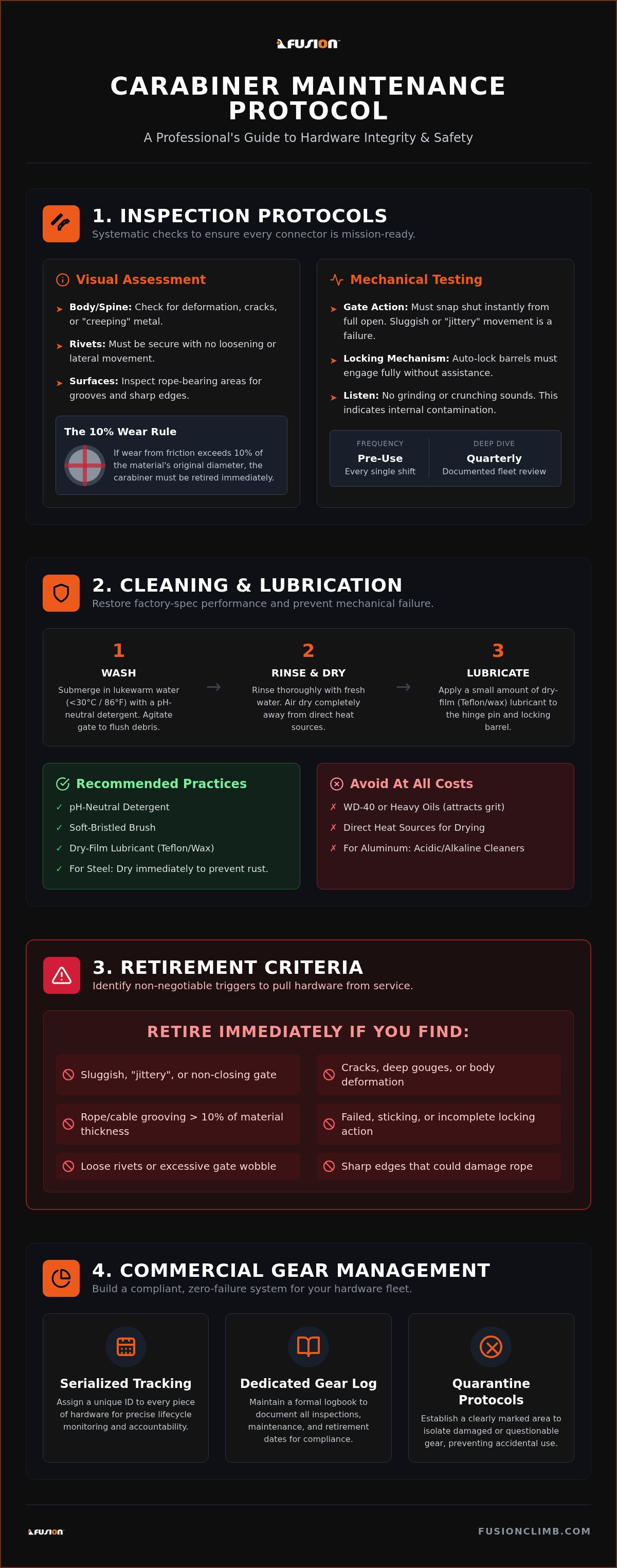
Safety starts before the first clip. A professional carabiner is a precision-engineered tool. Even the most durable Fusion Climb hardware requires a systematic eye to maintain its integrity. This carabiner maintenance guide begins with a fundamental rule: if you haven't inspected it, don't trust it. You must establish a pre-use inspection routine for every single shift. For commercial fleets, a deep-dive quarterly inspection is the industry standard for catching issues before they become liabilities.
Always use a high-lumen light source during your review. Hairline fractures and stress marks are often invisible in dim warehouse lighting or dappled outdoor sun. A formal carabiner maintenance guide is only as good as the documentation behind it, so log every inspection in a dedicated gear logbook. This record provides essential liability protection and helps you track the lifecycle of your hardware fleet effectively.
Visual Assessment: Body, Gate, and Rivets
Start with the spine. Look for any signs of deformation or "creeping" where the metal has shifted from its original manufactured shape. If the geometry is off, the load distribution is compromised. Check the rivets next. They must be secure with no signs of loosening or corrosion around the head. Any lateral movement in the rivet is a mandatory retirement trigger.
Inspect the rope-bearing surfaces and the gate hinge for excessive wear. Follow the "10% rule" found in professional safety standards. If the wear from rope or cable friction exceeds 10% of the original cross-sectional diameter, the carabiner must be pulled from service immediately. Deep grooves can create sharp edges that damage your ropes or lanyards.
Mechanical Testing: Gate Action and Locking Mechanism
Test the gate action by opening it fully and letting it go. It should snap back instantly with a decisive metallic sound. If the movement is "jittery" or the gate hangs open even slightly, the internal spring may be weakened or fouled. Sluggish gates are a primary cause of accidental roll-outs during a fall.
Verify that all auto-locking barrels engage fully without any manual assistance. For triple-action mechanisms, each movement must be smooth and the reset must be absolute. Listen closely for grinding or crunching noises during operation. These sounds indicate internal sand, salt, or grit contamination. This debris acts like sandpaper on the internal spring and pin, leading to rapid mechanical failure if not addressed through proper cleaning.
The Professional Cleaning and Lubrication Process
Cleaning is more than a cosmetic chore. It's a mechanical necessity. Grit and salt deposits act as abrasives that grind down internal springs and pins over time. If a gate becomes sluggish due to contamination, it may fail to close completely, leaving you unable to meet OSHA gate strength requirements during a sudden fall. This carabiner maintenance guide outlines the exact steps to restore your hardware to factory-spec performance.
Start by submerging your hardware in a basin of lukewarm water mixed with a pH-neutral, mild detergent. To protect internal components and seals, the water temperature must never exceed 30°C (86°F). While the carabiner is submerged, agitate the gate mechanism repeatedly. This action flushes out internal debris from the hinge and the spring hole where grit hides. Use a soft-bristled brush to reach the "pusher" area and scrub away stubborn buildup. Once the movement feels smooth, rinse the hardware thoroughly with fresh water and air dry in a well-ventilated area away from direct heat sources.
Washing Techniques for Aluminum and Steel Hardware
Aluminum connectors require specific care to maintain their structural integrity. Don't use acidic or highly alkaline cleaners. These chemicals cause surface pitting, which creates dangerous stress risers in the metal. Steel hardware is more resilient to chemicals but highly susceptible to oxidation. You must ensure immediate and thorough drying of steel carabiners to prevent flash rusting within the hinge or locking barrel. This attention to detail is what separates a professional maintenance routine from a casual wipe-down. If you are managing a large fleet, consider upgrading to high-durability Fusion Climb carabiners designed for easier maintenance in harsh environments.
Lubrication: Selecting the Right Compounds
Proper lubrication is a surgical process. Apply only a small amount of a dry-film lubricant, such as a Teflon or wax-based compound, directly to the hinge pin and the locking barrel. Avoid WD-40 or heavy oils at all costs. These substances are solvents rather than long-term lubricants; they attract abrasive dust and grime, eventually forming a thick paste that jams the mechanism.
Precision is key. Wipe away all excess lubricant with a clean cloth before returning the gear to service. Any oil that migrates to textile components like zipline lanyards and tethers can compromise the strength of the synthetic fibers. Maintaining a clean interface between hardware and soft goods is essential for long-term safety and hardware longevity.
Identifying and Mitigating Surface Damage
Surface wear is the physical record of your hardware's history. While every carabiner will eventually show signs of use, you must distinguish between harmless battle scars and terminal structural failure. This carabiner maintenance guide provides the technical baseline for evaluating metal health. Cosmetic scratches are shallow and don't reduce the cross-sectional area of the device. Structural gouges, however, create stress risers that can lead to catastrophic failure under load. If you can feel a nick with your fingernail, it requires immediate attention.
Deep rope grooving is a common issue in high-frequency environments like ziplines or rappelling stations. This wear occurs when consistent friction from a moving line grinds a channel into the metal. It doesn't just weaken the spine. It fundamentally changes the loading profile of the connector. More dangerously, rope grooving often produces razor-sharp burrs. These edges act like saws on your textile safety gear, including harnesses and lanyards. According to UIAA Safety Standards, connectors must maintain their original geometry to ensure the rated strength is preserved during a fall or rescue operation.
Removing Burrs and Smoothing Sharp Edges
You can often salvage a carabiner with minor surface nicks by performing a careful restoration. Use 400-600 grit sandpaper to gently buff out small burrs and sharp edges. Your goal is to restore a smooth surface that won't snag on ropes or webbing. Be methodical and limit material removal to the absolute minimum required. If the gouge or wear is deeper than 10% of the metal's original diameter, the structural integrity is gone. Retire the carabiner immediately. Never use a power grinder or aggressive files, as the heat generated can alter the temper of the metal alloy.
Managing Corrosion and Chemical Exposure
Environmental factors can be just as damaging as physical impact. Salt air is particularly aggressive toward both aluminum and steel hardware. You should rinse your gear with fresh water immediately after any exposure to marine or coastal environments. On aluminum carabiners, look for "white rust," a powdery oxidation that signals the need for a deep cleaning and possible retirement. Any contact with battery acid or harsh industrial solvents requires immediate retirement because these substances can cause invisible, catastrophic embrittlement of the metal alloy. If you work in chemical-heavy industries, keep your hardware in sealed containers when not in active use to maximize its service life.
Retirement Criteria: When to Pull Hardware from Service
Retirement is the final, most critical stage of hardware management. While diligent care extends gear life, it cannot reverse structural fatigue or molecular changes in the metal. You must adhere to the "if in doubt, throw it out" mantra without exception. In life-safety applications, the cost of a replacement is negligible compared to the catastrophic cost of a failure. This carabiner maintenance guide emphasizes that retirement isn't a suggestion. It's a mandatory safety protocol that protects your team and your operation.
Monitor your gear for "gate shutter" during high-vibration activities like high-speed zipline use. This phenomenon occurs when harmonic vibrations cause the gate to open and close rapidly, potentially compromising the system's security. If a connector exhibits this behavior, it's a signal of high-cycle fatigue. Similarly, pull any hardware with illegible strength ratings or manufacturer markings from service. If you can't verify the Minimum Breaking Strength (MBS) or the origin of the device, you can't guarantee its performance under load.
The 10% Wear Rule and Structural Deformation
Precision measurement is essential for commercial operators managing large fleets. Use calipers to monitor rope-bearing surfaces regularly. You must retire the hardware if wear exceeds 10% of the original metal thickness. Beyond surface abrasion, check for any "out of plane" twisting of the carabiner body. Lay the device on a flat reference surface; any warping indicates the frame has experienced a significant structural overload. Verify the gate-to-nose alignment too. A gate that no longer seats perfectly in the nose is a clear sign that the frame has been permanently stretched or bent.
Heat Exposure and Stress Loading Indicators
Thermal damage often hides in plain sight. Inspect the metal for "blueing" or rainbow-like discoloration. This indicates the hardware was exposed to extreme heat, which likely compromised the alloy's heat-treatment and temper. Retire any carabiner involved in a major fall or significant shock-load event immediately. While modern gear is resilient, a significant impact on a hard surface from height is a valid reason for retirement due to the risk of internal micro-fractures that lead to sudden failure later.
The lifespan of professional climbing carabiners varies by environment. In sandy or corrosive coastal areas, the retirement clock ticks much faster. If your hardware fails any part of this inspection, remove it from the fleet and destroy it to prevent accidental reuse. When you identify a need for new equipment, replace your retired hardware with professional-grade connectors that meet the highest safety standards.
Implementing a Commercial Gear Management System
Managing a commercial gear fleet requires more than a casual eye; it demands a rigorous administrative framework. A robust carabiner maintenance guide is only as effective as the management system supporting it. For professional operators, safety isn't just about the physical state of a single connector. It's about the verifiable history of every component in the system. You must move beyond simple inspections and implement a zero-failure organizational strategy that accounts for every cycle of use.
Start by assigning a unique serial number to every piece of hardware. This tracking allows you to monitor the specific history of each unit, including its exposure to high-corrosion zones or shock-load events. Establish a dedicated, clearly labeled quarantine bin for any gear awaiting a deep-dive inspection or permanent retirement. This physical barrier prevents suspect hardware from accidentally returning to the active rotation. You must also ensure that all connectors integrate safely with your ropes course safety equipment, verifying that gate clearances and loading profiles match the requirements of your specific pulleys and lanyards.
Documentation and Logbooks for ANSI Compliance
Documentation is your primary defense against liability and mechanical failure. Your gear logbook must record the purchase date, the date of first use, and the results of every formal inspection. Note the specific environment where the hardware was deployed; gear used in coastal or high-humidity areas requires more frequent review. To remain compliant with industry standards, keep these records for at least the lifetime of the product plus an additional three years. This digital or physical paper trail proves your commitment to professional-grade safety protocols and provides a roadmap for future hardware procurement.
Storage Best Practices for Longevity
Proper storage is a silent guardian of hardware integrity. Always store your equipment in a cool, dry, and well-ventilated area. You must keep hardware away from direct sunlight, which can degrade any integrated textile components. Never store carabiners near damp ropes or corrosive chemicals like bleach and battery acids. Ensure all carabiners are stored with their gates closed. This practice maintains the proper tension on the internal spring and protects the delicate gate hinge from accidental impact or snagging while in the gear room. By controlling the environment, you maximize the service life of your high-performance hardware.
Maintain the Standard of Excellence
Proper hardware management is the bedrock of every safe vertical operation. By following the protocols established in this carabiner maintenance guide, you ensure that your gear remains within strict ANSI and OSHA parameters. You now possess the technical knowledge to identify structural deformation, execute professional-grade cleaning, and manage a serialized fleet with absolute precision. Safety isn't a one-time event; it's a continuous commitment to excellence and hardware integrity.
Since 1998, Fusion Climb has manufactured safety gear that withstands the most demanding industrial and zipline environments. Our ANSI Z359.12 compliant hardware provides the industrial-grade durability that professional operators trust for high-stakes applications. Don't leave your crew's safety to chance or aging equipment that has passed its prime. Upgrade your fleet with Fusion Climb Professional Carabiners to ensure your operation is backed by nearly three decades of engineering expertise. Stay diligent in your inspections and move forward with the confidence that only high-performance hardware can provide.
Frequently Asked Questions
How often should I inspect my climbing carabiners?
You must perform a visual and functional inspection before every single use. For commercial operators, a more thorough and documented inspection is required at least every six months according to OSHA and ANSI standards. If you operate in harsh environments like coastal areas or high-grit industrial sites, increase this frequency to every three months. Consistent monitoring ensures that minor issues like gate sluggishness are caught before they compromise life-safety systems.
Can I use WD-40 to fix a sticky carabiner gate?
Never use WD-40 or heavy household oils on your hardware. These products act as magnets for dust, sand, and grime; they eventually create a thick paste that jams the internal spring mechanism. Instead, apply a dedicated dry-film lubricant like a Teflon or wax-based compound. Only apply a small drop to the hinge and barrel area, then wipe away any excess to prevent it from contaminating your ropes or harnesses.
Is it safe to use a carabiner that I dropped on a hard surface?
Retire any aluminum carabiner that has fallen from a significant height onto a hard surface like concrete or rock. While modern alloys are resilient, high-impact drops can cause invisible micro-fractures that compromise the structural integrity under load. If the drop was minor, perform a rigorous visual check using a high-lumen light. However, the professional standard remains clear; when in doubt about the impact history of a connector, pull it from service immediately.
What is the "10% rule" for carabiner wear and tear?
The 10% rule is a mandatory retirement criterion for hardware with visible rope or cable grooving. You must measure the cross-sectional diameter of the metal at its thinnest point using precision calipers. If the wear exceeds 10% of the original thickness, the carabiner's loading profile and breaking strength are compromised. This carabiner maintenance guide recommends pulling these units from service immediately to prevent damage to textile components and ensure system safety.
How do I remove sand and grit from a locking carabiner barrel?
Submerge the hardware in lukewarm water mixed with a pH-neutral detergent to flush out internal contaminants. Agitate the gate and locking barrel repeatedly while underwater to loosen trapped sand and grit. For stubborn debris, use a soft-bristled brush to reach into the hinge and pusher areas. Once the movement feels smooth and the grinding noise stops, rinse the unit thoroughly in fresh water and allow it to air dry completely.
What should I do if the markings on my carabiner become illegible?
You must retire any carabiner with illegible strength ratings, batch numbers, or manufacturer markings. Professional safety standards require that every connector be traceable and its Minimum Breaking Strength (MBS) clearly identifiable. If the laser etching or stamping has worn away, you can no longer verify the hardware's performance limits or age. Pulling these units from service is a critical step in maintaining a compliant and safe gear management system for professional operations.
Can I use a steel brush to clean rust off a carabiner?
Avoid using a steel brush or aggressive wire wheels to clean your hardware. These tools can strip away protective anodized coatings and create deep scratches that act as stress risers. For steel carabiners with surface oxidation, use a soft-bristled brush or gently buff the area with 400 to 600 grit sandpaper. Limit your material removal to the absolute minimum required to restore smoothness. If deep pitting is present, the carabiner has reached its terminal limit.
How long do carabiners typically last before they need to be retired?
There is no universal expiration date for metal hardware; service life depends heavily on frequency of use and environmental exposure. A carabiner used daily in a commercial zipline operation may require retirement in less than a year due to high-cycle fatigue. Conversely, gear used occasionally and stored properly can last up to ten years. Always follow the specific manufacturer's recommendations and use this carabiner maintenance guide to evaluate the physical condition of your fleet regularly.