



Rescue Zipline Pulley: Professional Buyer’s Guide
A high load rating alone doesn’t make a pulley rescue-ready. Choosing a Zipline pulley for rescue applications means looking beyond the headline number and asking how the pulley will function in the complete system. Product listings can make it difficult to distinguish a rescue-hauling pulley from a travel trolley, or either of those from equipment designed to capture progress.
Ratings matter, but so do the task, line compatibility, connections, and system design. This guide explains how to assess a pulley’s intended function, compare hauling, progress-capture, and cable-travel equipment, and review product information before selection. Use the checklist to evaluate the pulley alongside the other components in a professionally designed rescue system. Start by defining the job the pulley must perform, then check every component against that purpose.
Key Takeaways
- Define the rescue task first so the pulley’s function supports the role it must perform in the system.
- Match rope or cable type, diameter, construction, and connectors to the pulley’s documented specifications.
- Compare hauling pulleys, progress-capture systems, and cable-travel trolleys by function before choosing equipment.
- Use a pre-purchase review to account for system role, operating conditions, inspection needs, and product documentation.
- Evaluate a Zipline pulley for rescue applications alongside compatible carabiners, lanyards, and tethers, not as a standalone component.
What a Zipline Pulley for Rescue Applications Actually Does
A rescue pulley is one component in a rope-based system, chosen to perform a defined task. It may redirect a rope or support load movement as part of a hauling arrangement. A pulley can contribute to mechanical advantage when used in an appropriate configuration, but its role depends on the complete system design. The basic principles of fixed, movable, and compound arrangements are outlined in Pulley.
Keep four functions distinct. Hauling applies force to move a load. Load movement is the movement supported by the rope-and-pulley setup. Progress capture retains gained movement through a separate suitable device or system component. Cable travel moves a rider or load along a cable. A pulley alone does not establish a complete rescue system. Line choice, connections, configuration, and intended operation all matter.
Rescue hauling pulley or zipline travel trolley?
A hauling pulley supports or redirects rope used to move a load through a rope-based system. A zipline travel trolley is designed to roll along a compatible cable. The equipment may look similar, but its intended line and system role can be different. A rescue hauling pulley redirects or supports rope-based load movement; a zipline travel trolley is designed to travel along a compatible cable. Don’t treat one as a substitute for the other based on appearance. Compare its documented function and compatibility with the complete system design.
Why one rating cannot answer every selection question
A published rating applies to specific equipment under defined conditions. It is not a universal recommendation for every rescue task, and one component’s rating does not establish the capacity of an assembled system. Other components and the configuration also affect system performance. Read the product documentation in context: identify what the rating describes, then check whether the stated use and compatibility fit the system design. A number without that context can mislead.
For a Zipline pulley for rescue applications, begin with the task, not the product title. Is the pulley intended to redirect a hauling line, support a load-moving arrangement, or travel on a cable? Is progress capture handled by another component? Answering these questions narrows the equipment category before you compare construction, connections, line compatibility, and documented ratings. Similar appearance does not prove equivalent function. Select each component for its defined role, then assess how it works with the rest of the system.
How to Evaluate a Rescue Pulley’s Function, Ratings, and Compatibility
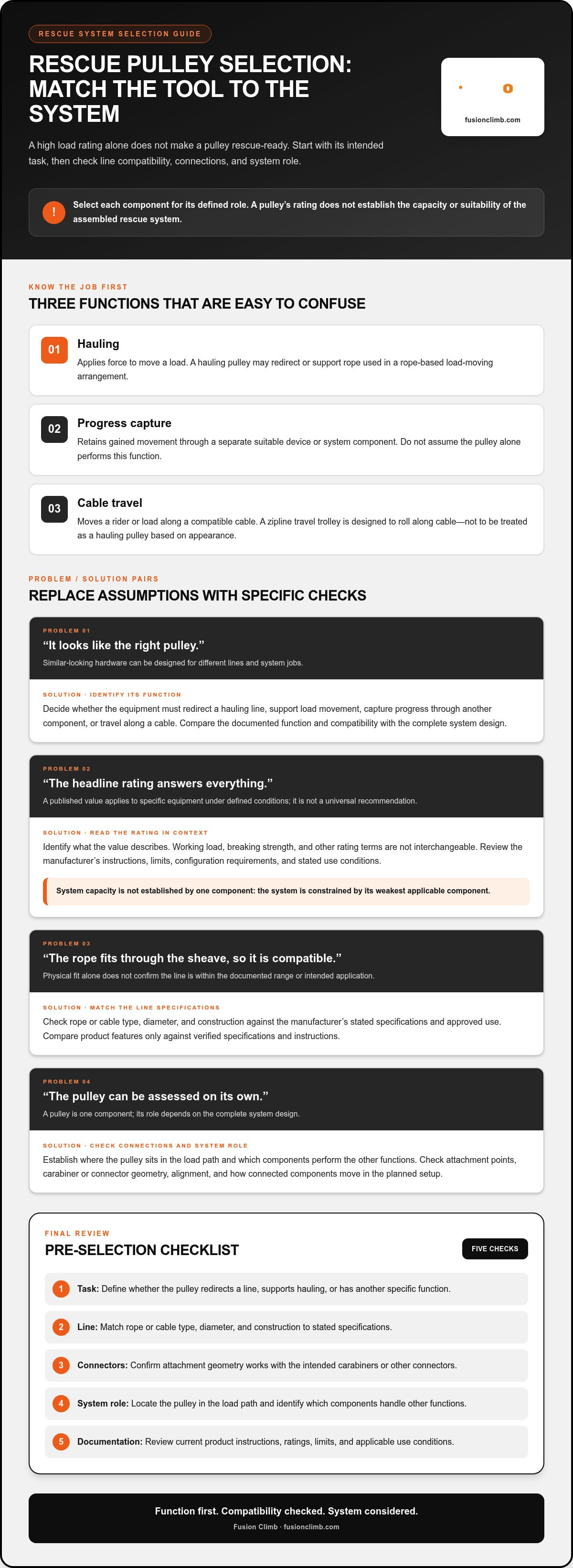
Once the task is defined, check whether the pulley fits the intended line, connections, and system role. A product title or isolated rating cannot establish compatibility. Use this checklist to guide the review:
- Task: Identify whether the pulley redirects a line, supports hauling, or serves another defined function.
- Line: Match rope or cable type, diameter, and construction to the manufacturer’s stated specifications.
- Connectors: Check that attachment geometry works with the intended carabiners or other connectors.
- System role: Establish where the pulley sits in the load path and which components handle other functions.
- Documentation: Review current product instructions, ratings, limits, and applicable use conditions.
Match the pulley to the line and connectors
Check the specified line dimensions and approved use before comparing pulley features. A rope that fits through a sheave may still be outside the manufacturer’s stated range or intended application. Check attachment points and connector geometry, too. Consider how connected components align and move in the planned setup. For a closer look at connection considerations, see this guide to professional climbing carabiners.
Bearings and sheave configuration can affect how a pulley operates, but appearance or a feature label alone does not establish performance. Compare these characteristics using verified product specifications and instructions. For broader rescue context, the International Commission for Alpine Rescue (ICAR) provides a reference point for mountain-rescue knowledge. Product-specific limits come from the manufacturer’s documentation.
Read ratings and documentation in context
First identify what a published value describes. Working load, breaking strength, and other rating terms are not interchangeable. Each stated figure applies to defined equipment and conditions, so read the terminology alongside the manufacturer’s instructions, use limits, and configuration requirements. A system is constrained by its weakest applicable component, so one component’s rating cannot establish the capacity of the assembled system. Don’t turn a number from one product listing into a universal recommendation.
Assess each component as part of the intended setup, then compare suitable zipline pulley and connection hardware options against the documented requirements. Evaluate a Zipline pulley for rescue applications for its specified function and compatibility, not on a headline rating alone.
Rescue Pulley Designs Compared: Hauling, Progress Capture, and Cable Travel
Choose equipment by function, then confirm the line, connections, and documented system role. Similar-looking designs can serve different jobs, so a category name or broad use claim does not establish suitability. Use this comparison to identify the equipment type, then review its product-specific instructions.
| Design | Primary function | Line compatibility | System role | Buyer checks |
|---|---|---|---|---|
| Single hauling pulley | Redirects a line or forms part of a hauling arrangement. | Rope specified by the manufacturer for that pulley. | Supports rope-based load movement within a designed system. | Check rope type and dimensions, connector fit, intended use, and applicable documentation. |
| Progress-capture system | Supports a system function intended to retain progress. | Use only with the line types and dimensions specified for the equipment. | Provides progress capture only when that function is explicitly documented. | Confirm the capture function, system role, compatibility, and use limitations in current instructions. |
| Cable-travel trolley | Travels along a compatible cable. | Cable type and dimensions specified for the trolley. | Supports movement along a cable, not automatically rope hauling. | Check cable compatibility, attachment arrangement, intended application, and documentation. |
When a hauling pulley fits the defined task
A single hauling pulley may redirect a rope or form one component of a hauling arrangement. For example, a system designer might specify a pulley to change the direction of a line during planned load movement. That example describes a possible system role, not a blanket endorsement of every pulley for that task. Assess line compatibility, connectors, system design, and applicable manufacturer instructions together. For broader pulley context, see this commercial zipline pulley engineering guide.
When progress capture or cable travel changes the choice
Progress capture and cable travel are separate functions. A pulley does not provide progress capture simply because it appears in a hauling system. The function must be explicitly documented for the equipment being considered. Likewise, a travel trolley is designed for compatible cable travel, not automatically for rescue hauling. Don’t infer either use from appearance. Check the stated application and system role in current product documentation before assessing suitability.
Use the comparison to identify the equipment category, not to approve a complete setup. A Zipline pulley for rescue applications must match its documented function and the intended system. Product-specific details determine whether it fits the defined task.
A Practical Pre-Purchase Checklist for Rescue Pulley Applications
Write down the intended use before comparing products. A consistent review makes gaps in compatibility or documentation easier to spot. Qualified rescue-system design and applicable procedures take precedence over product marketing.
Define the rescue scenario before comparing products
Begin with the task and operating context. Identify who is responsible for system design and equipment approval, and define the pulley’s specific role. Don’t treat the word “rescue” in a product listing as proof that the equipment suits your application.
- Define the task. Record what the pulley must do, such as redirect a line or support a hauling arrangement.
- Specify the line. Note rope or cable type, construction, and dimensions. Compare them with the product’s stated compatibility.
- Map the system role. Record where the pulley sits in the planned arrangement and what other components perform connected functions.
- Check connections. Assess attachment geometry and compatibility with intended connectors. Review connected components such as lanyards and tethers using this zipline lanyards and tethers safety guide.
- Consider conditions. Document relevant environmental exposure, such as moisture, dirt, or temperature, and compare it with the equipment instructions.
Review standards, inspection, and lifecycle information
Finish the review with the documentation, not assumptions. Check current manufacturer instructions for inspection, maintenance, use limitations, and retirement criteria. Include the applicable guidance in the equipment review so the selection can be traced to the product and planned use.
- Verify standards references. If a listing cites ANSI/ASSP or NFPA, confirm the exact reference, its current status, and whether it applies to that equipment and use. Don’t imply a standard covers a product or system without product-specific evidence.
- Review lifecycle requirements. Identify how the manufacturer directs users to inspect, maintain, and retire the equipment. Follow applicable procedures rather than relying on appearance or a listing summary.
- Resolve gaps before selection. If line fit, system role, environmental limits, or documentation remains unclear, treat it as an unresolved design question rather than assuming the equipment is suitable.
Use this sequence to compare a Zipline pulley for rescue applications as part of a designed system, not as a standalone purchase. Review Fusion Climb’s zipline pulley and safety hardware against the same application-led checklist.
Choose Rescue-Application Pulley Hardware with Fusion Climb
Fusion Climb manufactures zipline pulleys and related climbing and safety hardware, including carabiners, lanyards, and tethers. Evaluate these components in relation to the intended system rather than judging an individual pulley in isolation. Fusion Climb has manufactured specialized safety and tactical equipment since 1998. Use current product documentation to assess each item’s stated function, specifications, and limitations. Don’t assume a rescue certification or system approval that the documentation does not establish.
Build a coherent equipment set around the pulley
A pulley’s attachment points, connectors, and connected hardware affect whether components fit together as intended. Assess the pulley alongside the carabiner, lanyard, or tether used in the system, checking each component’s documented compatibility and role. A matching category or brand alone does not establish system compatibility. For broader equipment context, review this guide to ropes course safety equipment, then apply the product-specific documentation to your planned setup.
Keep the decision grounded in the equipment and its intended use. A Zipline pulley for rescue applications should be assessed as one part of a professionally designed system, with related hardware reviewed against the same requirements. Product descriptions can help identify categories, but they do not replace the manufacturer’s instructions or the responsible system designer’s requirements.
Move from evaluation to a documented equipment decision
Before finalizing a selection, create a concise record of the details behind it:
- Task and system role: State what the pulley must do and where it belongs in the system.
- Compatibility: Note the intended rope or cable, its specifications, and the connected hardware.
- Ratings and limits: Record what each published value means and the conditions that apply.
- Documentation: Identify the current manufacturer instructions and any applicable inspection or lifecycle guidance.
Use that record for a final review against product instructions and the responsible system designer’s requirements. Then Explore Fusion Climb equipment to evaluate relevant pulley and connection hardware for your selection process.
Make Your Next Pulley Decision System-Led
A sound choice starts with the task, then checks the pulley’s intended function, line and connector compatibility, system role, and current manufacturer documentation. Keep hauling, progress capture, and cable travel distinct. Don’t treat one component rating as proof of complete-system capacity. Evaluate a Zipline pulley for rescue applications within a professionally designed system, considering every connected component.
Fusion Climb manufactures zipline pulleys and climbing safety hardware, drawing on its specialized safety and tactical equipment manufacturing experience since 1998. Use product-specific documentation to assess specifications and limitations, then align the equipment decision with the responsible system designer’s requirements.
Explore Fusion Climb equipment to review pulley and related hardware categories for your application. A careful, documented selection process helps you make a clear, informed equipment decision.
Frequently Asked Questions
Can a zipline pulley be used for rescue applications?
Yes, when the pulley’s documented function and compatibility suit the planned rescue system. A rope-hauling pulley and a cable-travel trolley serve different purposes, even if they look similar. The responsible system designer should assess the pulley alongside the line, connectors, and other components. Don’t infer rescue suitability from a broad product title or from the fact that a pulley can move a load.
What should I look for in a rescue pulley?
Start with the task the pulley must perform, then check its specified rope or cable type, dimensions, and attachment compatibility. Confirm its role in the complete system and whether its documentation covers the intended use. Review the meaning and limits of published ratings, along with manufacturer instructions for inspection and maintenance. Select a Zipline pulley for rescue applications against system requirements, not appearance or a headline claim alone.
Is a higher strength rating enough to choose a rescue pulley?
No. A higher number by itself does not establish that a pulley suits a particular task, line, or system configuration. First determine what the stated value measures, such as working load or breaking strength, and follow the manufacturer’s explanation of its limits. A component’s rating also does not determine the capacity of the assembled system. The responsible system designer must consider every component and the configuration together.
What is the difference between a rescue pulley and a zipline trolley?
A rescue hauling pulley supports or redirects rope as part of a rope-based load-moving arrangement. A zipline trolley is designed to travel along a compatible cable. Their functions and compatible lines can differ, so don’t substitute one for the other based on appearance. Check the manufacturer’s documentation for each item’s intended role and line compatibility before considering it for a system.
How do I know whether a pulley is compatible with my rope or cable?
Compare the exact line type, construction, and diameter with the pulley manufacturer’s stated specifications and approved use. For cable travel, check that the trolley is intended for the cable type and dimensions in the system. Assess attachment geometry and connector fit as well. A line that physically fits may still be outside the specified range, so use product documentation rather than visual fit to establish compatibility.
Do rescue pulleys need to meet a specific standard?
Applicable standards depend on the equipment, intended use, and requirements governing the system. Don’t assume one standard applies to every rescue pulley or that a general reference establishes suitability. Check the precise standard cited in current product documentation and verify its scope and applicability to the equipment and use. Any compliance claim should be supported by product-specific evidence and assessed against the responsible system designer’s requirements.
How often should a rescue pulley be inspected?
Follow the manufacturer’s current instructions and any applicable inspection procedures for the equipment and system. Those directions establish the inspection schedule and identify conditions requiring closer examination or removal from service. Don’t assume one interval applies to every pulley or operating environment. Keep inspection records where your procedures require them, and take equipment out of service if it fails the stated criteria or its condition is uncertain.