



Sealed Bearing Zipline Pulley: A Smooth Ride Buying Guide
A sealed bearing can help a zipline pulley roll smoothly, but it can’t compensate for a poor cable fit or an unsuitable load rating. If you’re comparing a Sealed bearing zipline pulley for smooth ride, treat the bearing as one part of the decision, not a guarantee of performance.
Sealed bearings are designed to limit dirt and moisture from entering the bearing, but “sealed” doesn’t mean maintenance-free. Smooth travel depends on the entire system, including cable dimensions, sheave design, rider load, braking, and operating conditions.
This guide explains how bearing and sheave design affect rolling performance, how to check compatibility and safety information, and which specifications to confirm before buying. It also covers why sealed bearings still need inspection and how the pulley works with the cable and braking setup. Fusion Climb manufactures zipline pulleys, but bearing details and ratings vary by product. Check the documentation for the specific pulley you’re considering.
Key Takeaways
- Use the zipline system’s documented requirements to narrow pulley options before comparing bearing types.
- Check cable specifications, pulley fit, intended use, and manufacturer-stated load limits before selecting equipment.
- A Sealed bearing zipline pulley for smooth ride may suit some setups, but seals alone don’t guarantee smooth travel or eliminate inspection.
- Compare bearing configurations by contamination protection, rolling characteristics, inspection needs, and manufacturer guidance.
- For any Fusion Climb pulley, verify the exact product documentation for bearing details and compatibility rather than assuming it uses sealed bearings.
What Makes a Zipline Pulley Ride Smoothly? Start With the Whole System
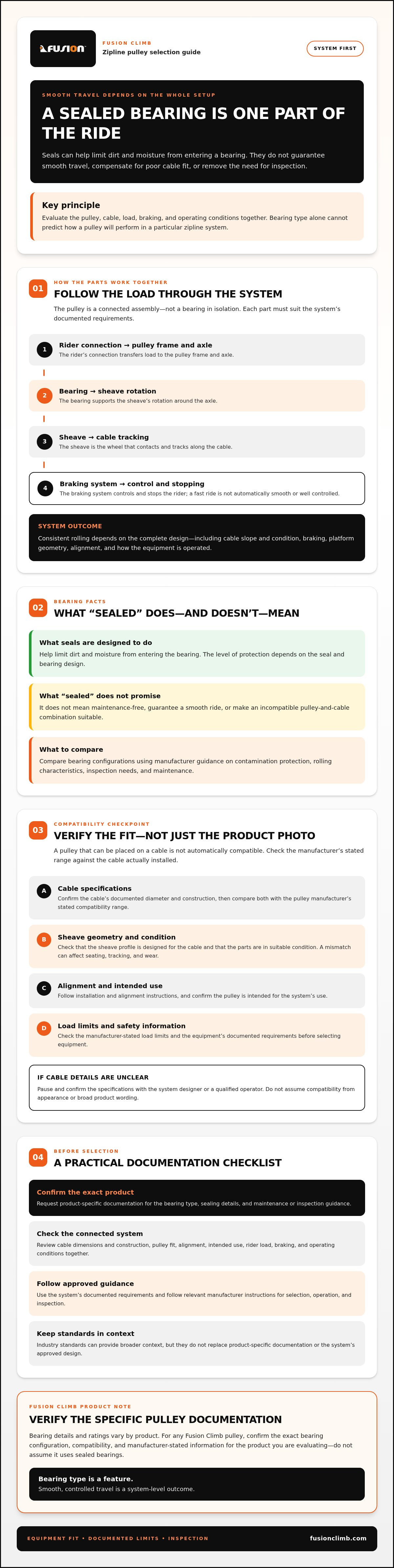
A smooth ride means the pulley travels consistently along the cable, without irregular rolling or unwanted vibration. It doesn’t promise a particular speed or level of comfort. Those outcomes depend on the zipline’s full design, including cable slope and condition, braking system, platform geometry, and how the equipment is operated.
Several parts work together at the pulley. The bearing allows the sheave, the wheel that contacts and tracks the cable, to rotate. Their dimensions and condition must suit the cable and intended use. Alignment matters as well: a pulley that doesn’t track properly may roll differently from one matched to the system, even if both listings describe the same bearing type.
A bearing is one pulley feature; smooth, controlled travel is a system-level outcome. Keep that distinction in mind as you compare equipment. A Sealed bearing zipline pulley for smooth ride may be worth evaluating, but the bearing type alone can’t predict how it will perform in a particular setup.
What does a sealed bearing do in a zipline pulley?
A bearing supports rotation between moving parts, as described in this overview of mechanical bearings. Seals help limit contaminants from entering the bearing, but the level of protection depends on the seal and bearing design. A seal doesn’t mean the pulley needs no inspection or care.
Don’t confuse the bearing with the sheave. The bearing supports the sheave’s rotation, while the sheave rides on the cable. Product listings may use different terms or leave out details, so check the manufacturer’s documentation for the exact bearing configuration, seal information, and maintenance guidance.
Why a bearing label cannot guarantee a smooth ride
Cable wear or contamination, pulley alignment, and a mismatch between cable and sheave geometry can all affect rolling behavior. A bearing may rotate as designed while an incompatible sheave or misaligned assembly prevents consistent tracking. Check cable specifications and pulley compatibility together instead of judging by the bearing description alone.
Perceived smoothness also differs from operating speed. Slope and other system factors influence travel, while the braking system controls and stops the rider. A fast ride isn’t automatically smooth or well controlled. Evaluate the pulley as part of the complete system, and follow the relevant manufacturer documentation for selection, operation, and inspection.
How Sealed Bearings, Sheaves, and Zipline Cables Work Together
Think of the pulley as a connected assembly, not a bearing mounted in isolation. The rider’s connection transfers load to the pulley frame and axle. The bearing supports sheave rotation around the axle, and the sheave tracks along the cable. Each part must suit the system’s documented requirements. A mismatch can affect tracking and wear, even if the bearing itself is in good condition.
Specify the pulley and cable as a compatible pair because their fit and geometry work together under load. Check more than a product photo or a broad claim such as “fits zipline cable.” Confirm the manufacturer’s stated cable diameter and construction range, then compare it with the cable actually installed. If the cable type or specifications are unclear, pause and confirm them with the system designer or a qualified operator.
Inspect bearing and sheave details
Request the exact product documentation. Look for the bearing type, sealing details, and manufacturer guidance on inspection or maintenance. Check the sheave material and profile, along with the stated cable compatibility. Two pulleys can look similar yet have different internal components or intended applications. Appearance isn’t a specification.
For commercial systems, review equipment requirements alongside applicable operating and design guidance. The Association for Challenge Course Technology (ACCT) publishes standards for the challenge course and zipline industry. Its resources can provide broader standards context, but they don’t replace product-specific documentation or the system’s approved design.
Confirm cable fit and alignment
Verify the cable against its records, and check that its construction and diameter fall within the pulley manufacturer’s stated compatibility range. Then confirm that the installed pulley sits and tracks as intended. A sheave profile not designed for the cable may not seat or roll correctly, and alignment issues can affect tracking. Don’t assume a pulley is compatible just because it can be placed on the cable.
Follow the equipment’s installation and alignment instructions. Confirm system-level questions with the designer or a qualified operator. For more context on commercial equipment considerations, read the commercial zipline pulleys engineering and operator guide. Fusion Climb manufactures zipline pulleys; review its zipline pulley options and verify bearing details, cable fit, and stated limits for each product before selecting one.
Sealed vs. Other Zipline Pulley Bearings: Compare the Trade-Offs
Bearing labels are useful only when the product documentation explains what they mean. A sealed design may help limit contaminant entry, but sealing alone doesn’t prove that a pulley will roll more smoothly, suit a particular cable, or need no maintenance. Performance and care requirements depend on the specific bearing and pulley assembly.
Use this comparison as a starting point, not a substitute for manufacturer specifications. “Other” may include open or shielded bearings, but only when the product documentation identifies them. Their characteristics aren’t interchangeable across designs.
| What to compare | Sealed bearing | Other documented configuration |
|---|---|---|
| Contamination protection | Seals are intended to limit contaminant entry. Actual protection depends on seal and pulley design. | Protection varies by configuration. Check whether the bearing is open, shielded, or otherwise protected. |
| Rolling characteristics | Can’t be judged from “sealed” alone. Confirm the manufacturer’s description and intended use. | Also depends on the specific bearing, condition, and pulley design. Don’t assume a configuration is inherently smoother. |
| Inspection needs | Seals don’t make equipment maintenance-free. Follow product-specific inspection guidance. | Follow the same principle: use the manufacturer’s instructions for inspection and care. |
| Manufacturer guidance | Verify bearing details, operating limits, and maintenance directions for the exact pulley. | Confirm the bearing type and any application limits in the product documentation. |
When a sealed bearing may suit the operating environment
Consider the pulley’s actual exposure to dust, moisture, and debris, then check whether its documented sealing design is intended for those conditions. Exposure alone doesn’t determine the right choice. The bearing assembly, sheave, cable fit, and manufacturer-stated operating limits also matter. Review inspection instructions before selecting equipment, and include inspection in the operating plan. OSHA’s zipline safety guidance provides broader context on equipment safety and maintenance.
Look beyond the bearing type
Start with cable compatibility, load requirements, intended use, and how the pulley fits into the system, including its braking arrangement. Compare complete product specifications instead of choosing by one feature label. For broader equipment-selection context, consult this ropes course safety equipment standards and hardware guide. Before purchase, verify bearing details, limits, and inspection directions for the exact pulley. Confirm claims about a sealed bearing’s advantages against the manufacturer’s documentation.
How to Choose a Zipline Pulley for a Smooth, Compatible Setup
Start with the system, not the bearing label. Gather the zipline design and equipment records, then use this checklist before selecting or replacing a pulley. A Sealed bearing zipline pulley for smooth ride is a candidate only if its documented specifications match the actual setup.
- Review the system requirements. Identify the intended use and the system designer’s requirements for the pulley, cable, rider connection, and operation. Don’t select equipment from a general description alone.
- Verify the cable. Confirm its type, construction, and dimensions from reliable records or a qualified assessment. Match those details to the exact pulley’s stated compatibility range.
- Check the pulley’s application and limits. Review the manufacturer’s product-specific documentation for intended use and load ratings. Confirm what each rating means and whether it applies to your system. Don’t treat ratings from different products as interchangeable.
- Confirm attachment fit. Check that the pulley connection works with the other specified system components. Verify that the assembly can be installed and aligned according to the applicable instructions.
- Review the complete operating setup. Consider braking compatibility, rider connections, and operator procedures alongside pulley selection. The pulley should fit the system design. Don’t change other components without qualified review.
Ask about inspection and maintenance
Before purchase, ask the manufacturer what inspection frequency, maintenance instructions, and retirement criteria apply to the exact pulley. A sealed bearing doesn’t remove the need to follow those directions. Keep the guidance with the equipment documentation so the people responsible for inspection can refer to it.
During inspection, abnormal noise, rough rotation, visible damage, or another change from the expected condition calls for assessment under the manufacturer’s instructions. These signs don’t establish a diagnosis by themselves. Don’t return questionable equipment to service based on appearance or a quick hand test. Follow the prescribed process and seek manufacturer or qualified professional guidance if the outcome is unclear.
If cable details, load limits, attachment fit, or inspection instructions are missing or ambiguous, stop and get confirmation from the manufacturer, system designer, or a qualified professional. To compare documented options, review Fusion Climb zipline pulleys and check the specifications for each product.
Evaluate Fusion Climb Zipline Pulleys and Confirm Your Next Steps
Fusion Climb manufactures zipline pulleys, but bearing details and ratings depend on the specific product. Don’t assume a pulley uses sealed bearings based on a general category description or its appearance. If you’re considering a Sealed bearing zipline pulley for smooth ride, first confirm that the exact model’s documentation identifies sealed bearings and explains how the pulley fits your system.
Before choosing, ask for clear, product-specific answers to these questions:
- Does this exact model use sealed bearings? Can you provide the bearing type, sealing details, and relevant product documentation?
- Which cable types, constructions, and dimensions is the pulley specified to fit?
- What load limits and intended applications are stated for this product, and how should those limits be interpreted for the planned setup?
- What instructions cover installation, use, inspection, maintenance, and retirement?
- Are the pulley’s attachment points compatible with the system’s other components and documented design requirements?
Specific answers matter. A generic statement that a pulley is “commercial” or “heavy duty” doesn’t replace documented compatibility, load information, or operating guidance. If an answer is unclear or missing, request clarification from the manufacturer or consult the system designer or a qualified professional before selecting equipment.
Compare documentation with the system
Put the pulley’s written specifications beside the zipline system requirements. Check that cable compatibility, load limits, attachment fit, and intended use align, then review the manufacturer’s instructions for operation and inspection. Treat unexplained gaps as a reason to pause, not as permission to assume a product will fit.
For broader operator context, read the commercial zipline pulley guide. Use it to inform your review, while relying on the exact product documentation and system requirements for the final equipment decision.
Ready to compare available equipment? Explore Fusion Climb zipline pulley options, then verify the bearing configuration, cable fit, load limits, and use instructions for the specific pulley before ordering. Choose by documented fit, not by a single feature label.
Choose for Fit, Then Ride with Confidence
A smooth zipline experience starts with a pulley that suits the complete system. Bearing seals may help protect bearing components, but they don’t guarantee smoother travel or remove the need for inspection. Cable compatibility, sheave fit, load requirements, connections, and braking all need careful review.
Before choosing a Sealed bearing zipline pulley for smooth ride, confirm the exact product’s bearing details, cable specifications, stated limits, and maintenance guidance. If any information is unclear, get confirmation from the manufacturer or a qualified professional before proceeding.
Fusion Climb manufactures zipline pulleys and specialized climbing hardware and was founded in 1998. Explore its pulley options and compare the documentation with your system’s requirements. Explore Fusion Climb zipline pulley options to find a product whose documented specifications match your setup.
Frequently Asked Questions
Is a sealed bearing zipline pulley always smoother?
No. A sealed bearing may help limit contaminants from reaching internal bearing components, but that alone doesn’t guarantee smoother travel, higher speed, or a more comfortable ride. Rolling behavior also depends on bearing condition, sheave design, cable compatibility, alignment, and the complete zipline system. Compare the exact pulley specifications with system requirements, and follow the manufacturer’s instructions for selection, inspection, and maintenance.
Can a sealed bearing pulley fit any zipline cable?
No. Compatibility depends on the specific pulley design and the cable’s documented specifications. Check the cable type, diameter, and construction against the exact pulley manufacturer’s stated compatibility information. A pulley’s appearance or a broad product description isn’t enough to confirm fit. If cable or pulley details are missing or unclear, ask the manufacturer or a qualified system professional to verify compatibility before use.
How do I choose a zipline pulley for a smooth ride?
Start with the zipline system’s documented requirements, then verify the pulley’s cable compatibility, load limits, intended application, and connection fit. Review bearing and sheave details, but don’t treat either as a guarantee of smooth travel. Include braking compatibility and inspection requirements in the assessment. If you’re comparing a Sealed bearing zipline pulley for smooth ride, confirm its exact specifications with the manufacturer before purchasing or operating it.
Do sealed bearings need maintenance?
Yes, they may still require inspection and care. Seals can help limit contaminant entry, but they don’t make a pulley maintenance-free. Requirements depend on the bearing and pulley design, operating environment, and manufacturer instructions. Follow the product documentation for inspection intervals and retirement criteria. If rotation feels rough or damage is visible, don’t rely on appearance alone to judge the equipment. Follow the specified assessment process.
What should I check if a zipline pulley does not roll smoothly?
Don’t assume the bearing is the only possible cause. Follow the manufacturer’s inspection guidance and have the pulley, sheave, cable compatibility, alignment, and visible condition assessed. Abnormal noise or rough movement warrants attention. Don’t continue operating questionable equipment or return it to service based only on appearance or a quick check. A qualified operator or professional should determine whether it’s suitable to use again.
Are all zipline pulleys with sealed bearings designed for commercial use?
No. A sealed-bearing description doesn’t establish that a pulley is suitable for commercial operation. Check the exact model’s stated intended use, load limits, cable compatibility, and supporting documentation, then compare those details with the zipline system requirements and operating procedures. If a product listing lacks the information you need, request written clarification from the manufacturer before selecting the pulley.