



Horizontal Zipline Harness: Safety Buying Guide
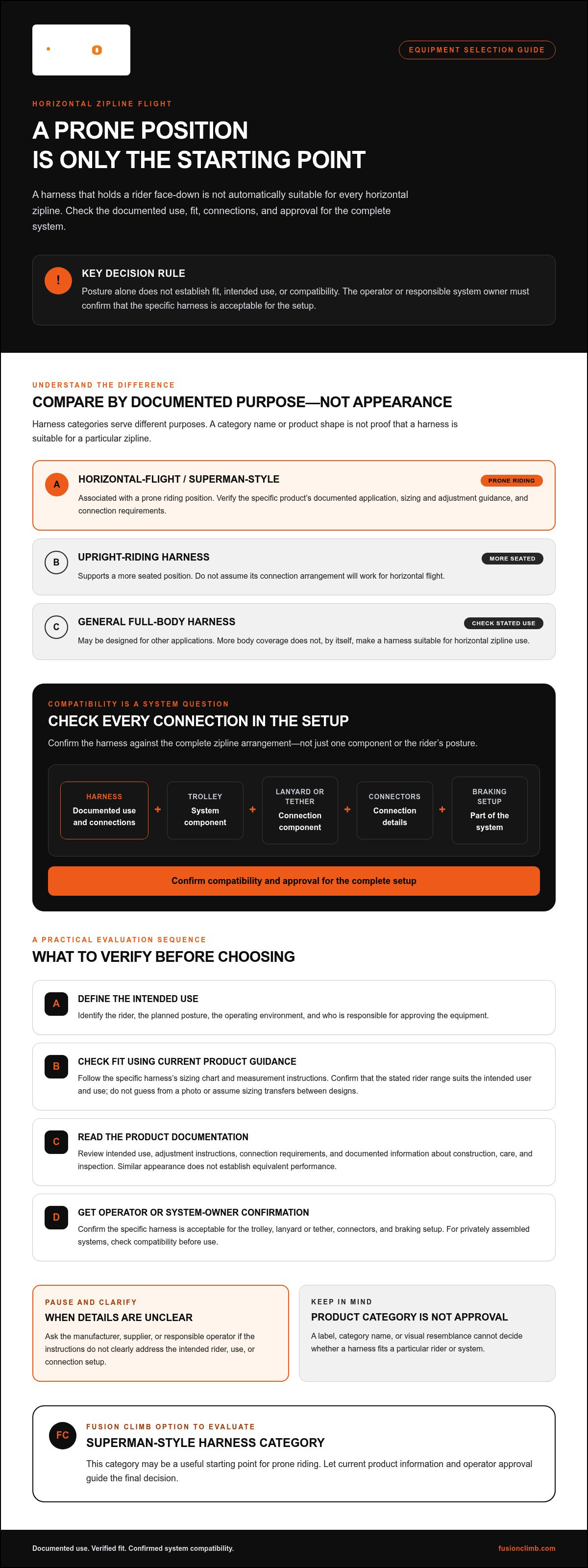
A Zipline harness for horizontal flight must support a rider in a prone position and work with the complete zipline system. A harness that puts a rider face-down isn’t automatically suitable for every horizontal zipline. Posture alone is not enough to judge fit, intended use, or compatibility.
Before choosing, check the harness’s documented application, sizing and adjustment instructions, and connection requirements. Then confirm that the operator or system owner approves it for the trolley, lanyard or tether, connectors, and braking setup. This guide explains what to compare, what to ask, and when to pause for clarification. Fusion Climb’s Superman-style harness category may be a useful starting point, but current product information and operator approval should guide the final decision.
Key Takeaways
- Use the manufacturer’s current sizing instructions to check whether the harness is appropriate for the intended rider and prone position.
- Compare horizontal-flight, upright-riding, and full-body harness categories by their documented use, adjustment guidance, and connection information.
- Before choosing a Zipline harness for horizontal flight, identify the rider, posture, operating environment, and person responsible for approving the equipment.
- Check product documentation for intended use and connection details, then confirm compatibility with the complete zipline setup.
- Explore Fusion Climb’s Superman-style harness category as one option to evaluate, while relying on current product information and operator approval before selection.
Design Purpose of Horizontal Zipline Harnesses
A harness intended for horizontal zipline flight is designed to support a rider in a prone, face-forward position rather than an upright seated posture. “Horizontal” describes the rider’s position. It does not confirm that a harness is suitable for a particular rider, approved for an operation, or compatible with the system.
Harness categories serve different purposes. A Superman-style harness is associated with prone riding, while an upright-riding harness supports a more seated position. A general full-body harness may be designed for other applications. It does not become suitable for horizontal zipline use simply because it covers more of the body. Check the manufacturer’s stated use and the operator’s equipment requirements rather than judging by a product’s shape or category name.
How horizontal flight differs from upright zipline riding
In upright riding, the rider’s torso is generally closer to vertical. In horizontal flight, the torso is oriented more nearly face-down. That difference affects how the harness supports the rider and where its attachment points sit relative to the body. The harness geometry and connection locations need to suit the intended posture and the rest of the system. Do not assume a connection arrangement intended for one riding position will work for another.
For general background on harness components and types, consult Wikipedia’s overview of climbing harness design and types. It can help explain basic terminology, but it is not product-specific approval or a substitute for manufacturer documentation and operator guidance.
Who should evaluate this type of harness
Adventure operators should assess harnesses against the requirements of their actual operation. Review the documented intended use, connection configuration, and instructions for the complete setup, including the trolley and lanyard or tether. The operator or responsible system owner determines whether a particular harness is acceptable. A product label or general category cannot make that decision by itself.
Individual buyers should consider a Zipline harness for horizontal flight only after the operator or system supplier confirms that the specific harness suits the equipment and intended use. This is especially important for a privately assembled setup, where components may come from different sources. Confirm compatibility before use, not by appearance or assumption.
Rider requirements can vary. For minors and other rider groups, follow the applicable operator instructions and product guidance, including any stated limits or conditions. If the documentation does not clearly address the intended rider or use, ask the responsible operator or supplier before selecting the harness.
Evaluate Fit, Support, and Construction Before You Buy
Do not guess fit from a product photo or size label. Harness fit is a documented match between the rider’s measurements and the manufacturer’s sizing guidance. For a Zipline harness for horizontal flight, use the current instructions for the specific design and confirm that its stated rider range suits the intended user.
Check sizing and adjustment guidance
Start with the manufacturer’s sizing chart and measurement instructions. Check which measurements are required, how to take them, and whether the stated range applies to the rider and planned use. If any part of the guidance is unclear, ask the supplier or operating organization to confirm the size before ordering.
Do not assume a size from a climbing or upright-riding harness transfers to a different design. Patterns and adjustment systems vary. Follow the specific product instructions for setting and checking the harness. There is no single fitting method that applies to every horizontal-flight harness.
Review support and construction information
Read the product documentation to understand which support areas and adjustment features are intended to hold the rider in the specified posture. Check what the manufacturer says about materials, construction, adjustment range, care, and inspection. Compare products using details that are actually documented. Similar-looking webbing or hardware does not establish equivalent performance.
Appearance cannot confirm comfort, durability, or load performance. A broad description such as “heavy duty” also cannot show whether a harness suits a particular rider or system. Look for product-specific instructions and information, and ask the manufacturer or supplier to clarify anything missing. The Occupational Safety and Health Administration’s OSHA safety guidelines provide general context on protective equipment and inspection, but do not replace product instructions or the operator’s requirements for a zipline setup.
- Sizing: Follow the current chart and measurement method for the exact harness.
- Adjustment: Check the documented range and instructions for securing the harness in the intended posture.
- Construction: Compare materials and care requirements using published specifications, not appearance.
- Open questions: Resolve unclear fit or use details with the supplier or responsible operator before purchase.
As you compare options, review Fusion Climb harness information as a starting point. Confirm current sizing, intended use, and product-specific documentation before selecting a harness.
Compare Harness Options by System Compatibility, Not Appearance
Category names can narrow a search, but they do not establish whether a harness belongs in a particular setup. Compare documented use, rider posture, adjustment information, and compatibility requirements. If a specification is not published, treat it as a question to resolve rather than filling the gap with an assumption.
| Harness category | Intended posture | Manufacturer-documented use | Adjustment and compatibility details |
|---|---|---|---|
| Horizontal-flight | Prone or face-forward, if specified | Confirm that the manufacturer identifies the harness for the intended horizontal-flight application | Check sizing, adjustment instructions, connection configuration, and system approval |
| Upright-riding | Generally upright or seated, as documented | Confirm the stated riding application; do not assume it covers prone use | Verify documented adjustment range and compatibility with the intended components |
| General full-body | Varies by design and application | Check the exact manufacturer-stated use rather than relying on the category name | Confirm attachment details, adjustment information, and approval for the specific system |
Use this comparison to screen options, not to approve a setup. For a Zipline harness for horizontal flight, the responsible operator or system supplier must confirm that the harness, connectors, lanyard or tether, and trolley work together as specified. The Association for Challenge Course Technology (ACCT) provides industry context, but buyers still need to follow requirements and instructions that apply to their specific operation. For more on trolley considerations, see this guide to commercial zipline pulleys.
Confirm connection and equipment requirements
Read the manufacturer’s instructions for approved connectors, lanyards, and attachment configuration. Then ask the system supplier or responsible operator to verify compatibility among the harness, pulley, and other components. A connector that physically attaches is not automatically an approved connection. For related component-selection context, review this guide to zipline lanyards and tethers.
Separate product claims from verified specifications
Request product documentation for the stated application, sizing, materials, limitations, and connection requirements. Treat claims about load, speed, or rider range as unresolved until they are supported by product-specific information and accepted by the responsible operator. Apply the same care to connectors: consult this overview of professional climbing carabiners for related documentation context, then verify the exact connector requirements for your system.
Pre-Purchase Checklist to Reduce Selection Risk
Keep the selection process traceable. Before purchasing a Zipline harness for horizontal flight, record the intended rider, riding posture, operating environment, and person or organization responsible for approving the complete system. Use product documents to answer the checks below. Treat missing information as a question to resolve, not as evidence of suitability.
- Define the use. Identify who will ride, the intended prone position, the operating environment, and the responsible system owner.
- Confirm intended application. Check whether the manufacturer documents this specific harness for the planned horizontal-flight use.
- Verify sizing. Follow the current measurement instructions and sizing range. Confirm with the supplier or operator that the intended rider falls within the documented range.
- Review adjustment and care. Obtain current instructions for adjustment, inspection, care, and retirement. Make sure the responsible people can access and follow them.
- Check the connection chain. Confirm approved connectors and attachment configuration, then verify the harness works with the specified pulley and lanyard or tether.
- Record limitations and approval. Request published application limits and have the responsible operator or system owner confirm the harness for the particular setup.
Questions to ask the manufacturer or supplier
Ask for written, product-specific information rather than relying on a category label or verbal summary. Is this harness documented for the intended horizontal-flight application? Which sizing and adjustment instructions apply? What are the care, inspection, and retirement requirements? Which connectors and lanyards are approved, and what application limitations should the buyer observe? Request clarification before purchase if the documentation leaves any of these points unanswered.
Questions to confirm with the operator
Ask whether the specific harness is approved for the operator’s zipline system, not simply for horizontal riding in general. Confirm who supplies and fits the equipment, who inspects it, and who maintains its records and serviceability. For wider context on equipment selection, consult this guide to ropes course safety equipment.
Operators should apply their established inspection and operating procedures. This checklist supports product comparison, but it does not replace system-specific approval, staff procedures, or applicable professional review. To compare available categories, review Fusion Climb harness options and verify each product’s current documentation with the responsible operator before selection.
Explore Fusion Climb Harness Options and Confirm the Right Fit
A sound selection depends on four checks: documented intended use, rider fit, approved connections, and acceptance by the responsible operator or system owner. Fusion Climb manufactures Superman-style harnesses, a category buyers may consider when evaluating a Zipline harness for horizontal flight. The category is a starting point, not confirmation that a specific harness suits a particular rider or zipline system.
What to verify in Fusion Climb product information
Review current information for the specific harness under consideration. Confirm its stated application, sizing instructions, adjustment guidance, and included components. Check whether the documentation identifies limitations or explains the intended connection configuration. If a detail you need is not listed, ask Fusion Climb to clarify it before deciding.
Keep product information separate from system approval. A manufacturer’s description can help establish what a harness is designed for, but it does not independently confirm compatibility with a particular trolley, lanyard or tether, or operating setup. Do not infer rider ranges, performance, or approval from the harness category or appearance. Compare product-specific answers with the operating organization’s requirements.
Take the next step with a documented selection
Prepare the relevant details before contacting the supplier: the intended rider and posture, operating environment, system components, and any requirements provided by the operator. This helps focus questions on the exact fit, connections, and application under consideration. Keep written product information available for the operator to review, and clarify unresolved specifications before selection or use.
For buyers assessing a Superman-style harness, verify current product details with Fusion Climb and confirm application suitability with the operator. Explore Fusion Climb harness options, then compare the published information with your rider and system requirements.
Choose with Confidence, Then Confirm the System
Select a horizontal-flight harness by documented use and verified fit, not by appearance or posture alone. Check the manufacturer’s sizing, adjustment, connection, and care instructions, then have the responsible operator confirm that the harness and connected equipment are approved for the intended setup. A Zipline harness for horizontal flight is only one part of a complete system.
Fusion Climb manufactures specialized safety gear, including Superman-style harnesses that may be relevant to buyers evaluating prone riding. Confirm current product specifications and application suitability directly rather than assuming compatibility.
Have the rider and operator requirements ready as you review the available information. Explore Fusion Climb harness options and confirm the specifications for your application before deciding.
Frequently Asked Questions
What is a horizontal-flight zipline harness?
A horizontal-flight zipline harness is intended to support a rider in a prone or face-forward position rather than an upright seated posture. The term describes the rider’s position, not proof that a harness suits a specific person or zipline system. Check the manufacturer’s stated application and instructions, then ask the responsible operator or system owner to confirm that the harness is appropriate for the planned setup.
Is a Superman-style harness the same as a horizontal-flight harness?
“Superman-style” commonly describes a harness category associated with prone riding, but the label alone does not establish a product’s approved use. Confirm that the manufacturer documents the specific harness for the intended horizontal-flight application, and review its fit, adjustment, and connection instructions. Fusion Climb offers Superman-style harnesses, but verify current product details and system suitability directly rather than inferring them from the category name.
Can any zipline harness be used for horizontal flight?
No. Do not assume a harness intended for upright riding or another application is suitable for horizontal flight. The manufacturer must document the intended use, and the responsible operator or system supplier must confirm approval for the particular setup. A physical connection or similar appearance does not prove compatibility. Resolve unclear application or system requirements before purchasing or using the harness.
How do I choose the right size horizontal-flight harness?
Use the manufacturer’s current sizing chart and measurement instructions for the specific harness. Confirm that the intended rider falls within the documented range, and follow the product’s adjustment guidance. Do not assume a size from a familiar climbing or upright-riding harness transfers to a different design. If the sizing information is unclear, ask the supplier or operating organization to confirm the correct size before ordering.
What equipment must be compatible with a horizontal-flight harness?
Confirm compatibility across the complete connection system. Review the harness instructions for approved connectors and attachment configuration, then ask the operator or system supplier to verify that the specified pulley or trolley, lanyard or tether, and carabiners work with the harness in the intended setup. Components that connect physically are not necessarily approved for use together. Follow system-specific documentation and operator requirements.
Are horizontal-flight harnesses suitable for children?
Suitability depends on the specific product’s sizing and instructions, as well as the operator’s requirements for the activity. Do not assume an adult harness can be adjusted for a child or that every horizontal-flight harness includes an appropriate size. Check the child’s measurements against current manufacturer guidance and ask the operator to approve the specific harness and rider. Follow any age, size, or other stated limits.
How should a zipline harness be inspected before use?
Follow the manufacturer’s inspection instructions and the operator’s established procedures before each use. Check the harness for visible damage, wear, contamination, or other conditions identified in its documentation, and confirm that labels and adjustments can be assessed as instructed. Do not use equipment if its condition is questionable. Refer it to the responsible operator or designated equipment reviewer. This basic check does not replace required documented inspections or maintenance procedures.