



Commercial Zipline Business Plan Template: Build a Safer, Stronger Operation
What if your zipline concept looks profitable on paper but can’t support the operation it requires? A strong business plan tests that gap before launch. Visitor demand matters, but viability also depends on course capacity, staffing, safety systems, equipment, and realistic financial assumptions. A commercial zipline equipment checklist helps turn the concept into specific planning decisions, from identifying the hardware categories you need to assigning responsibility for inspection and replacement.
This framework helps you assess demand, map day-to-day operations, identify equipment categories, and test assumptions against evidence gathered for your own site and business model. You’ll get a fillable outline that connects each section of the plan to practical next steps, including how to consider harnesses, pulleys, lanyards, tethers, and carabiners as parts of a broader safety system. Equipment matters, but it doesn’t replace course design, training, inspection, or risk management. Build the plan carefully, and you’ll have a clearer basis for deciding what to validate before committing to launch.
Key Takeaways
- Separate evidence from assumptions when assessing demand, seasonality, capacity, and booking conversion.
- Translate the site concept into an operating model, including participant flow, staffing, operating days, and downtime.
- Use a commercial zipline equipment checklist to connect each equipment category with its role, selection criteria, and inspection owner.
- Keep startup investment, recurring expenses, replacement reserves, and revenue assumptions distinct so financial risks are easier to spot.
- Turn the plan into action by assigning evidence, an owner, a status, and a next step to each major assumption.
Start with the business case: is a commercial zipline concept viable?
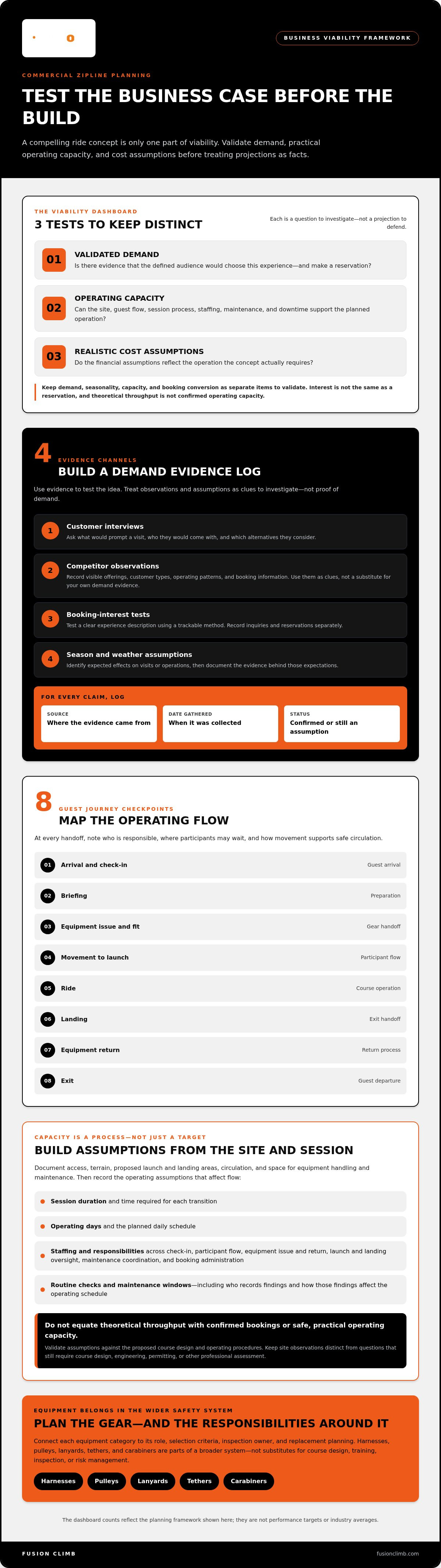
A commercial zipline needs more than a compelling ride concept. Its business case should connect a defined audience, a distinctive experience, a proposed site, and a clear reason guests would choose this operation over other activities. Feasibility depends on validated demand, operating capacity, and cost assumptions. Treat each as a question to test, not a projection to defend.
Define the customer and the zipline experience
Specify who the experience is designed for: families, school or community groups, corporate outings, tourists, or adventure-seeking individuals. These are possible segments, not proof of demand. Describe what participants will do, how the experience fits into a visit, and what sets it apart. A standalone attraction, an adventure park, and a ropes-course setting can serve different purposes and shape different expectations for the overall visit.
Map the guest journey from arrival through check-in, preparation, launch, landing, and departure. Consider how participants move between areas and whether the layout supports safe circulation and maintenance access. Accessibility needs, group size, and the time required for each session can affect both the guest experience and the number of people the operation can serve. For background on the activity’s broader context, see this overview of the history and uses of zip-lines.
Test demand before treating projections as facts
Build an evidence log. For each claim, record its source, the date gathered, and whether it is confirmed or still an assumption. Keep demand, seasonality, capacity, and booking conversion as separate items to validate. Stated interest in ziplining doesn’t automatically translate into a reservation, and theoretical daily capacity doesn’t establish how many sessions can run under the proposed operating plan.
- Customer interviews: Ask likely participants what would prompt a visit, who they would come with, and what alternatives they currently consider.
- Competitor observations: Note visible offerings, customer types, operating patterns, and booking information. Treat observations as clues, not a substitute for your own demand evidence.
- Booking-interest tests: Test a clear description of the proposed experience through a landing page, inquiry form, or other trackable method. Record inquiries and reservations separately.
- Season and weather assumptions: Identify the months and conditions you expect to affect visits or operations, then document the evidence behind those expectations.
Before committing major investment, set validation milestones tied to your plan. For example, define what customer feedback, trackable booking interest, or site and operating information you need before moving to the next planning stage. Choose measurable thresholds that make sense for your proposed capacity and financial model. Don’t borrow unsupported industry averages. If evidence falls short, revise the audience, experience, or operating assumptions and test again.
This gives the commercial zipline equipment checklist a practical purpose: equipment needs should follow a tested operating concept, not an untested projection.
Design the commercial zipline model around site and operating realities
A workable operating model starts with the site, not an idealized throughput target. Document what’s known about access, terrain, proposed launch and landing areas, participant circulation, and space for equipment handling and maintenance. Separate observations from open questions. Site measurements may be available, while course design, engineering, permitting, and other professional assessments may still be needed before the concept is ready to advance. For developers coordinating site entry, parking, and service vehicle turning requirements, guides from ML Traffic Engineers Australia illustrate how vehicle swept path analysis informs practical access planning.
The same route capacity can create very different operating demands depending on how guests arrive, prepare, move through the course, and exit. For related equipment-planning context, the ropes course safety equipment guide can help frame how hardware fits into a broader course operation.
Map the guest journey and operating capacity
Trace the full participant journey: arrival and check-in, briefing, equipment issue and fit, movement to launch, ride, landing, equipment return, and exit. Note who manages each handoff and where participants may wait or cross paths. Queues at check-in, equipment issue, or landing can slow the entire session, even when the ride itself is brief. Access routes and space for groups to gather also affect flow.
Build capacity from the planned session process rather than choosing a target first. Record the expected session duration, operating days, daily schedule, and time required for each transition. Treat these as planning assumptions to validate against the actual course design and operating procedures. Don’t equate theoretical throughput with confirmed bookings or safe, practical operating capacity.
Plan staffing, maintenance, and downtime
List the roles the proposed operation needs and assign clear responsibilities. Depending on the operating model, these may include guest check-in, participant flow, equipment issue and return, launch and landing oversight, maintenance coordination, and booking administration. Identify where responsibilities overlap and where a task needs a designated owner. Account for the people and time required, not simply job titles.
- Routine checks: Show when they occur, who records them, and how findings affect the operating schedule.
- Maintenance windows: Reserve time for planned work and note how it changes available sessions or capacity.
- Weather or other closures: Document the conditions and decision process that may pause operations, without assuming how often closures will occur.
- Reduced-capacity scenarios: Model how the schedule, staffing, and guest communication would change if part of the operation is unavailable.
Use the commercial zipline equipment checklist to connect planned equipment categories with their operating roles, while keeping course design, training, inspection, and risk management as distinct parts of the system. Fusion Climb’s commercial challenge-course equipment can be included in equipment planning for commercial operations.
Finally, label every site or operating item as confirmed, assumed, or awaiting assessment. This keeps the business model grounded and shows what must be resolved before capacity and operating-day projections become firm.
Build the equipment and safety section into an operating system
Equipment planning should follow the course design and operating procedures, not sit apart as a shopping list. A commercial zipline equipment checklist is most useful when it identifies each category’s role, selection considerations, and the person responsible for inspection. Use the table below as a planning framework, then assess component suitability against the specific system and intended use.
Match equipment categories to the planned operation
Start with the participant experience and connection system. Harness configuration should suit the intended ride position and the procedures staff will use to fit, connect, and manage equipment. A pulley must be compatible with the cable system and intended application. Lanyards, tethers, carabiners, ropes, and other load-bearing hardware also need to be considered as parts of the system, not as isolated components. The commercial zipline pulleys guide offers component-level context for pulley planning.
| Equipment category | Operational role and selection considerations | Planned inspection owner |
|---|---|---|
| Harness system | Supports the participant configuration; align fit, adjustment, and use with the planned experience and procedures. | Assign a trained, designated equipment inspector. |
| Zipline pulley | Interfaces with the cable system; assess system compatibility and intended use. | Assign an inspector familiar with the pulley and its use. |
| Lanyards and tethers | Connect components as specified by the system; evaluate configuration and compatibility. | Assign a designated inspector for connection equipment. |
| Carabiners and connectors | Join compatible elements; selection should reflect the system’s intended configuration. | Assign a designated inspector for connectors and closures. |
| Ropes and load-bearing hardware | Support the designed system; selection depends on the course design and application. | Assign an owner with responsibility for records and escalation. |
Equipment specifications do not replace site-specific risk assessment, course design, or documented operating procedures. Standards and certifications are product- and application-specific. Verify the current edition, scope, and applicability before citing a standard or associating it with equipment or an operation. Fusion Climb states that its products undergo laboratory-grade testing before shipment, and its manufacturing and assembly take place in the United States.
Document inspection, retirement, and procurement controls
Give every item a traceable record: equipment category, identifying information, date received, inspection history, findings, and current status. Define how staff report damage or uncertain condition, who can remove an item from use, and who documents a retirement decision. Establish responsibilities for receiving checks, storage, routine inspections, and inventory replacement planning. The zipline lanyards and tethers guide adds context for connection-system planning.
Build equipment ownership into the operating plan, then explore commercial challenge-course equipment as you shape procurement around the course and its intended use.
Create financial projections that expose risk instead of hiding it
A financial plan is useful when it shows what must be true for the operation to sustain itself. Keep startup investment, recurring operating costs, equipment replacement reserves, and revenue assumptions in separate worksheets. That structure makes it easier to trace a shortfall to its source instead of masking it inside one broad estimate. Projections are decision tools, not guaranteed outcomes.
Structure the budget and revenue assumptions
Use site-specific estimates and current quotes wherever available. Label each figure with its source, date, payment timing, and confidence level. Avoid unsupported cost averages, and tie equipment quotes to the proposed configuration rather than treating a generic allowance as a confirmed amount.
- Startup investment: Organize site development, course work, equipment, initial staffing and training, insurance setup, and launch marketing as distinct items.
- Recurring operating costs: Track staffing, insurance, maintenance, marketing, and administration separately so changes in one category remain visible.
- Replacement reserves: Plan a separate reserve for equipment replacement, informed by the operating plan and documented procurement assumptions. A commercial zipline equipment checklist can help define the categories to include, but it doesn’t determine their cost.
- Revenue assumptions: Show how projected sessions, available capacity, operating days, and booking assumptions combine. Label each input and distinguish observed evidence from estimates.
Keep gross revenue distinct from operating costs, and show cash-flow timing as well as totals. For example, a projection can look positive over a full season while still showing periods when payments are due before expected booking revenue arrives. Make the timing visible instead of relying only on an annual summary.
Stress-test the plan before committing
Build conservative, expected, and stronger-demand scenarios. Don’t change several assumptions at once without recording them, or it will be difficult to see what drives the result. For each scenario, note the evidence and confidence behind the projected demand, season length, capacity, and booking rate.
Then test disruptions that could alter revenue or cash needs. Consider lower booking demand, a shorter operating season, weather-related closures, reduced capacity, or greater equipment replacement needs. Identify which changes have the largest effect on cash flow. Those assumptions deserve stronger evidence or a clearer contingency before the plan advances.
Finish with a funding-needs worksheet that records the amount required by category, when it is needed, and what decision depends on it. Set decision gates, such as completing site assessments, validating demand inputs, or obtaining current project quotes before making the next commitment. The purpose isn’t to predict every outcome. It’s to know which conditions would prompt a pause, revision, or next step.
As you refine equipment-related assumptions, explore commercial zipline equipment that fits the operation you’re modeling.
Use the template to turn planning into a credible next step
A useful business plan is more than a polished summary. It records what the operation intends to do, what supports each decision, and what still needs validation. Use the prompts below to create a working document, then update it as evidence, site information, and operating requirements develop.
Assemble the business plan section by section
- Executive summary: Describe the proposed experience, intended audience, site scope, and reason guests would choose it. Mark the summary provisional until core assumptions are supported.
- Market: Identify target customer segments, alternatives, demand evidence, seasonality assumptions, and the next validation step.
- Operating plan: Outline the guest journey, operating schedule, capacity assumptions, staffing roles, maintenance approach, and possible downtime scenarios.
- Equipment and safety: List equipment categories, intended roles, selection considerations, inspection responsibilities, and unresolved safety or assessment items.
- Marketing: Record the channels to test, the audience each channel targets, the evidence of interest, and how results will be reviewed.
- Finances: Separate startup investment, recurring expenses, replacement reserves, revenue assumptions, and cash-flow timing. Attach the source and confidence level for each estimate.
- Milestones: Set decision gates, the evidence needed at each gate, the person responsible, and the next action.
For every major assumption, add four fields: evidence, owner, status, and next action. Use clear status labels such as “supported,” “under review,” or “unresolved.” Put supporting site information, supplier details, risk documents, and market research in an appendix, then reference each item from the relevant plan section. If a detail remains open, assign an owner and a planned validation step instead of treating it as settled.
Move from template to equipment planning
Compare proposed equipment needs with the participant experience, operating procedures, and inspection system. A commercial zipline equipment checklist should connect each category to its intended function and place in procurement and recordkeeping. Fusion Climb manufactures and assembles safety-focused equipment in the United States, including harnesses, pulleys, lanyards, tethers, and carabiners for commercial challenge-course operations. Treat equipment selection as one part of a broader operating plan, not as a substitute for course design, training, inspection, or risk management.
For connector-specific planning, the professional climbing carabiners guide provides further context for evaluating connection components. Keep product standards and certifications tied to the specific product and intended application, and document how each selection fits the planned system.
With the plan’s needs defined, explore Fusion Climb’s commercial zipline equipment as you develop the procurement portion of your business plan.
Put the next decision on solid ground
Your plan doesn’t need every answer before it can move forward. It does need a clear record of what you know, what remains uncertain, and what evidence will support the next commitment. Keep that discipline as you refine the commercial zipline equipment checklist: let the proposed operation guide procurement, and revisit assumptions when new information changes the design or budget.
As you compare equipment needs, consider practical details that affect fit with the intended use. For example, the TCH-109-3 New Falcon Racer 3 Leap of Faith Zipline Harness is available in XS/M, M/XL, and XL-3XL, with leg-steel-adjuster or leg-quick-release buckles and optional padding. These configuration options can inform how a specific harness fits into equipment planning. Fusion Climb manufactures and assembles its products in the United States.
Take the next step with a defined list of requirements, not a guess. Explore Fusion Climb’s commercial zipline equipment as you shape procurement around your operating plan. Build deliberately, validate each decision, and give your operation a stronger foundation from the start.
Frequently Asked Questions
What should a commercial zipline business plan include?
A commercial zipline business plan should cover the concept, customers, market, operations, site, staffing, equipment, safety, marketing, finances, and implementation milestones. Make it a decision record, not just a narrative: link important claims to evidence, identify the person responsible for open questions, and state what finding would change the plan. A useful test is whether someone unfamiliar with the concept can trace how a proposed decision follows from the available information.
How do I estimate demand for a commercial zipline business?
Estimate demand by defining likely customer groups and testing whether they show measurable interest in the proposed experience. Compare interview responses with market research, observed alternatives, and trackable booking inquiries. Note where the evidence came from and when it was collected. Separate casual interest from a concrete inquiry or reservation. Review results by audience and season so that a strong response from one group doesn’t distort the whole forecast.
How much startup funding does a commercial zipline need?
There’s no reliable universal funding figure because site conditions, course design, equipment, development work, and operating plans differ. Build the estimate from current project quotes and site-specific assessments, then identify when each payment is expected. Keep one-time investment separate from recurring expenses, and account for the time between cash outlays and incoming revenue. Before treating the plan as ready, test how weaker bookings or downtime could affect available cash.
What equipment should a commercial zipline operator plan for?
A commercial zipline equipment checklist should reflect the designed system and its operating procedures. Depending on the setup, categories may include harnesses, pulleys, lanyards or tethers, carabiners, ropes, and load-bearing hardware. For each item, record intended use, compatible components, manufacturer documentation, storage approach, and who manages inspection and replacement decisions. Don’t infer that a component is suitable from its category alone; match its specifications and any applicable standard to the planned application.
Do I need a business plan before buying zipline equipment?
A written plan is a practical step before procurement because it connects equipment choices to the participant experience, course design, staffing, and operating procedures. For instance, a change in the planned ride configuration could affect harness selection or system compatibility. Document the requirements that drive each purchase and distinguish confirmed specifications from unresolved design questions. A checklist can organize procurement, but it can’t establish the suitability of equipment for an unfinalized system.
How should I include safety in a commercial zipline business plan?
Include safety by documenting who owns equipment records, inspection processes, maintenance follow-up, participant procedures, and incident reporting. Describe how staff will record a finding, escalate a concern, and track its resolution. Identify questions that need qualified professional input, and verify the edition and scope of any standard before citing it. Keep certification claims specific to the product and intended use; they don’t replace a site-specific risk assessment or clear operating procedures.