



Best Safety Harnesses for Wind Turbine Technicians: 2026
A 300-foot vertical climb isn't the place to realize your equipment was built for a construction site rather than a nacelle. You understand that every ounce of weight and every snagged buckle matters when you're working in tight turbine ladders or battling the onset of suspension trauma. Selecting the best safety harnesses for wind turbine technicians is about more than just checking a box. It's about choosing a tool that supports your body through grueling shifts. Trust your gear. Demand precision. Your safety depends on equipment that works as hard as you do.
We agree that your gear should be a silent partner that eliminates physical fatigue while maintaining full compliance with ANSI Z359.11-2022 standards. This article provides the technical blueprint to select a high-performance harness that balances ergonomic suspension science with high-strength hardware. You'll learn how to identify modular gear that integrates with rescue systems and why 3D padding is essential for preventing circulation issues. We also examine how the March 2026 Wind Turbine System Safety Rules impact your equipment choices for high-voltage environments, ensuring you stay protected as industry regulations evolve.
Key Takeaways
- Master the latest ANSI Z359.11 requirements and 2026 GWO training updates to ensure your gear meets current industrial safety benchmarks.
- Discover how ComfortCore™ 3D padding in safety harnesses for wind turbine technicians prevents suspension trauma and improves heat dissipation during long vertical climbs.
- Learn why auto-locking steel carabiners and specific pulley configurations are non-negotiable for high-stakes nacelle work and rescue operations.
- Compare the TCH-501 and TCH-603 models to find the right balance between specialized rope access and versatile multi-mission tower work.
- Use our professional sizing guide and understand the "no returns" safety policy to secure a reliable, made-to-order fall protection system.
Essential Standards for Wind Turbine Fall Protection
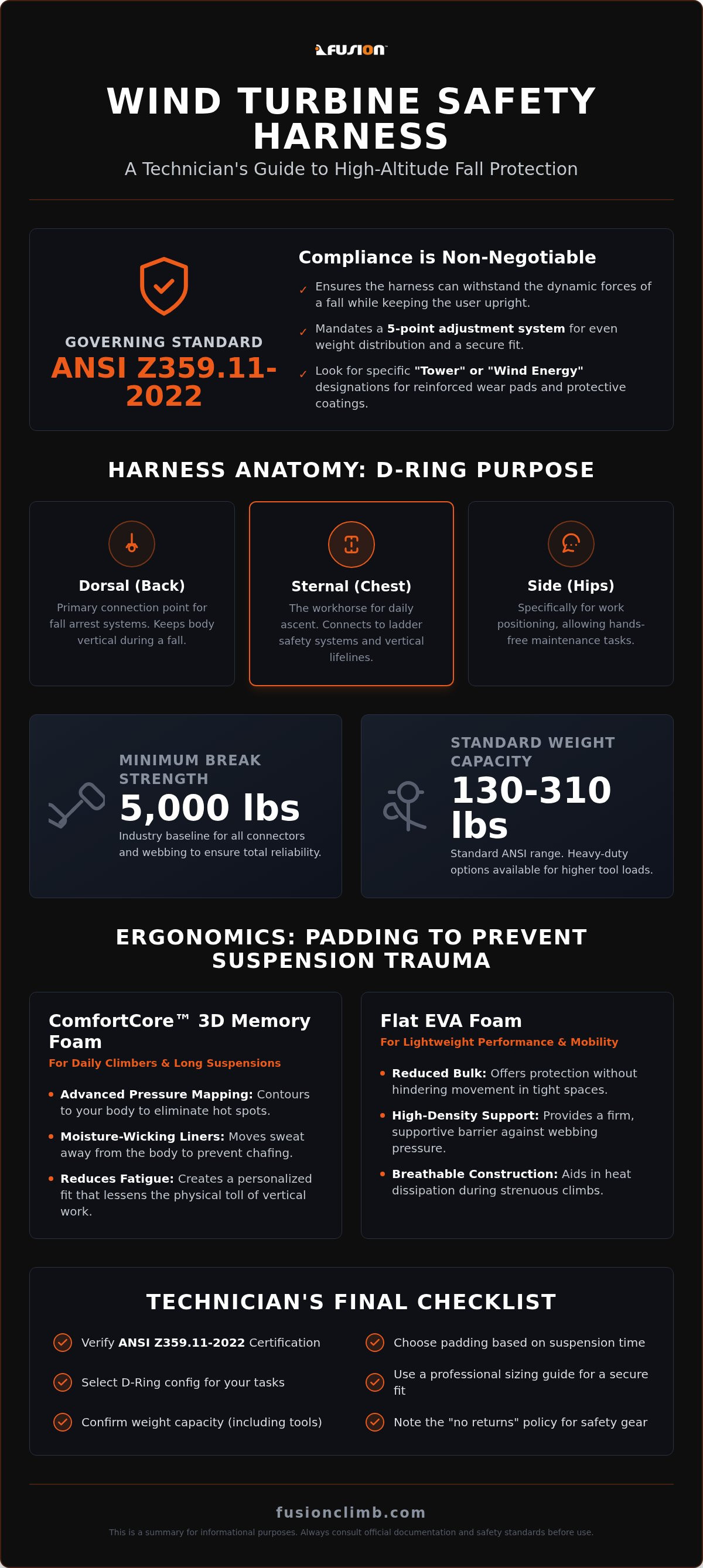
High-altitude environments demand more than a basic safety strap. The ANSI Z359.11-2022 standard serves as the primary benchmark for safety harnesses for wind turbine technicians. This regulation ensures that every full-body harness can withstand the dynamic forces of a fall while keeping the user upright. For wind-specific applications, professionals look for harnesses with "Tower" or "Wind Energy" designations. These specialized models include reinforced wear pads and protective coatings that resist the corrosive grease and industrial grit common inside a nacelle. A 5-point adjustment system is a non-negotiable feature for these environments. It allows you to distribute your weight evenly across the torso and legs, which prevents the harness from shifting during a 300-foot vertical climb.
Understanding the distinction between fall arrest systems and work positioning is vital for your safety. Fall arrest is designed to stop a plunge mid-air, whereas work positioning allows you to lean back and use both hands for maintenance tasks. Wind technicians require a hybrid approach. You aren't just climbing; you're often suspended for hours performing precision repairs on the hub or blades. Your gear must support these dual roles without compromising comfort or structural integrity.
The Role of D-Rings in Turbine Climbing
D-ring placement dictates how you move through the tower. The dorsal D-ring is your primary connection for fall arrest during nacelle work. It keeps your body in a vertical position if a fall occurs. However, the sternal D-ring is the workhorse for your daily ascent. It connects directly to ladder safety systems and vertical lifelines, keeping you close to the ladder. Side D-rings are reserved specifically for positioning. They allow you to lock into a fixed point on the turbine structure, freeing your hands for bolt torquing or electrical work without losing your balance or stability.
Weight Capacity and Break Strength Realities
ANSI standards typically cover a user weight range of 130 to 310 pounds. If you carry heavy tool kits or fall outside this range, you must seek out heavy-duty gear rated for higher capacities. Regardless of your personal weight, the hardware must remain uncompromising. A 5000-pound minimum break strength is the industry baseline for all connectors and webbings. For a deeper look at the hardware that keeps you anchored, review our guide on Professional Climbing Carabiners. Every component in your system must meet these rigorous strength ratings to ensure total reliability in the field.
Ergonomics and Padding: ComfortCore™ 3D vs. Flat EVA Foam
Padding is a critical barrier between your body and the onset of suspension trauma. When you're suspended in high-performance safety harnesses for wind turbine technicians, the leg loops can restrict femoral blood flow, leading to rapid physiological distress. Modern padding technology aims to mitigate this risk through superior pressure distribution. Meeting OSHA fall protection requirements means more than just surviving a fall; it involves ensuring you remain conscious and mobile during the rescue window. Proper ergonomics also address heat dissipation. This is vital during summer tower climbs where interior nacelle temperatures can soar. High-density padding must breathe, moving moisture away from the skin to prevent chafing and heat exhaustion.
ComfortCore™ 3D Memory Foam: For Daily Climbers
The TCH-501 TAC-SCAPE-H utilizes ComfortCore™ 3D memory foam to solve the problem of long-term suspension fatigue. This material provides advanced pressure mapping, contouring to your specific anatomy to eliminate hot spots. It's especially effective for technicians who spend hours in work positioning mode. Over time, the memory foam adapts to your body type, creating a personalized fit that reduces the physical toll of repetitive vertical movement. Moisture-wicking liners are integrated into the 3D structure, ensuring that sweat is moved away from the body to maintain a dry, professional environment within the harness. If you prioritize all-day comfort during technical rescues, consider upgrading to professional-grade padded harnesses designed for maximum support.
Flat EVA Foam: Lightweight Performance
While memory foam offers maximum comfort, flat EVA foam provides essential maneuverability in tight quarters. In the TCH-625 TAC-SCAPE LITE, the reduced bulk of EVA padding allows you to navigate narrow turbine ladders and cramped nacelle spaces without gear snagging. EVA foam is also highly resistant to the industrial lubricants, oil, and grease common in wind energy environments. It doesn't absorb liquids, making it easier to decontaminate after a messy maintenance shift. The TCH-603 series offers both variants, allowing teams to choose between the plush support of 3D memory foam or the streamlined, rugged profile of flat foam based on their specific mission profile. Choosing the right foam is a tactical decision. You must weigh the need for all-day suspension comfort against the necessity of rapid, snag-free movement in confined spaces. This balance of materials ensures that safety harnesses for wind turbine technicians remain functional across diverse operational climates.
Beyond the Harness: Integrating Carabiners and Descenders
A safety harness is the foundation of your protection, but the hardware you attach to it determines your operational success. In the vibration-heavy environment of a wind turbine, standard screw-gate carabiners pose a significant risk. They can vibrate open over time. Auto-locking connectors are required to prevent accidental gate opening during complex maneuvers. These components must integrate seamlessly with safety harnesses for wind turbine technicians to ensure a closed-loop system. When selecting hardware, you must also prioritize oval-shaped carabiners. Their symmetrical design ensures even load distribution on pulleys and prevents the shifting that can compromise a rescue line.
Adhering to OSHA fall protection requirements involves verifying every link in your safety chain. For those involved in complex rigging, understanding the mechanics of your hardware is vital. We recommend reviewing our Commercial Zipline Pulleys Guide to master the engineering standards required for high-load environments. Proper rigging ensures that your hardware works with your harness rather than against it.
Steel vs. Aluminum in the Turbine
Weight management is a constant battle during a 300-foot ascent. Aluminum Swift Auto Lock carabiners are excellent for reducing the load on your gear loops during long climbs. However, durability takes precedence in high-stress rigging scenarios. The Tacoma Steel 50KN Auto Lock is the industry standard for anchor points and heavy-duty hauling. Its forged steel body resists the abrasive effects of industrial grit. When using pulleys or rigging plates, the Ovatti Steel Auto Lock provides the necessary oval profile to keep your system centered and stable. Choose steel for permanent rigging and aluminum for personal gear to balance strength and mobility.
Descent and Rescue Hardware
Emergency evacuation requires precise speed control. The Figure 8 Descender with Ears allows you to increase friction by wrapping the rope around the "ears," which is critical for controlled descents from the nacelle. For harsher conditions, the Kura Steel Rescue 8 offers superior wear resistance compared to aluminum plates. It handles the heat generated by long descents without degrading. If your team operates with multi-point anchor systems, the Aluminum 30KN Rigging Plate organizes your connections. It creates a clean, manageable hub for your descent and backup lines. These tools ensure that if a rescue is necessary, you have the mechanical advantage to execute it safely.
Top-Rated Fusion Climb Harnesses for Wind Energy Techs
Vertical mobility is the primary challenge in wind energy maintenance. Standard harnesses often restrict hip movement or create unnecessary friction points during the ascent. Fusion Climb utilizes a V-Style design across its tactical line to provide maximum freedom of movement during vertical ladder climbs. This ergonomic geometry ensures that the harness follows your body's natural mechanics rather than fighting against them. For professionals seeking high-performance safety harnesses for wind turbine technicians, these models represent a shift toward specialized, task-oriented equipment that prioritizes both survival and efficiency.
The TCH-501: Professional Rope Access
The TCH-501 TAC-SCAPE-H is the premium choice for technicians who perform rope access or technical rescue. Its suspension system is ANSI Z359.11-2022 and CE certified, making it suitable for long-duration hanging without the risk of circulation loss. You can select the ComfortCore™ 3D Memory Foam variant to achieve maximum relief during extended maintenance shifts. The black tactical finish provides a professional, industrial aesthetic while remaining resistant to the harsh environment of the nacelle. This model is built for those who treat their gear as a permanent workstation rather than just a safety backup. It provides the stability needed for hands-free work on the hub or blades.
The TCH-603: Tactical Multi-Mission Utility
Versatility is the hallmark of the TCH-603 Multi-Mission harness. This model features detachable mission-specific components that allow you to strip down for nacelle work or build up for complex tower rescues. If you operate in extremely tight spaces, the Flat-Foam option provides a streamlined profile that eliminates gear snagging on internal turbine structures. This heavy-duty construction is reflected in the price range of USD 270.5 to 345.0, signaling a professional-grade investment in your personal safety system. It's a tool designed for the technician who moves between different turbine models and requires an adaptable platform that doesn't compromise on break strength or comfort.
For technicians focused on speed and weight reduction, the TCH-625 TAC-SCAPE LITE offers a stripped-down alternative. It maintains the core strength of the tactical line without the added bulk of multi-mission attachments. Every harness in this lineup is made to order. This ensures that your soft goods are fresh and have never sat in a warehouse for years, maintaining the highest levels of material integrity. Explore our full range of professional-grade safety harnesses to find the exact fit for your mission profile and climbing style.
The Technician Checklist: Finalizing Your Fall Protection System
Your safety system is only as strong as its weakest component. Once you have selected from the high-performance safety harnesses for wind turbine technicians, the focus shifts to fit and maintenance. A harness that is too loose will cause internal injuries during a fall, while one that is too tight restricts movement and blood flow. You must also consider your secondary equipment. Nylon sling runners with a 5000 lbs minimum break strength serve as essential anchor extensions when your primary D-ring cannot reach a secure tie-off point. These extensions provide the reach needed for complex maintenance tasks inside the nacelle without compromising your safety margin.
Sizing and Fit for Layered Clothing
Wind energy environments are unpredictable. You may be climbing in a light t-shirt in July or bulky thermal layers in January. Always measure your waist and chest while wearing your heaviest winter turbine workwear. Most professional harnesses come in ranges from S/M through 2XL-3XL to accommodate these variations. Once donned, apply the "two-finger" rule. You should be able to slide two fingers between the webbing and your body at the leg loops and chest straps. This ensures the harness is snug enough for fall arrest but loose enough for vertical mobility. When securing your position, adjust the Infinity Rebar Snap Hook to ensure a rock-solid connection that won't slip under load.
Safety is our absolute priority. This is why we maintain a strict no returns policy on all soft goods, including harnesses, belts, and lanyards. When you receive your gear, you have the guarantee that it is made to order and has never been used, stressed, or improperly stored by another user. This policy eliminates the risk of receiving a compromised harness. It ensures that every piece of equipment you take up the tower is brand new and factory-certified for the high-stakes environment of wind energy.
Maintenance and Gear Retirement
Daily inspections are mandatory. Before every climb, run your hands along the webbing to feel for nicks, frays, or hard spots that indicate heat damage. Check all buckles for smooth operation and inspect D-rings for any signs of warping or rust. In the wind industry, you must be particularly vigilant about chemical damage. Turbine oils and hydraulic fluids can degrade nylon fibers over time, often without visible discoloration. As a general rule of thumb, retire any harness after five years of service, regardless of its appearance. If your gear is involved in a fall event, retire it immediately. To secure your next system, browse the full Fall Protection Collection for Wind Energy Techs and invest in equipment that meets the highest industrial standards.
Secure Your Future in the Vertical Environment
The evolution of wind energy safety demands equipment that matches the complexity of the turbine itself. You've seen how the latest ANSI Z359.11 certified designs and the March 2026 safety rule updates prioritize both structural integrity and technician wellness. Selecting the right safety harnesses for wind turbine technicians is a tactical choice between the all-day suspension comfort of ComfortCore™ 3D memory foam and the streamlined maneuverability of flat EVA foam. Every component, from the Tacoma 50KN carabiner to the Figure 8 descender, must function as a unified system to ensure your safety during 300-foot climbs.
Our rugged tactical-grade construction is tested in rigorous industrial environments to provide a silent partner you can trust. We manufacture our soft goods to order. This ensures your harness arrives fresh and ready for the high-stakes demands of the nacelle. Take the lead in tower safety by choosing gear built for professional-grade craftsmanship and meticulous manufacturing. Don't settle for generic equipment when the mission requires precision engineering.
Equip Your Crew with ANSI-Compliant Wind Energy Harnesses
Climb with confidence. Your expertise deserves the protection of a dependable guardian who is deeply committed to your safety.
Frequently Asked Questions
What is the best D-ring configuration for wind turbine climbing?
A multi-point configuration featuring dorsal, sternal, and side D-rings is the industry standard for wind energy work. The dorsal D-ring serves as your primary fall arrest connection during nacelle tasks. Your sternal D-ring is essential for ladder safety systems during the vertical climb. Side D-rings allow for stable work positioning, freeing your hands for maintenance. This setup ensures you're protected throughout every phase of the mission, from ascent to repair.
How do I know if my harness is ANSI Z359.11 compliant?
Verify compliance by inspecting the permanent safety label stitched into the harness webbing. It must explicitly state the ANSI Z359.11-2022 standard. This certification ensures the equipment has passed rigorous dynamic drop tests and static load requirements. High-quality safety harnesses for wind turbine technicians also undergo testing for suspension trauma mitigation. Never use a harness if the label is missing, illegible, or references an outdated or non-industrial standard.
Can I use a standard climbing harness for wind turbine maintenance?
You can't use a recreational climbing harness for industrial wind turbine maintenance. Recreational gear lacks the sternal and side D-rings required for ladder safety systems and work positioning. Industrial harnesses are built with heavier webbing to resist abrasion from grease and grit. They also meet specific break strength requirements that recreational gear doesn't. Using non-compliant equipment violates safety regulations and puts your life at significant risk during a fall event.
How often should a wind technician harness be inspected?
Perform a thorough user inspection before every single climb. You must check for webbing frays, buckle corrosion, and D-ring deformation. Additionally, a competent person must conduct a formal, documented inspection at least once every twelve months to maintain compliance. In harsh offshore or high-chemical environments, you should increase the frequency of these formal reviews. Professional vigilance is the only way to ensure your gear remains a dependable guardian in the field.
What is the difference between 3D memory foam and flat EVA foam in a harness?
ComfortCore™ 3D memory foam provides superior pressure mapping and blood flow preservation during long suspension sessions. It contours to your body to reduce fatigue. Flat EVA foam offers a lower profile, which is better for navigating extremely tight nacelle spaces without snagging gear. While 3D foam is the gold standard for comfort, flat foam is a tactical choice for technicians who prioritize speed and streamlined movement in confined turbine structures.
Why are steel carabiners preferred over aluminum for wind energy applications?
Steel carabiners, like the Tacoma 50KN, are preferred for high-stress rigging and anchor points due to their extreme durability. They resist the abrasive effects of industrial grit and the wear from constant vibration better than aluminum. While aluminum is lighter for personal gear, steel provides a sobering sense of security for rescue systems. Forging steel bodies ensures a higher minimum break strength, which is vital when your life depends on a single connection point.
How do I choose the right size harness for winter workwear?
Choose your size by measuring your waist and chest while wearing your heaviest cold-weather layers. Safety harnesses for wind turbine technicians must accommodate bulky thermal jackets without restricting movement. Once you've adjusted the straps, apply the two-finger rule to the leg loops and chest. If you can't fit two fingers, it's too tight. If you can fit more, it's too loose. Proper sizing ensures the harness distributes fall forces correctly across your frame.
What should I do if my harness is exposed to turbine hydraulic fluid?
Inspect the webbing immediately for signs of discoloration, stiffening, or texture changes. Hydraulic fluids and turbine oils contain chemicals that can silently degrade synthetic fibers, compromising the harness's break strength. If the fluid has penetrated the core of the webbing, you must retire the gear. Safety soft goods are made to order to ensure material integrity. Don't gamble with contaminated equipment; replace it to maintain your professional safety standards.