



Zipline Trolley for Professional Operators in Wet and Cold Weather
Cold or wet weather doesn’t automatically rule out professional zipline operation, but it makes trolley design and maintenance more important. A zipline trolley for professional operators must suit the cable system and operating conditions. Whether a self-returning, bi-directional setup is appropriate depends on the design of the complete system.
Weather can affect equipment performance and what operators need to monitor. Choosing a trolley is about more than speed: bearings, return operation, compatibility, and consistent maintenance all matter. This article explains how these factors work together, what to consider in cold or wet conditions, and how to assess trolley performance as part of the whole line. You’ll have a practical framework for evaluating design and upkeep for professional use.
Key Takeaways
- Assess bearing quality, cable compatibility, and operating speed together when selecting a trolley for smoother, quieter travel.
- Consider how self-returning, bi-directional operation fits the line’s design and the way staff handle the trolley.
- Account for cold and wet conditions in operating checks and maintenance, since weather can affect equipment performance.
- Compare commercial trolley options by system compatibility and intended use, rather than choosing by speed alone.
High-speed and noise-reducing trolley design
For a commercial line, consider trolley speed, noise, braking, and cable compatibility as connected design choices. Bearings and operating conditions also influence how smoothly a trolley travels.
Trolley Load Ratings and Speed Capabilities
Match the trolley’s load rating to the complete rider-and-equipment load, then compare its operating-speed limits with the line’s expected speeds. A higher speed rating alone doesn’t establish suitability: cable type, braking arrangement, and system design matter too. ISC trolley selection, for example, depends on rider speed, cable, and who carries the trolley.
Commercial zipline trolley prices in the United States vary according to load rating, cable compatibility, braking integration, and construction. These factors shape the equipment configuration, so a single price won’t represent every trolley.
Commercial Trolley Models
Compare commercial models by intended cable, rated load, speed capability, and braking integration. Check how each design manages rolling resistance and sound. High-quality bearings support smoother movement and can contribute to equipment lifespan. For a quieter line, assess bearing quality alongside trolley and cable compatibility rather than treating noise control as a separate add-on.
Braking compatibility depends on the trolley, cable, and arrest system working together. Magnetic braking is one possible design approach, but it isn’t automatically compatible with every trolley; confirm that the braking method is designed for the specific system. Commercial zipline arrest devices are described for lines running at speeds up to 72 km/h.
U.S. operators buy commercial trolleys through manufacturers or specialist sales channels. Service follows the trolley maker’s maintenance guidance and service channel. Before operation, assess the trolley, cable, and braking setup as one system. Changing a component can affect what the others can support, so don’t consider speed and noise goals in isolation.
Self-returning, bi-directional trolley operation
A self-returning, bi-directional setup is designed to let a trolley travel along a line in both directions and return for another dispatch. For a commercial operation, consider how that movement fits the route, cable, rider speed, and operating procedure. These choices need to work as one system.
Start by mapping the trolley’s full travel cycle. Identify where a rider launches, where the trolley reaches the end of its travel, and how it returns to the next dispatch point. A return method suited to a short, controlled route may not fit a longer line or a different cable layout. The route determines what the trolley must do between rides.
Braking is a separate design consideration from return travel. The braking arrangement must be compatible with the trolley and cable, and suited to the system’s operating speeds. A trolley that moves smoothly in both directions still needs a braking solution designed for that configuration. Treat return function and braking as connected decisions, not interchangeable features.
Before selecting equipment, work through these points:
- Confirm the cable type and the trolley’s compatibility with it.
- Define the rider speed and the expected direction of travel.
- Establish how the trolley returns and where staff handle it.
- Assess braking integration across the complete line system.
These checks matter because changing one component can affect the options available for others. ISC trolley selection, for example, depends on rider speed, cable type, and who carries the trolley. The handling plan is therefore part of equipment selection, not an afterthought.
When assessing a bi-directional design, evaluate the complete cycle under the intended setup, including smooth travel, return handling, and braking compatibility. A return feature alone doesn’t establish that a trolley suits the line. A sound assessment connects route, cable, speed, and handling in one operating plan.
Weather, maintenance, and cold-weather operation
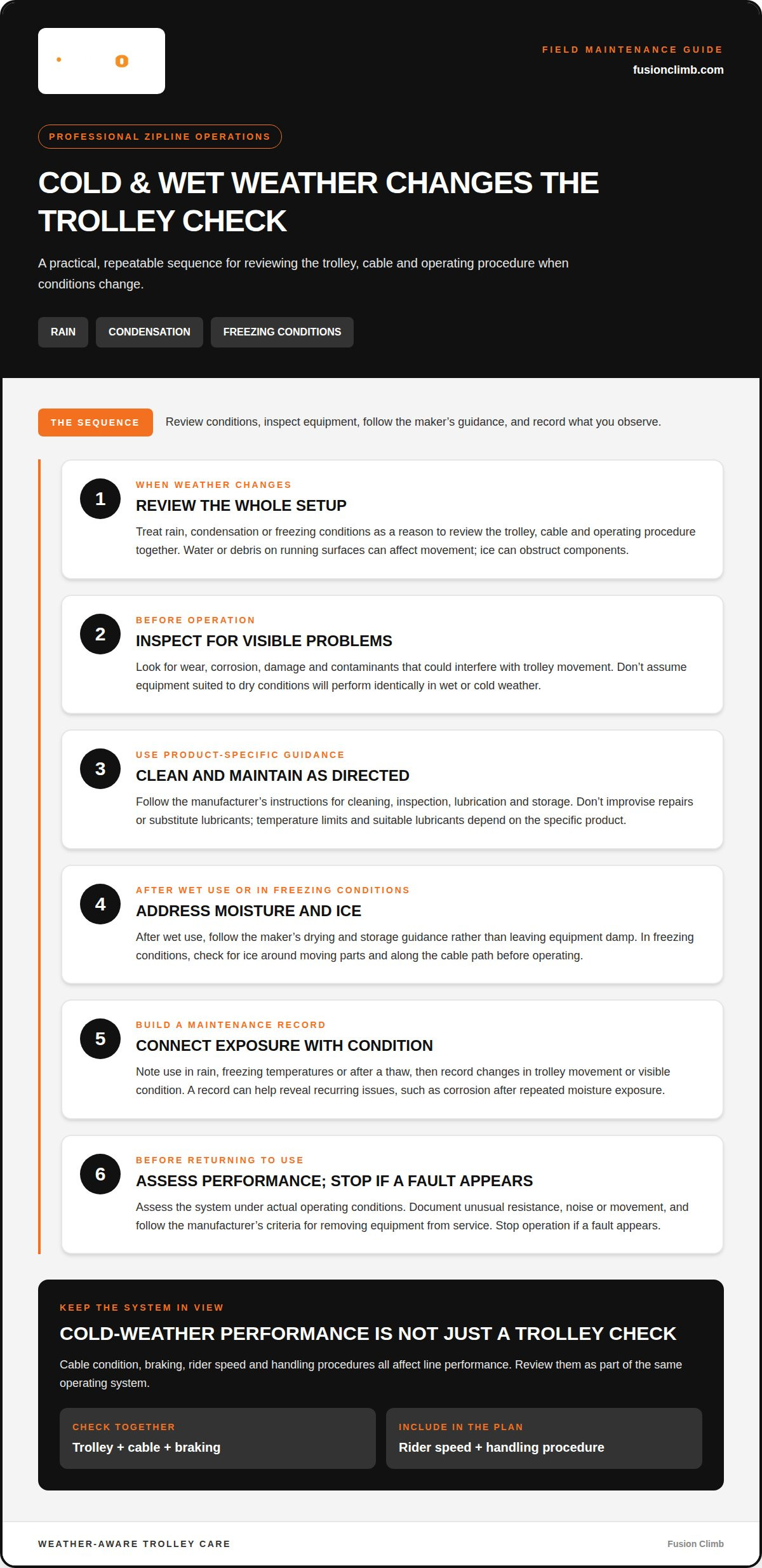
Rain, condensation, and freezing conditions change the environment around a zipline. Treat each weather change as a reason to review the trolley, cable, and operating procedure together. Water or debris on running surfaces can affect movement, while ice can obstruct components. Don’t assume a trolley suited to dry conditions will perform identically in cold or wet weather.
Use the manufacturer’s maintenance instructions for cleaning, inspection, lubrication, and storage. Before operation, look for visible wear, corrosion, damage, and contaminants that could interfere with trolley movement. After wet use, follow the maker’s drying and storage guidance rather than leaving equipment damp. In freezing conditions, check for ice around moving parts and the cable path before operating the line.
A practical maintenance record can link weather exposure with observed equipment condition. Note whether the line was used in rain, freezing temperatures, or after a thaw, then record changes in trolley movement or visible condition. This helps identify recurring issues, such as corrosion after repeated moisture exposure. Follow the manufacturer’s criteria for removing equipment from service; don’t improvise repairs or substitute lubricants.
Cold-weather operation depends on the whole system, not just the trolley. Cable condition, braking, rider speed, and handling procedures all affect line performance. A trolley that moves smoothly during a dry inspection still needs assessment under actual operating conditions. Keep inspections consistent, and document unusual resistance, noise, or movement before returning equipment to use.
Set clear steps for changing conditions: assess the equipment, address contamination according to manufacturer guidance, and stop operation if a fault appears. Temperature limits and suitable lubricants are product-specific, so use the manufacturer’s instructions for the exact trolley. A weather-aware maintenance routine gives operators a repeatable way to manage wet and cold exposure without assuming every model responds the same way.
Which zipline trolley models are designed for commercial operators?
Commercial suitability depends on the complete operating system, not a model label alone. A zipline trolley for professional operators must match the cable, rider speed, load, braking arrangement, and handling procedure. Manufacturer documentation should define its intended application, operating limits, inspection criteria, and compatible components. These details help distinguish a trolley suited to the system from equipment chosen for its appearance or a single speed claim.
Assess the line’s operating needs before comparing models. A fixed route with staff-managed trolley handling may call for different functions than a self-returning, bi-directional setup. Confirm how the trolley connects with the cable and braking system, then review its maintenance instructions for the operating environment. These choices are interdependent: changing the cable or arrest method can change which trolley designs fit.
- Application: Confirm the manufacturer describes the trolley for the intended commercial use.
- Compatibility: Match its cable interface and braking arrangement to the installed system.
- Operating limits: Compare load and speed ratings with the line’s design and use.
- Serviceability: Review inspection, maintenance, and replacement guidance for the model.
EN 13796 covers cableway installations, including motorized zipline systems. Its presence in a system discussion doesn’t establish that a particular trolley meets a requirement; examine the applicable system documentation and equipment specifications. For example, an operator evaluating a motorized line should consider how the trolley integrates with the drive, cable, and braking elements, rather than selecting it in isolation.
Build the decision around documented compatibility and the line’s operating profile. For a zipline trolley for professional operators, record the selected model, approved configuration, and maintenance procedure so staff can apply consistent equipment controls. For a system component review, explore commercial zipline pulley options alongside the other equipment in the line design.
Choose models whose manufacturer documentation specifies the intended commercial application and confirms compatibility with the line’s cable, braking arrangement, load, speed, and handling procedure. Use these criteria to guide selection rather than relying on a model name alone.
Fusion Climb
Fusion Climb supplies key equipment for zipline systems, including pulleys and rider connection gear. When reviewing a trolley setup, consider how each component fits the line’s intended use and operating procedure. Full Body Harnesses, Superman Style Harnesses, Zipline Pulleys, and lanyard and tether options serve different roles in the equipment configuration.
Use the system criteria covered above to guide your next step: cable compatibility, operating speed, braking integration, handling, and maintenance needs. These factors help identify which equipment categories matter for a particular operation, without treating any single component as a complete system solution.
Discuss your zipline equipment needs with Fusion Climb to find gear for your operation.
Set Your Next Equipment Decision in Motion
Before committing to a replacement or system change, turn operating priorities into a written selection brief. Define what the line needs to support, which components must work together, and the conditions the equipment will face. This gives your review a clear purpose and keeps purchasing decisions tied to the system rather than a single attractive feature.
A zipline trolley for professional operators should be considered within the line’s documented configuration and operating needs. Use those criteria to guide equipment discussions, plan future reviews, and keep decisions consistent as the operation evolves. A clear process gives your team a practical foundation without treating any single component as the whole solution.
When you’re ready to discuss trolley options, contact Fusion Climb about trolley options. Move forward with a focused plan and confidence in the decisions ahead.
Frequently Asked Questions
Does it work in cold or wet weather?
Use a trolley in cold or wet conditions only within its manufacturer’s stated operating guidance. For example, after rain followed by freezing temperatures, inspect for moisture, ice, and restricted movement before operation. Follow the model’s instructions for cleaning, drying, lubrication, and storage. If inspection reveals damage or a fault, remove the trolley from service rather than assuming it will perform normally.
What is a professional zipline trolley and how does it work?
A professional zipline trolley is a wheeled assembly that travels along a zipline cable and connects to the rider’s suspension setup. As the rider moves down the line, the wheels roll along the cable. The trolley must be designed for that cable and the system’s braking arrangement. Depending on the system design, some configurations also allow travel in both directions or a return to the dispatch point.
What are the load capacity, speed, and line compatibility specifications of professional zipline trolleys?
Specifications vary by model, so use the manufacturer’s ratings rather than assuming one capacity or speed suits every trolley. Compare the trolley’s rated load with the complete rider-and-equipment load, then match its operating range to the line’s expected speeds. Cable type and dimensions matter too: a trolley intended for one cable design may not fit another system’s interface.
What certifications and safety standards apply to commercial zipline equipment in the United States?
Applicable standards depend on the equipment and system; don’t treat a component certification as approval of an entire zipline. EN 13796 covers cableway installations, including motorized zipline systems. Product standards are also specific: the TCH-109-3 harness meets CE EN 12277:2015 and ANSI Z359.11-2021, while the Tacoma Steel 50KN Triple-Lock Carabiner meets CE EN 12275:2013 and ANSI Z359.12-2019.
How should operators inspect, maintain, and retire a zipline trolley?
Follow the manufacturer’s inspection and maintenance instructions for the exact trolley. Before use, examine its frame, wheels, attachment points, and moving parts for visible wear, damage, corrosion, or restricted movement. Record findings to identify recurring changes. Remove a trolley from service if it fails inspection or shows damage, then follow the manufacturer’s criteria for repair or retirement.
How do operators choose a trolley for a specific zipline cable, slope, and rider setup?
Start with the cable specification and trolley compatibility, then account for the line’s slope, expected rider speed, total rider-and-equipment load, and braking setup. For example, a steeper route can produce different operating speeds than a gentler one, changing the trolley capabilities the system needs. Confirm that the manufacturer’s documented limits cover the complete configuration, including rider attachment and handling procedures.