



Zipline Pulley for Extreme Conditions: Wear and Service
Wear can make a zipline pulley unsafe before the housing fails completely. A zipline pulley for extreme conditions needs to be removed from service if its aluminum housing is cracked, its metal edges are sharp, or its sheave feels gritty, makes excessive noise, or won’t move freely by hand. Damaged impact surfaces call for repair with genuine replacement parts or replacement of the trolley.
It’s reasonable to expect rugged hardware to withstand demanding use, but exposure and repeated operation can still cause visible or mechanical wear. This guide explains what to inspect on an aluminum trolley and pulley housing, how to spot changes in sheave movement and impact surfaces, and where replacement or field service has limits.
Use these checks to identify concerns, not as a substitute for the equipment instructions or a complete safety assessment. The guidance distinguishes damage that calls for immediate removal from service from conditions that may be addressed with appropriate replacement parts, helping you make an informed decision about pulley condition.
Key Takeaways
- Look for cracks, sharp edges, and changes in sheave movement; these signs can mean a trolley needs to leave service.
- Match pulley selection to the operating load, speed, and line setup rather than relying on a general “heavy-duty” label.
- Compare material and bearing design when assessing corrosion exposure, then consider how those features affect inspection and service.
- Understand which damage may call for genuine replacement parts and when replacing the trolley is the safer course.
Aluminum trolley and pulley housing wear
A wear inspection is not a certification. For use in the United States, identify the documentation and standards that apply to the specific pulley and operation. A clean visual check alone does not establish conformity.
Inspecting the housing also does not determine whether a commercial zipline meets local requirements. Review equipment condition and site compliance separately, especially when exposure and operating conditions vary.
There is no useful universal price range for heavy-duty pulleys. Construction, bearing design, and compatibility all influence product choice, so compare those factors rather than relying on a broad label.
A pulley used beyond its intended conditions may wear faster or stop moving properly. Cracks, sharp edges, and a rough-running sheave can also damage connected equipment or textile components.
Wheel size and pulley design influence how the sheave tracks and rotates, while the braking setup affects deceleration. Operation can generate friction and heat, so wheel size alone cannot determine speed, braking, or temperature performance.
Rope or cable compatibility depends on the pulley’s specified diameter and construction range. Match the line to the equipment documentation. A poor fit can cause tracking problems or wear the line.
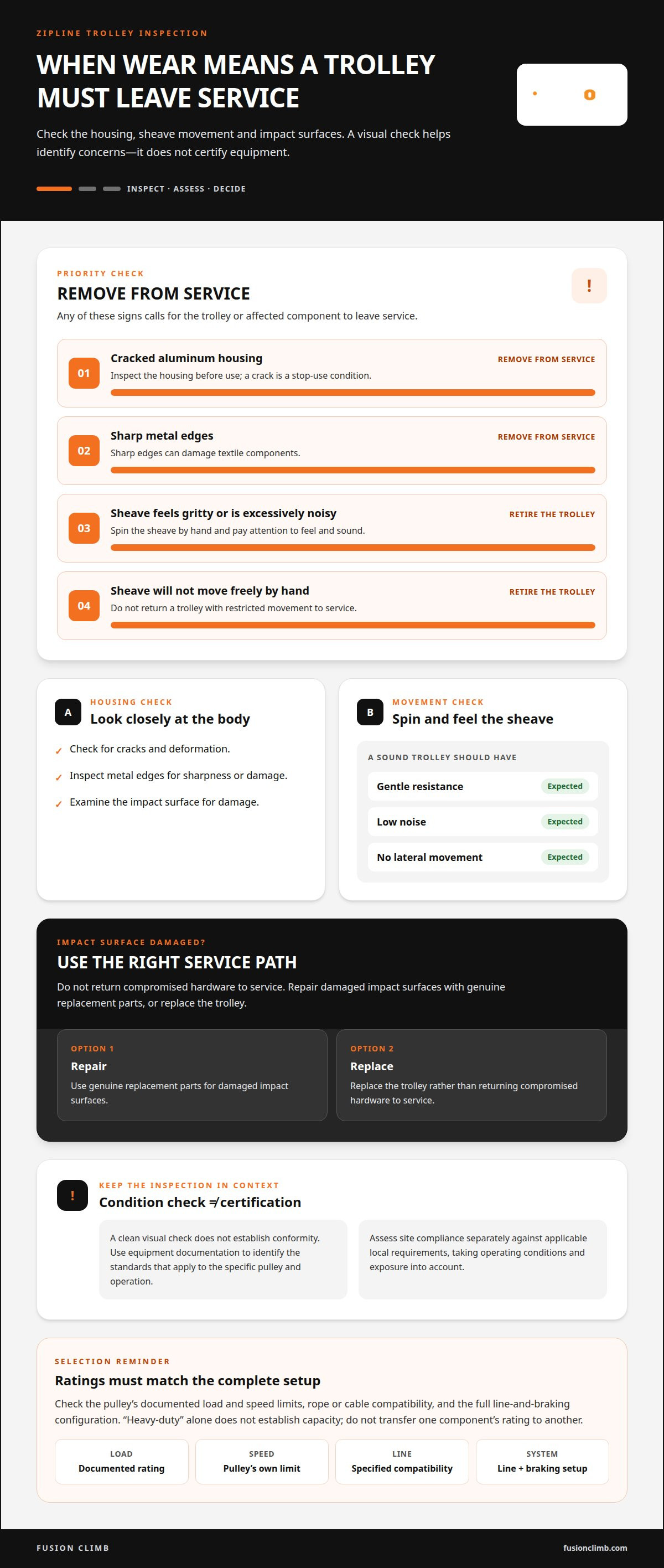
Inspect the aluminum housing before use. Look for cracks, deformation, sharp edges, and damage around the impact surface. Remove cracked housings and components with sharp metal edges from service, as they can damage textile components.
- Spin the sheave by hand: retire it if it feels gritty, makes excessive noise, or doesn't move freely.
- Check bearing movement: a sound trolley should have gentle resistance, low noise, and no lateral movement.
- Examine impact surfaces: repair damaged areas with genuine replacement parts or replace the trolley.
These checks help distinguish visible housing damage from changes in rotation. If an impact surface is damaged, use genuine replacement parts; otherwise, replace the trolley instead of returning compromised hardware to service.
The applicable standards depend on the specific pulley and operation. Use the equipment documentation to identify them. A visual inspection does not establish conformity or certify the equipment.
Assess site compliance separately against applicable local requirements, taking operating conditions and exposure into account. Equipment condition and site compliance are distinct reviews.
Which zipline pulleys are rated for heavy loads, high speeds, and long lines?
A pulley is suitable only when its documented load and speed ratings match the operating system. “Heavy-duty” alone does not establish capacity. Rider load, line layout, braking method, and operating speed all affect equipment selection. A long line can create different demands from a short setup, so assess the complete configuration rather than one component in isolation.
Line length provides useful context, but it is not a pulley rating. A pulley selected for a long installation still needs ratings that suit the intended load, line, and braking arrangement. Length alone cannot determine suitability; route profile and operating conditions also affect the demands on the trolley.
- Match the load rating: Compare the pulley’s documented rating with the intended operating load and system requirements.
- Match the speed rating: Confirm that the pulley’s stated operating limits suit the expected speed and braking arrangement.
- Match the line: Check the pulley’s stated rope or cable compatibility before pairing it with a line.
- Review the full setup: Treat the trolley, line, and braking system as a connected configuration, not separate rating claims.
Rope dimensions require the same care. A recommendation for semi-static rope does not establish universal compatibility. The pulley’s stated line range determines whether a particular rope fits; both diameter and construction matter for proper tracking.
Speed claims also need context. A rating for a braking product does not establish that a pulley has the same limit. Keep each component’s documented limits distinct, and never transfer one product’s speed figure to another.
For a long-line setup, assess the pulley alongside the route, operating load, and braking method. Select equipment within the specific model’s documented limits, then evaluate how the complete configuration works together.
Forum participants described a 200 m zip line at an accrobranche park near Montpellier, France, and a garden line about 75 m long using semi-static caving line; these reports do not establish pulley ratings.
What are the load limits, speed limits, and temperature ratings of popular zipline pulleys?
There is no single load, speed, or temperature rating that applies to every zipline pulley. Ratings belong to a specific model and configuration. Use the manufacturer’s documentation to identify each limit, then match it to the intended line, operating load, and braking setup. A figure for one component does not transfer to another.
For example, a zipline braking product described in the available information is engineered for speeds up to 72 km/h. That figure applies to the braking product, not automatically to a pulley used with it. Keep component ratings separate, and don’t treat a braking speed as proof of a trolley’s capacity.
- Load: Find the pulley’s stated load rating and compare it with the complete system’s operating requirements.
- Speed: Use the pulley’s own speed limit, not a figure published for a brake or another component.
- Temperature: Check the model documentation for its operating range and any restrictions tied to use or storage.
- Service: Follow the model’s maintenance instructions before attempting adjustments or field work.
Temperature ratings matter because pulley materials, bearings, and lubrication can respond differently to heat and cold. Use the stated operating range for the exact model. Do not infer it from aluminum construction, bearing type, or the housing’s appearance.
Serviceability also varies by design. The Precision Pulley has no user-serviceable parts, so field disassembly is not an appropriate maintenance step for that model. Treat this instruction as specific to the Precision Pulley, rather than assuming all pulleys have the same service limits.
Record the model name, documented load and speed limits, and temperature range together. Compare those specifications with the planned setup and braking equipment. If the documentation does not state a component’s rating, do not substitute a number from another product. A sound decision matches each limit to its own component and operating role.
How do stainless steel, aluminum, and sealed-bearing zipline pulleys compare for corrosion resistance?
Stainless steel and aluminum are materials; sealed-bearing describes a bearing design. They are not direct alternatives. Stainless steel components can resist corrosion, while aluminum develops a surface oxide. Neither material makes a pulley immune to damage, and material alone does not establish suitability for a particular environment.
When inspecting aluminum housings, focus on the housing and its exposed surfaces. Look for corrosion, pitting, and changes around joints or bearing seats. Inspect stainless steel parts too, especially where surfaces meet other materials or grime and moisture can remain trapped. An exterior finish alone cannot reveal the bearing’s internal condition.
A sealed bearing is designed to limit contaminants entering the bearing. It does not change the metal used in the housing or sheave, and “sealed” does not mean “corrosion-proof.” Check the pulley’s documentation for bearing service limits and cleaning instructions. Do not assume a sealed unit can be opened or serviced in the field.
- Identify each material: Distinguish the housing, sheave, and bearing parts rather than treating the pulley as one material.
- Inspect exposed surfaces: Look for corrosion or pitting that could affect movement or contact with the line.
- Check rotation: Note unusual noise, roughness, or resistance during the prescribed inspection.
- Follow care instructions: Use the manufacturer’s maintenance guidance instead of an improvised lubricant or cleaning method.
For example, a pulley may combine an aluminum-alloy body with stainless-steel concave sheaves. That does not make every component stainless or guarantee corrosion resistance in every setting. Component material, exposure, drainage, and maintenance all influence what to inspect.
Choose by construction and documented care requirements, not a material label alone. Review pulley construction options when comparing materials, sheaves, and bearing designs for your setup.
Fusion Climb: Zipline Pulleys
Fusion Climb offers zipline pulleys for readers evaluating options after reviewing wear, operating limits, and material considerations. Use the specific pulley’s documentation to assess compatibility with your line and intended setup. A material label alone cannot establish suitability for every condition.
For a broader equipment configuration, Fusion Climb also offers full body harnesses, Superman style harnesses, and lanyards and tethers. These products serve different roles in zipline equipment selection, while pulley choice should remain grounded in the component’s documented specifications and service limits.
If you’re considering equipment for your setup, contact Fusion Climb.
Make Your Next Equipment Decision Deliberate
Base your next step on operating conditions, not a broad label such as “heavy-duty.” Before selecting equipment or planning service, define the environment, each component’s role, and the documentation needed to assess fit. This gives the decision a clear basis and keeps assumptions from replacing model-specific information.
Selecting a zipline pulley for extreme conditions starts with understanding how the system will be used. Treat a zipline pulley for extreme conditions as part of a planned equipment decision, not an isolated upgrade. Keep that in mind as conditions change, equipment is replaced, or service needs arise.
Fusion Climb can be part of that equipment decision. Discuss your pulley needs with Fusion Climb and take the next step with a clear understanding of your setup.
Frequently Asked Questions
What features make a zipline pulley suitable for extreme weather and harsh environments?
Choose a pulley with documented operating limits that match expected exposure and system demands. Look for clear details on materials and bearings, environmental guidance, and cleaning and service instructions. A sealed bearing can help limit contaminant entry, but that feature alone does not establish suitability for every environment. For a winter installation, for example, consider how ice could affect wheel movement and follow the manufacturer’s operating guidance.
How do you choose a pulley for wet, icy, dusty, or saltwater conditions?
Match the pulley’s documented environmental use and maintenance instructions to the actual site. In wet conditions, pay attention to drainage and corrosion; ice can obstruct rotation, dust can enter moving parts, and saltwater exposure can accelerate corrosion. Do not assume a material name or sealed bearing makes a pulley suitable for saltwater. After exposure, clean and inspect it as directed, and remove it from service if its movement or condition changes.