



Zipline Pulley for Rope and Cable: How to Choose the Right Fit
A pulley that looks right can still be wrong for the line. Choosing a Zipline pulley for rope and cable means checking more than the product label. The line type, diameter and construction, the sheave that contacts the line, and the pulley’s connection to surrounding hardware all affect fit. A mismatch can leave you with equipment that doesn’t suit the setup.
Rope and cable systems can require different pulley designs, so start with the actual line and intended arrangement rather than appearance or a general-use description. Use the line and pulley documentation to compare their specifications before considering other features.
This guide explains how to compare line construction and diameter, pulley design, and attachment interfaces. It also includes a checklist for recording the details you need to evaluate a product. Fusion Climb manufactures zipline pulleys and related safety hardware, so the focus is on matching the pulley to the line and complete system with safety in mind.
Key Takeaways
- Choose a Zipline pulley for rope and cable by matching its documented compatibility to the line’s type, diameter, and construction.
- Learn how sheaves, trolleys, and rope or cable pulleys differ, so you can interpret product descriptions more confidently.
- Compare pulley designs, bearing descriptions, and attachment interfaces by intended use and stated fit, not appearance alone.
- Use a practical checklist to record the line and setup details that matter before reviewing hardware specifications.
- Consider the pulley as part of a complete system, including the connecting hardware and the manufacturer’s product documentation.
Zipline Pulley for Rope and Cable: Understand the Compatibility Question
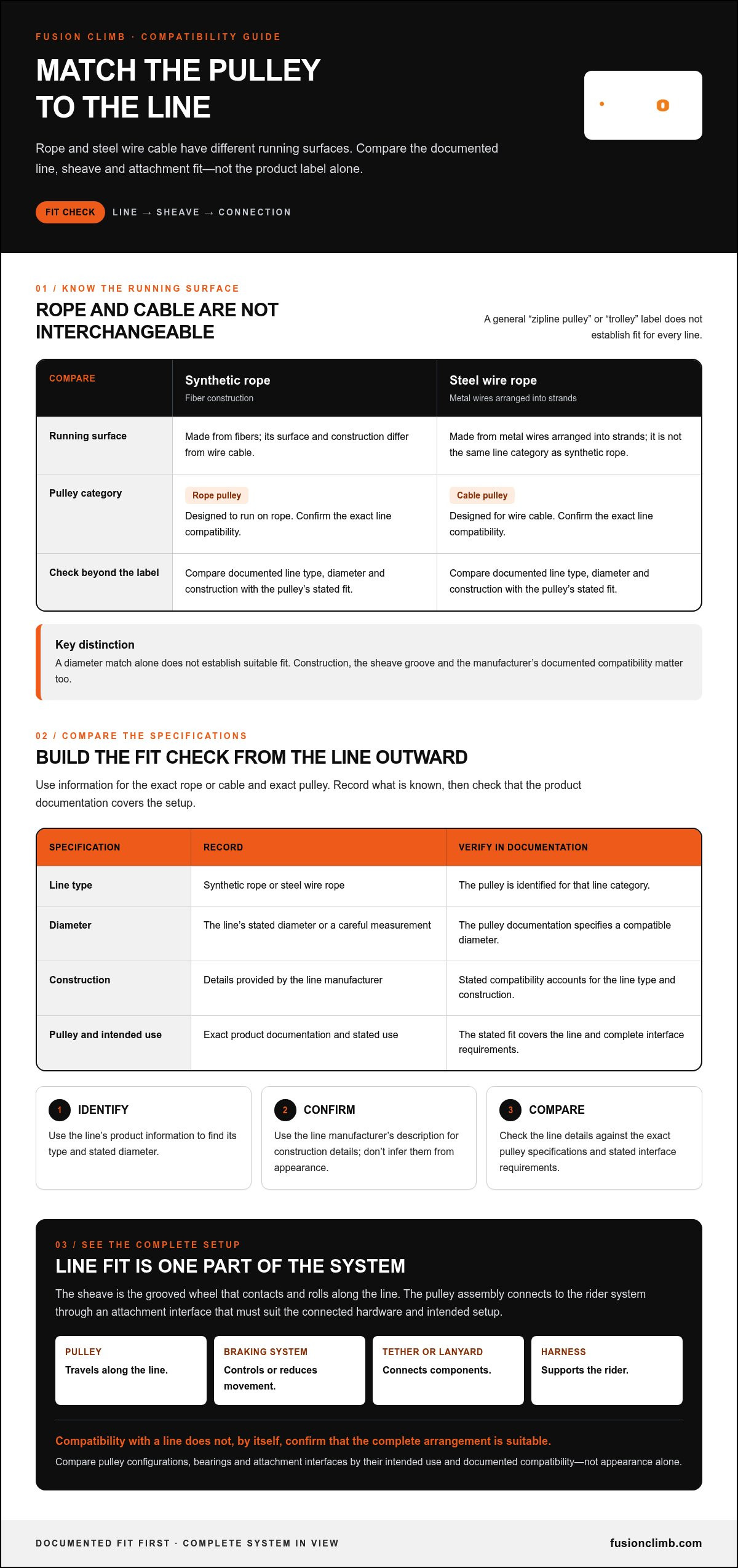
Line material and construction affect which pulley can run on it. Synthetic rope and steel wire rope have different running surfaces, so a pulley described for one should not be assumed to suit the other. A shared label such as “zipline pulley” or “trolley” doesn’t establish compatibility with every rope or cable.
Pulley compatibility is the documented fit between a pulley’s sheave and attachment interface and the line and connected hardware specified for the setup. It depends on more than the product name. Line type, diameter, construction, and the pulley manufacturer’s stated use all matter.
How rope and wire cable differ as pulley running surfaces
Synthetic rope is made from fibers; steel wire rope is made from metal wires arranged into strands. They have different surface and construction characteristics, so the terms aren’t interchangeable. A rope pulley is designed to run on rope, while a cable pulley is designed for wire cable. Those broad descriptions alone, however, don’t identify every compatible line.
Diameter and construction affect how a line sits against the sheave, the grooved wheel that contacts and rolls along it. A line that seems close in size may still differ in construction or surface. Compare the line’s documented type and dimensions with the pulley’s stated compatibility instead of relying on nominal size or visual resemblance.
What a zipline pulley does within the complete setup
As the rider travels, the sheave rolls along the line. The pulley assembly connects to the rider system through an attachment interface that must suit the connected hardware and intended setup. “Trolley” generally refers to the complete travelling assembly, while “pulley” may refer to the wheel or the assembly, depending on the product description.
Keep each component’s role clear. The pulley travels along the line; a braking system controls or reduces movement; a tether or lanyard connects components; and a harness supports the rider. These parts work together, but one function doesn’t establish another. A pulley’s compatibility with a line doesn’t, by itself, confirm that the complete arrangement is suitable.
For a wider view of equipment in commercial settings, see the commercial zipline pulley guide. When selecting a Zipline pulley for rope and cable, start with the actual line and complete system, then compare those details with the pulley’s product documentation.
Match Pulley Fit to Rope or Cable Specifications
Build the fit check from the line outward. Record the rope or cable type, its diameter and construction, and the pulley’s manufacturer-stated compatibility. Treat every dimension and fit statement as product-specific. Check it against the documentation for the exact line and pulley instead of assuming a general description applies.
| What to compare | What to record | What to verify |
|---|---|---|
| Line type | Synthetic rope or steel wire rope | The manufacturer identifies the pulley for that line category |
| Measured diameter | The line’s stated diameter or a careful measurement | The pulley documentation specifies a compatible diameter |
| Construction | Construction details provided by the line manufacturer | The pulley’s stated compatibility accounts for the line type and construction |
| Pulley compatibility | The exact product documentation and intended use | The stated fit covers the line and complete interface requirements |
Which rope and cable measurements matter?
Start with the line’s identification or product information. Find its type and stated diameter. If you need to measure it, use a suitable measuring method and record the result clearly. Don’t infer construction details from appearance. Use the line manufacturer’s description, then compare it with the pulley documentation. A diameter match alone doesn’t establish a suitable fit.
How sheave grooves and pulley geometry affect fit
The sheave groove contacts and guides the line as the pulley rolls. Its shape and dimensions need to correspond to the intended line, so compare documented geometry and compatibility rather than judging by sight. Two pulleys may look similar but differ in groove design or other fit details. Visual resemblance isn’t proof of compatible or safe operation.
Nominal size is a useful starting point, but it may not describe the line’s full surface or construction, or how the line sits in a specific groove. Read the specifications together: line information, pulley compatibility, and stated interface requirements. For commercial operations, the Association for Challenge Course Technology (ACCT) is a resource for industry standards and operational context. It doesn’t replace product-specific fit documentation.
Apply the same specification-first approach when comparing Fusion Climb zipline pulleys. Match the documented details to the actual line and setup before selecting a pulley.
Compare Zipline Pulley Designs, Bearings, and Attachments
Once you’ve established line fit, compare pulley configurations by intended application and documented compatibility, not by how robust or familiar they look. Single-wheel and multi-wheel assemblies are different configurations, but appearance alone won’t tell you which line they’re designed for or whether their attachment suits your setup. Use the manufacturer’s specifications to compare intended line and use, connection points, and any stated limitations.
What bearing and sheave details tell a buyer
The sheave is the wheel that contacts and guides the line. The bearing supports the sheave’s rotation. They have separate roles, so a bearing description isn’t proof of line compatibility. If the product documentation identifies a bearing type or maintenance requirements, use those details to understand the design and care instructions. Don’t infer a specific speed, friction level, durability, or service life unless the manufacturer provides substantiated information.
Keep the complete operating arrangement in view. The forces involved depend on the system and its use; the physics of zipline forces provides useful background on force balance and trajectory. That context is another reason to base pulley selection on product documentation, not a visual guess or bearing label alone.
Check the pulley connection and surrounding hardware
Inspect the attachment point and how the connecting hardware sits through it. Connector shape, gate or closure design, and available clearance can affect whether components fit together as intended. Compare the pulley’s interface dimensions and instructions with the connector information, and consider how the parts align in the intended setup. A connection that appears to fit isn’t automatically a compatible system interface. For terminology and connection considerations, see the professional climbing carabiner guide.
Keep the functions distinct: the pulley travels along the line, the carabiner or other connector links components, the tether connects parts of the rider system, the harness supports the rider, and braking equipment controls or reduces movement. Choosing a Zipline pulley for rope and cable is only one part of the assembly. Review each component’s stated purpose and compatibility together, and base material, rating, and performance comparisons on the relevant product documentation.
For a focused comparison, explore Fusion Climb zipline pulleys alongside the related connection hardware, then assess each option against the line and complete system requirements.
Use This Zipline Pulley Buying Checklist Before Selecting Hardware
Gather the line and system details before comparing pulley options. Use this checklist to create a consistent record while reviewing product descriptions and manufacturer documentation. Don’t fill gaps with assumptions. If a specification affects fit, it needs to be documented.
- Identify the running line. Record whether it’s synthetic rope or steel cable, along with the line’s product identification. Keep the line manufacturer’s documentation with your notes.
- Record dimensions and construction. Note the stated or measured diameter and any construction details the line manufacturer provides. A similar-looking line or nominal size isn’t a substitute for these details.
- Describe the use case and operating conditions. Write down the intended application and relevant conditions for the setup. Record what the pulley is expected to do, without assuming that a general-purpose label covers your use.
- Map the surrounding hardware. List the pulley’s connection point, the connector or carabiner, tether or lanyard, harness, and any braking components in the system. Record the interface requirements and clearances described by their manufacturers.
- Review the complete specifications. Compare the exact pulley documentation with the line and connected components. Check stated compatibility, ratings, limitations, and intended configuration. Make sure each specification applies to the assembled system rather than assuming a component’s rating covers the whole arrangement.
Review documentation, not assumptions
Use product information for the exact pulley under consideration. Compatibility statements should match the line type, dimensions, and construction. Interpret ratings and limitations in the configuration specified by the manufacturer. If documents use different terms or describe different setups, pause the comparison until the details are clear. The ropes course safety equipment guide offers wider context on how equipment fits into a larger system.
A Zipline pulley for rope and cable decision is strongest when every key detail has a source: line data, pulley documentation, connection requirements, and system context. Keep those records together to compare options on the same basis.
Explore Fusion Climb zipline pulleys and compare their product details with your recorded line and interface requirements.
Choose a Fusion Climb Zipline Pulley with the Full System in View
Make the decision in sequence: identify the running line, compare its documented details with the pulley’s stated fit, review the product documentation, then assess how the pulley connects within the complete system. This keeps the choice grounded in the actual equipment rather than a broad product label or an assumption based on appearance.
Fusion Climb manufactures zipline pulleys and related climbing and zipline hardware, including carabiners, lanyards, tethers, and harnesses. Considering these components together helps clarify how each part fits into a setup. Product-specific compatibility, ratings, limitations, and performance details should come from current manufacturer documentation, not general category descriptions.
Compare the pulley as part of the complete equipment setup
A pulley doesn’t operate in isolation. Its sheave runs along the line, while its attachment interface connects with surrounding hardware and rider equipment. Line type and dimensions, pulley fit, connector shape and clearance, tether configuration, and harness interface all contribute to the assembled system. Review the relevant instructions for each component and consider the intended connections as a whole.
Keep component roles distinct. The pulley travels along the line; a connector joins compatible components; a tether links parts of the rider system; and the harness supports the rider. Braking equipment has its own function and must be considered separately. A pulley isn’t a substitute for braking or other equipment required by the system design.
Make a decision from verified fit
Before selecting a Zipline pulley for rope and cable, match the line’s type, diameter, and manufacturer-described construction to the pulley’s documented compatibility. Then review the intended application, attachment interface, ratings, and stated limitations. Check that each specification applies to the exact product and intended configuration. A rating for one component shouldn’t automatically be treated as approval for the full assembly.
This process gives you a clear basis for comparing options: identify, match, review, and assess the complete system. For a safety-minded next step, explore Fusion Climb zipline hardware and review the product information alongside your line and setup requirements.
Make Your Next Pulley Choice with Confidence
A reliable selection starts with the line, not the label. Identify whether your setup uses rope or steel cable, record its documented dimensions and construction, then compare those details with the pulley’s stated compatibility. Review the sheave, attachment interface, and product documentation together so your choice reflects the complete system.
The right Zipline pulley for rope and cable matches the intended line and connects appropriately with the surrounding hardware. Keep the pulley, connector, tether, harness, and braking equipment in their distinct roles. Don’t treat one component’s specifications as proof that an entire setup is suitable.
Fusion Climb manufactures zipline pulleys and specialized climbing and zipline safety gear, including carabiners, lanyards, tethers, and harnesses. Explore Fusion Climb zipline pulleys and review product details against your line and equipment requirements. Start with the line and compare the complete system to make an informed selection.
Frequently Asked Questions
Can one zipline pulley work with both rope and cable?
It depends on the specific pulley and line specifications. Synthetic rope and steel cable differ in construction, diameter, and contact surface, so a shared product label doesn’t establish that one pulley suits both. Compare the manufacturer’s stated compatibility with the line type, documented dimensions, and construction details. If the product documentation doesn’t clearly address the intended line, don’t assume the fit based on appearance or a general-use description.
How do I know what size zipline pulley I need?
Start by identifying the line type and its documented diameter, then compare those details with the specifications for the exact pulley. Include the intended application and the pulley’s connection interface in your assessment. A measurement alone doesn’t establish compatibility, capacity, or suitability for the complete system. Check the manufacturer’s documentation for the stated fit and relevant limitations, and don’t rely on a general sizing chart that isn’t tied to the specific product.
What is the difference between a rope pulley and a cable pulley?
The terms generally describe pulleys intended to run on rope or steel cable, respectively, though exact designs vary by product. The sheave groove contacts and guides the line, so its design needs to match the intended running line. Rope and steel cable aren’t interchangeable. Use the manufacturer’s compatibility information to compare options; the product name alone doesn’t establish that a pulley fits a particular line.
Does a zipline pulley need a specific type of bearing?
There isn’t one bearing type that can be named as suitable for every pulley or application. Bearings support the sheave’s rotation, and the appropriate design depends on the specific product and intended use. Review the manufacturer’s bearing description and maintenance information where provided. Don’t assume that a bearing label guarantees a particular speed, lifespan, or performance advantage. Compare those details alongside line compatibility and the pulley’s complete product documentation.
Can I use a climbing pulley on a zipline?
Not based on the climbing label alone. A pulley intended for climbing isn’t automatically suitable for zipline use, because intended application, line compatibility, ratings, and system interfaces all matter. Compare the exact product documentation with the line and complete setup. Don’t rely on a broad category name or create an improvised configuration. The pulley’s stated use and limitations need to match the intended arrangement before it’s considered for that application.
What should I check before buying a zipline pulley for cable?
Identify the cable type, documented diameter, construction details, and intended use. Then compare those specifications with the exact pulley’s manufacturer documentation, including stated cable compatibility, connection interface, ratings, and limitations. Confirm that any rating applies to the intended configuration rather than assuming it covers the entire system. A visual match or product title isn’t enough to establish suitability. Keep the cable and pulley documentation together while comparing options.
How does a zipline pulley connect to a harness or tether?
The pulley connects into the equipment assembly through an interface intended to work with the surrounding hardware. The harness supports the rider, while a tether links components; these functions are distinct from the pulley’s role. Connector dimensions, orientation, clearance, and product instructions can affect how components fit together. Review the documentation for the pulley, connectors, tether, and harness as a complete setup rather than assuming one component’s fit validates the rest.