



Shock Absorbing Lanyards: A Practical Buying Guide for 2026
The lanyard with the most reach or connectors isn’t automatically the right choice. When comparing shock absorbing lanyards, consider how a single-leg or Y-style design, connector type, and overall length fit your task and fall-protection system.
Those details matter because an energy absorber is designed to deploy during a fall arrest. Its deployment can affect the clearance needed below the worker, while a connector that doesn’t match the anchor interface can make the setup unsuitable.
This guide explains what an absorber does and how to compare leg configurations, connectors, and lengths. It also covers why you need to consider clearance and compatibility across the complete system, not just the lanyard. Use the comparisons and checklist to narrow your options to a configuration that fits the task and approved fall-protection setup.
Key Takeaways
- Understand how an energy absorber deploys during fall arrest and why it must be considered as part of a compatible system.
- Compare shock absorbing lanyards by leg configuration, absorber design, connector type, and length, rather than relying on product names alone.
- Use Fusion Climb listings to compare configurations, then match the details to your task and system interfaces.
- Review harness attachment points, anchor interfaces, labels, and instructions before selecting equipment.
- Follow a clear buying sequence: define the task, identify system interfaces, assess clearance, and then compare listings.
What Are Shock Absorbing Lanyards, and When Are They Used?
A shock-absorbing lanyard is a connecting device with an energy absorber designed to deploy during a fall arrest and reduce the forces transmitted through a compatible fall-protection system. It connects a worker’s harness to an appropriate anchorage as part of a system designed to arrest a fall.
The lanyard is only one component. Its suitability depends on how it works with the harness, anchor, connectors, and task. A mismatch between components, or insufficient clearance below the worker, can make the overall arrangement unsuitable. The system’s instructions and the task’s requirements matter as much as the lanyard’s basic type.
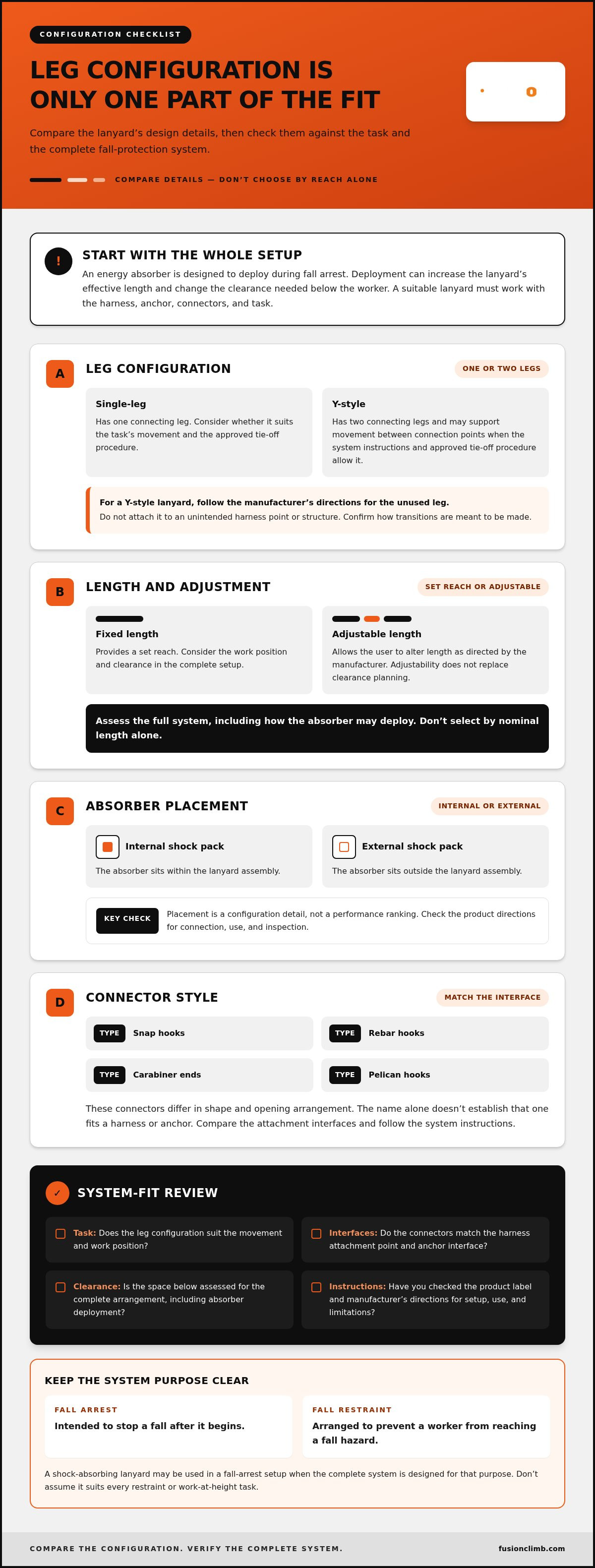
Fall arrest and fall restraint have different purposes. A fall-arrest system is intended to stop a fall after it begins. A restraint system is arranged to prevent a worker from reaching a fall hazard. A shock-absorbing lanyard may be used in a fall-arrest setup when the complete system is designed for that purpose. Don’t assume it suits every restraint or work-at-height task.
How does a shock absorber work during a fall?
During a fall arrest, the energy absorber is designed to deploy progressively, helping manage the energy created as the worker’s movement is stopped. Deployment doesn’t guarantee a safe outcome, and the details vary by device. As the absorber opens, the lanyard’s effective length can increase, changing the system configuration and the clearance needed beneath the worker.
Read the product label and manufacturer’s instructions for the specific device. They explain its intended setup, use, and limitations. For a general overview of harnesses and their role in fall protection, see Safety harness with shock-absorbing lanyard.
Where are shock-absorbing lanyards commonly used?
These lanyards are used in work-at-height environments such as industrial safety, construction, tower climbing, rescue, and rope access. Each setting brings different work positions, anchor arrangements, and movement needs. The task and complete system determine which equipment is suitable. The industry label alone isn’t enough to make that decision.
For example, movement between work positions may affect the required leg configuration, while the anchor interface determines which connector can be used. Clearance must also account for the full system arrangement, including absorber deployment. Don’t select by reach or convenience alone.
Zipline tether applications have their own equipment considerations. The related Zipline Lanyards & Tethers guide provides a focused look at those connections. For fall-arrest work, choose equipment for the task and use it only within a compatible system, following its labels and instructions.
Compare Shock Absorbing Lanyard Designs, Lengths, and Connectors
Compare each feature against the task and the system’s instructions. A lanyard’s leg count, length, absorber placement, and connector shape describe its configuration. None of these details alone establishes that it suits a particular setup. Use the product label and manufacturer instructions to evaluate the complete arrangement.
Single-leg or Y-style: which configuration fits the task?
A single-leg design has one connecting leg. A Y-style design has two, which may support movement between connection points when that use is allowed by the system instructions and approved tie-off procedure. Neither configuration is automatically better. The task, anchorage layout, and permitted connection method determine what fits.
With a Y-style lanyard, follow the manufacturer’s directions for the unused leg. Don’t attach it to an unintended harness point or structure, as this can alter the system in a way the equipment wasn’t designed for. Confirm how transitions are meant to be made before relying on the second leg.
| Design choice | What differs | What to consider |
|---|---|---|
| Single-leg or Y-style | One connecting leg or two | Task movement and approved tie-off procedures |
| Fixed or adjustable length | Set length or a length that can be adjusted | Work position, instructions, and clearance in the full setup |
| Internal or external shock pack | Absorber placement within or outside the lanyard assembly | Product-specific directions and configuration |
| Connector style | Different shapes and attachment interfaces | Compatibility with the harness and anchor connection points |
What do lanyard length and connector types change?
Fixed-length options provide a set reach, while adjustable designs allow the user to alter the lanyard length as directed by the manufacturer. Adjustability doesn’t replace clearance planning. Assess the complete system, including how the absorber may deploy, and don’t choose by nominal length alone.
Internal and external shock-pack designs differ in where the energy absorber sits in the assembly. Treat this as a configuration detail, not a performance ranking. Check the product’s instructions for how it must be connected, used, and inspected.
Connector selection depends on the compatible attachment interface. Snap hooks, rebar hooks, carabiner ends, and pelican hooks have different shapes and opening arrangements. The name alone doesn’t establish that a connector fits a given harness or anchor. Compare the interface and follow the system instructions. The Professional Climbing Carabiners guide can help clarify carabiner terminology.
Use this framework to compare shock-absorbing lanyard configurations by their stated design details, then match a candidate to the task and approved system.
Compare Fusion Climb Shock-Absorbing Lanyard Options
Product names can help identify a configuration, but they don’t replace checking the full description, label, and instructions. Fusion Climb’s collection includes single-leg and Y-style lanyards, fixed and adjustable options, internal shock-pack designs, and several connector arrangements. Compare the features in the listings, then match them to the task and approved system.
Connector style describes the attachment end; absorber design describes how the energy-absorbing component is arranged. These are separate selection details, even when both appear in a product name. A hook type alone doesn’t establish that the complete lanyard is suitable for your harness and anchor.
Examples of Y-style and adjustable configurations
Fixed-Length Y-Lanyard with Shock Absorber - Lobster Claw Style is an example of a Y-style configuration identified as fixed-length, with a lobster-claw style named in its title. This can help narrow a search when the task calls for a fixed-length, two-leg arrangement. It isn’t a recommendation by itself; confirm its specific setup against the system instructions.
By comparison, Adjustable Y-Lanyard with Shock Absorber & Hitched Loop - Open Ends names an adjustable Y-style design and identifies a hitched loop and open ends. Those words describe the listed arrangement. Review the product information to understand how adjustment works and how its ends are intended to connect. Don’t infer fit or compatibility from the title alone.
Other Y-style listings use connector variations, including carabiner-end or pelican-hook-end configurations. These examples let you compare attachment styles while keeping leg arrangement in view. The word “ANSI” in a listing name should not replace checking the product’s stated specifications and documentation.
Examples of single-leg and internal shock-pack designs
Fall Protection Shock Absorbing Lanyard With Two Snap Hooks - Black identifies a shock-absorbing lanyard with two snap hooks. Compare those connector interfaces with the connection points in your system. Don’t assume that two hooks mean a Y-style design unless the description identifies it that way.
Fall Protection Internal Shock-Absorbing Lanyard With Steel Snap Hook - Black provides a contrast because its name specifies an internal shock-absorbing design and a steel snap hook. Check the product details for the absorber arrangement and connector type. The name doesn’t establish a performance ranking against an external-pack design.
The listing titled Shock pack only, no hooks. No D-rings. is a component-only option, not a complete hooked lanyard. Treat it differently from assembled lanyard listings and consider it only where the required compatible components and instructions call for that configuration.
As you compare shock absorbing lanyards, shortlist by task, leg arrangement, absorber design, and connector interface. The collection describes high-strength webbing, reinforced stitching, and abrasion-resistant materials, but those general collection details don’t determine whether a specific configuration fits your system. Read each listing closely and use product-specific instructions to make the final comparison.
Check Compatibility, Clearance, and Common Selection Mistakes
A lanyard is suitable only when its connectors and intended use fit the rest of the fall-arrest system. Before choosing, check the harness, anchor, lanyard, and their instructions as one setup. A part that looks sturdy or fits through an opening may still be unsuitable if its use isn’t permitted by the product instructions.
How to check lanyard and system compatibility
- Match the interfaces. Check the lanyard connector against the intended anchor or harness attachment point. Confirm that the connector closes and engages as its instructions specify. Don’t assume a hook fits every ring, anchor, or attachment point.
- Read the labels and instructions. Look for the product’s stated applications, limitations, connection method, and inspection guidance. Follow directions for the exact model and configuration, including instructions for a second leg or adjustable feature.
- Review claims in context. Standards, ratings, and stated limits are product-specific. Verify the exact claim on the product label or manufacturer documentation rather than assuming it applies to every lanyard in a category.
- Check the whole arrangement. Confirm that the harness attachment, lanyard, connector, and anchorage work together as intended. System-level planning matters; the Full Body Fall Arrest System Guide provides broader context for how components fit together.
Plan clearance before selecting by length
Clearance is the space needed below a worker for the system to arrest a fall without striking a lower level or obstruction. Assess the actual work position and anchor location, then account for the lanyard’s length and the space that may be needed as its energy absorber deploys. Consider the complete setup, not just the lanyard’s stated length. Product instructions provide device-specific information. A competent assessment can help evaluate the worksite and system when clearance is uncertain.
Don’t treat a shorter lanyard as an automatic solution. Anchor position, connection arrangement, movement, and absorber deployment all affect the available clearance. Confirm the setup against the manufacturer’s instructions before use.
Which mistakes can undermine a lanyard selection?
- Choosing by appearance or length alone. A familiar-looking design or convenient reach doesn’t establish compatibility with the harness, anchor, and task.
- Assuming every hook fits. Connector style must suit the intended attachment interface and be used as directed.
- Improvising with unused legs. Don’t attach a lanyard leg to an unintended harness point or nearby structure. Follow the manufacturer’s specified connection procedure.
- Returning equipment to use after fall arrest. Don’t reuse equipment after it has arrested a fall unless its instructions explicitly allow it. Follow the stated inspection and removal-from-service guidance.
Use this checklist to review the complete setup before narrowing your options. Compare Fusion Climb shock-absorbing lanyard configurations by their stated connections and design details, then assess each against the task, system instructions, and clearance needs.
Choose and Order the Right Shock Absorbing Lanyard
Make the decision in sequence. Start with the work, map the equipment interfaces, assess clearance, and then compare product listings. This keeps a convenient feature from driving the choice before you know what the fall-protection system requires. Recording the task and system details also makes it easier to compare options consistently.
Use this checklist before selecting a listing
- Define the task. Note where the work will take place, the worker’s position, and how movement or transitions affect the connection. Describe the actual work, not just the industry or job title.
- Identify the system interfaces. Record the harness attachment point and the anchor interface, then refer to the instructions for the harness, anchorage, and other system components. The connector and connection method must fit those documented requirements.
- Check the required configuration. Establish whether the approved procedure calls for a single-leg or Y-style lanyard and whether a fixed or adjustable length is specified. Don’t choose a configuration simply because it seems more flexible or easier to handle.
- Assess clearance. Consider the work position, anchor location, lanyard arrangement, and absorber deployment when evaluating the space below. Use product-specific instructions and an appropriate competent assessment for the worksite. Don’t treat the lanyard’s stated length as the full clearance calculation.
- Compare listings against the record. Check each product’s connector type, absorber arrangement, length details, labels, and instructions against the system requirements you’ve identified. Set aside options that don’t match rather than adapting the system around a preferred listing.
Keep the information together: task, connection points, applicable instructions, and clearance considerations. This gives you a practical basis for comparing shock absorbing lanyards and helps prevent a product name or single feature from being mistaken for proof of compatibility. Before ordering, review the selected listing’s product-specific details and make sure the configuration matches the intended system.
Browse the collection with the right requirements in hand
Fusion Climb’s collection brings together different lanyard configurations for comparison. Use your checklist as a filter, not as a substitute for product instructions. Read the listing and label carefully, and compare only options that align with the documented system and work task.
Review the ordering policy before purchase: Fusion Climb soft goods are made to order and aren’t eligible for returns, exchanges, or refunds. Make your configuration decision carefully before placing an order.
Browse shock-absorbing lanyards and compare the listed options against your system requirements.
Make Your Next Move With a Clear Plan
The right choice should make sense on paper and in the work area where the system will be used. Before ordering, turn your task and system requirements into a short selection record. Keep it with your equipment planning, and revisit it if the work position, anchor arrangement, or approved procedure changes. Don’t assume a lanyard selected for one setup is suitable for another.
Use the same discipline after purchase. Make sure the people using the equipment can identify its intended configuration and follow the product-specific instructions. Build inspection and care into regular work practices, and remove equipment from use when its condition or history raises concern. Good selection is a deliberate process, not a guess based on appearance.
Choosing shock absorbing lanyards means matching a specific device to a documented task and compatible system. Compare the relevant listings against your requirements, then make your selection based on those details.
Browse Fusion Climb shock-absorbing lanyards and compare configurations for your system requirements.
Frequently Asked Questions
Is a shock-absorbing lanyard the same as a fall-restraint lanyard?
No. Fall restraint is set up to keep a worker from reaching a fall hazard, while fall arrest is designed to stop a fall after it begins. The equipment’s label and instructions, along with the system’s design, determine its intended use. For example, a connection that allows a worker to reach an unprotected edge shouldn’t be treated as restraint simply because the lanyard is short.
What happens to a shock-absorbing lanyard after it arrests a fall?
The absorber may deploy, and the lanyard can be visibly changed or extended. Remove the equipment from service after a fall arrest and follow its manufacturer’s instructions for evaluation and disposal or replacement. Don’t rely on appearance alone to decide it’s reusable; internal damage or deployment may not be obvious. Keep it separate from ready-to-use equipment so it can’t be mistakenly put back into service.
How often should a shock-absorbing lanyard be inspected?
Inspect it before each use, and follow the manufacturer’s instructions for any additional inspection schedule or method. Look closely at webbing, stitching, connectors, and the absorber area for damage, unusual wear, contamination, or signs of deployment. Check that labels remain legible so the equipment can be identified and its instructions followed. Remove questionable equipment from use until it’s handled according to those instructions.
Can a shock-absorbing lanyard be used for work positioning?
Only if the specific product and complete system are intended for that use. Work positioning supports a worker at a work location, while fall arrest addresses a fall that has started. A lanyard described as shock absorbing shouldn’t automatically be treated as a positioning device. Check the equipment’s stated applications and the work system’s instructions, including whether a separate fall-protection arrangement is required.
Do shock-absorbing lanyards have a maximum user-weight limit?
Yes, the permitted user-weight range is product-specific, so check the label and instructions for the exact lanyard and system. ANSI/ASSP Z359.13-2013 (R2022) addresses energy-absorbing lanyards for users weighing 130 to 310 pounds, but that range shouldn’t be assumed to apply to every product. Don’t select equipment based on a general standard reference alone; use the product’s documented limits.
Can a shock-absorbing lanyard be shortened or modified?
Don’t cut, tie, splice, or otherwise alter a lanyard unless the manufacturer’s instructions explicitly describe an approved adjustment for that model. A modification can affect how the equipment connects or how its absorber functions. If a fixed length doesn’t fit the required setup, compare an appropriate listed configuration rather than improvising. Use adjustment features only as directed, and preserve the original labels and components.
What does maximum arrest force mean on a lanyard product description?
Maximum arrest force describes the highest force transmitted to the user during a fall-arrest test or event under the stated conditions. It isn’t the lanyard’s user-weight limit, nor does it describe how much load the anchor can support. Interpret the figure alongside the product’s standard, test conditions, and instructions. Don’t compare values from different products unless their stated testing basis is comparable.