



Full Body vs. Seat Harness: Ziplining Safety Guide
A single degree of line grade can be the difference between a thrilling descent and a dangerous rider inversion. Choosing between a full body vs seat harness for ziplining isn't just about guest comfort; it's a critical decision rooted in physics and liability management. You want to provide an unforgettable experience that keeps guests secure and your operation compliant with the latest standards like ANSI Z359.11. Selecting the wrong hardware for a steep line or a high-volume tour puts your riders at risk and exposes your business to unnecessary legal vulnerability.
We understand the pressure to balance operational efficiency with rigorous safety protocols. This guide provides the technical clarity you need to determine which harness configuration suits your specific line geometry and rider demographics. We'll break down the engineering behind center-of-gravity requirements, explain the nuances of current industry standards, and help you maximize the cycle-life of your professional-grade equipment. By the end of this article, you'll have a clear roadmap for selecting gear that ensures maximum safety and performance for every rider on your line.
Key Takeaways
- Master the technical distinction between a full body vs seat harness for ziplining to match your equipment to specific course geometry.
- Identify when seat harnesses provide the necessary ergonomic efficiency and freedom of movement for commercial tours and ropes courses.
- Learn why full body systems are the industrial-grade standard for preventing rider inversion on steep, high-angle lines.
- Understand the physics of Center of Gravity and how attachment points dictate rider orientation during high-speed braking.
- Explore specialized hardware requirements for Superman-style prone flight to deliver a premium guest experience while maintaining rigorous safety standards.
Seat vs. Full Body: Understanding the Zipline Safety Equation
Safety isn't a suggestion. It's a structural requirement. Every zipline operation must account for the specific physics of their course, and the primary variable in that equation is the harness system. The debate between a full body vs seat harness for ziplining often centers on comfort, but the real priority is mechanical reliability. Harness selection is the most critical safety decision an operator makes because it determines how the rider's body reacts to gravity, speed, and braking forces. It's the difference between a controlled descent and a liability risk.
Rider orientation is the cornerstone of this safety equation. It describes the angle at which a guest hangs while in flight. If the orientation is incorrect, a rider might tip backward or struggle to maintain a stable posture during high-speed sections. This stability depends on the precision of the connection points between the rider and the trolley. Total system integrity relies on every component, including professional climbing carabiners that ensure a secure, fail-safe connection to the lanyard and pulley.
The Seat Harness Defined
A seat harness, often categorized as a Type C climbing harness, consists of a reinforced waist belt and two leg loops connected by a belay loop. This design focuses the load-bearing capacity on the lower body. It's highly effective for low-angle, low-speed recreational lines where the risk of inversion is minimal. The primary advantage is the "sit-back" posture. This allows the rider to relax into the gear during flight, providing a natural experience for standard tours. Because the center of gravity is lower, it offers excellent freedom of movement. This is essential for ropes courses that require climbing or traversing between platforms.
The Full Body Harness Defined
A full body harness integrates shoulder straps and chest support to provide total torso containment. This Type A system is the industrial standard for high-angle adventures and steep lines where the risk of the rider flipping is high. It acts as a fail-safe against accidental ejections in high-dynamic environments where sudden stops or steep drops occur. By distributing forces across the shoulders, chest, and thighs, it keeps the rider upright and secure regardless of the line's grade. These systems often utilize dorsal or sternal attachment points to meet specific rigging needs. In commercial operations, full body gear is essential for beginners who may lack the core strength to maintain stability in a seat harness alone.
Seat Harnesses: Efficiency and Freedom for Standard Lines
Seat harnesses are the industrial workhorses of the aerial adventure industry. They offer a specific balance of comfort and agility that is hard to replicate with more restrictive systems. For commercial operators managing long-duration tours, the ergonomic design of a seat harness reduces user fatigue. It focuses pressure on the large muscle groups of the thighs rather than the torso. This design is particularly advantageous on hybrid ropes courses. Participants often need to climb ladders or navigate obstacles between zipline segments. The unrestricted leg movement allows for a natural range of motion that full body systems can sometimes hinder.
During high-volume summer operations, the lower weight and increased ventilation of a seat harness become vital. Heavy, padded gear can lead to heat exhaustion during peak hours. A streamlined seat harness keeps riders cooler and more comfortable, which directly impacts guest satisfaction. These systems integrate seamlessly with standard zipline lanyards and tethers, ensuring a reliable connection to the trolley. When evaluating a full body vs seat harness for ziplining, operators must consider how these efficiencies impact the daily workflow of their guides and the overall guest experience.
Operational Throughput and Ease of Fitting
Efficiency drives profitability in commercial parks. Seat harnesses allow for faster guest turnover because they are significantly easier to fit and adjust. Instead of managing complex shoulder and chest straps, guides can focus on a single waist belt and two leg loops. This simplicity reduces gearing up time by several minutes per group. It also allows operators to manage a diverse range of body types with fewer SKUs. Professional-grade harnesses feature color-coded webbing and quick-release buckles to streamline this process. If you are looking to upgrade your fleet, consider exploring our range of industrial-grade zipline harnesses to improve your daily throughput.
Limitations: When the Seat Harness Falls Short
Despite their efficiency, seat harnesses have strict operational boundaries. They rely on the user's waist-to-hip ratio to maintain a secure fit. For children or adults with smaller hips, there is a legitimate risk of slipping out if the harness is not perfectly tensioned. They also lack the upper body support required for high-impact events. If a rider hits a braking system at high speed, a seat harness provides no stabilization for the torso, increasing the risk of whiplash. Most critically, seat harnesses are generally unsuitable for lines with a grade steeper than 6%. On these high-angle descents, the risk of inversion is too great. Operators must adhere to OSHA fall protection standards and industry guidelines to ensure their equipment matches the physical demands of the course.
Full Body Harnesses: Maximum Security for High-Angle Adventure
Safety is as much psychological as it is mechanical. For beginners, children, and those tackling high-angle lines, the "fail-safe" nature of a full body harness provides immediate confidence. Unlike a seat harness that requires the rider to actively maintain their posture, a full body system uses integrated chest support to keep the guest in a stable, upright orientation. This is critical for high-speed descents where the wind or braking forces might otherwise cause a rider to pitch backward. When analyzing a full body vs seat harness for ziplining, the primary advantage of the full body model is this total torso containment. It eliminates the risk of a rider slipping out, regardless of their waist-to-hip ratio.
Engineering these systems requires a deep understanding of force distribution. In the event of sudden braking or a dynamic impact, a full body harness spreads the energy across the shoulders, chest, and hips. This prevents concentrated trauma to the lumbar region and keeps the spine aligned. Industrial reliability is the hallmark of professional gear. For a comprehensive look at the hardware required to maintain these safety margins, consult our professional guide to ropes course safety equipment. Selecting the right gear is a foundational step in managing the risks associated with modern aerial parks.
ANSI Z359.11 Compliance and Industrial Standards
In a global market projected to reach $12.4 billion by 2034, commercial operators cannot afford to cut corners on equipment standards. ANSI Z359.11 is the current U.S. benchmark for manufacturing and testing full body harnesses. Compliance with this standard is often a non-negotiable requirement for insurance providers. Professional-grade harnesses must include fall arrest indicators. These are visual stitching patterns that "pop" or reveal a warning color if the webbing has been subjected to excessive force. At Fusion Climb, we use high-tensile, industrial-grade webbing to ensure every harness survives the rigorous cycle-life demands of a busy commercial season.
Specialized Applications: Beyond the Standard Course
Full body systems are mandatory for specific course elements that go beyond standard horizontal lines. Vertical drops, "power fan" descents, and staff rescue training all require the torso support that only a Type A harness provides. These systems are also essential for use with certain commercial zipline pulleys that feature high-mount attachment points. If your course includes steep grades or complex braking systems, the upright stability of a full body harness is your best defense against rider inversion. It remains the dependable choice for operators who prioritize absolute security over operational speed.
The Physics of Flight: Center of Gravity and Inversion Risks
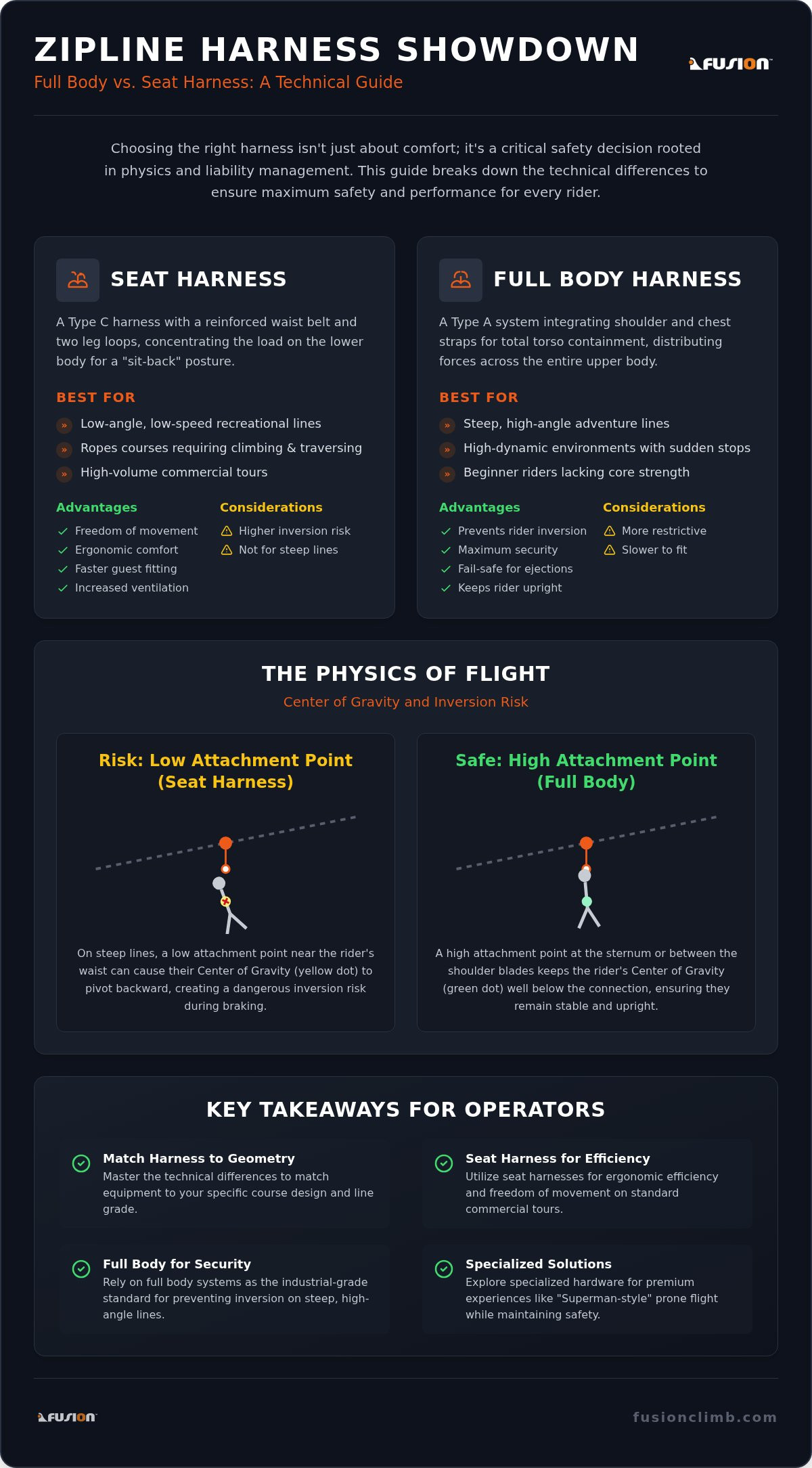
Every zipline is a laboratory for gravity and momentum. The Center of Gravity (CoG) serves as the pivot point for every rider, and its location relative to the attachment point determines stability. In a seat harness, the connection is at the waist, which places the CoG relatively high. This proximity between the pivot and the mass creates a potential for rotation. When a rider accelerates, any shift in body position can cause the harness to tilt. Understanding the mechanics of a full body vs seat harness for ziplining requires looking at how these attachment points manage the forces of flight.
The "Pendulum Effect" becomes most apparent during high-speed braking. When the trolley hits the arrestor, the rider's lower body continues to move forward due to inertia. If the attachment point is low, the legs can swing upward toward the line. This creates a dangerous "Inversion Point," which is the exact moment a rider's center of gravity passes the axis of the trolley. Once this threshold is crossed, the rider flips. Total system stability depends on the relationship between line tension, rider weight, and the vertical distance between the trolley and the harness connection.
Rider Orientation and Course Grade
Steep zipline grades, specifically those exceeding 10%, significantly increase the risk of back-flipping when using a seat harness. On a steep descent, gravity naturally pulls the rider's torso into a reclined position. While a reclined posture can help with aerodynamics, it makes effective braking much harder to manage. Most recreational guests lack the core strength to fight these gravitational forces on a 12% or 15% grade. Full body harnesses are the engineered solution for steep-line stability because they provide the mechanical support needed to keep the rider's head above their feet at all times.
The Role of the Sternal Attachment
A sternal or chest attachment point raises the effective pivot point of the rider. By moving the connection higher on the torso, you create a larger vertical gap between the CoG and the trolley. This prevents the "head-down" scenario during sudden stops. While a dorsal (back) attachment is excellent for aerodynamics and speed, the sternal connection offers superior visibility and upright control for the rider. Inversion risk is the primary technical reason for choosing full body over seat harnesses on high-velocity or high-grade lines. To ensure your course meets these rigorous physical demands, explore our selection of professional-grade full body harnesses designed for maximum stability.
Beyond the Basics: Superman Style and Specialized Solutions
Adventure operators often seek a way to differentiate their course by offering a premium rider experience. Prone flight, commonly known as "Superman style," represents the peak of this evolution. While the standard debate of full body vs seat harness for ziplining covers most upright applications, prone flight introduces a third dimension of engineering. It shifts the rider from a seated or vertical posture to a head-first, horizontal orientation. This isn't just a novelty; it's a high-performance configuration that requires specialized hardware to manage unique gravitational loads.
Fusion Climb leads the industry in the development of Superman style harnesses designed for commercial reliability. These systems are not interchangeable with standard gear. They require specialized pulleys and high-strength tethers to maintain the rider's horizontal plane. Our US-made hardware is engineered to withstand the repetitive stress of high-velocity tours while providing a sobering sense of security for the guest. Transitioning to prone flight requires a commitment to specific safety protocols and a deep understanding of horizontal load distribution.
Engineering for Prone Flight
Horizontal flight demands a total redistribution of weight. In a Superman style harness, the load is spread across the entire length of the torso and thighs to prevent "hammocking" or mid-flight sagging. Multi-point attachment systems are critical here. They provide the lateral stability needed to prevent the rider from rolling or pitching during high-speed descents. Safety protocols for prone operations also differ from standard lines. Guides must ensure precise tensioning of the leg and shoulder supports to maintain aerodynamics. Without this precision engineering, the rider risks losing orientation during the braking phase, which is why industrial-grade hardware is the only viable choice for these installations.
Final Selection Checklist for Operators
Choosing the right equipment depends on your specific course geometry and the "vibe" you want to provide. Use this checklist to finalize your gear strategy:
- Seat Harnesses: Select these for low-angle lines, ropes courses with climbing elements, and operations prioritizing fast guest turnover.
- Full Body Harnesses: Deploy these for steep grades (over 10%), beginners, and any scenario where preventing rider inversion is the primary safety goal.
- Superman Style: Use these for premium, high-speed lines where a head-first "flight" experience is the main attraction.
- Inspection and Retirement: Regardless of style, implement a strict schedule for gear retirement based on cycle-life and real-world wear.
Your equipment is the silent partner in every guest's journey. Ensure you are providing the highest level of protection by selecting hardware that meets or exceeds industrial testing standards. If you are ready to upgrade your fleet with professional-grade gear, explore the full Fusion Climb harness collection for your next operation.
Elevate Your Operational Safety Standards
Mastering the physics of aerial adventure requires gear that matches the technical complexity of your lines. Whether you are managing steep descents that demand torso containment or standard lines prioritizing throughput, your equipment remains the primary barrier against liability. The decision between a full body vs seat harness for ziplining is a technical calculation of center of gravity and inversion risk. It's about protecting your guests while maximizing the cycle-life of your professional-grade hardware.
Fusion Climb provides the precision engineering needed for high-stakes vertical environments. We maintain US-based manufacturing to guarantee quality and remain a trusted supplier to government agencies. Our ANSI Z359.11 compliant designs ensure your park meets industrial reliability standards for every tour. Don't leave your safety margins to chance. Secure your course with Fusion Climb's professional-grade harnesses and provide an experience that's as dependable as it is exhilarating. Your next season of adventure starts with the right connection.
Frequently Asked Questions
Can I use a seat harness for a steep zipline over 10% grade?
You shouldn't use a seat harness for lines with a grade exceeding 10%. At this steepness, the risk of rider inversion increases significantly because the center of gravity shifts too close to the attachment point. A full body harness provides the necessary torso containment to keep the rider upright during high-velocity descents. Using the wrong gear on steep grades creates a massive liability and endangers your guests. Always prioritize stable rider orientation over simple comfort.
Is a full body harness required by law for commercial ziplines?
No single federal law mandates full body harnesses, but they are often required by state regulations and insurance providers. Most commercial operators must follow ANSI/ACCT 03-2019 standards to maintain coverage and minimize liability. If your course features steep grades or high-speed braking, insurance adjusters usually insist on full body systems. Always check your specific local jurisdiction's requirements to ensure your operation remains compliant with the most current safety benchmarks.
How do I know if my zipline harness is ANSI compliant?
Look for a permanent label or tag sewn into the webbing that explicitly states the harness meets ANSI Z359.11 standards. This label should include the manufacturer's name, the date of manufacture, and a serial number for tracking. Professional-grade hardware from Fusion Climb undergoes rigorous real-world testing to ensure industrial reliability. If the label is missing, illegible, or only mentions recreational standards like EN 12277, the harness may not meet your commercial requirements.
What is the weight capacity of a professional-grade zipline harness?
Most professional-grade zipline harnesses are rated for a maximum capacity of 310 pounds, which aligns with standard ANSI Z359.11 testing parameters. This weight includes the rider and all attached gear. While some specialized heavy-duty models may support more, you must never exceed the manufacturer's stated limit. Exceeding these specifications compromises the integrity of the high-tensile webbing and increases the risk of component failure during a dynamic event or a sudden braking stop.
Are full body harnesses safer for children than seat harnesses?
Full body harnesses are generally safer for children because kids often lack the defined waist-to-hip ratio required to keep a seat harness secure. If a child flips upside down in a seat harness, they can potentially slip out of the leg loops. A full body system provides total torso containment, keeping them upright and secure throughout the flight. This setup also provides a psychological "fail-safe" that helps younger riders feel more confident during their first experience.
How often should I replace my zipline harnesses in a commercial setting?
You should replace commercial harnesses every five to ten years, depending on the manufacturer's guidelines and the intensity of use. However, you must retire any gear immediately if it shows signs of excessive wear, chemical damage, or if the fall arrest indicators have been deployed. High-volume parks often retire gear sooner due to the "cycle-life" of the webbing. Daily inspections are mandatory to identify frayed stitching or hardware corrosion before any guests use the equipment.
Can I convert a seat harness into a full body harness using a chest strap?
You can't safely convert a standalone seat harness into a full body system using a separate chest strap unless the manufacturer specifically designed them to work together as a certified unit. Combining mismatched components can cause the harness to fail under load or lead to dangerous rider orientation. When deciding between a full body vs seat harness for ziplining, you must purchase the specific configuration required for your line's grade to ensure total system integrity and reliability.