



Durable Full Body Harness for Industrial Work: How to Choose
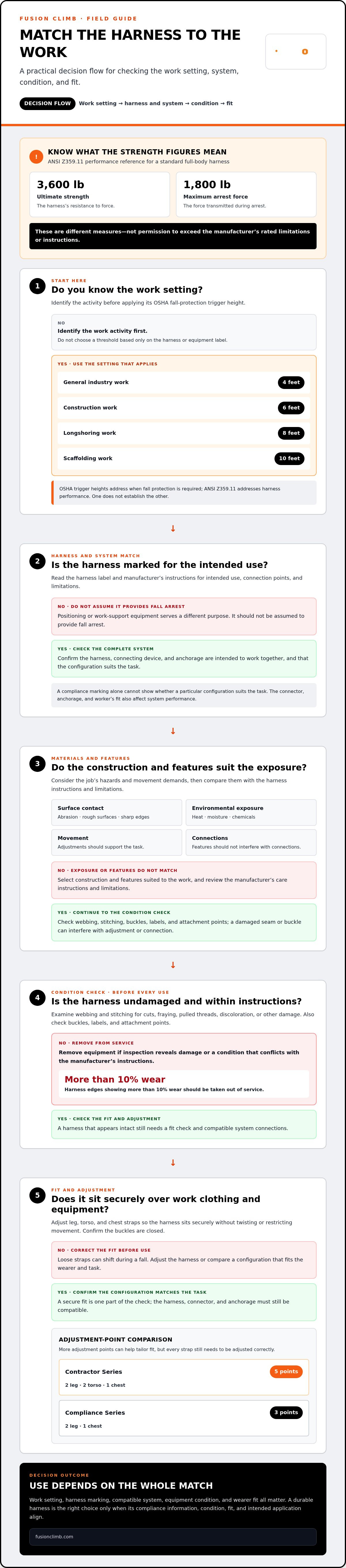
A durable full body harness for industrial use must do more than withstand hard conditions: it must fit correctly and connect the worker to a compatible fall-protection system. A standard full-body harness has an ultimate strength of 3,600 pounds and a maximum arrest force of 1,800 pounds.
Choosing a harness involves more than checking whether the webbing feels sturdy. Durability also depends on the components, configuration, fit, and standards suited to the work. A harness that does not fit or match the task can compromise safe use.
This guide explains how a full-body harness works and what to assess in its straps, buckles, D-rings, materials, and fit. You’ll also learn what ANSI Z359.11 compliance means, how to compare harnesses with body belts, and how OSHA fall-protection requirements vary by work setting. Use these factors to understand what a harness needs to do on the job, not just what it looks like on the shelf.
Key Takeaways
- Understand how a full-body harness distributes forces through its straps and attachment points during a fall arrest.
- Compare harness materials, adjustment points, and fit to identify a configuration suited to the work and the wearer.
- Learn what ANSI Z359.11 compliance covers, including the stated 3,600-pound ultimate strength and 1,800-pound maximum arrest force.
- According to the Occupational Safety and Health Administration (OSHA), fall-protection trigger heights are 4 feet for general industry work and 6 feet for construction work.
- See why body belts are not a substitute for a full-body harness in fall-arrest applications, and how harness components support different tasks.
ANSI Z359.11 compliance
ANSI Z359.11 provides a performance reference for full-body harnesses used in personal fall-arrest systems. Compliance matters because the harness must function as part of a connected system, not as an isolated piece of equipment. The connector, anchorage, and worker’s fit all affect system performance. A marking alone cannot show whether a particular configuration suits the task.
The standard values described for a standard harness include an ultimate strength of 3,600 pounds and a maximum arrest force of 1,800 pounds. These figures describe different measures. Ultimate strength concerns the harness’s resistance to force, while maximum arrest force concerns the force transmitted during arrest. Don’t treat either value as permission to exceed the manufacturer’s rated limitations or instructions.
Use the harness label and manufacturer’s instructions to identify its intended use, connection points, and limitations. Compare those details with the planned fall-protection system. A harness marked for fall arrest must be connected to compatible equipment and an approved anchorage. Positioning or work-support equipment serves a different purpose and should not be assumed to provide fall arrest.
- Read the marking: Match the standard designation and harness information to the manufacturer’s instructions.
- Check the complete system: Confirm that the harness, connecting device, and anchorage are intended to work together.
- Inspect condition: Look for damaged webbing, stitching, buckles, labels, or other signs that could affect use.
- Match the task: Select a configuration and connection point suited to the work, not simply the closest available harness.
ANSI harness performance and OSHA’s fall-protection trigger heights address different questions. ANSI Z359.11 concerns harness performance; OSHA requirements address when workers need fall protection. According to the Occupational Safety and Health Administration (OSHA), the fall-protection trigger height for construction work is 6 feet. According to the Occupational Safety and Health Administration (OSHA), the trigger height for longshoring work is 8 feet. According to the Occupational Safety and Health Administration (OSHA), the trigger height for scaffolding work is 10 feet. Identify the work setting before applying its threshold.
For example, a crew working from scaffolding should consider the 10-foot OSHA trigger height for that work, while a construction crew uses the 6-foot threshold. Neither threshold proves that a harness meets ANSI Z359.11. Conversely, a harness’s compliance marking doesn’t determine whether fall protection is required at a particular height. Employers need to assess the work activity, exposure, equipment instructions, and system connections together.
Before use, follow a consistent inspection routine: examine the harness and its identification, then confirm that the selected connection and system suit the task. Remove equipment from service if inspection reveals damage or a condition that conflicts with the manufacturer’s instructions. A durable full body harness for industrial use is the right choice only when its compliance information, condition, fit, and intended application align.
Choosing harness materials, features, and fit
Choose a harness by matching its construction and adjustment features to the work, the wearer, and the connected system. A suitable fit and appropriate materials support control and comfort during demanding tasks.
Harness Material and Feature Choices
Compare the harness construction and adjustments with the job’s exposure and movement demands. Abrasion, sharp edges, heat, and chemical contact can affect webbing and stitching, while unsuitable features can restrict movement or create poor connections. Review the manufacturer’s care instructions and limitations alongside the task hazards.
Look closely at webbing, stitching, buckles, labels, and attachment points. A harness may appear intact while a damaged seam or buckle interferes with adjustment or secure connection. Remove equipment if its condition conflicts with manufacturer instructions; harness edges showing more than 10% wear should be taken out of service.
- Assess exposure: Consider contact with rough surfaces, heat, moisture, or chemicals, then compare those hazards with the harness instructions.
- Inspect construction: Examine webbing and stitching for cuts, fraying, pulled threads, discoloration, or other damage.
- Match features to movement: Choose adjustment and attachment features that support the task without interfering with tools or work clothing.
Adjustment layout provides a practical point of comparison. The Contractor Series harness has five adjustment points: two leg, two torso, and one chest adjustment. The Compliance Series harness has three: two leg and one chest adjustment. More adjustment points can help tailor the fit, but each strap still needs to be adjusted correctly.
Fit and Compatibility Risks
A damaged, poorly fitted, or incompatible fall-arrest harness may not hold the wearer correctly or connect as intended. During a fall, loose straps can shift, damaged components may not perform as designed, and an incompatible connector or anchorage can undermine the system. That is why inspection and fit checks are essential before every use.
Put on the harness over the clothing and equipment required for the job. Adjust the leg, torso, and chest straps so the harness sits securely without twisting or restricting movement. Confirm that the buckles are closed and, for a Class A configuration, the back D-ring sits between the shoulder blades. Have the wearer move through relevant work positions and check that the straps stay in place.
- Check alignment: Ensure straps lie flat and the attachment point matches the harness configuration.
- Check connections: Confirm the connector fits the harness attachment point and works with the selected system.
- Check condition: Inspect the harness before use and remove damaged equipment from service.
For a task-specific comparison, review full-body harness configurations alongside the job’s movement and fit requirements.
What is a Full-Body Harness and How Does It Work?
A full-body harness secures a worker with connected straps around the torso and legs, and an attachment point links the wearer to a fall-protection system. During a fall, it helps distribute arrest forces across the body rather than concentrating them at the waist. Its function depends on the harness type, connection, and task.
There is no single cost that applies to every industrial harness. Price depends on the materials, configuration, adjustment features, and requirements of the intended application.
In fall arrest, the harness connects to a compatible connecting device and anchorage. If a worker falls, that system arrests the descent and holds the worker in the harness. The guide identifies fall-arrest harnesses for high-risk settings where workers may face a free fall of 6 to 12 feet. That application requires a harness designed and marked for fall arrest, not a belt or a harness intended only for another purpose.
Harness classes and attachment positions reflect different work needs. The classes described include A, D, E, L, and P. Class A identifies a back D-ring positioned between the shoulder blades, a common fall-arrest connection point. The class designation distinguishes configurations, but workers must still match the harness instructions and connection to the planned system.
- Fall-arrest harness: Connects the wearer to a system intended to arrest a fall.
- Positioning harness: Supports a worker in a work position, allowing hands-free tasks when used with suitable equipment.
- Suspension harness: Supports work performed while suspended, with configuration suited to the suspension system.
For example, a worker exposed to a fall from an elevated work surface needs a fall-arrest setup. A worker who must lean back to use both hands may need positioning equipment instead. These functions are not interchangeable. Choose equipment for the task so workers do not rely on a harness for a purpose it was not designed to serve.
A body belt doesn’t distribute support around the torso and legs like a full-body harness. A reported study found an average-sized man could survive only 32 seconds while suspended in a body belt. That figure underscores why suspension and fall-arrest equipment must support the wearer appropriately; a body belt isn’t a substitute for a full-body harness in fall arrest.
Before use, inspect the webbing, stitching, buckles, labels, and attachment points. Clean the harness according to the manufacturer’s instructions, then store it dry and protected from conditions that could damage its materials. Retire it if inspection reveals damage, its identification is unreadable, or the manufacturer’s service-life instructions require removal. These steps help track the harness’s condition and intended use throughout its working life.
Harness components and configurations
Choose a lanyard, lifeline, and anchor by checking each component’s instructions, connectors, and intended application. Confirm that the harness attachment point suits the connection, then assess the complete setup against the work position and potential fall path.
D-rings are positioned for specific functions, so their location matters. A front D-ring distinguishes ladder-climbing harnesses and connects to a ladder-climbing safety system. Hip-positioning D-rings work with positioning devices, helping workers use both hands while supported. A D-ring on each shoulder strap facilitates upright rescue retrieval from confined spaces.
Other configurations support different work methods. Descent harnesses typically use a front D-ring with descent-control devices. Suspension or rigging harnesses typically include a front D-ring and often side D-rings for positioning. Full-body harness and belt combinations have two side D-rings on the positioning belt. These attachment points are not interchangeable: select the one intended for the task.
- Ladder access: Match the front D-ring to a compatible ladder-climbing safety system.
- Positioning work: Use hip or side D-rings with positioning devices designed for that purpose.
- Confined-space retrieval: Shoulder D-rings support upright retrieval configurations.
- Descent or suspension: Match the front and side attachment points to the descent or rigging setup.
Compatibility involves more than the harness connector. Check the lanyard or lifeline instructions for compatible connections and intended use, then compare them with the harness label and anchor requirements. For example, do not pair a lanyard designed for a specific connection with a harness point or anchor arrangement outside its instructions. Anchor location also affects clearance and the worker’s potential fall path, so assess these factors together before work begins.
Choose the configuration to suit the job, not convenience. A worker climbing a fixed ladder needs a ladder-climbing connection; a worker using both hands while positioned needs suitable positioning points and devices. A confined-space retrieval plan calls for shoulder attachment points intended for upright retrieval. Each scenario requires different connections, even if the harness body looks similar.
Before use, trace the connection from worker to anchor: identify the harness point, connecting device, lifeline if used, and anchorage. Confirm that each component is intended for the application and that connectors engage as designed. Inspect hardware for damage or deformation, and check the webbing and stitching around attachment points. This system-level review can reveal mismatches a quick look at the harness alone may miss.
What OSHA standards apply to industrial full-body harnesses in the United States?
OSHA fall-protection requirements depend on the type of work, so identify the work setting before choosing equipment. According to the Occupational Safety and Health Administration (OSHA), the fall-protection trigger height for general industry work is 4 feet.
That threshold helps determine when fall protection applies in general industry; it does not mean every harness suits every task. A workplace system also depends on the worker’s exposure, harness configuration, connecting equipment, and anchorage. Assess these components together rather than treating a harness label as proof that the entire system meets workplace needs.
Separate the equipment question from the workplace requirement. OSHA addresses fall protection at work, while ANSI Z359.11 is a performance standard for full-body harnesses. The two relate to safety but aren’t interchangeable: a harness’s standard marking doesn’t replace an assessment of the job, and a workplace threshold doesn’t identify which harness configuration to use.
For example, a general industry task performed above the 4-foot trigger height calls for a fall-protection assessment. Consider the work surface, possible fall path, connection point, and whether the system supports the task. A worker moving between work positions may need a different connection arrangement from someone remaining at one location. Match the equipment instructions to the actual work, not just the height.
- Identify the work category: Determine whether the task falls under general industry or another work setting before applying a trigger height.
- Assess exposure: Consider where a fall could occur and how the worker moves through the task.
- Review equipment markings: Use the harness identification and manufacturer instructions to understand intended applications and limitations.
- Evaluate the full system: Check that harness, connector, lifeline, and anchorage are compatible for the planned use.
Body belts also require careful distinction. OSHA banned body belts for fall-arrest applications in 1998. A belt used for positioning doesn’t become a fall-arrest harness simply because it connects to equipment. Select equipment based on its intended function and the system instructions, especially where a worker could be exposed to a fall.
Keep the decision process clear: establish the work category, apply the relevant OSHA trigger, assess the exposure, then match the harness and connected system to the task. Record equipment identification and inspection findings according to workplace procedures. This gives teams a practical basis for consistent selection across workers and shifts, rather than relying on appearance or a single marking.
For equipment selection that aligns with your application, explore full-body harness options and compare configuration needs against the work task.
Fusion Climb: Full Body Harnesses
Fusion Climb offers full body harnesses for those comparing harness options with the demands of their work. For specialized aerial applications, Superman Style Harnesses offer another category to consider. Zipline pulleys and lanyard and tether options address related equipment needs, but each component must match the intended system and application.
Use the criteria in this guide to set your priorities: intended use, fit, attachment configuration, and compatibility with connected equipment. Then compare the relevant harness category with your work requirements and the manufacturer’s instructions. A harness should support the task, not replace a complete fall-protection assessment.
For help exploring Fusion Climb’s harness options, contact Fusion Climb and describe the application you’re assessing.
Make Your Next Harness Choice Deliberate
Turn your selection criteria into a practical equipment decision. Before equipping a crew, define the tasks, movement demands, and connection needs the harness must support. This grounds the choice in the actual work rather than appearance alone. Assess a durable full body harness for industrial use as one part of a planned system, with the wearer and application guiding the comparison.
Fusion Climb offers full body harnesses, Superman Style Harnesses, and zipline pulleys. These categories meet different equipment needs, so focus on the one relevant to your application and how it fits your setup. Clear requirements make it easier to compare configurations and choose equipment with purpose.
Ready to discuss harness options for your application? Contact Fusion Climb about harnesses. Take the next step with a clear task in mind and keep safety at the center of every equipment decision.
Frequently Asked Questions
Which ANSI/ASSP Z359 standards cover industrial fall-protection harnesses?
ANSI/ASSP Z359.11 covers full-body harnesses, while ANSI Z359.12-2019 applies to connecting components such as carabiners. Fusion Climb lists ANSI Z359.11-2021 for harnesses and ANSI Z359.12-2019 for carabiners. These identifiers help distinguish harness requirements from connector requirements. Read the equipment markings and instructions together, so each component’s standard and intended role are understood within the assembled fall-protection system.
What materials and construction make a full-body harness durable for industrial use?
Durability depends on suitable webbing, strong stitching, and construction matched to the work environment. For a concrete construction example, Fusion Climb describes its harnesses as using MIL-SPEC webbing measuring 1.75 inches (44.5 mm), with heavy-duty bartack stitching. Assess these details alongside the manufacturer’s care and use instructions. Abrasion, chemical contact, heat, and storage conditions can affect equipment, so select materials suited to the actual exposure.
How do industrial full-body harnesses compare by application, such as construction, manufacturing, and confined-space work?
Choose a harness configuration based on the work activity and required connection. Construction work may involve moving between elevated work areas, while manufacturing tasks can require repeated access around machinery or platforms. Confined-space retrieval calls for equipment arranged to support the planned rescue method; shoulder attachment points, for example, can support upright retrieval configurations. Do not assume one harness layout suits every application. Compare its intended use with the task and system instructions.
What harness features should I compare, including attachment points, buckles, padding, and fit adjustments?
Compare features against the wearer’s task and the equipment used alongside the harness. Attachment points must suit the intended connection; buckles should close and adjust as designed, and padding should not interfere with strap placement. Adjustment points help tailor the fit over work clothing and carried equipment. Fusion Climb’s TCH-109-3 lists steel adjuster or quick-release leg buckles and optional padding, illustrating how configurations can differ by model.
What are the weight limits and size ranges for industrial full-body harnesses?
Weight ratings and size ranges are model-specific, so use the marking and manufacturer instructions for the exact harness. The 11011010 full-body harness is listed with a rated load of 140 kg; that figure shouldn’t be generalized to other models. As an example of model-specific sizing, Fusion Climb lists the TCH-109-3 in XS/M, M/XL, and XL-3XL. Confirm the selected model’s own limits and fit range for its intended application.