


Commercial Zipline Harnesses for Your Park’s Operating Needs
The Superman Zipline Harness requires a 3-point connection trolley for its prone riding position. A park logo may be possible depending on the maker’s customization options, but branding shouldn’t take priority over fit, certification, or trolley compatibility when choosing commercial zipline harnesses for adventure parks.
It’s understandable to want equipment that reflects your park’s identity and keeps guest loading efficient. But a harness must also suit the ride system and experience, especially when riders are positioned headfirst.
This guide covers certification considerations, trolley connections, fitting speed, and rapid attachment when selecting commercial zipline harnesses for adventure parks. It also compares Superman-style designs, so you can assess practical trade-offs and focus on the details that matter to your operation.
Key Takeaways
- Assess harness certifications alongside the equipment’s intended use, and build pre-use visual inspections into operating procedures.
- Match a Superman-style harness to a compatible 3-point connection trolley before planning the ride setup.
- Streamline fitting by selecting sizing and adjustment features that suit your rider mix, while keeping staff instructions part of each fitting.
- Review each attachment step for avoidable delays, but keep safe connection and verification ahead of speed.
- Compare the Superman harness’s prone riding position, size range, and weight limit with the experience your park plans to operate.
1. What certifications apply to commercial zipline harnesses?
Certification depends on the harness model, intended use, and standard cited by its manufacturer. The Zipline TYRO is Category III personal protective equipment certified to EN 12277:2015 and PPE Regulation (EU) 2016/425. The Zipline Sit Comfort Harness is certified to EN 1651. These are product-specific certifications, so compare the exact model and its documentation rather than assuming one standard applies to every zip line harness.
In the United States, industry organizations also inform inspection practices. ACCT, the Association for Challenge Course Technology, is described as accredited by ANSI. PRCA is another ANSI-accredited organization whose standards operators may follow. These organizations are not harness models; their standards and inspection frameworks relate to course operations and professional practice. Consider both the equipment documentation and your park’s operating procedures.
Build equipment checks into the operating routine. Trained staff should visually inspect each commercial zipline harness before every session for visible wear or damage. Professional zipline courses conduct visual checks and equipment verification daily before riders use the course. Inspect the full setup, including harnesses, carabiners, and cables, for wear and maintenance concerns. ACCT inspection protocols include daily, weekly, monthly, and annual inspections, while ACCT-certified professionals conduct a comprehensive course inspection annually.
Keep every harness traceable. Record inspections by unit and track each harness by serial number so staff can monitor its condition over time. Store harnesses in a dry, ventilated space away from direct sunlight and chemicals. Retire a harness immediately after a fall-arrest or arrest-load event, visible damage, hardware deformation, chemical contamination, or uncertainty about its history. These criteria support consistent decisions instead of relying on appearance alone.
How do full-body and sit harnesses compare for zipline operations? A full-body harness supports the rider with shoulder, torso, and leg straps, while a sit harness supports the pelvis and legs. Choose based on the ride position and operating system, then confirm the model’s documented use and fit requirements.
How often should commercial zipline harnesses be retired or replaced? Retire a harness immediately after any listed damage, contamination, arrest event, or uncertainty about its history. Otherwise, use inspection records and the manufacturer’s care guidance to assess its condition. There is no single replacement interval that suits every unit.
How much do commercial zipline harnesses cost? Cost depends on design, construction, and intended operating setup. Compare documented specifications and fit with your park’s needs rather than choosing by brand name alone.
2. Does the Superman harness require a specific trolley?
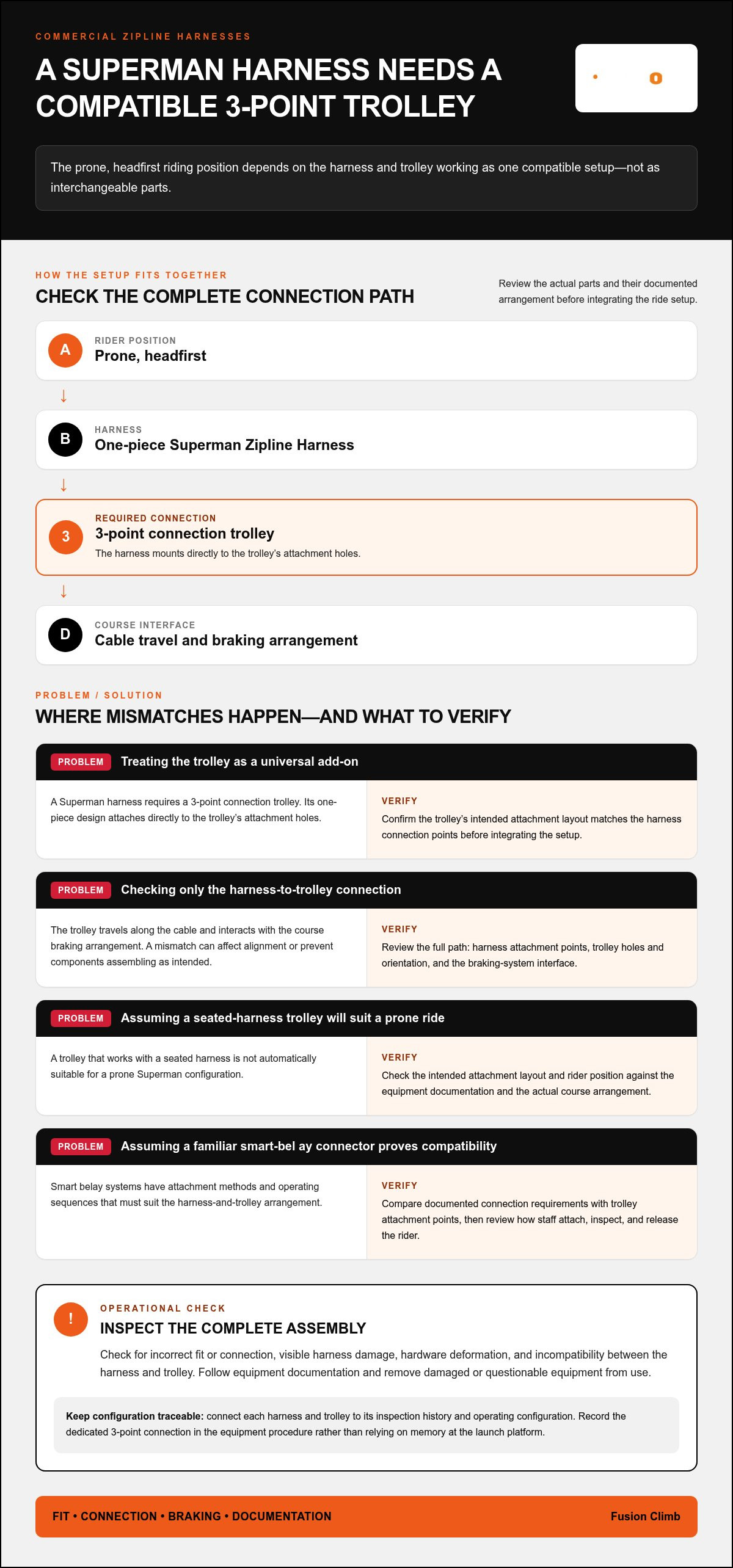
Yes. The Superman Zipline Harness requires a 3-point connection trolley for its prone riding position. It’s a one-piece harness mounted directly to the zipline trolley’s attachment holes, so the connection is part of the ride system, not a universal add-on. Confirm the trolley’s intended attachment layout and the harness connection points work together before integrating them into an operating setup.
Braking compatibility matters, too. The trolley travels along the cable and interacts with the course’s braking arrangement, while the harness supports the rider. Review the full connection path: harness attachment points, trolley holes and orientation, and the braking-system interface. A mismatch can affect alignment or prevent components from assembling as intended. Don’t assume a trolley that works with a seated harness also suits a prone configuration.
Passive braking and redundant safety systems also depend on the overall design. Treat them as connected components, not independent labels. The trolley must travel through the course as designed, and its connection to the harness must preserve the intended rider position. Compare the primary connection and any secondary safety connection with the equipment documentation. This gives the operations team a clear basis for checking the setup and maintaining consistent procedures.
Smart belay systems add another compatibility consideration. Their attachment method and operating sequence must suit the trolley and harness arrangement. Before selecting a Superman configuration, compare the smart belay’s documented connection requirements with the trolley’s attachment points. Then review the complete assembly, including how staff attach, inspect, and release the rider. A familiar connector alone does not establish compatibility across the system.
What are the main safety risks and failure points of zipline harnesses? Key concerns include incorrect fit or connection, visible harness damage, hardware deformation, and incompatibility between the harness and trolley. Inspect the complete assembly, follow the equipment documentation, and remove damaged or questionable equipment from use.
Keep records that connect each harness and trolley to their inspection history and operating configuration. Clear records help staff follow consistent checks and support equipment documentation for park operations and insurance discussions. For example, if a Superman harness uses a dedicated 3-point trolley connection, record that configuration in the equipment procedure rather than relying on memory at the launch platform.
Before integrating a new setup, compare its connection geometry with the actual trolley and braking system used on the course. A practical equipment review can include zipline trolley and harness components alongside the system documentation. Prioritize the specified connection and operating arrangement over convenience or visual similarity.
3. Harness fitting speed and rider throughput
Fitting time affects how smoothly riders move from check-in to launch. One estimate compares a 90-second fitting with a 45-second fitting and indicates that reducing the process can improve throughput on a busy zipline operation. Treat that comparison as a prompt to review your own workflow, not as a promised operating result. Count the steps staff perform, identify repeated adjustments, and keep required safety instruction in the process.
Speed must not come at the expense of a correct fit. Before strapping in a rider, on-site staff should provide instruction. Then staff can check that the harness sits as intended, the straps are arranged correctly, and the rider understands the attachment sequence. A rushed fitting can lead to missed steps; a consistent sequence gives staff a repeatable way to prepare each participant.
Weight limits are a practical screening point. The Zipline Sit Comfort Harness and Superman Zipline Harness are specified for participant weights up to 150 kg. Use the limit for the exact model when assessing rider eligibility, and keep that decision separate from fitting speed. A quick process cannot make a harness suitable for a participant outside its stated range.
Size choice also influences fit time. The Zipline Sit Comfort Harness is available in 5 sizes, from kids to XL. The Superman Zipline Harness is available in 4 sizes, from S to XL. Choosing commercial zipline harnesses for adventure parks means matching these size ranges to your rider mix, then making and inspecting each fit according to the harness instructions.
Harness weight matters for handling and staging. The Superman Zipline Harness weighs 3 kg, while its participant weight specification reaches 150 kg. These figures describe different things: equipment weight affects staff handling, while participant weight determines the stated rider limit. Keep both details visible in equipment records so staff don’t confuse the harness’s weight with its capacity.
To improve flow without skipping checks, review each fitting stage:
- Sort harnesses by size before the operating session, using labels such as kids, S, and XL where applicable.
- Give staff one consistent order for positioning, adjustment, and final inspection.
- Provide rider instructions before attachment, then allow time for questions and corrections.
- Observe fitting duration across the process, including adjustment and instruction, rather than timing only strap placement.
A 45-second target is useful only if staff still complete every necessary check and instruction. For operators comparing commercial zipline harnesses for adventure parks, measure the process against the 90-second baseline and remove avoidable pauses, not fit verification. A correctly sized harness, clear instructions, and a repeatable staff sequence help balance rider comfort, safe preparation, and steady launch flow.
4. Operational throughput and rapid attachment
Rapid attachment works best as a controlled sequence, not an improvised shortcut. Map the rider’s movement from the staging area to the launch point, then identify each handoff. For example, one operator can explain the process while another completes the equipment connection. This division can reduce confusion during busy periods, provided everyone follows the park’s assigned procedure.
Keep the attachment sequence consistent for every rider. The operator should identify the correct equipment, connect it according to its documentation, and verify the setup before dispatch. Staff should know their assigned steps and when responsibility transfers. A clear handoff prevents assumptions, such as one operator thinking another has completed the final check.
Brief riders before attachment begins. Explain where to stand, when to move, and which instructions to follow during connection. On-site staff must instruct participants before they are strapped into a harness. A short, repeatable briefing helps riders respond promptly, while allowing operators to complete equipment steps without competing explanations.
Design the staging area around the actual sequence. Keep the next rider clear of the operator’s workspace, and place equipment where staff can identify it without interrupting the connection. For example, separate ready-to-use equipment from items awaiting inspection or reset. Clear labels and a defined return point help prevent equipment from entering the wrong part of the workflow.
Rapid attachment must never mean bypassing fit checks, instructions, or the equipment’s documented connection method. If a rider shifts position or a connection needs adjustment, pause and address it before dispatch. Operators should use direct, consistent language, such as asking the rider to wait while they complete a check. A deliberate pause is safer than letting queue pressure dictate the procedure.
Review the workflow by observing rider transitions, from briefing through dispatch and equipment reset. Note where riders wait, where operators repeat instructions, and where handoffs become unclear. Then revise the staging layout or staff roles and document the updated procedure. During the next operating period, observe whether the change removes a bottleneck without skipping a required step.
Throughput depends on the whole operation, not attachment speed alone. Rider readiness, clear operator roles, orderly equipment staging, and a consistent final check all shape dispatch flow. Set a procedure staff can repeat under pressure, then assess it through direct observation. The goal is a controlled process that moves prepared riders forward without treating speed as a substitute for safe operation.
5. Headfirst prone Superman-style zipline harnesses
What types of commercial zipline harnesses are used in adventure parks? Parks commonly use sit harnesses, full-body harnesses, and Superman-style harnesses for prone, headfirst riding. The right design depends on the ride position and compatible trolley setup. A Superman-style configuration creates a distinct flying posture, while seated and full-body designs support other ride experiences.
The prone position changes how equipment connects and how the rider is supported. The Superman Zipline Harness is a one-piece harness mounted directly to the attachment holes of a zipline trolley. It requires a 3-point connection trolley. That combination is central to the setup: assess the harness and trolley together, rather than treating either as a standalone purchase.
Let the ride’s purpose guide your comparison. A seated experience positions the rider differently from a headfirst, prone flight, so the harness must match the intended posture. Before choosing a Superman-style system, map the attachment points, trolley orientation, and rider position. Then consider how operators will position and secure each participant consistently at the launch area.
Fit options matter for park use. The Superman Zipline Harness is available in 4 sizes, from S to XL, and is specified for participant weights up to 150 kg. These limits help define rider selection and size planning. Staff should select the appropriate size and follow the product’s fitting instructions, rather than relying on a single adjustment to accommodate every participant.
Equipment details also affect handling and planning. The Superman Zipline Harness weighs 3 kg and includes a mobile phone pocket with Velcro fastening. Its stated made-to-order lead time is 8 to 10 weeks, a consideration for inventory planning before a new ride launches or an existing operation changes its setup.
- Match the prone harness to its required 3-point trolley connection.
- Use the 4-size range to plan fitting and rider selection.
- Account for the 3 kg harness weight when staging and handling equipment.
- Consider the Velcro-fastened phone pocket as a design detail, not a substitute for operating procedures.
A headfirst design is a choice about the whole guest experience, not just appearance. Parks considering this format should align the harness, trolley, ride position, sizing process, and operating instructions before introducing it. Select a Superman-style setup only when its prone position and dedicated connection arrangement suit the course’s operating design.
Fusion Climb: Full Body Harnesses
Fusion Climb offers Full Body Harnesses for parks assessing options based on rider position, fitting needs, and operating setup. For a headfirst, prone experience, its Superman Style Harnesses serve that distinct ride format. Zipline Pulleys and Lanyard and tether are related equipment categories to consider when reviewing the connection system. Match the intended use, fit, and compatible components rather than treating the harness as an isolated choice.
Turn to Fusion Climb when comparing gear categories for your park’s zipline operation. Reviewing the harness and related components together can help clarify which equipment aligns with your planned ride configuration.
Visit Fusion Climb’s website to explore its offerings or get in touch.
Build Your Equipment Plan Around the Ride
Turn your operating priorities into a clear equipment plan before your next purchase. Define the rider experience you want to deliver, the fit needs your team encounters, and how each component will work within the course setup. This gives decision-makers a practical basis for comparing commercial zipline harnesses for adventure parks, rather than choosing by appearance alone.
Fusion Climb offers Full Body Harnesses, Superman Style Harnesses, and Zipline Pulleys. These categories can help parks assess equipment for different ride positions and system configurations. Focus your next discussion on intended use and the components that must work together, so your selection supports your team’s operating plan.
Contact Fusion Climb about harnesses to explore equipment options for your park. Make the next step a deliberate one, and keep shaping an experience riders will be ready to take on.
Frequently Asked Questions
Can harnesses be branded with a park logo?
Use only manufacturer-authorized branding methods, and don’t assume every harness can be customized with a park logo. Any marking should preserve identification labels, inspection records, and the integrity of the harness materials. For example, avoid adhesives or stitching through load-bearing webbing. If branding is a priority, include it in the equipment specification process and assess it alongside fit, intended use, and documentation.
Does the Superman harness require a specific trolley?
Yes. The Superman Zipline Harness uses a 3-point connection trolley, with the harness mounted directly to the trolley’s attachment holes. For example, a park planning a prone ride should assess the trolley and harness as a paired system, including the connection arrangement and course configuration. A trolley’s general suitability for ziplining doesn’t establish compatibility with this specific harness setup.
What accessories extend the operational range of each harness?
Accessories support different parts of the equipment setup, but they don’t automatically expand a harness’s approved use. Zipline Pulleys, Lanyard and tether, and Carabiners are relevant hardware categories for operators to consider. A pulley relates to travel along the line, while connectors relate to attachment. Select components according to the harness and course documentation, and don’t combine parts just because they physically connect.
What certifications apply to commercial zipline harnesses?
Certification is model-specific, so check the documentation for the exact harness. The Zipline TYRO is Category III PPE certified to EN 12277:2015 and PPE Regulation (EU) 2016/425; the Zipline Sit Comfort Harness is certified to EN 1651. These are European standards and certifications, not a blanket certification for every commercial harness. Match each certificate to the specific equipment and its intended use.
What is the participant weight range for each model?
The Zipline Sit Comfort Harness and Superman Zipline Harness are specified for participant weights up to 150 kg. That limit applies to those named models, not automatically to every harness in a park’s inventory. For operational planning, keep model documentation with the equipment and use the relevant model’s stated participant limit when setting rider eligibility. Don’t substitute the harness’s own equipment weight for its participant weight limit.
Which manufacturers sell commercial zipline harnesses for parks?
Fusion Climb sells harnesses for zipline and adventure applications, including Full Body Harnesses and Superman Style Harnesses. Related equipment categories include Zipline Pulleys, Lanyard and tether, and Carabiners. Compare each model’s documentation, intended use, connection arrangement, and sizing details with the course setup. A manufacturer’s general product range alone does not establish that every model suits every ride configuration.
What certifications and standards apply to commercial zipline harnesses in the United States?
ANSI standards cited for specific equipment include ANSI Z359.11-2021 for harnesses and ANSI Z359.12-2019 for carabiners. ACCT, the Association for Challenge Course Technology, and PRCA are ANSI-accredited organizations whose standards operators may follow. These references serve different purposes: a product standard concerns equipment, while an organization’s standards may guide course operations. Check the exact model documentation and the operating framework used by the park.
What harness features improve comfort, fit, and adjustability for diverse guests?
Look for size choices, adjustment options, and padding where offered, then assess the combination against the rider group and intended position. For example, the TCH-109-3 New Falcon Racer 3 “Leap of Faith” Zipline Harness comes in XS/M, M/XL, and XL-3XL, with leg steel adjuster or leg quick-release buckles and optional padding. Those features can help operators configure fit for different guests while following the model’s instructions.